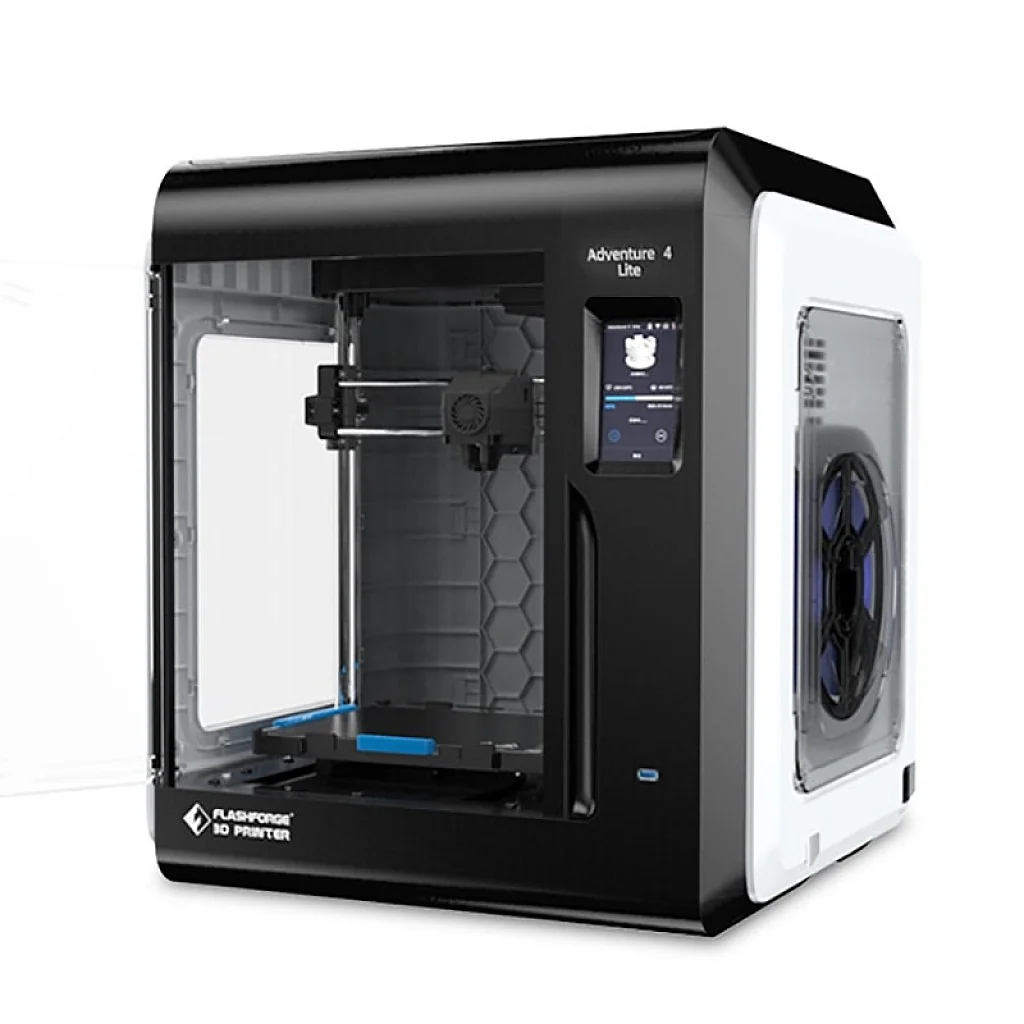
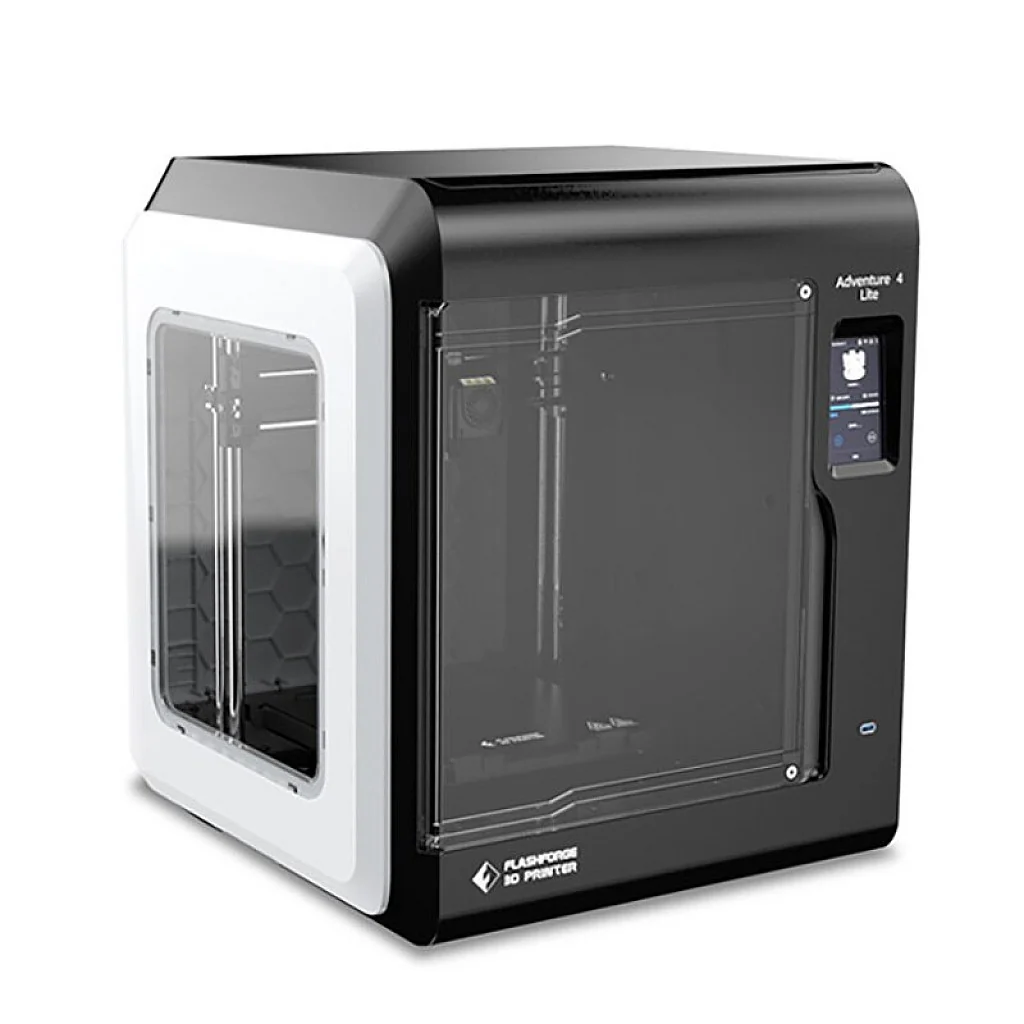
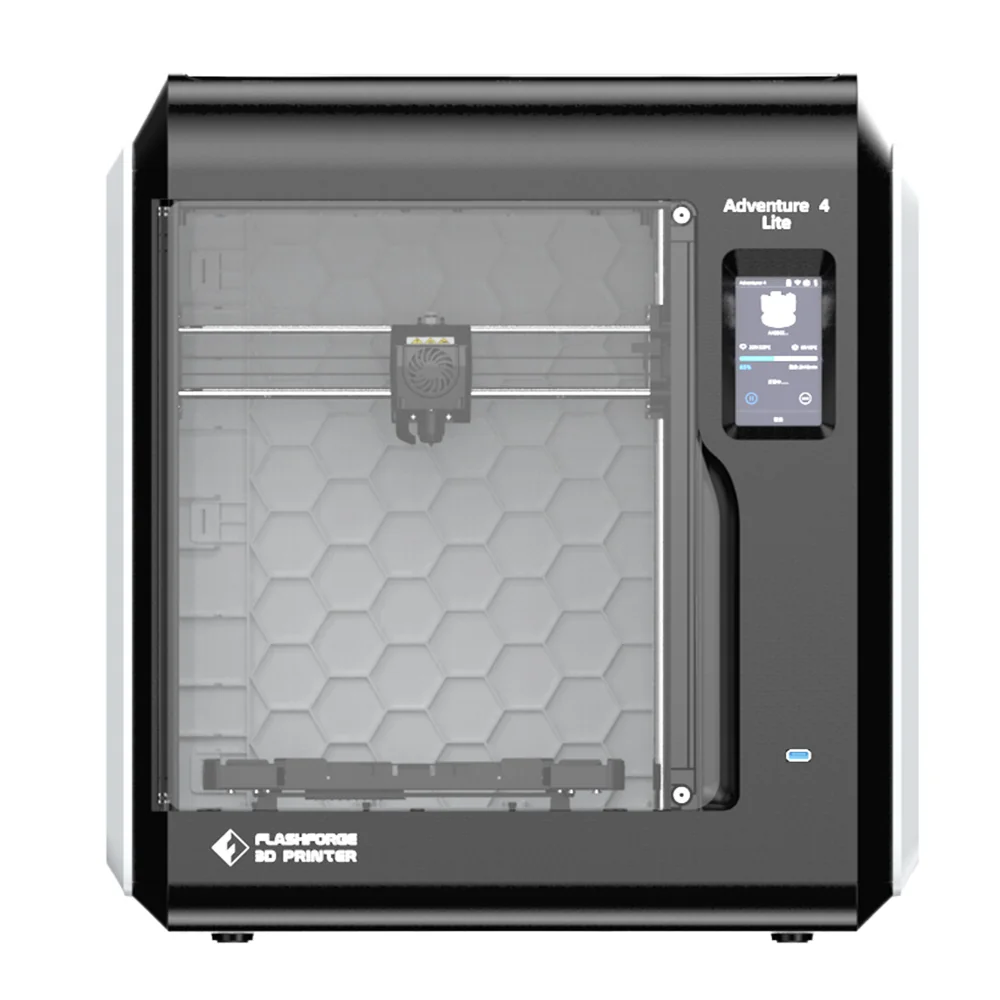
FlashForge Adventurer 4 Lite
By FlashForge · 3D Printers · 3D Printing · More from FlashForge
- Build volume: 220 x 200 x 250 mm
- Nozzle diameter: 0.4 mm
- Layer thickness: 0.1-0.4 mm
- Max extruder temp: 240°C
- Print speed: 10-150 mm/s
Price not listed
- FlashForgeView at FlashForge
- eBayView at eBay
- AmazonView at Amazon (paid link)
- eBay (used) eBay: used, open-box, refurbishedView at eBay (used)
Stores are listed in a fixed order, never by price or commission. Prices are snapshots. Check the current price with the store.
Summary
The FlashForge Adventurer 4 Lite is the budget variant of FlashForge’s enclosed Adventurer 4 Series: a fully enclosed FDM printer with a 220 × 200 × 250 mm build volume, a 240°C extruder and a glass bed, aimed at PLA and ABS. No independent test of the Lite exists and FlashForge US no longer sells it, so check seller listings carefully — they routinely copy the standard Adventurer 4’s photos and specifications.
Strengths
- A fully enclosed chamber with tool-free nozzle changes in about 3 seconds, per the series brochure.
- Fast heat-up: the brochure claims 60 seconds to 200°C.
- Tom’s Hardware praised the standard machine’s rigid motion system.
- Filament run-out detection, power-failure resume and remote printing over Wi-Fi or Ethernet are listed in the brochure.
Weaknesses
- FlashPrint comes across as unfinished in the hands-on reviews, and owners report Wi-Fi connectivity issues.
- Seller listings copy the standard Adventurer 4’s photos and specifications, overstating temperature, materials, camera and filtration.
- “Leveling-free” is marketing language; the manual still requires extruder calibration after first use and nozzle changes, and documents a 9-point leveling routine.
- PLA stringing shows up in independent testing of the standard machine.
- The model is discontinued from FlashForge’s US store, so US warranty and support terms are unconfirmed.
Verified specifications
| Build volume | 220 × 200 × 250 mm. |
|---|---|
| Nozzle diameter | 0.4 mm default; 0.3 and 0.6 mm optional. |
| Layer thickness | 0.1–0.4 mm. |
| Maximum extruder temperature | 240°C standard; 265°C with the optional high-temperature nozzle. |
| Print speed | 10–150 mm/s. |
| Printing precision | ±0.1 mm on a 100 mm test cube. |
| Filament | 1.75 mm; the manual rates the Lite for ABS and PLA, depending on the nozzle. |
| Build plate | glass. |
| Maximum bed preheat temperature | 110°C. |
| Remote camera | none. |
| HEPA 13 air filter | none. |
| Interface | 4.3-inch touchscreen LCD. |
| Connectivity | USB disk, Wi-Fi, Ethernet. |
| Slicer | FlashPrint, with Cura and Slic3r also supported. |
| Calibration | extruder calibration plus a 9-point leveling offset in Normal Mode. |
| Power supply | built-in 320 W, AC 100–240 V input. |
| Certifications | CE, FCC, RoHS. |
| Dimensions | 500 × 470 × 550 mm per the official manual; the series brochure lists the frame at 500 × 470 × 540 mm. |
| In the box | printer, filament, screwdriver, unclogging pin tool, power cable, grease, Allen wrench, leveling card, filament guide tube joint, scraper and glue. |
Full research notes and sources
What the Lite gives up
FlashForge itself draws the line: “Adventurer 4 lite features a glass platform with no camera and no air filter.” The Lite swaps the standard Adventurer 4’s flexible spring sheet for a glass plate, drops the remote camera and the HEPA 13 air filter, and caps the extruder at 240°C — 265°C only with the optional high-temperature nozzle — against the standard machine’s 265°C and a filament list that adds PC, PETG, PLA-CF and PETG-CF. Model removal changes too: Adventurer 4 owners bend the flexible plate, Lite owners scrape the glass plate, which is why a scraper and glue are in the box. Windows Central called the standard machine’s camera images and video “basically useless” because of interior lighting, so losing it costs little.
Seller listings deserve caution. Copy and photos are frequently lifted from the standard Adventurer 4, overstating temperature, material coverage, camera and filtration; even the official manual illustrates the Lite’s interface with the Adventurer 4’s screen. The manual rates the Lite for ABS and PLA “according to the nozzle”, so a listing that shows 265°C or a filter is selling you the wrong machine.
Software and connectivity
The Lite shares the series’ chassis, motion system and extruder, so treat those findings as a guide to the family, not as validation of the exact model. The pattern is consistent: capable, beginner-friendly hardware held back by software. Tom’s Hardware’s verdict was “Solid Hardware, Buggy Software”, with FlashPrint described as not completely finished and Wi-Fi connectivity flagged as an issue. NimbleTech found the self-leveling less automated than in many other 3D printers and noticed PLA stringing (“spider webs”), and CD-Soft saw stringing on both the Adventurer 3 and 4. Owners echo the Wi-Fi complaints, and r/FlashForge threads report minor first-layer adhesion trouble.
Maintenance and support
The manual documents the upkeep: grease the guide rail roughly every other month when the printer sits unused, run extruder calibration after first use and after any nozzle change, and fall back on the 9-point leveling routine if large prints fail. Nozzles are tool-free to swap in about 3 seconds per the brochure, though Tom’s Hardware called the nozzle assembly relatively expensive to replace. The manual scopes the extruder at 400 hours, excludes filament-change blockages from that scope, and states that any modification to the device voids the guarantee. Support runs 8:00 a.m.–5:00 p.m. PST Monday–Saturday through support@flashforge.com. FlashForge’s store states a one-year official warranty, but that policy covers the products the store now sells, and the Lite is no longer among them, so US warranty terms for the Lite are unconfirmed. The EU download center still hosts Lite manuals, quick-start guides, firmware and the series spare-parts lists.
Is it worth it?
Owner sentiment caps the class well below its original pricing: one detailed r/FlashForge breakdown called the Adventurer 4 reliable but overpriced at its $350 asking price and recommended paying no more than about $300 for an Adventurer 4-class machine, while an owner who paid around $700 at release later called the machine “quite outdated”. For context, the standard Adventurer 4 launched at $799 in September 2021 and was $850 by late 2022, when TechRadar called it solid but expensive and not an entry-level option at that price.
Buy it only as a budget enclosed PLA and ABS printer.
Which model this is
This page covers the Adventurer 4 Lite, FlashForge’s entry variant of the Adventurer 4 Series. FlashForge USA lists “Adventurer 4” and “Adventurer 4 Lite” as separate consumer products, and the EU download center hosts separate Lite manuals, quick-start guides and firmware. The Amazon listing for this printer is ASIN B09P69QYNC. Do not merge the Lite with the standard Adventurer 4: the glass bed, the missing camera and filter and the 240°C standard extruder are real differences, even though the two machines share the chassis, motion system and extruder.
Sources
Manufacturer:
- FlashForge Adventurer 4 Series user guide (EN/CN)
- FlashForge Adventurer 4 Series brochure (EN)
- Adventurer series download center: Lite manuals, firmware and spare lists — FlashForge EU
- Download — FlashForge USA
- FlashForge US official store — Adventurer series line-up
- FlashForge announces the enclosed Adventurer 4 — PRNewswire
Independent reviews:
Owner reports:
- Adventurer 4 from Flashforge is awesome so far! (r/3Dprinting)
- FlashForge Adventurer 4 opinions (r/FlashForge)
- Looking back, what are our thoughts on the Adventurer 4? (r/FlashForge)
- For anyone asking if they should buy the Adventurer 3 or 4 (r/FlashForge)
- Adventurer 4 printing issues (r/FlashForge)
- High-resolution pictures of the insides of the FlashForge Adventurer 4 (r/FlashForge)