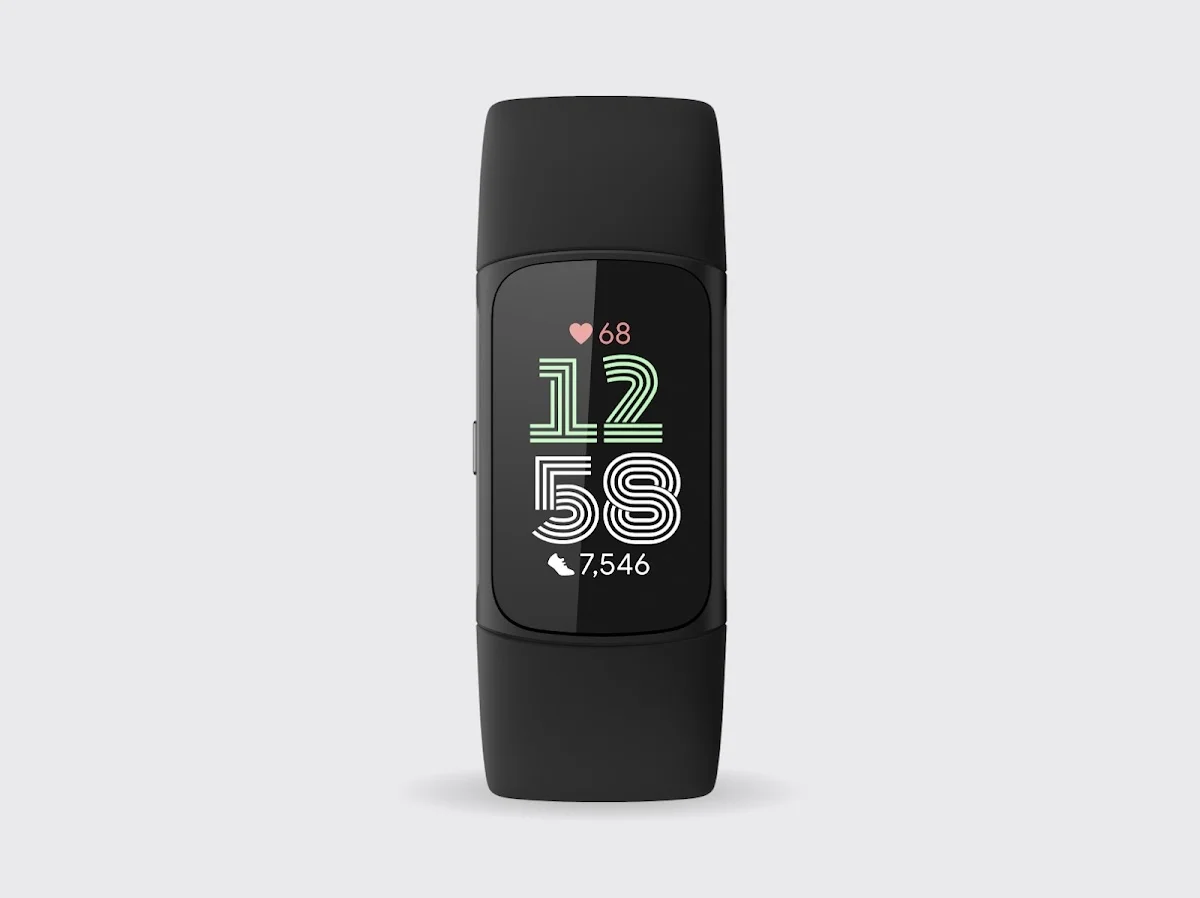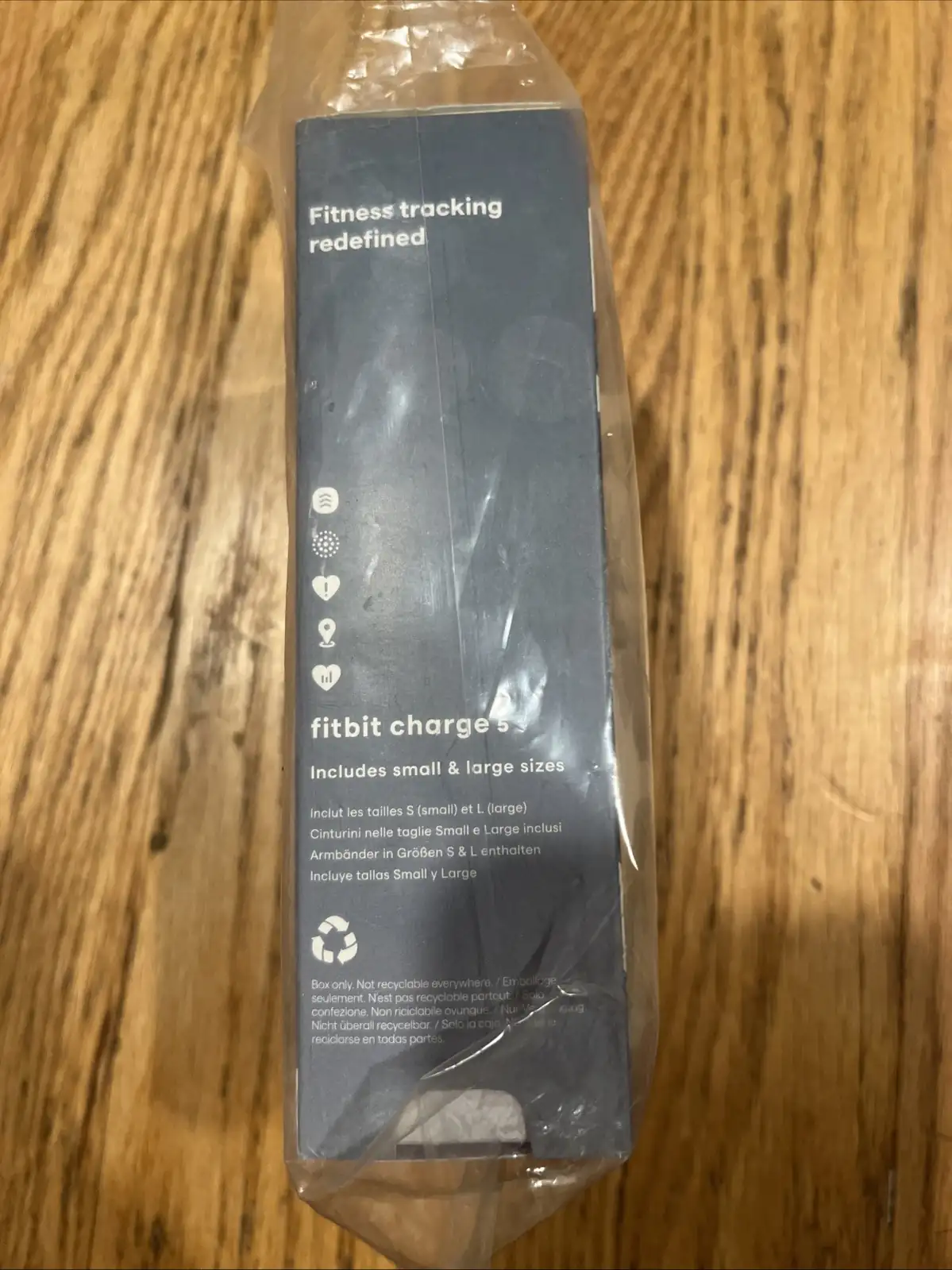
Fitbit Charge 5
By Fitbit · Fitness Trackers · Phones & Computers · More from Fitbit
- 1.04-inch AMOLED color touchscreen
- Built-in GPS + GLONASS
- Up to 7 days battery life (5 hours with continuous GPS)
- Water resistant to 50 meters
- ECG app + EDA Scan sensor
Price not listed
- FitbitView at Fitbit
- Best BuyView at Best Buy
- eBayView at eBay
- AmazonView at Amazon (paid link)
- eBay (used) eBay: used, open-box, refurbishedView at eBay (used)
Stores are listed in a fixed order, never by price or commission. Prices are snapshots. Check the current price with the store.
Summary
A 2021 Fitbit band tracker with built-in GPS, ECG and EDA sensors, now discontinued and out of warranty. Check the firmware-failure history before you buy: three update waves left some units dead or draining within hours.
Strengths
- Bright color AMOLED with an always-on option, readable even in direct sunlight.
- Built-in GPS and GLONASS lock within seconds, with real-time pace and distance on the wrist.
- ECG, EDA and skin-temperature sensors that PCMag pulled down from the $299.95 Sense.
- Metal case, 10 percent thinner than Charge 4, comfortable enough for sleep and all-day wear.
- Fitbit Pay, plus sleep staging with HRV, breathing rate, SpO2 and skin-temperature variation.
- Step counting proved accurate: within 25 steps of a manual tally in a controlled 3,300-step walk.
Weaknesses
- Three firmware waves in 2022, 2023 and 2024 left some units dead, black-screened or unable to boot.
- The GPS antenna sits under the bezel near the skin; T3 says no firmware fix can make it a running watch.
- No physical button — The Verge called the touchscreen-only design “touchscreen fatigue”.
- No Spotify control, no music storage, no reply-to-notification, no third-party apps.
- Discontinued, out of warranty since 2022, and no official parts channel exists.
Verified specifications
| Model | Fitbit Charge 5; regulatory model FB421, FCC ID XRAFB421. |
|---|---|
| Display | 1.04-inch color AMOLED, 260 × 170 pixels, up to 450 nits, Corning Gorilla Glass 3, with an always-on option. |
| Positioning | built-in GPS receiver with GLONASS. |
| Sensors | optical heart-rate tracker, EDA stress sensor, ECG app, SpO2, skin temperature, 3-axis accelerometer, ambient light sensor, vibration motor. |
| Exercise tracking | 20 exercise modes with SmartTrack automatic recognition; six shortcuts fit on the device at once. |
| Water resistance | 50 m (5 ATM); tracker and silicone band water resistant to 164 feet. |
| Wireless | Bluetooth 5.0 and NFC for Fitbit Pay. |
| Battery | rechargeable lithium-polymer, 65 mAh per a spec database; up to 7 days claimed, up to 2 days with always-on, up to 5 hours with continuous GPS. |
| Charging | magnetic USB cable, up to 2 hours; no power adapter in the box. |
| Memory | 7 days of detailed data, 30 days of daily totals. |
| Dimensions | 1.44 × 0.89 × 0.44 in (36.78 × 22.79 × 11.2 mm); 0.98 oz (28 g) without strap. |
| Materials | anodized aluminum and surgical-grade stainless steel case, silicone band; small fits 5.5-7.1 in wrists (140-180 mm), large 7.1-8.7 in (180-220 mm). |
| In the box | tracker with small band attached, large bottom band, charging cable. |
| Warranty | one year. |
Full research notes and sources
Battery life and the firmware problem
Fitbit claims up to 7 days, up to 2 days with the always-on display and up to 5 hours with continuous GPS. PCMag measured three full days with always-on enabled. Charging takes up to 2 hours over the magnetic cable, and no power adapter is in the box.
The hardware numbers are not the problem. What happened to some units over time is. Three firmware waves — July 2022, July 2023 and December 2023 to January 2024 — were followed by owner reports of sudden battery drain, black or unresponsive screens, lost sleep tracking, failure to sync and devices that would not boot at all. In July 2022 the changelog for firmware 1.171.50 was later edited to say it “fixed a battery drain issue some customers may have experienced with GPS-enabled devices”, and owners still reported drain, one from 100 percent to dead within two hours; the forum thread grew past 77 pages. After firmware 194.61 in July 2023, the documented workaround was a “three pulse” restart — press the button on the flat end of the charging cable three times within 8 seconds — and failing that, a full drain and recharge.
The December 2023 update, firmware 194.91, drew more than 400 comments on the official forum thread. Owners described batteries lasting hours instead of a week, charging once or twice a day, devices that would not turn on and “NO DATA” under every field. Google told the BBC it was “still investigating” and could “confirm” the issue was not due to the firmware update; no root cause and no fix firmware was published. Out-of-warranty owners got discount codes — 35 percent in 2023, 50 percent reported by some in 2024, nothing for others — rather than repair.
Treat this honestly: every failure account is self-selected forum and Reddit reporting, with no recall, no root cause and no failure-rate figure published. But the pattern spans three years of firmware updates, and the one-year warranty has expired for every original unit.
GPS, steps and heart rate
Step counting is the Charge 5’s strongest measurement. In Tom’s Guide’s April 2024 controlled walk, the Charge 5 recorded 3,325 steps against a true 3,300 on a manual tally counter — inside 25 steps. A 10-mile run comparison against a Garmin Fenix 6S Pro showed 10.14 miles on the Fitbit against 10.01 on the Garmin, with the Fitbit’s pace optimistic from mile five onward.
T3 goes furthest: it reports the GPS antenna sits under the bezel close to the skin, so Fitbit’s own advice to wear the band looser for GPS trades directly against the tight fit heart-rate accuracy needs. Its conclusion: the Charge 5 is “not fit for the purpose” of running training, and no firmware update can move an antenna. Live Science sits between the two, calling the GPS accurate enough for most people but not for precise distance. Consumer Reports found heart-rate and step accuracy below highly rated trackers such as the Garmin Forerunner 235, while CNET’s chest-strap comparison went better than expected. PCMag’s workout tests tracked an Apple Watch Series 6 closely. The honest read: excellent for daily activity, sleep and general fitness; not a precision running watch.
Screen, water and build failures
Owners report screens physically detaching from the case and the metal ring around the sensors coming apart after a few months. The only repair guidance in community discussion is informal teardown advice — remove the screws, disconnect the battery, clean the edges with isopropyl alcohol and re-seat the screen. No official parts channel exists.
Water is the other owner-reported failure mode. One owner’s Charge 5 died after a lake swim, was replaced under warranty, and a second device died after a brief jump into water. Another died after a swim in a 2 m pool: “It was supposed to be waterproof up to 50m, the pool was 2m at most.” A forum reply states plainly that water damage is not covered by warranty.
Is it worth it?
Charge 5 is discontinued: Fitbit’s current lineup page has no Charge 5, and Wirecutter’s October 2026 picks are the Inspire 3, Fitbit Air and Charge 6. Fitbit’s launch price was $179.95 in 2021; PCMag’s page later showed a $149.95 MSRP. Other-retailer price anchors: Walmart had the Charge 5 at $103 (PCMag, 2021); Tom’s Guide’s April 2024 test listed the Charge 6 at $138 at Walmart and called the Charge 5 worth it “especially if you can find one on sale for closer to $100”; Wirecutter’s 2026 page lists the Inspire 3 at $82 from Walmart and $100 from Best Buy, and the Charge 6 at $115 from Walmart.
Running costs are modest. Fitbit Premium is bundled for 6 months, then costs $10 a month or $80 a year (Consumer Reports, 2021); Wirecutter’s 2026 page lists $10 a month or $100 a year. Core tracking needs no subscription — only the Daily Readiness Score’s personalized recommendations are Premium-gated. Replacement bands sell for $29.95 to $49.95 (Fitbit, 2021).
At or under roughly $100 used or on clearance, with a real return window from the seller, the Charge 5 is defensible for someone who wants built-in GPS, ECG and EDA in a band and accepts that no manufacturer remedy exists if the device fails. Above that, a new Charge 6 at $115 to $138 adds 40 exercise modes, a haptic side button, current firmware support and an intact one-year warranty. Above roughly $140 it is not defensible for a 2021 model with an expired warranty and three documented firmware-failure episodes behind it.
Which model this is
This page covers the Fitbit Charge 5, announced 25 August 2021 and released in September 2021, regulatory model FB421, FCC ID XRAFB421. Three colorways were sold: black/graphite stainless steel, lunar white/soft gold stainless steel and steel blue/platinum stainless steel. The ECG app and Daily Readiness Score shipped in November 2021, after launch. Charge 4 straps and the Charge 4 charger do not fit — Fitbit changed the charging port again. The Amazon listing for the Charge 5 is ASIN B09BXQ4HMB.
Sources
Manufacturer:
- Fitbit Charge 5 user manual (PDF)
- Fitbit Charge 5: Redefining strength — Google Blog
- Fitbit — devices and current lineup
- Google Fitbit warranty and hardware support documentation
- How to use your Fitbit Charge 5 — Fitbit Device 101
Independent reviews:
- Gadgets & Wearables specifications
- Tom’s Guide: 3,300-step walk test
- Tom’s Guide: Charge 6 vs Charge 5
- Ars Technica: owners fed up with battery problems
- Android Central: battery drain and black screen issues
- Android Central: the update allegedly bricking wearables
- TechRadar: sudden battery drain after an update
- TechRadar: Fitbit denies the update bricked trackers
- 9to5Google: units dying, Google says not updates
- TechTimes: users demand a fix
- Gadgets & Wearables: battery drain issues continue
Owner reports:
- Charge 5 bricked by the latest firmware update (r/fitbit)
- Charge 5 bricked (r/fitbit)
- Is your Charge 5 bricked after the new update? (r/fitbit)
- Charge 5 screen fell off — how to repair it (r/fitbit)
- Charge 5 and water (r/fitbit)
- My Charge 5 got water damage because I swam in a pool (r/fitbit)
- Fitbit Charge 5 falling apart? (r/fitbit)
- Charge 5 firmware update 194.91 (Fitbit Community)
- Charge 5 battery draining quickly after the update (Fitbit Community)
- Charge 5 firmware 188.58 (Fitbit Community)