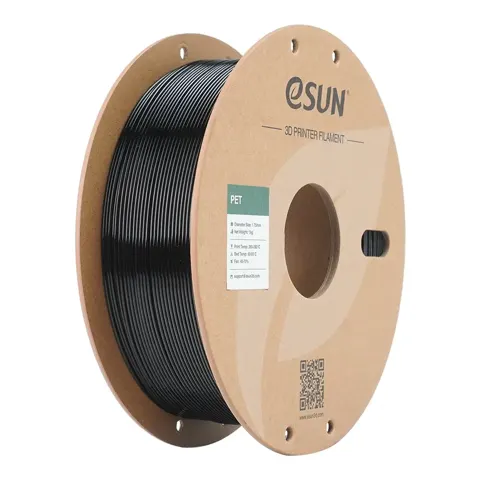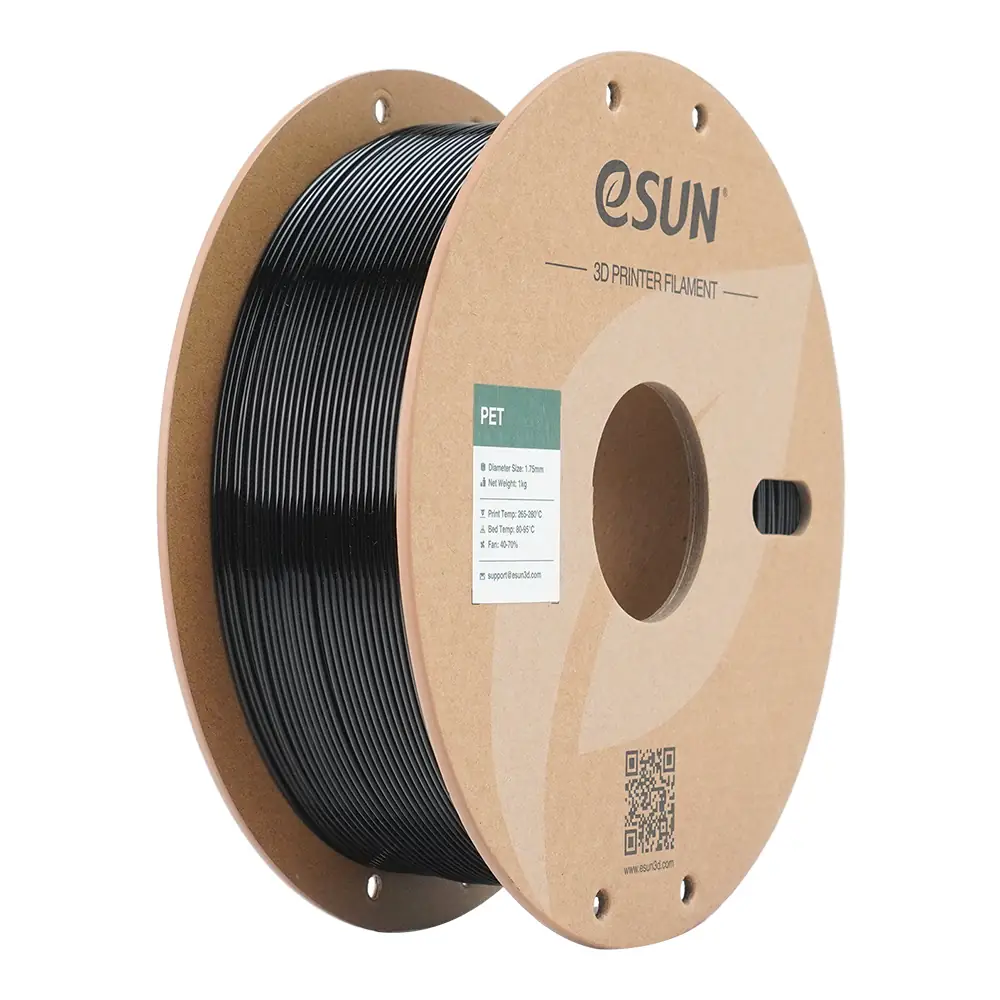
eSUN PET Filament 1.75mm Heat Resistance High
By eSUN · Filament & Resin · 3D Printing · More from eSUN
- 1.75 mm filament diameter
- 1 kg spool (2.2 lbs)
- PET material
- heat resistance ~75°C
- 8 colors available
Price not listed
- eSUNView at eSUN
- eBayView at eBay
- AmazonView at Amazon (paid link)
- eBay (used) eBay: used, open-box, refurbishedView at eBay (used)
Stores are listed in a fixed order, never by price or commission. Prices are snapshots. Check the current price with the store.
Summary
eSUN PET is an unfilled polyethylene terephthalate filament on a 1 kg, 1.75 mm spool, marketed for heat resistance and toughness above ordinary PLA. Check your hotend and bed first: the exact PET technical sheet calls for 265–280°C at the nozzle and 80–95°C at the bed, and the maker’s 75°C heat-resistance claim is a marketing figure, not a certified continuous service temperature.
Strengths
- Manufacturer positions PET between PLA convenience and mechanical performance: greater heat resistance than ordinary PLA, less stringing than its PETG comparator, plus toughness and dimensional accuracy. These are eSUN’s assertions; no controlled PET-versus-PETG comparison was located.
- The published 60–80°C heat deflection at 0.45 MPa may help where plain PLA is marginal, provided joints and thin walls are not the load path.
- Opaque and translucent variants exist without fillers or an abrasive-fiber nozzle requirement.
- One owner testing eSUN PET for miniatures in October 2026 reported good surface detail and less-fragile supports than with PLA; a single self-reported observation without controlled settings or measurements.
- The maker publishes an exact PET technical sheet with concrete print settings rather than a broad heat-resistant claim.
Weaknesses
- One owner reported two spools with bad winding that blocked an AMS feed path and about five extruder clogs plus a separate hotend clog; a single account, not verified production-defect data.
- The 75°C marketing figure is not a continuous service temperature; the sheet states 60–80°C at 0.45 MPa and marks both continuous and maximum short-term service temperatures N/A.
- Low-temperature community profiles at 220–250°C sit well below the sheet’s 265–280°C; using them unvalidated risks insufficient melt flow on fast prints.
- No established lifespan or failure frequency: only one negative two-spool report and one favorable miniature-printing anecdote, not a representative reliability study.
- Reports from eSUN PETG, PET-CF and PET-FR cannot be counted as this plain PET’s performance.
- The US store showed 0 in stock for the selected variant during the checked crawl, so availability by color is unconfirmed.
Verified specifications
| Identity | eSUN PET, 1.75 mm nominal diameter, 1 kg net spool; the US store lists Solid Black, Transparent Grey, Transparent Blue, Natural, Solid White, Solid Silver, Solid Orange and Transparent Orange. No color-specific part number or UPC was verified in the checked listing. |
|---|---|
| Print settings (July 2024 PET TDS v1.0) | 265–280°C nozzle, 80–95°C bed, 10% part-cooling fan, 40–300 mm/s theoretical speed range; reference setup is a Bambu P1S with a 0.4 mm nozzle and OrcaSlicer 2.1.0 Beta. |
| TDS inconsistency | the same sheet’s printed test setup lists 260°C nozzle, 90°C bed, 10% fan and 10 mm³/s maximum volumetric flow. |
| Manufacturer lab properties (injection-molded specimens): density 1.07 g/cm³ (GB/T 1033); melt-flow index 13.2 g/10 min at 220°C and 10 kg; tensile strength 35–45 MPa in Z; elongation at break 4–6% in Z; XY flexural strength 90–100 MPa; XY flexural modulus 2,100–2,500 MPa; XY Izod impact 3–5 kJ/m²; heat deflection 60–80°C at 0.45 MPa. | |
| Independent database conflicts | SpoolScout lists 250–280°C nozzle, 70–90°C bed, 1.28 g/cm³ density; SpoolBites lists 220–250°C nozzle, 1.12 g/cm³ density and ±0.03 mm nominal tolerance. |
| Drying | the July 2024 PET sheet marks drying N/A; SpoolBites advises 60–70°C for 4–6 hours and iDryer lists 70°C for 4 hours. |
| No hardened nozzle or sealed chamber is specified for the unfilled polymer; no food-contact certification or fire rating is claimed for the exact formula. | |
Full research notes and sources
Print settings and compatibility
The exact July 2024 sheet is the right starting reference: 265–280°C nozzle, 80–95°C bed, 10% fan, and a theoretical 40–300 mm/s. The same sheet’s printed test setup lists 260°C, 90°C, 10% fan and 10 mm³/s maximum volumetric flow, so treat the range as a starting envelope, not a validated performance limit. The sheet’s reference print used a Bambu P1S with a 0.4 mm nozzle and OrcaSlicer 2.1.0 Beta. Standard low-temperature PTFE-lined hotends or printers without enough bed heat are not appropriate without manufacturer-approved upgrades. Third-party databases disagree materially: SpoolScout shows 250–280°C and 70–90°C bed, SpoolBites shows 220–250°C. Contact eSUN to confirm current stock settings.
Moisture and drying
The exact PET sheet marks drying N/A. SpoolBites advises 60–70°C for 4–6 hours and iDryer lists 70°C for 4 hours, but those are community and vendor practices, not verified manufacturer cycles. Store the spool airtight and dry only with a confirmed safe temperature for the particular reel. The optional eSUN eBOX Lite dryer was listed at $40.28 on the brand store with 0 stock in the US selector.
Heat resistance and real-world use
The headline heat-resistant claim of roughly 75°C should not be read as a continuous service temperature. The sheet states 60–80°C at 0.45 MPa and marks both continuous and maximum short-term service temperatures N/A. Injection-molded lab values for tensile, flexural and impact strength are not the same as printed-part strength. Hot-car brackets, electrical enclosures and structural hot parts need finished-part testing. Translucent variants are not crystal-clear; appearance varies with wall count, layer size and viewing light.
Is it worth it?
At $15/kg or less for an actually available, correctly labeled spool, eSUN PET is a reasonable buy for a user who can sustain 265–280°C and 80–95°C. The directly listed $19.99 with 0 stock is not a compelling blind first-time purchase against ordinary PETG. Above $19.99/kg, ELEGOO Rapid PETG at $13.99 is the better default if similar printability matters more than proving a specific PET property. On eSUN’s US store, volume brackets run 3+ at $17.00, 4–9 at $16.00 and 10+ at $15.00 per kg; a cached promotional display showed $15.20. eSUN PETG at $14.99 and Polymaker PETG at $18.99 are different materials, not drop-in equivalents. Illustrative annual material cost at the $19.99 listed price: 1 kg is $19.99, 3 kg is $59.97, 5 kg is $99.95 and 10 kg is $199.90, before supports, failed prints, postage, taxes, electricity and labor.
eSUN’s direct-store return policy permits an application within 14 days after delivery for unused products in original packaging, with receipt or proof of purchase; customer-requested returns require the buyer to pay return freight, while eSUN covers return shipping for its own wrong or damaged shipments. After-sales contact is after-service@esun3d.com and general order matters go to estore@esun3d.com, with working-day response availability, not guaranteed response time. No defined multi-year material warranty was found for the exact PET 1 kg spool; the technical sheet describes its data as indicative and disclaims guarantees derived from those numbers.
Which model this is
This page covers eSUN PET, 1.75 mm, 1 kg, an unfilled polyethylene terephthalate filament sold in eight colors. It is not eSUN PETG, PET-Basic, PET-CF or PET-FR, which have different datasheets, profiles and performance claims. No color-specific SKU, UPC or GTIN was verified in the checked listing.
Sources
Manufacturer:
- eSUN US store: PET 1.75 mm 1 kg
- eSUN PET technical data sheet v1.0, July 2024
- eSUN US store: PETG 1.75 mm 1 kg (different material)
- eSUN store: eBOX Lite filament dryer
- eSUN store: return and refund policy
- eSUN store: contact and after-sales support
- eSUN global store: PET product page
Independent reviews:
- SpoolScout: eSUN PET data sheet index
- SpoolBites / Open Filament Database: eSUN PET
- iDryer filament catalog: eSUN PET drying suggestions
- ELEGOO US: Rapid PETG 1.75 mm 1 kg
- Polymaker US: PETG
- ELEGOO US: PETG Pro 1.75 mm 1 kg
Owner reports: