eSUN EBox
By eSUN · Filament Dryers · 3D Printing
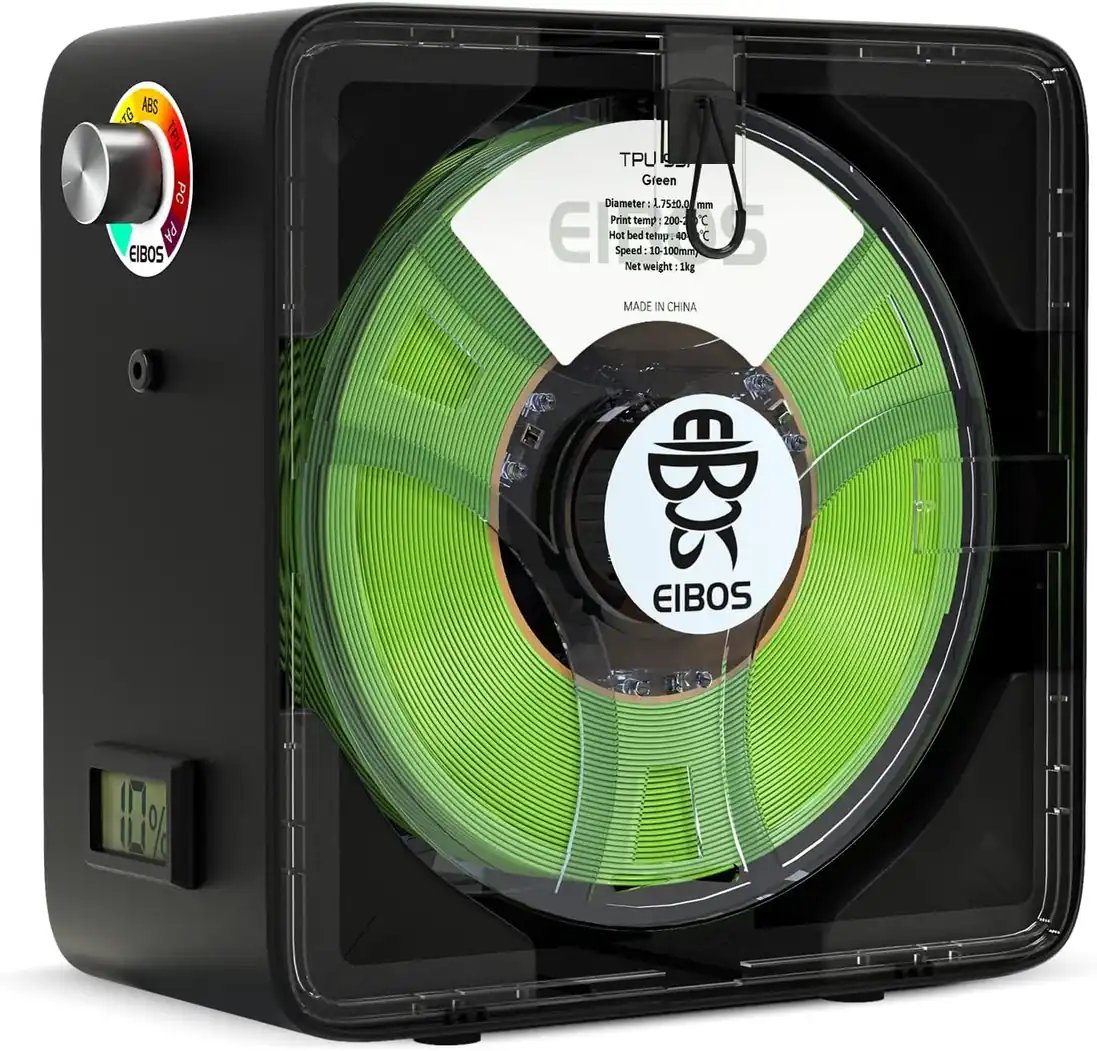
- Constant temperature and humidity storage
- Moisture-proof and dust-proof with heating and weighing functions
- Transparent PC cover for real-time filament monitoring
- Four preset temperature levels: 50C, 60C, 70C, 80C
- Accommodates spools up to 200mm diameter, 73mm wide, max 2kg load
Price not listed
- eSUNView at eSUN
- eBay (used) eBay: used, open-box, refurbishedView at eBay (used)
- eBayView at eBay
- AmazonView at Amazon
Prices are snapshots. Check the current price with the store.
Summary
A compact filament drying and storage box for 3D printing, with four heat levels, a built-in scale and spool rollers for one spool up to 200 mm. Check your filament type and spool size before you buy: inside air tops out at 50 °C, which owners say is not enough for Nylon, and the chamber fits spools only up to 200 mm × 73 mm.
Strengths
- Drying works: an owner measured chamber humidity falling from ~18 % to under 10 % over 3-4 hours on a moist ABS reel.
- The built-in scale tracks remaining filament, and owners call the empty-reel-weight offset feature neat.
- Four heat levels cover PLA through PC in the manual’s table.
- Spool rollers give low-friction feeding, and the transparent cover lets you watch the spool.
Weaknesses
- The circulation fan is quite noisy, and the mechanical relay clicks about once a minute.
- There is no humidity sensor, so you cannot see chamber humidity without adding your own hygrometer.
- Condensation pools at the top of the chamber; owners cut holes and add small fans to force moisture out.
- eSUN says do not disassemble or repair the unit yourself, and no parts catalog exists.
Verified specifications
| Heater | 36 W PCB heating plate with a digital temperature controller. |
|---|---|
| Power | AC100-240 V ~ 50/60 Hz input; DC12 V ~ 3 A adapter output. |
| Temperature levels | four presets — hot plate 50/60/70/80 °C, inside air 36/40/45/50 °C. |
| Filament diameter | 1.75 mm, 2.85 mm and 3 mm. |
| Spool capacity | up to 200 mm diameter × 73 mm wide. |
| Scale | built-in, 2 kg maximum load, 0.02 g accuracy. |
| Cover | transparent polycarbonate. |
| Dimensions | 215 × 104 × 238.5 mm; 750 g. |
| In the box | dryer, US power adapter, 60 cm PVC Bowden tube, bayonet, manual (English and Chinese), UK plug socket. |
| Working modes | Gram, Pound, Weight-setting (WOC), Temperature, Time. |
Full research notes and sources
Drying, temperatures and the scale
The four “temperature levels” are hot-plate settings: 50/60/70/80 °C at the plate, but only 36/40/45/50 °C of inside air, with inside humidity of 30/28/24/15 % at those levels. Because the controller watches the plate, not the air, the heater cycles often and the relay audibly clicks.
The hands-on evidence is limited but consistent. An EEVblog owner cooked a known-dry ABS reel for 1 hour (hygrometer at 10 %, inside air ~40 °C), then a reel that had sat on a printer for about 4 months: chamber humidity rose to ~18 %, then fell below 10 % after 3-4 hours with a 100 g silica gel sachet. He concluded the drying function “really does appear to work”. Both sources are old or manufacturer-affiliated, and no major-outlet independent test of this model exists.
The scale needs a one-time setup: after power-on the weight clears automatically, and you enter WOC mode to set the empty-tray weight before gram readings mean anything. Owners on forums call the feature neat for tracking what is left on a spool.
Noise and condensation
The two recurring complaints are noise and moisture. The circulation fan is described as “quite noisy”, and the mechanical relay “makes a clicking sound almost every minute” — the eBOX has no heat insulation and uses a mechanical relay, unlike the eBOX Lite’s electronic switch. If the dryer will sit near your desk or bed, expect to hear it work.
Condensation is the subtler problem. Owners report eSUN (and Sunlu) dryers get condensation at the top because moisture driven out of the filament has nowhere to go; community mods cut a hole in the cover and add a small fan to force moisture out. A Reddit owner of the eBox Lite likewise notes the lack of a top vent and periodically opens the lid. The manual advises against opening the box while temperature is being lost during drying, which fights against the venting some owners add.
Repairs, warranty and running costs
Running costs are low: the manual advises using desiccant from the filament’s original packaging, and the only consumable is that desiccant. Cut power when the unit is not in use, and unplug it if the power line or socket is worn.
Repairability is poor on paper. eSUN’s own product page says “DO NOT disassemble or repair it on your own”, and no manufacturer parts catalog for the eBOX has been found. A community mod culture exists — Thingiverse hosts mounts, filament-hole caps, fan guards and roller-bearing upgrades — but it is owner-driven, not factory support. No first-party eBOX warranty statement was found on the product page or manual, so US warranty terms are unknown. Nobody has published failure rates for the relay, fan or heater, so treat long-term reliability as unverified.
Is it worth it?
At the $46.99 sale price listed in eSUN’s US store in a 2023-01-31 sponsored review (discounted from $79), the package is a strong budget buy — four heat levels, a built-in scale, rollers and printing straight from the box in one compact unit, with noise and condensation as acceptable tradeoffs. eSUN’s own store lists the eBOX at $99.99 (checked 2026-10-14), and at that price it is harder to justify against newer insulated dryers — eSUN’s comparison lists the eBOX Lite at $52.99 with insulation added — unless the built-in scale and compact footprint are the deciding features. An EEVblog owner paid £42 delivered from TomTop in December 2018, which shows what the box used to cost. If you find one near the old sale price, the cautions are tolerable; at full store price, they are harder to swallow.
Which model this is
This page covers the original eBOX — the four-level dryer with the built-in scale — sold under ASIN B091Y619T9 on Amazon US. Do not confuse it with the eBOX Lite (three temperature levels, no scale, per eSUN’s own Lite manual), the eBOX Pro (64 W heater, different specs) or the newer eBOX Plus. The first-generation eBOX from 2017 used plain steel rollers in plastic slots; eSUN later adopted ball-raced rollers after users 3D-printed bearing upgrades, and buyers should not assume all stock is identical.
Sources
Manufacturer:
- eSUN eBOX user manual (ManualsLib)
- eSUN eBOX user manual, parameter and level reference table (ManualsLib)
- eSUN official eBOX product page
- eSUN eBOX Lite manual (PDF)
- eBOX Pro — eSUN EU store
Independent reviews:
Owner reports: