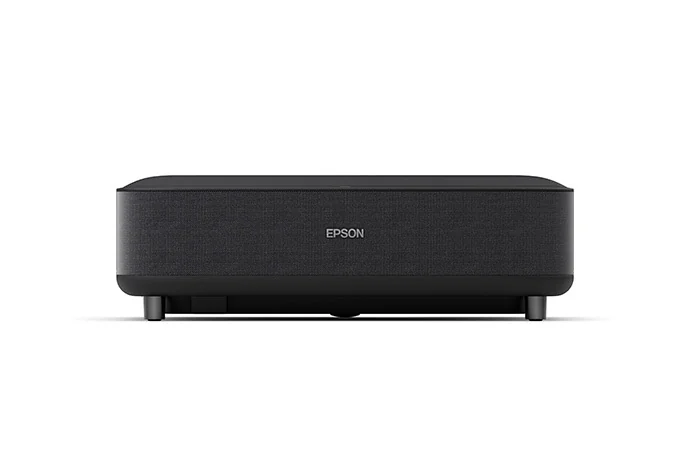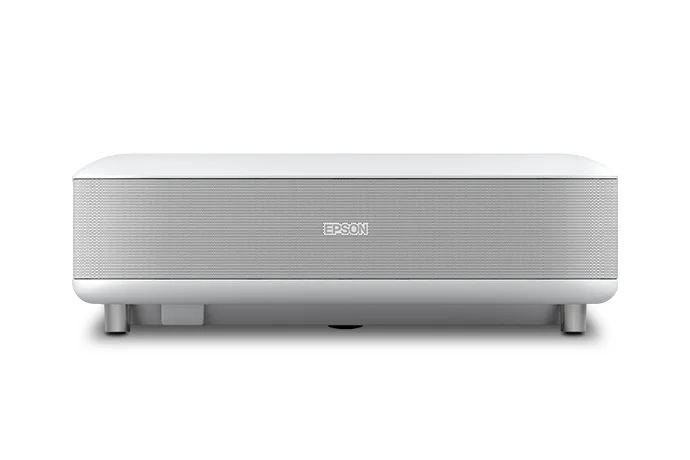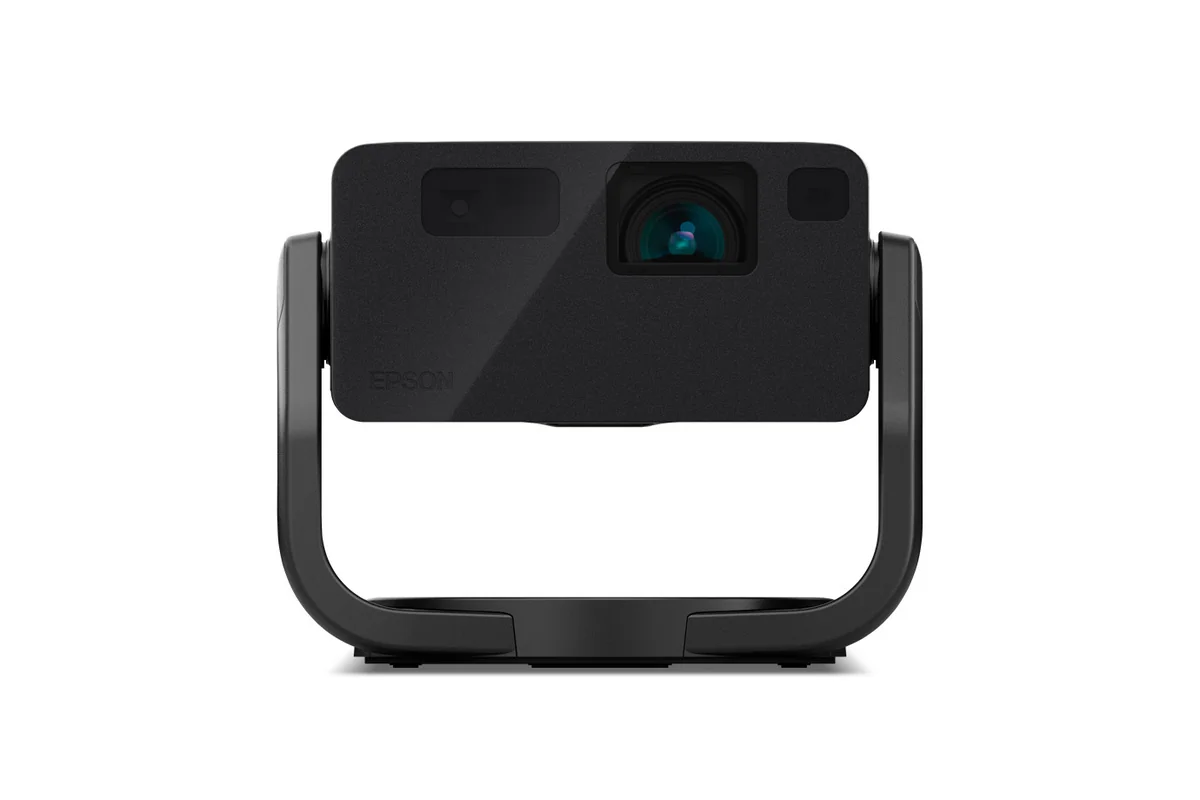
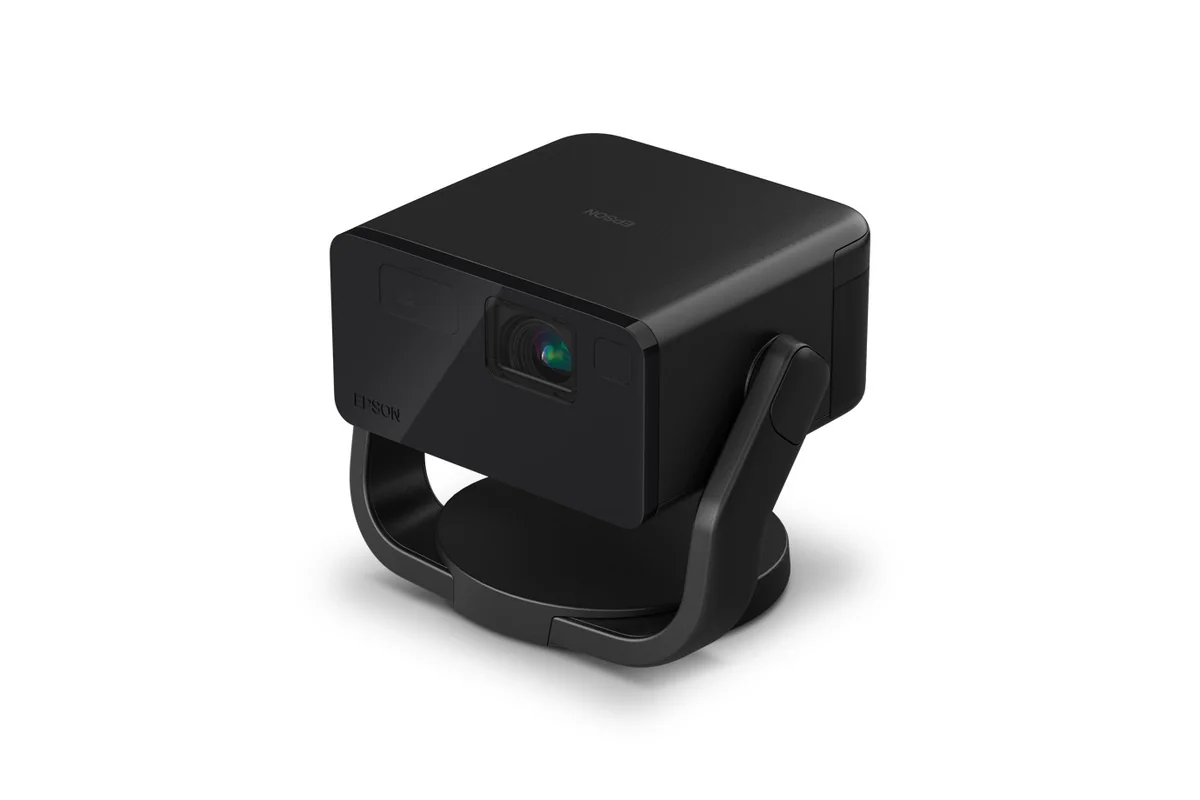
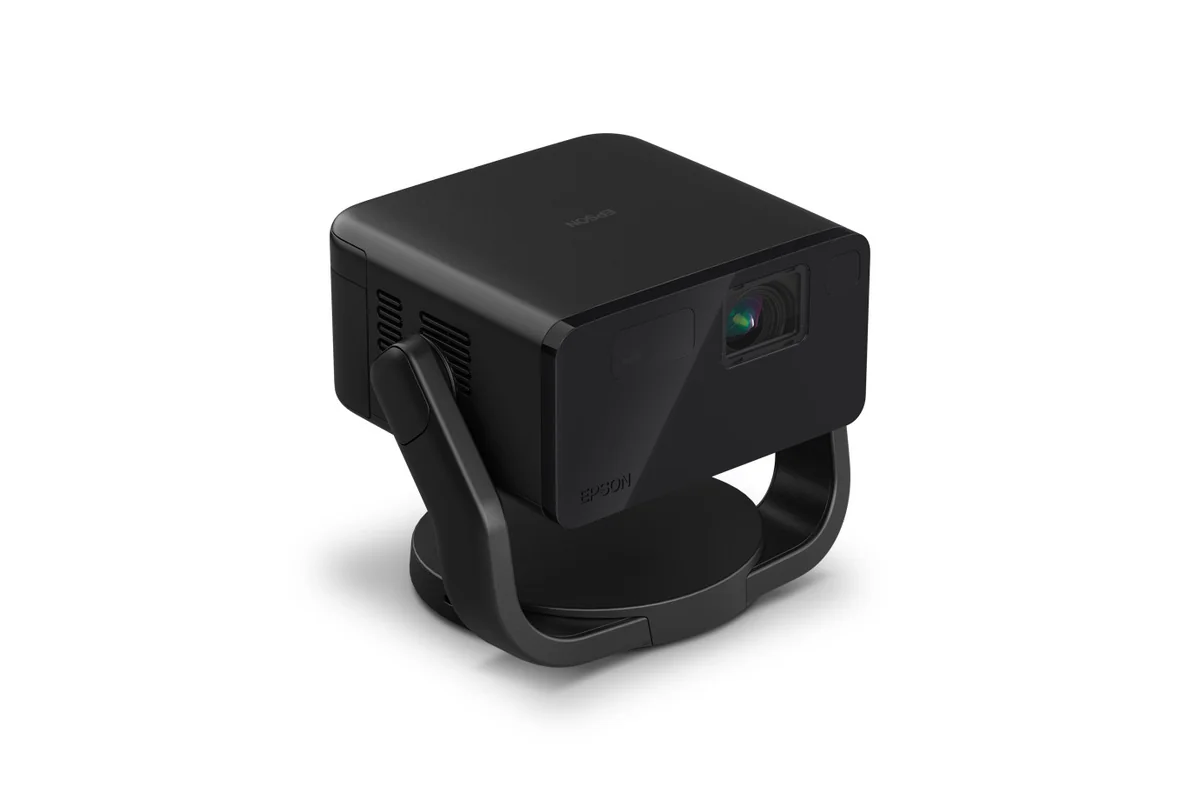
Epson EpiqVision Mini EF22
By Epson · Smart Projectors · Audio & Electronics · More from Epson
- 1080p native resolution, supports 4K input
- 1,000 ISO lumens color and white brightness
- 3-chip 3LCD laser phosphor, 20,000hr life
- Google TV built-in, 2 x 5W Dolby speakers
- 360-degree swivel stand with tilt, 6.6 lbs
Price not listed
- EpsonView at Epson
- eBay (used) eBay: used, open-box, refurbishedView at eBay (used)
- eBayView at eBay
- AmazonView at Amazon (paid link)
Stores are listed in a fixed order, never by price or commission. Prices are snapshots. Check the current price with the store.
Summary
A 1080p 3-chip 3LCD laser projector on a 360-degree swivel-and-tilt stand, with Google TV and a certified Netflix app, made to move movie night between rooms. Check the discontinued status before you buy: Epson has flagged every US colorway, so the seller and the warranty start date matter as much as the price.
Strengths
- 3LCD color cannot show rainbow artifacts, the reason owners give for picking it over single-chip DLP rivals.
- The gimbal stand puts the image on any wall or straight up at the ceiling, no mount needed.
- Google TV runs properly here, with a certified Netflix app that most Android-based portables lack.
- Measured output beats the 1,000-lumen claim: 1,081 lumens in Dynamic mode by ProjectorCentral’s ISO 9-point average.
- The 2 × 5 W speakers with passive radiators fill a family room, loud enough that full volume can be too much.
- A 20,000-hour laser and a 2-year full-unit-replacement warranty.
Weaknesses
- Dark-room blacks are gray: PCMag lost shadow detail on SDR discs, and What Hi-Fi saw a quite pronounced layer of greyness.
- No game mode and no low-latency mode; measured input lag runs 25.7 to 76 ms depending on the lab.
- The 1,000-lumen claim holds only in Dynamic mode; accurate modes measure 670–755 lumens.
- Epson has flagged every US colorway “Discontinued”, so new stock is whatever retailers have left.
- The auto keystone, screen fit and obstacle avoidance are digital corrections that cost brightness; PCMag turned them off for testing.
- One HDMI, no Ethernet, no battery, no card slot, and no optical zoom.
Verified specifications
| Projection system | Epson 3LCD, 3-chip, 0.62-inch panels; laser phosphor light source rated 20,000 hours. |
|---|---|
| Native resolution | 1920 × 1080 (16:9); it accepts 4K HDR input and renders it at 1080p. |
| Brightness | 1,000 lumens white (ISO 21118) and 1,000 lumens color (IDMS 15.4). |
| Measured brightness (ProjectorCentral) | 1,081 lumens Dynamic, 755 Vivid, 699 Natural and Cinema, 670 Custom. |
| Contrast | over 5,000,000:1 dynamic; Epson publishes no native ratio. |
| HDR | HDR10 and HLG only; no HDR10+, Dolby Vision or 3D. |
| Lens | fixed F/2.0, throw ratio 1.0–1.81; zoom is digital, not optical. |
| Image size | 30 to 150 inches, with 100 inches at about 88 inches of throw. |
| Auto setup (EpiqSense) | auto focus, keystone, screen fit and obstacle avoidance for 30–100 inch images at 25–88 inch throw. |
| Stand | 360-degree pan and 150-degree tilt; it can project straight up at a ceiling. |
| Audio | 2 × 5 W stereo with passive radiators, four sound modes, Bluetooth speaker mode. |
| Connections | one HDMI with ARC/eARC and HDCP 2.3, one USB-A 2.0, one service-only USB-B, one 3.5 mm audio out. |
| Smart platform | Google TV with Google Assistant and a certified Netflix app; no AirPlay. |
| Power | 105 W normal, 75 W eco, 100–240 V; the adapter is an external brick that plugs into the stand. |
| Fan noise | rated 22 dB normal and 18 dB eco; ProjectorCentral measured 32.3 dB and 31.1 dB at 5 feet. |
| Dimensions | 9.3 × 7.5 × 7.5 in (236 × 191 × 191 mm) including stand; 6.6 lb (3.0 kg). |
| In the box | projector, power supply, power cable, remote control, two AAA batteries, quick setup guide. |
| Warranty | 2-year limited with full-unit replacement, per Epson’s spec sheet. |
Full research notes and sources
Brightness and picture quality
Epson rates the EF22 at 1,000 lumens white and 1,000 color. The catch: only Dynamic gets there. Accurate modes land at 670–755 lumens (ProjectorCentral), so seller copy that implies 1,000 lumens of cinema-mode brightness overstates it.
What Hi-Fi still found it brighter and punchier than anything else in the lifestyle class. Brightness uniformity was 76% — a 1,209-lumen brightest sector against a 925-lumen dimmest — and the falloff was not obvious in use. Laser speckle is present but not awful; subtle moiré can appear on large blocks of solid color at certain throw distances, and it vanished on a smooth wall or a 100-inch screen (ProjectorCentral).
Contrast is the weak point. Epson’s 5,000,000:1 is a dynamic figure with no published native ratio, and What Hi-Fi calls numbers like that marketing. On SDR discs PCMag saw a significant loss of contrast and shadow detail, enough to lose the thread in the hardest test scenes; HDR and streaming held up better, with a black level high enough to bother some viewers in a dark room. What Hi-Fi is blunter: predominantly dark scenes sit behind a quite pronounced layer of greyness. Skin tones can look slightly jaundiced in some presets, and HDR highlights clip with few controls to fix it.
“Supports 4K” means the signal is accepted and rendered at 1080p — PCMag says it behaves like a 4K projector with soft focus. Epson’s 150-inch claim is best-case; What Hi-Fi puts the realistic ceiling closer to 130 inches.
Stand, setup and sound
The stand is the whole reason this model exists. It is the EF21’s engine in a cradle: 360 degrees of pan, 150 degrees of tilt, no mount, and power arrives through an external brick that plugs into the stand rather than the projector body. Outside the US the same projector sells as the EF-22N.
ProjectorReviews called the auto keystone and focus sluggish. PCMag turned everything off except autofocus for picture testing, because these digital adjustments lower image brightness. There is no optical zoom; Epson’s 1.0–1.82 figure is digital. A smart eye-protection sensor dims the image when something crosses the light path; Empire found the dimming immediate.
Google TV is the other reason to buy. It carries a certified Netflix app, Chromecast and Google Assistant on the remote — a proper smart platform, which many Android-based portables lack. First-time setup takes 20 minutes to half an hour (ProjectorCentral), What Hi-Fi hit a 40-minute update on first install, and BBC iPlayer and Freeview Play did not work on the UK unit.
Sound punches above the size class. The 2 × 5 W system adds passive radiators the EF21 lacks. ProjectorCentral calls it powerful and free of tinny quality, the best part of the package for music and film; Empire heard a wide soundstage that stayed clean at volume. What Hi-Fi is the dissenter: loud, but lacking projection and scale for cinematic content. Audio leaves over HDMI ARC/eARC, 3.5 mm or Bluetooth, and the projector doubles as a Bluetooth speaker. An r/projectors owner describes the unit as really quiet and very portable, with detailed controls for fitting the image to any surface.
Connections are minimal: one HDMI, no Ethernet, no battery, no card slot.
Warranty, parts and running costs
Epson’s spec sheet promises a 2-year limited warranty with full-unit replacement, plus dedicated toll-free support in the US and Canada; ProjectorCentral calls it one of the better ones around. A one-year extended plan is available at $85.95 (ProjectorCentral, 2024).
There is no lamp and nothing to consume — the 20,000-hour laser is framed as the lifetime of the projector, and the only running cost is the power draw: 105 W normal, 75 W eco. Maintenance means cleaning the lens and air vents by the book; no liquids, no aerosols, no blocked vents. Firmware arrives through Epson’s update app, and a full internal storage can block system updates until apps and cache are deleted.
Repairability is limited by design: no user-serviceable lamp, no interchangeable lens, no teardown path. The practical repair path is the full-unit replacement warranty. The only documented accessories are the Custom Travel Case, $49.99 at launch (Epson, 2024), and a safety wire set. The manual documents an over-temperature shutdown with an orange indicator, and fans that can run in standby — Epson says that is not a malfunction.
Is it worth it?
Gaming is not what this is for. There is no game picture mode, and measured input lag spans 25.7 ms (PCMag) to 60.7 ms (ProjectorCentral) to 76 ms (What Hi-Fi) — two labs using the same tester class disagree by more than 2×, so treat any single number as unreliable. ProjectorCentral found no color mode works well in dark game atmospheres; brightly colored games and Switch titles were fine. Empire says skip it for fast-paced shooters.
At $999.99 — the October 2024 launch MSRP — the reviewers did not crown it. PCMag rates it excellent and still names the Anker Nebula Mars 3 the better value; TechRadar says it “doesn’t really achieve greatness in any area” and points at the BenQ X300G or Xgimi Horizon Pro; CNET notes the BenQ HT2060 is the same price at a 2,300-lumen rating. The one defensible reason to choose it over DLP rivals is that 3LCD cannot produce rainbow artifacts. Below $800 the trade-offs get cheap; above MSRP there is no argument for it.
Then the ownership reality. Epson flags all five US colorway pages “Discontinued” and ProjectorCentral lists the model as discontinued since June 2026, while B&H still lists a new Stone Blue unit and a Certified ReNew unit backed by the same 2-year manufacturer warranty. If you buy, confirm the seller, the warranty start date and whether the unit is ReNew — and remember the EF21 is the same engine without the cradle, launched $100 lower and listed around $448.08 in a January 2026 roundup. In the UK, Empire’s January 2026 page lists an £829.96 RRP, and What Hi-Fi saw street prices near £799 against a £999 list.
One r/budgetprojectors owner who moved up from a projector costing about $40 says the Epson was “barely better” — a single opinion set by a very low baseline, not a defect rate. Other r/projectors threads circle buyer questions the spec sheet can settle: 8-bit processing versus a “24 bit” claim for the BenQ GV50, and a 360:1 to 480:1 native contrast gap to the older EF12 that Epson does not publish and nobody has verified. Nobody has published a failure rate for the EF22, so treat the known annoyances as annoyances.
Which model this is
This page covers the Epson EpiqVision Mini EF22 (EF-22N outside the US), the gimbal-stand member of the EpiqVision Mini pair launched on October 1, 2024 alongside the cradle-free EF21. US part numbers: V11HB38020 (Diamond White), V11HB38120 (Onyx Black), V11HB38320 (Opal Green), V11HB38220 (Quartz Rose) and V11HB38420 (Stone Blue).
Its US Amazon listing is ASIN B0DGRF8Z49.
It is not the EF21. The EF21 is the same engine without the swivel stand and launched at a $100 lower MSRP.
Sources
Manufacturer:
- Epson EpiqVision Mini EF22 user manual
- Epson EpiqVision Mini EF22 specification sheet (CPD-64585R3)
- EF21/EF22 projector dimensions (Epson)
- Epson EpiqVision Mini family launch press release
- Epson EpiqVision Mini EF22 – Stone Blue product page (V11HB38420)
Independent reviews:
Owner reports:
- “Is the Epson Epiqvision mini EF-22 a good projector?” (r/projectors)
- “I’ve got the Epson EF22, and honestly, I’m not impressed with the quality” (r/budgetprojectors)
- “Epson Mini EF22 vs. BenQ GV50” (r/projectors)
- “Epson ef 12 vs ef 22 ?” (r/projectors)
Stores: