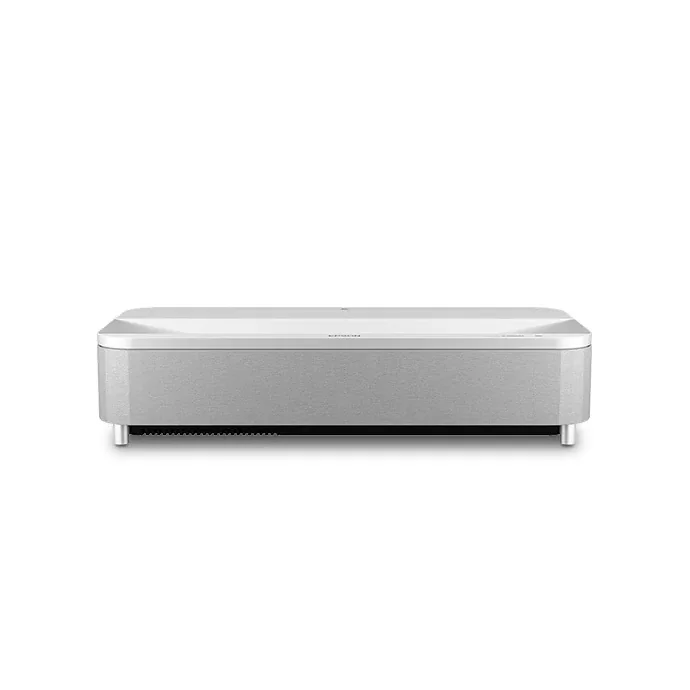
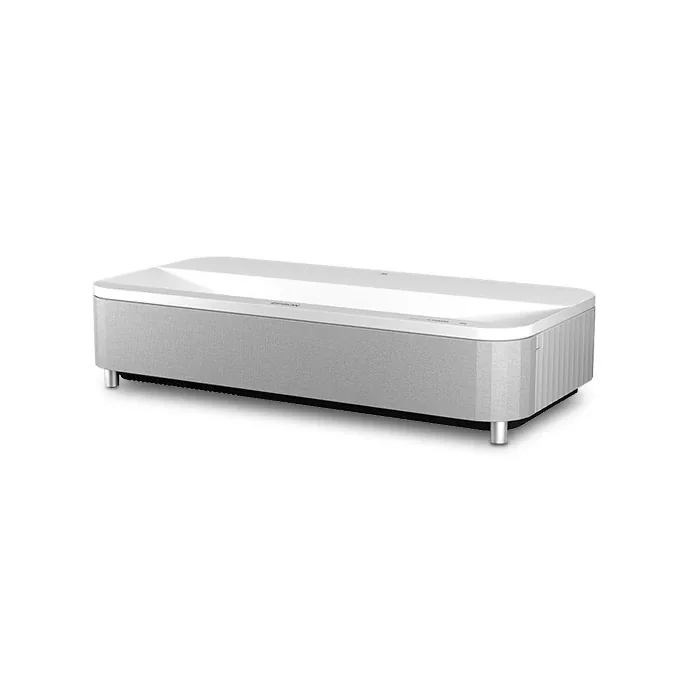
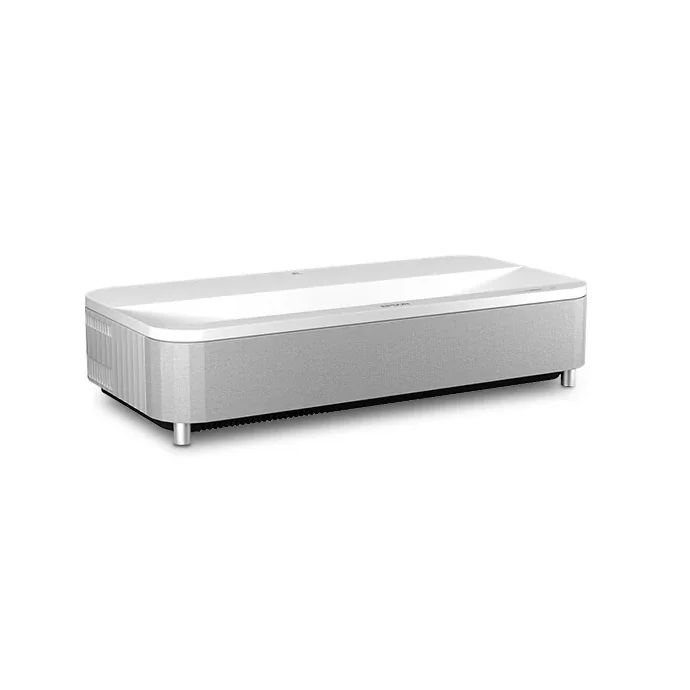
Epson EpiqVision LS800
By Epson · Smart Projectors · Audio & Electronics · More from Epson
- 4000 lumens color brightness (IDMS) and 4000 lumens white brightness (ISO)
- 4K PRO-UHD pixel-shifting enhancement, 3840 x 2160
- Image size up to 150 inches on screen
- 10-bit HDR color processing accepting 100% of HDR source
- 3-chip 3LCD laser light source with 0.16:1 ultra short-throw lens
Price not listed
- EpsonView at Epson
- Best BuyView at Best Buy
- eBayView at eBay
- AmazonView at Amazon (paid link)
- eBay (used) eBay: used, open-box, refurbishedView at eBay (used)
Stores are listed in a fixed order, never by price or commission. Prices are snapshots. Check the current price with the store.
Summary
A 3-chip 3LCD laser projector that throws a 100- to 150-inch picture from a cabinet sitting inches away from the screen, bright enough for a lit living room. Check the screen and the stock before you buy: Epson has discontinued this model, and the ambient-light-rejecting screen Epson sells for it costs more than the projector.
Strengths
- All three LCD primaries are shown at once, so there are no single-chip DLP rainbow artifacts.
- Brightness measures near 4,000 ANSI lumens in Dynamic, with white and color output matching.
- It throws 100 to 150 inches from furniture that sits inches from the wall, tighter than most rivals.
- The Game port measured 21 ms at 4K/60 and 12.3 ms at 1080p/120, against triple-digit lag elsewhere.
- Yamaha 2.1-channel speakers with real bass beat the mono speaker most projectors carry.
- Epson still publishes manuals, sells the air filter and runs a Certified ReNew program with a two-year warranty.
Weaknesses
- The picture is softer than true 4K panels, because the LCD panels are 1920 × 1080 and detail comes from pixel shifting.
- Blacks look gray in bright mixed scenes, and Epson’s 2,500,000:1 figure is dynamic contrast, not a measured black level.
- Calibration is limited: no full CMS, and one sample showed grayscale and color-point errors around Delta E 5 to 10.
- Fans get loud at full brightness, about 37.9 dBA at roughly 3 ft in Normal mode.
- The internal Android TV was not certified for the native Netflix app in a 2022 test, and owners report app and standby wake problems.
- No 4K/120, no eARC, no Dolby Vision and no 3D, and none of those arrive by firmware.
Verified specifications
| Imaging | 3-chip 3LCD, 1920 × 1080 per panel, with 4K PRO-UHD pixel shifting. It is not a native 3840 × 2160 panel. |
|---|---|
| Screen size | 80 to 150 inches diagonal. |
| Throw | about 0.16 to 0.17:1. RTINGS puts the lens 0.9 inches from the wall for an 80-inch image and 9.9 inches for 150 inches; Epson shows a 100-inch image with the cabinet back roughly 3.9 inches from the wall. |
| Setup | manual focus, adjustable feet, geometric correction through the setup app, no optical zoom and no user lens shift. |
| HDR | HDMI takes HDR10 and HLG at 10-bit. No Dolby Vision, no HDR10+ and no 3D. |
| Game input | HDMI3, marked “Game”, bypasses Android TV. ProjectorCentral measured 21.0 ms at 4K/60, 22.1 ms at 1080p/60 and 12.3 ms at 1080p/120. 4K/120 is not supported. |
| Other inputs | 101 to 113 ms measured on HDMI1 and HDMI2. |
| Ports | three HDMI (one ARC, not eARC; one Game), optical S/PDIF out, 3.5 mm audio out and USB for service, media and power. No Ethernet LAN and no RS-232C. |
| Smart system | Android TV 11 with Chromecast and Google Assistant over Wi-Fi. |
| Sound | Yamaha-designed 2.1-channel system with two 5W full-range channels and 10W of bass. |
| Light source | laser, rated for up to about 20,000 hours in Normal, Medium and ECO. There is no removable bulb. |
| Power | Normal 350W, Medium 271W, ECO 217W while running; 0.4W in Shutdown standby and 2.0W in Suspend standby. |
| Noise | Epson rates 32 dB Normal, 27 dB Medium, 19 dB ECO. ProjectorCentral measured about 37.9 dBA, 32.7 dBA and 30.3 dBA at roughly 3 ft against a 27.6 dBA room floor. |
| Size and weight | about 27.6 to 28.4 lb. |
| In the box | projector, power cable, smart remote, two AAA batteries and quick-start material. Screen, streaming subscriptions, extra HDMI cable, external receiver and 3D glasses are not included. |
Full research notes and sources
Brightness and picture modes
The mode you pick moves the numbers more than the room does. At the same Normal laser setting, ProjectorCentral measured 4,084 ANSI lumens in Dynamic, then 2,165 in Vivid, 2,030 in Cinema and 1,981 in Natural. At Medium the same four modes gave 2,638, 1,398, 1,311 and 1,280. At ECO they fell to 1,205, 639, 599 and 584. The quietest setting, ECO Cinema, produces 599 ANSI lumens, a fraction of the headline figure, so do not plan a sunlit 150-inch screen around “4,000 lumens” and “quiet” at the same time.
Color and geometry are where this projector bends. Its picture controls leave out the full grayscale, gamma and CMS adjustments that dedicated cinema machines carry, and ProjectorCentral measured out-of-box grayscale and color-point errors around Delta E 5 to 10 on its sample. RTINGS says shadow blacks appear gray and contrast drops in high-brightness mixed scenes, while Projector Reviews liked the black level on its SilverFlex setup. Epson’s 2,500,000:1 is dynamic contrast advertising, not proof of deep black. HDMI takes HDR10 and HLG at 10-bit, but there is no Dolby Vision, no HDR10+ and no 3D.
Lag, gaming and inputs
Only one of the three HDMI inputs is a gaming input. ProjectorCentral measured 21.0 ms at 4K/60 and 12.3 ms at 1080p/120 on the HDMI3 “Game” port, which bypasses Android TV processing, and 101 to 113 ms on the other two. A console plugged into the wrong cable feels sluggish. 4K/120 is not supported, so a console that wants it has to run 1080p/120 on the Game port.
Their fix is a frame-matched external streamer. A December 2024 owner described the same stutter across Blu-ray and input sources, and commenters suggested the Game port as a workaround, though nobody has shown it fixes the problem every time.
Ports are modest for an install. There is one ARC HDMI, and it is ARC rather than eARC, so a soundbar cannot take advanced uncompressed Dolby Atmos formats straight from the projector. There is optical S/PDIF out, a 3.5 mm audio out and USB for service, media and power. There is no Ethernet LAN and no RS-232C, so a rack-mounted theater needs an external HDMI switch or streamer, and ordinary streaming runs over Wi-Fi.
Screen, placement and running costs
At a 0.16 throw, a few millimeters of tilt or a wavy wall bends the image badly, and digital keystone fixes the shape by throwing away pixels. Follow Epson’s placement diagram rather than eyeballing it. Measure three separate distances before you order: wall to lens, cabinet back to wall, and screen height.
The screen is the expensive part. Epson’s SilverFlex Ultra 100-inch ambient-light-rejecting screen (ELPSC35) lists at $2,500, and the 120-inch (ELPSC36) at $3,800, both sold separately (Epson store, October 2026). They are advertised to reject up to 90% of ambient light depending on conditions, and they cost more than the projector. A plain white wall will not behave like a television in daylight.
There is no subscription and no lamp. At 3 hours a day, 1,095 hours a year, 20,000 hours of rated life is about 18.3 years; at 8 hours a day it is about 6.8 years. That arithmetic says nothing about the fan, the power board or the LCD panels.
Electricity is the running cost. Epson lists Normal at 350W, Medium at 271W and ECO at 217W, plus 0.4W in Shutdown standby and 2.0W in Suspend standby. At 3 hours a day and an assumed $0.20 per kWh, Normal draws 383.25 kWh a year, about $76.65, and ECO 237.615 kWh, about $47.52. Standby adds $0.61 a year in Shutdown mode or $3.07 in Suspend, which also means the projector comes back faster.
The air filter is the only consumable. Epson’s own LS800 parts list names the ELPAF64, part V13H134AE0, at $63 (Epson store, October 2026, listed out of stock at the time of the check; CDW showed the same $63). Do not confuse it with the ELPAF60 used on the LS300. Epson publishes no mandatory annual replacement interval. Averaging one $63 filter over three years gives $21 a year, which is an illustration, not a schedule.
What owners report
Owner reports on this model are thin and mostly anecdotal. In January 2023 a r/projectors owner described a unit that rebooted and immediately shut down, with a high-speed fan and an orange temperature indicator, and said a factory reset did not help. Another participant described exchange units with dead pixels, pink blobs and a mechanical rattle.
In November 2025 another r/projectors owner reported an LS800W stuck in a firmware update loop, the fan running at full power and the unit restarting, after about 2.5 years of light weekend use. No service outcome was published. On August 30, 2026 an r/hometheater owner reported a unit dead after about three years and a claimed 1,200 hours, with no lights and no fan, and said a first unit had been replaced for bad pixels.
None of that adds up to a failure rate. Nobody has published how often LS800 laser modules, LCD panels, power boards or fans fail, so read these as isolated reports rather than a defect trend. Software complaints are more common than hardware ones. A 2025 r/Epson owner saw a YouTube “Unverified device” error on the black LS800B while an external stick kept working, and Best Buy owners describe app compatibility, HDMI routing and unwanted standby wake events on the internal Android TV.
When a leftover or refurbished unit arrives, test it before the return window closes: cold starts, uniform gray and white screens for spots, focus at all four corners, real 24p films, the Game port with a console, the internal streaming apps and the sound.
Is it worth it?
Epson has discontinued the LS800, and what you pay depends on what the unit actually is. Epson’s Certified ReNew page lists the white unit at $1,999.99 with a two-year limited warranty, a 30-day return and free shipping (Epson store, October 2026). B&H lists the black LS800 at $2,499.95 new, advertised as a $1,300 instant saving against a $3,799.95 reference (B&H, October 2026). A ProjectorCentral partner listing showed $2,299 for an authorized dealer, and the same buying guide rendered $3,800 on another crawl, so treat dealer numbers as offers to confirm at checkout rather than a going rate. Launch MSRP was $3,799.99.
Buy it like this. Under $1,600 used, only with return protection and a clean optical inspection. Between $1,700 and $2,100, the Certified ReNew unit at $1,999.99 is the strongest window, because the warranty is Epson’s and not a stranger’s. Between $2,100 and $2,400 new, it depends on your room and screen. Between $2,400 and $2,600 new, the B&H figure only makes sense for bright daytime sports and the shortest throw on the market. Above $2,600 it stops making sense for a discontinued projector, and above $3,000 it is hard to defend next to Epson’s own refurbished money.
Two named alternatives matter at those numbers. The Hisense PX3-PRO lists at $2,499.99 at Best Buy (October 2026) with 3,000 lumens, triple-laser DLP, Google TV, Dolby Vision, HDR10+, IMAX Enhanced and 3D. RTINGS measured much better contrast, wider color and better dark-room cinema from it, while the Epson stays brighter and free of DLP rainbows. The Epson Lifestudio Grand lists at $2,299.99 (Epson store, October 2026) with 3,600 lumens, Google TV with Netflix, a Bose 2.1 system and a 0.25 throw, which is longer than the LS800’s 0.16 and tops out at 120 inches.
Which model this is
This page covers the Epson EpiqVision Ultra LS800, the 2022 ultra-short-throw laser projector built on a 3-chip 3LCD engine. The white LS800W carries model code V11HA90020 and the black LS800B is V11HA90120; the electronics are the same and only the color changes. The Certified ReNew version of the white unit is V11HA90020-N, an inspected refurbished purchase rather than new retail stock. Retailer model codes can also encode stock condition rather than different hardware.
Two things to keep apart. Epson’s Lifestudio Grand (V11HB82120) is a different projector: brighter on paper, a newer Google TV system and a longer 0.25 throw. And ProjectorCentral dates the LS800 discontinuation to June 2026, so a listing that looks new may be old stock.
Sources
Manufacturer:
- Epson US LS800 white V11HA90020 product page, features, discontinuation and two-year warranty
- Epson Certified ReNew LS800 white V11HA90020-N, $1,999.99, two-year warranty and 30-day return
- Epson LS800W V11HA90020 model-specific US support portal
- Epson LS800 laser light source rated life and aging
- Epson LS800 US electrical consumption and standby power
- Epson LS800 original parts list: ELPAF64 filter, ELPSC35 and ELPSC36 screens, ELPWR01
- Epson US ELPAF64 replacement air filter V13H134AE0, $63, sold out
- Epson SilverFlex Ultra 100-inch ambient-light-rejecting screen ELPSC35, $2,500
- Epson SilverFlex Ultra 120-inch ambient-light-rejecting screen ELPSC36, $3,800
- Epson US Service Net replacement, shipping and return terms
- Epson US Lifestudio Grand black V11HB82120, $2,299.99 and 3,600 lumens
Independent reviews:
- ProjectorCentral LS800W model specs, release date, discontinuation and warranty
- RTINGS Epson LS800 vs Hisense PX3-PRO laboratory comparison
- Best Buy Hisense PX3-PRO listing at $2,499.99
Owner reports:
- r/projectors: orange temperature light, high fan and pixel artifacts after exchange (2023)
- r/projectors: LS800W stuck in a firmware update loop (2025)
- r/hometheater: LS800 dead at three years old (2026)
- r/Epson: LS800B YouTube unverified-device error (2025)
- r/projectors: occasional motion stutter and the HDMI3 workaround (2024)