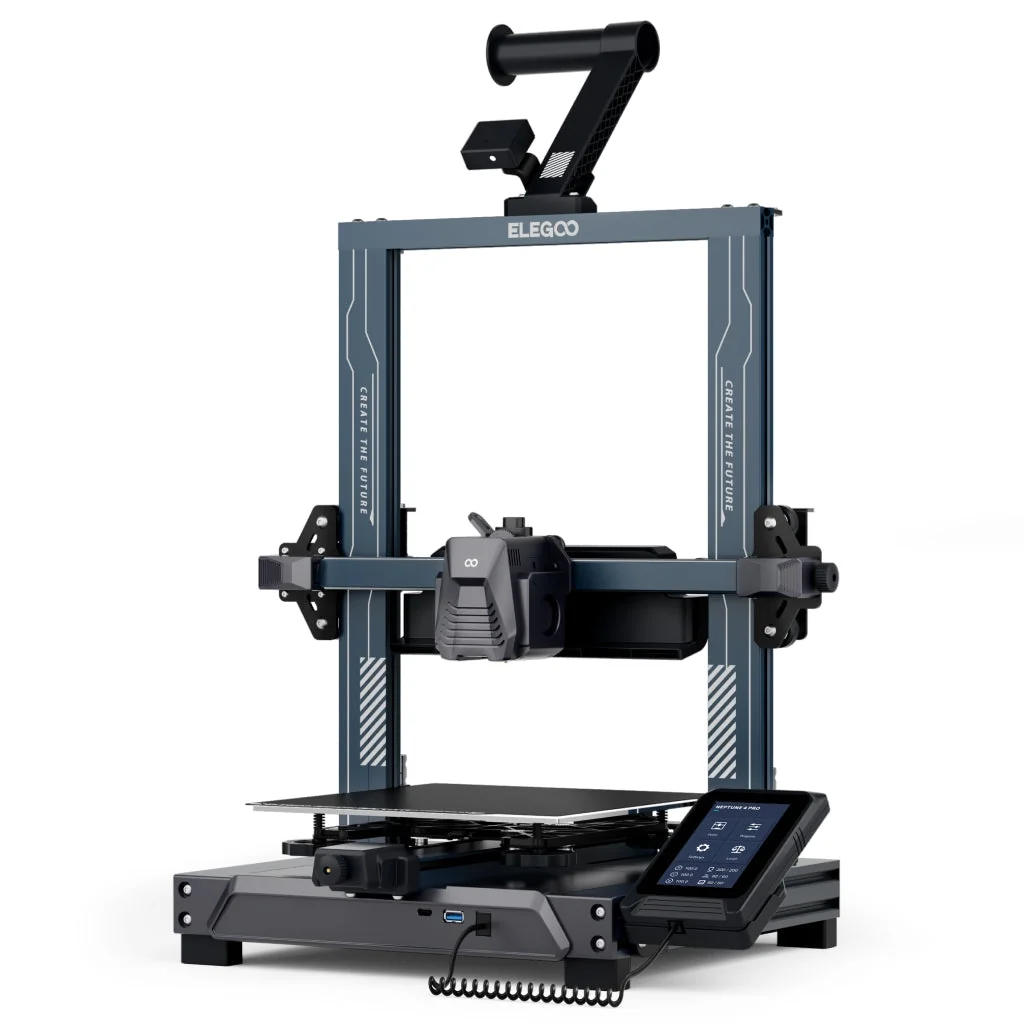
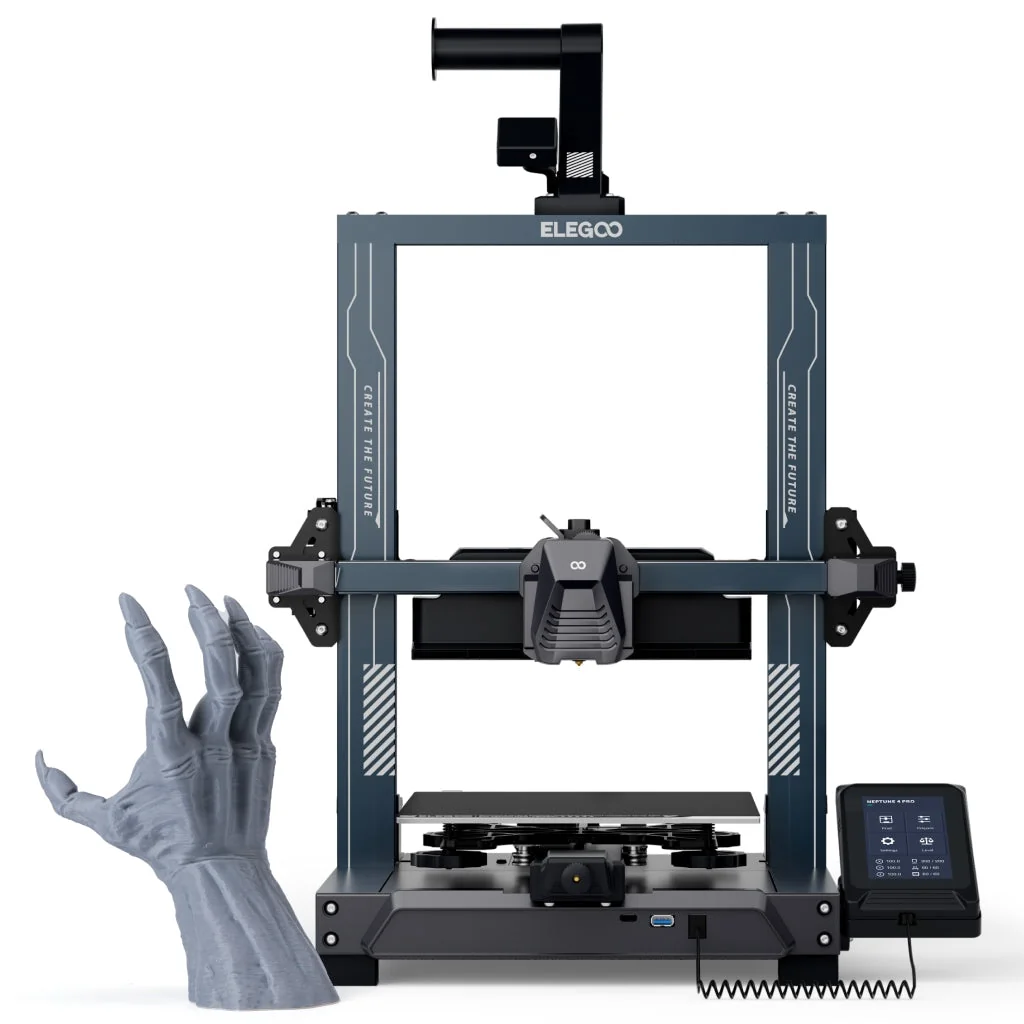
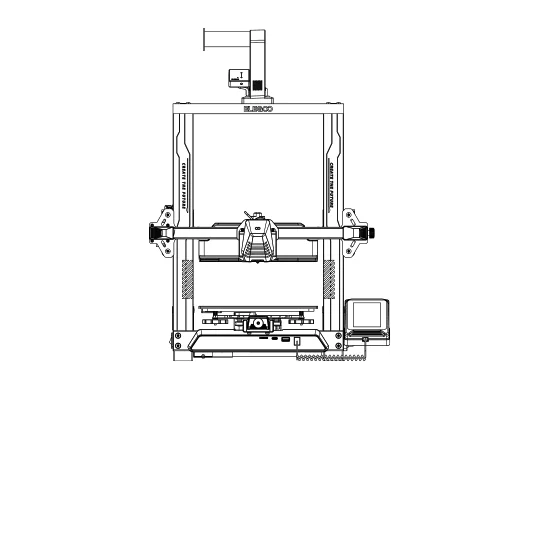
Elegoo Neptune 4 Pro
By Elegoo · Budget 3D Printers · 3D Printing
- 300 °C high-temperature nozzle
Lowest price seen
$209.99
from $209.99 at MatterHackers · Checked Oct 4, 2026
- MatterHackers $209.99View at MatterHackers
- ElegooView at Elegoo
- WalmartView at Walmart
- eBayView at eBay
- eBay (used) eBay: used, open-box, refurbishedView at eBay (used)
- AmazonView at Amazon
Prices are snapshots. Check the current price with the store.
Summary
A 225 x 225 x 265 mm open-frame FDM printer with Klipper pre-installed, a 500 mm/s maximum and a 300 °C hotend, sold to buyers willing to tune it. Budget a first weekend for firmware: owners report the factory firmware does not keep its Z-offset, and replacing it with OpenNept4une or plain Klipper fixes that along with mesh, touchscreen and power-loss problems.
Strengths
- Tom’s Hardware gave it an Editor’s Choice and printed a Benchy in 18 minutes with only faint hull banding.
- TechRadar measured a 0.2 mm combined average dimensional error across test targets, with full marks for overhangs and bridging.
- Steel linear rollers replace the plain Neptune 4’s plastic V-wheels.
- The direct drive handles flexible filaments like TPU with the right settings.
- Owners report long clean runs once configured, including 540 hours with zero problems.
- ELEGOO support replaces printheads and levers and supplies firmware by serial number.
Weaknesses
- The factory firmware does not keep its Z-offset; one owner measured it drifting from -0.470 to -0.250 against a true value near -0.500.
- Bed mesh and the inductive probe are unreliable, with one owner replacing the printhead twice.
- Extruder clogs are common, tied to missing thermal paste and filament wrapping the drive gears.
- The nozzle is proprietary with no third-party equivalent; a Creality HF substitute was 1 mm short.
- The “below 50 dB” figure is manufacturer-only; reviewers describe loud fan behaviour.
- The bundled ELEGOO Cura slicer is widely disliked, and firmware installs have been reported to brick the board.
Verified specifications
| Model | Neptune 4 Pro; FDM printing technology. |
|---|---|
| Build volume | 225 x 225 x 265 mm (8.85 x 8.85 x 10.43 in). |
| Footprint | 475 x 445 x 515 mm (18.70 x 17.52 x 20.28 in); net weight 8.9 kg (about 19.6 lb). |
| Frame | CNC-machined aluminium extrusion. |
| Voltage | 115/230 V, 50/60 Hz. |
| Speed | 500 mm/s maximum, 250 mm/s recommended, with a stated 30-500 mm/s range. |
| Acceleration | up to 20,000 mm/s² in ELEGOO’s current specifications. |
| Board | ARM 64-bit 1.5 GHz quad-core with 8 GB storage. |
| Firmware | Klipper pre-installed with input shaping and pressure advance. |
| Nozzle | 0.4 mm, maximum 300 °C; proprietary length with no V6 or MK8 equivalent. |
| Bed | maximum 110 °C, segmented heatbed at 100 W + 150 W (250 W total). |
| Levelling | 121-point (11x11) automatic plus auxiliary hand-twist knobs under the bed. |
| Build surface | magnetic removable textured PEI platform, 235 x 235 mm. |
| Extruder | dual-gear direct drive at 5.2:1 with a copper-titanium bi-metal throat pipe. |
| Cooling | two 4015 ball-bearing fans plus four 4020 blowers behind the printhead. |
| Display | removable 4.3-inch capacitive touchscreen. |
| Power supply | 310 W; power-loss resume and filament-runout detection included. |
| Filament | 1.75 mm; PLA, TPU, PETG, ABS, ASA and nylon. |
| Noise | below 50 dB per the manufacturer, not independently measured. |
| Warranty | 12 months for the printer; six months for extruder and printhead kits; build plates, nozzles, PTFE tube and tools are consumables with no warranty. |
Full research notes and sources
Speed, accuracy and the numbers
ELEGOO publishes 500 mm/s as a machine maximum and recommends 250 mm/s; owners print at 200 to 250 mm/s. TechRadar is the only outlet with accuracy numbers: a combined average dimensional error of 0.2 mm (X 0.23 mm, Y 0.18 mm) across 5 to 25 mm targets, and a 23.5 out of 30 feature score with full marks for overhangs and bridging but only 2.5 for Z-axis alignment and XY resonance. Tom’s Hardware printed a Benchy in 18 minutes with only faint hull banding and called the adhesion best-in-class. The weak resonance and alignment scores fit a bed-slinger on linear rails, and owners confirm tall or thin parts suffer for it. The “below 50 dB” figure is manufacturer-only; no outlet measured noise, and reviewers describe fan noise loud enough to hear through a door.
Firmware first
The factory firmware is the weak point. Across six owner threads the most repeated defect is that the Z-offset does not persist: one owner watched it drift from -0.470 to -0.390 to -0.250 against a true value near -0.500 to -0.520, and others say the machine forgets the value at power-off. The community fix is to replace ELEGOO’s firmware with OpenNept4une or plain Klipper, a roughly two-hour job owners call not difficult; it resolves mesh failures, touchscreen freezes and unreliable power-loss resume at the same time. Do that before replacing hardware. Note that ELEGOO firmware and Mainsail installs have also been reported to brick the board with no clean eMMC dump to restore from.
Clogs, nozzles and maintenance
Hardware issues that firmware will not fix: bed mesh and the inductive probe are unreliable, with one owner replacing the entire printhead twice and hand-writing the mesh into printer.cfg; extruder clogs are common, attributed to missing thermal paste between the heatbreak and heatsink and to filament wrapping the drive gears; and the nozzle is proprietary, with the closest Creality substitute measuring 1 mm short. Nozzles wear quickly, and one owner used up the first in three weeks. The textured PEI plate is a consumable and was reported destroyed once after roughly 20 relevel attempts. TPU works with about 30 mm/s and a 0.6 mm nozzle. “Blob of death” failures, where plastic escapes above the nozzle and encases the heater and thermistor wiring, have destroyed hotends on nearly new units; inspect nozzle seating and wiring before reuse.
Parts and running costs
ELEGOO still sells the parts directly years after launch, which is the long-term argument for this platform. The complete Neptune 4 Pro extruder is $39.99, a complete hotend is $19.99, a dual-sided build plate is $19.99, a proximity sensor is $12.99, the extruder PCB is $17.99, the touchscreen is $33.99 and PTFE tube is about $9.99. Multi-size brass nozzle kits run about $10.99 and hardened steel kits $11.99. The compatible enclosure is $39.99.
Running costs are mostly filament. The 310 W power supply is a maximum rating, not a measured draw; at the July 2026 US residential average of 18.31 cents/kWh, a worst-case 10 hours a week at full 310 W would be about $29.50 a year, and 20 hours a week about $59 a year. A $19.99 build plate every two years averages roughly $10 a year. ELEGOO publishes no fixed replacement interval for nozzles or plates.
Is it worth it?
FilaScope tracked a best price of $260.00, a low of $229.00 and a typical price of $244.50 (2026-10-03), and TechRadar cited $299.99 at Walmart in August 2023. ELEGOO’s US store lists the Type-C version at $229, reduced from $274, and Walmart showed $229.99 out of stock when checked. Under $250 it is a strong buy if you accept the setup work. At $250 to $300 it stays defensible and matches where both independent reviews were written. Above $300 the value thins fast, because that is where enclosed Bambu options appear and owners repeatedly say those require far less intervention; ELEGOO’s own Centauri 2 at $279 adds CoreXY motion and full-auto calibration, and the Bambu Lab A1 mini is $249 with a much smaller build volume. The Ender-3 V3 KE is listed at $259. ELEGOO’s warranty coverage is 12 months for the printer.
Which model this is
This page covers the ELEGOO Neptune 4 Pro, an open-frame FDM printer; the ASIN is B0C749177C. The US and UK pages note it is the Type-C version with OTA updates, so match parts to that variant. Do not merge it with the plain Neptune 4, the Neptune 4 Plus (320 x 320 x 385 mm) or the Neptune 4 Max (420 x 420 x 480 mm and an 85 °C bed limit), and note that owners say the Pro and the Plus/Max use different extruders even though they look the same.
Sources
Manufacturer:
- ELEGOO US: Neptune 4 Pro product page
- ELEGOO: Neptune 4 Pro FDM 3D printer
- ELEGOO UK: Neptune 4 Pro FDM 3D printer
- ELEGOO: warranty periods
- ELEGOO US: Neptune 4 Series accessories and spare parts
- ELEGOO US: assembled extruder kit for Neptune 4 Pro
- ELEGOO US: assembled hotend kit for Neptune 4/4 Pro
- ELEGOO US: dual-sided build plate for Neptune 4 Series
- ELEGOO US: Centauri 2
Independent reviews:
- Tom’s Hardware: Elegoo Neptune 4 Pro review
- Tom’s Hardware: Neptune 4 Pro price drop
- Tom’s Hardware: fastest 3D printers benchmarked
- TechRadar: Elegoo Neptune 4 Pro review
- FilaScope: Elegoo Neptune 4 Pro specs and price
Owner reports:
- Why does autoleveling not work? Z-offset drift and probe knocks (r/ElegooNeptune4Pro)
- Firmware swap to OpenNept4une (r/ElegooNeptune4Pro)
- Filament stuck in the extruder again (r/ElegooNeptune4Pro)
- I’m done with the N4P after 11 days (r/ElegooNeptune4Pro)
- Why so much hate towards the N4 Pro? (r/3Dprinting)
- Custom nozzles on the Neptune 4 Pro (r/ElegooNeptune4)
- OpenNept4une is the Z-offset fix (r/ElegooNeptune4)
- Neptune 4 Pro extruder jammed (r/elegoo)
- Repeated clogs between PTFE tube and throat pipe (r/ElegooNeptune4)
- New Neptune 4 Pro printhead blob failure (r/3Dprinting)
- Noise: Centauri Carbon versus Neptune 4 Pro (r/elegoo)
Firmware and parts: