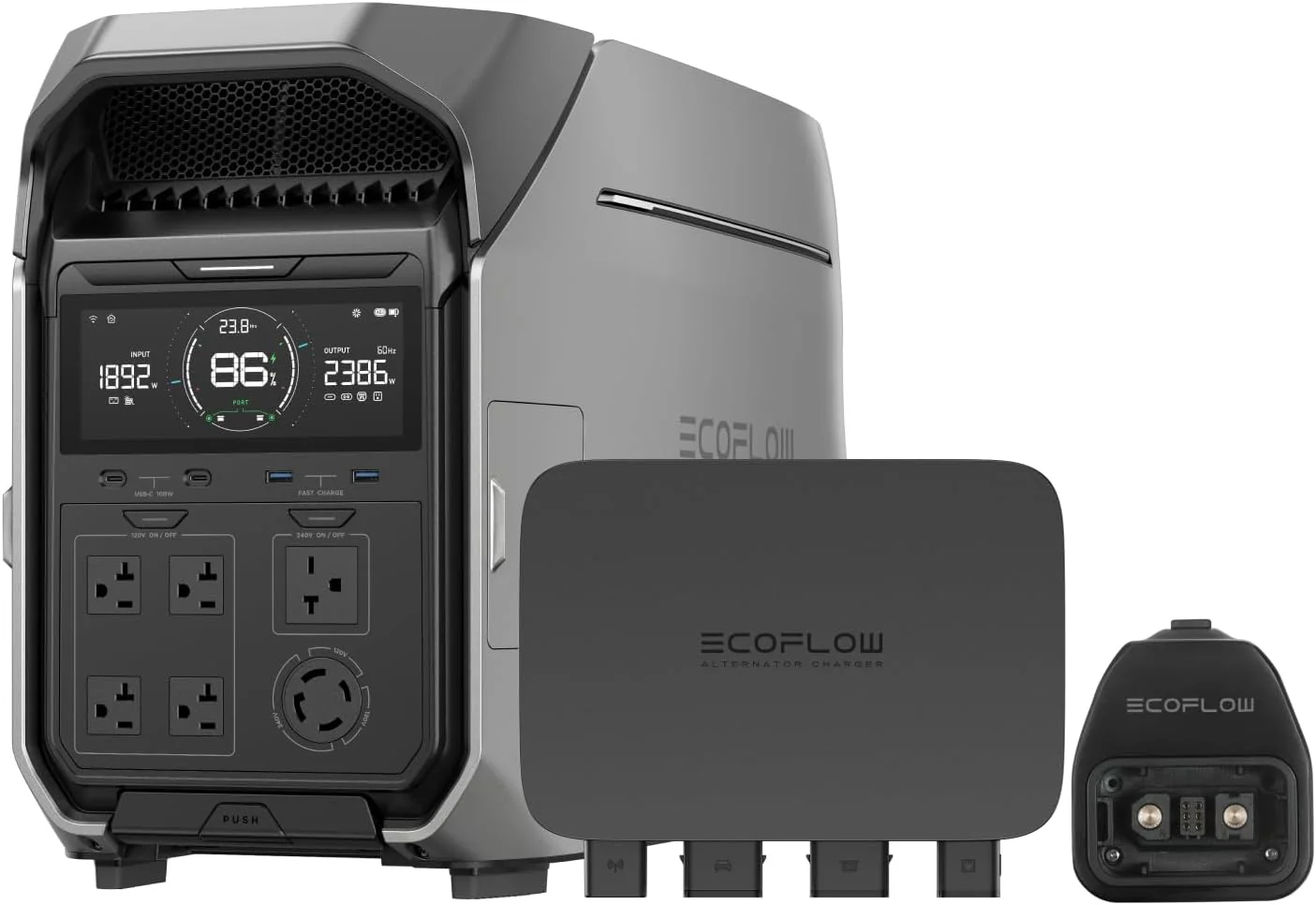
EF ECOFLOW Delta Pro 3
By EF ECOFLOW · Portable Power Stations · Audio & Electronics
- 4096Wh capacity
- 4000W AC output
- 120V/240V split-phase output
- 2600W solar input
- Expandable to 48kWh
Price not listed
- EF ECOFLOWView at EF ECOFLOW
- eBayView at eBay
- AmazonView at Amazon (paid link)
- eBay (used) eBay: used, open-box, refurbishedView at eBay (used)
Stores are listed in a fixed order, never by price or commission. Prices are snapshots. Check the current price with the store.
Summary
A single-box 4,096 Wh LiFePO4 power station with 4,000 W output and split-phase 120/240 V, built for home backup, RV and off-grid use. It weighs 113.5 lb (51.5 kg), so check whether you really need to move it before you buy.
Strengths
- Output headroom: 4,000 W continuous and 8,000 W surge cover high-draw appliances and starting loads.
- Fast charging: about 50 minutes to 80% from AC, unusually quick for a 4 kWh unit.
- Split-phase 120/240 V from a single box, so one unit can run both kinds of loads.
- Seven AC outlets plus USB-C, USB-A and 12 V DC, with solar, car and EV-charger charging.
- Quiet for its class: 30 dB at 2,000 W on the EU spec page.
- Expandable to 12 kWh with two extra batteries, and it works with older Delta Pro expansion batteries.
Weaknesses
- It weighs 113.5 lb (51.5 kg), so it is awkward on stairs and a chore to move even with wheels.
- 240 V and 120 V outputs cannot run at the same time from a single unit.
- The 12 V car socket is gone; DC output now comes from DC5521 and Anderson ports.
- There is no integrated light, which hurts during an outage.
- Firmware quirks: a long-term reviewer reset the unit three times in five weeks to clear BMS errors.
- Plugged into AC, output is capped at roughly 1,800 W, so a starting compressor can trip it.
Verified specifications
| Capacity | 4,096 Wh LiFePO4 (LFP) battery, rated for 4,000 cycles to 80% capacity. |
|---|---|
| AC output | 4,000 W continuous, up to 6,000 W briefly with X-Boost; 8,000 W surge. |
| Output voltage | 120 V and 240 V split-phase from one unit, but not at the same time. |
| Solar input | up to 2,600 W total, split as 1,600 W high-voltage PV (30–150 V) and 1,000 W low-voltage PV (11–60 V). |
| AC charging input (US) | up to 2,900 W from 200–240 V; charges to 80% in about 50 minutes. |
| AC outlets | seven in total, including a NEMA 6-20, an L14-30 locking outlet, a NEMA TT-30 RV outlet and NEMA 5-20 outlets. |
| USB | two USB-C up to 100 W and two USB-A up to 18 W. |
| 12 V DC | 12.6 V / 30 A, 378 W total, via DC5521 and Anderson ports; the 12 V car socket was dropped. |
| UPS / EPS switchover | under 10 ms. |
| Expandability | 12 kWh with two extra batteries, up to 36 kWh in a system; 12 kW with three inverters and a Smart Home Panel 2. |
| Weight | 113.5 lb (51.5 kg). |
| Dimensions | 27.3 × 13.4 × 16.1 in (693 × 341 × 410 mm). |
| Connectivity | Wi-Fi 2.4 GHz, Bluetooth, CAN. |
| Display | 6-inch front LCD. |
| In the box | unit, AC charging cable, grip protector, quick-start guide, safety guide and warranty card. |
Full research notes and sources
Charging and battery life
The Delta Pro 3 stores 4,096 Wh in LiFePO4 cells and is rated for 4,000 cycles to 80% capacity. EcoFlow says the US model charges to 80% from AC in about 50 minutes. The Solar Lab measured a full AC charge at 2 h 54 min instead, so treat the 50-minute figure as the fast end of the range.
PCMag measured a 1,500 W heater running 2 h 45 min, a dehumidifier running 9 h 50 min, and a lamp plus fan running about 37 hours on a full charge, with a 2 h 35 min recharge. The Solar Lab ran a sustained 3,650 W load for 60 minutes and calculated roughly 89% efficiency, and it handled a surge up to about 5,100 W for nearly a minute before shutting down near 6,000 W. It also heard a faint cricket-like sound from the AC input port during wall charging.
Ports, solar and expandability
Solar input tops out at 2,600 W, but that figure is the sum of two separate ports: 1,600 W from high-voltage PV and 1,000 W from low-voltage PV. The Solar Lab called the split needlessly complicated, and you need two differently rated inputs to reach the ceiling.
The front panel carries seven AC outlets, including a NEMA 6-20, an L14-30 locking outlet, a NEMA TT-30 RV outlet and NEMA 5-20 outlets, plus two USB-C up to 100 W, two USB-A up to 18 W and 12 V DC at 378 W. The 12 V car socket was removed relative to the original Delta Pro. You can add two extra batteries for 12 kWh, or build a system up to 36 kWh, and a Smart Home Panel 2 scales three inverters to 12 kW. The older Delta Pro Smart Extra Battery is backwards compatible, with a state-of-charge imbalance caveat.
Firmware, reliability and support
CleanTechnica ran roughly 4,000 W off-grid at once (microwave, toaster oven and air conditioning) without trouble, and with a second battery ran an older RV air conditioner about nine hours on hot nights. It also needed three resets in five weeks to clear errors: two false “electrical short” shutdowns and one cell-balancing error. After a firmware update the electrical-short error did not recur during the test, but that is not proof it is fixed for good.
Reddit users report the same reset procedure (disconnect inputs, hold the power button 10 seconds), so keep firmware current and know how to reset it. CleanTechnica’s bottom line: do not rely on it for critical, unattended backup, such as a pet in a hot camper.
Is it worth it?
Here is the money context, all from EcoFlow and reviewer listings with dates. PCMag listed MSRP $3,699 and a sale price of $2,099 in July 2025. How-To Geek listed $3,694 at EcoFlow direct in August 2024. TechRadar listed $3,699 base and $3,199 on sale in March 2025. EcoFlow’s US page showed a $2,799 sale price against a $3,699 compare-at, bundles at $4,459 (unit plus extra battery) and $5,499 (unit plus battery, 400 W panel and transfer switch), and a refurbished unit at $2,599. Extra batteries are $2,599 each, and an EV X-Stream adapter is about $99.
At sale prices near $2,100 to $2,800 the package is defensible if you need 4 kWh and 4,000 W in one box. At the $3,699 base price the value is harder to justify. Because the unit is heavy and firmware-dependent, it suits fixed locations — a garage, an RV, or whole-home backup with a transfer switch — more than frequent relocation. Look at competing high-capacity units if you need to carry it often or want fully unattended critical backup. PCMag gave it an Editors’ Choice for smart portable power stations and called it the most powerful smart generator it has tested.
Which model this is
This page covers the US/120–240 V EcoFlow Delta Pro 3, a single 4,096 Wh power station. The Amazon listing for this model is ASIN B0DLK7N1F4. Do not merge it with the older Delta Pro (3,600 Wh), the Delta Pro Ultra (6,144 Wh), the Delta 3 Ultra Plus (3,072 Wh), or the separate Delta Pro 3 Smart Extra Battery, which is a 4,096 Wh add-on pack rather than a power station. EcoFlow says the Delta Pro 3 is not compatible with the Delta Pro Ultra and cannot be paired with the original Delta Pro main unit.
Sources
Manufacturer:
- EcoFlow DELTA Pro 3 product page (US)
- EcoFlow DELTA Pro 3 US pricing and variants
- EcoFlow DELTA Pro 3 product page (EU)
- EcoFlow DELTA Pro 3 user manual (US)
Independent reviews:
Owner reports:
No direct owner thread was fetched for this model; the owner reports in this review come from CleanTechnica’s long-term test and the Reddit users it cites.