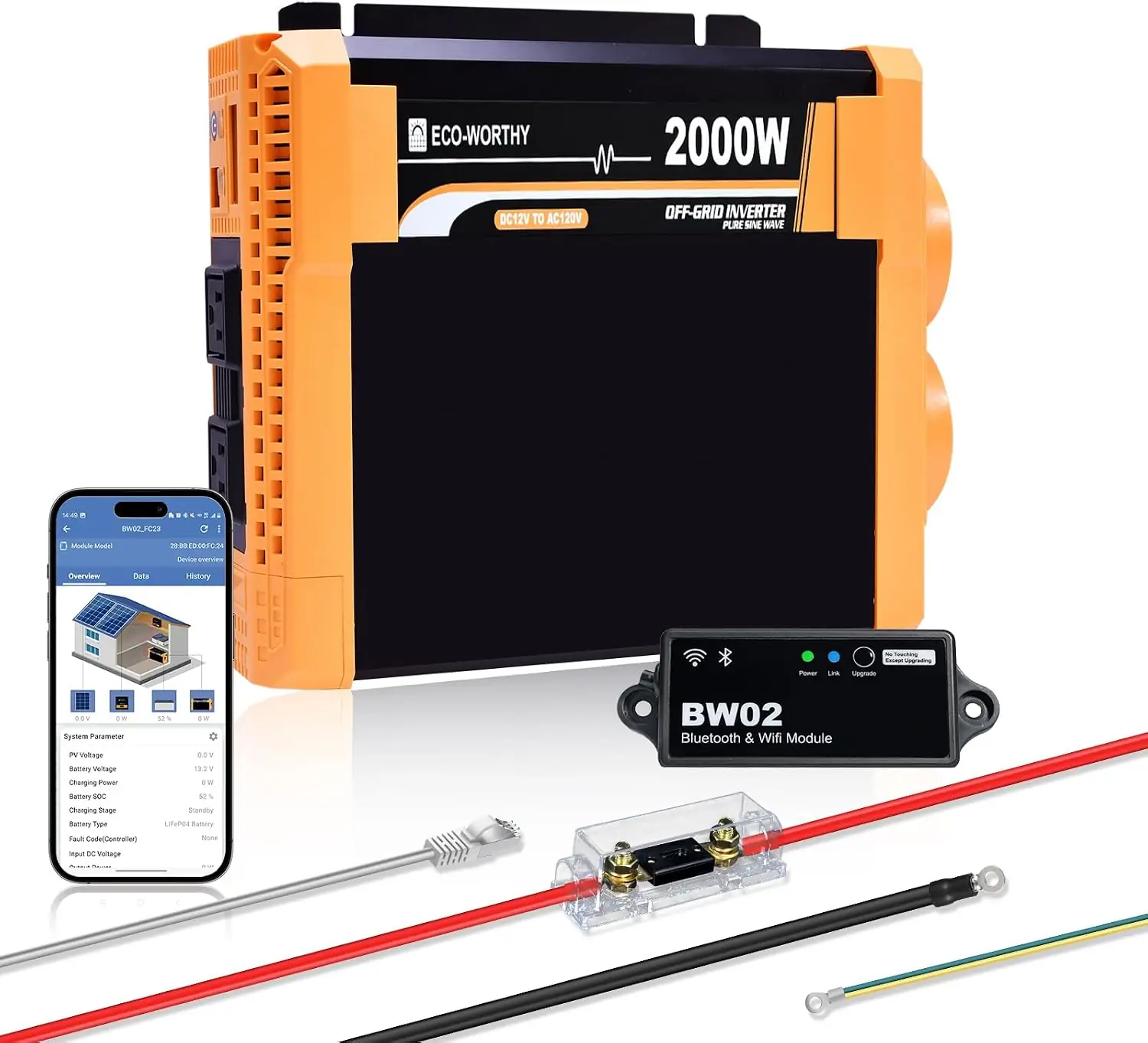

ECO-WORTHY 2000W Pure Sine Wave Solar Inverter
By ECO-WORTHY · Portable Power Stations · Audio & Electronics
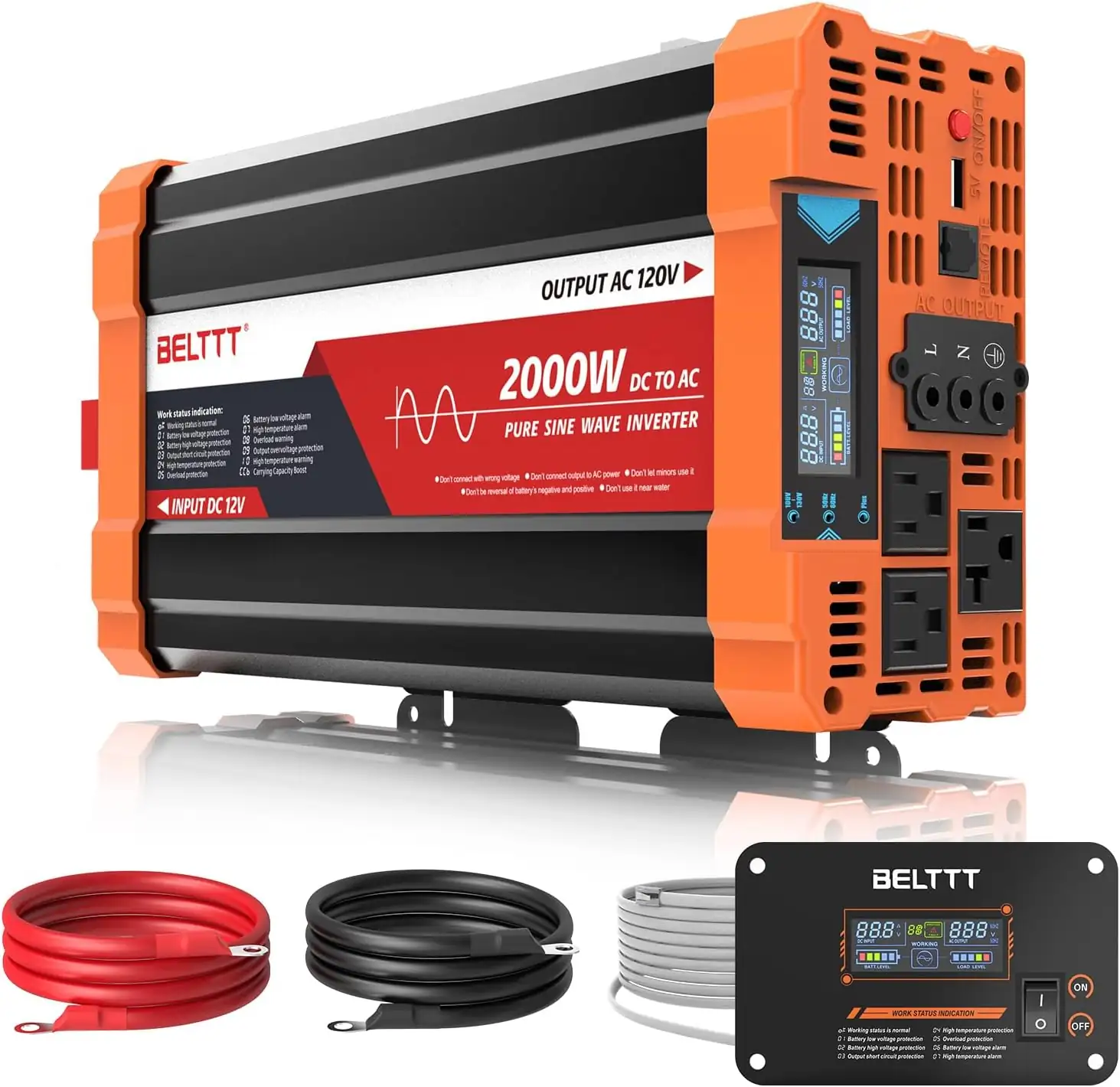
- 2000W continuous / 4000W surge, 12V DC to 120V AC pure sine wave
- 2x AC outlets + 2x 18W QC3.0 USB + hardwire terminal
- 85% min (96% max) conversion efficiency, 60Hz
- THD <4.5%, 10.5-16Vdc input, <1.2A no-load current
- Remote display with 16.4ft cable, Bluetooth module included
Lowest price seen
$299.99
from $299.99 at Tipp's Electrical · Checked Oct 20, 2026
- Tipp's Electrical $299.99View at Tipp's Electrical
- ECO-WORTHYView at ECO-WORTHY
- eBayView at eBay
- AmazonView at Amazon (paid link)
- eBay (used) eBay: used, open-box, refurbishedView at eBay (used)
Stores are listed in a fixed order, never by price or commission. Prices are snapshots. Check the current price with the store.
Summary
ECO-WORTHY’s 2000W pure sine wave inverter turns a 12V battery bank into 120V AC for RVs, cabins and boats, with two outlets, a hardwire terminal and a wired remote. It is a DC-to-AC inverter only, so you supply the battery, fuses and wiring, and you should confirm that the cables, remote and Bluetooth module actually ship in the box.
Strengths
- Substantial nominal capacity for an existing 12V installation: 2000W of AC output for electronics, lights and appliances when the battery, protection and cabling are sized for the current.
- Pure sine wave output with advertised THD under 4.5%, cleaner than modified-square-wave inverters for sensitive electronics and some motors.
- Three kinds of output: two household receptacles, a hardwire terminal and USB QC ports, plus a wired wall-mount remote for mounting the inverter near the battery.
- Basic telemetry on the LCD: battery voltage, output watts and protective alerts, without an app.
- Published wiring and troubleshooting documents: an official 15-page operator PDF and a remote-mounting guide.
- A third-party load-test video exists: RANDOMFIX tested this 2000W 12V model with an approximately 1500W+ load.
Weaknesses
- No published tested surge duration for the 4000W peak, so a fridge or compressor with a high locked-rotor surge may still trip it.
- The manual contradicts itself on wire gauge: 2 AWG for 3ft on one chart versus 0 AWG up to 6ft and 2/0 AWG up to 10ft elsewhere.
- The manual references a third-party “Krieger” name and gives a 16.8in length against the store page’s 15.1in, so generic instructions need verification.
- Full-load current is huge: about 174–196A at 12V before voltage drop, and low battery voltage, undersized wiring or long runs can trip protection.
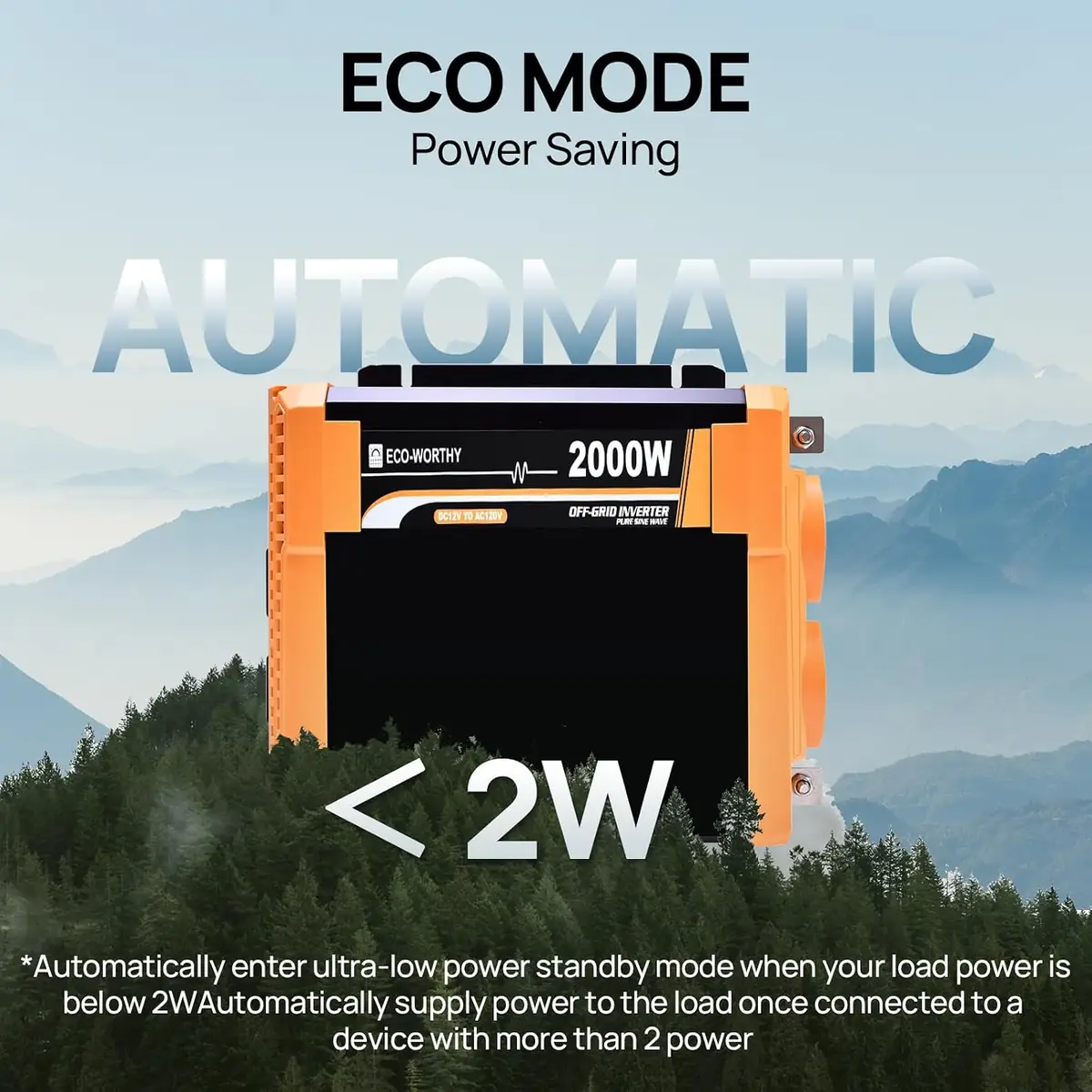
- Idle draw is under 1.2A, not zero, so leaving it on drains a small battery bank over long periods.
- The box contents are inconsistent: an “Included in the Box” list names a Bluetooth module, while the manual and product name emphasize a wired remote, and a UK customer reported missing battery leads.
Verified specifications
| Continuous output | 2000W AC, with an advertised 4000W peak that has no published tested duration. |
|---|---|
| DC input | 12V nominal battery, permitted input range 10.5–16.0 V DC ±0.3 V; nominal input at rated load 200A. It will not run from a 24V or 48V battery and has no PV-panel terminals. |
| AC output | 115 VAC ±10%, 60 Hz ±1 Hz, on two North-American receptacles rated 15A each plus a separate three-terminal hardwire output. The combined limit is 2000W, not two independent 2000W sockets. |
| Waveform | marketed as pure sine wave with THD under 4.5%; no independent oscilloscope test was located. |
| USB | two QC3.0 USB-A outputs, advertised 5V/3A or 9V/2A, up to 18W combined. |
| Efficiency | the technical table says 85% minimum while promotional text claims as high as 96%, varying with load and battery voltage. |
| Idle draw | under 1.2A DC in the published table, about 14.4W at a constant 12V. |
| Protection | over/undervoltage, overload, short-circuit and overtemperature shutdown, six internal 40A blade fuses and an external 200A ANL fuse. |
| Dimensions | 15.1 × 9.8 × 4.1 in on the store page, 16.8 × 9.8 × 4.1 in in the manual’s 2000W table. |
| Weight | 4.94 kg / 10.89 lb. |
| Wired remote | an LCD remote with power, menu, battery indication, input/output voltage, output watts and error/temperature warnings; the manual says 20ft / 6m cable while another listing says 16.4ft. |
| Certification | the seller says ETL-certified and the manual shows an Intertek cETLus mark with identifier 4010229; no matching independent Intertek record was located. |
| Warranty | one year. |
Full research notes and sources
Output and what it can run
Two North-American receptacles are rated 15A each and there is a separate three-terminal hardwire output, but the hardwire is not a third independent full-capacity channel. The 4000W peak is advertised with no tested duration, so a refrigerator or air conditioner with a high locked-rotor surge may or may not start depending on phase, current and battery voltage. The manual warns that pumps, fridges, freezers and air conditioners can draw several times their running power at startup; a 2800W startup might work or might trip. Two QC3.0 USB-A ports add 5V/3A or 9V/2A, up to 18W, for phones and small devices.
Installation and wiring
At 2000W output, a 12V source needs about 174–196A of steady DC input before voltage drop and transient effects. The manufacturer calls for a 200A ANL fuse at the battery end, six internal 40A blade fuses, correct DC fuse sizing, substantial copper wiring, ventilation and grounding. The manual contradicts itself on wire gauge: one chart calls for 2 AWG for 3ft, while another specifies 0 AWG up to 6ft and 2/0 AWG up to 10ft. At 200A those are not interchangeable assumptions, so consult electrical codes, protective-device requirements and a qualified RV, marine or off-grid electrician rather than copying one table. Low battery voltage, a battery or BMS unable to supply current, loose or undersized connections and long cable runs can all trip the low-voltage alarm. The unit is not weatherproof: the manual warns against water exposure, sunlight, blocked vents and flammable vapors, and no ingress-protection code is confirmed. Installing into an RV or off-grid distribution board needs correct neutral/ground isolation and transfer-switch design; do not backfeed house wiring or improvise neutral-ground bonds.
Running costs and parts
There is no subscription and no scheduled inverter-specific consumable. Idle draw is the main standing cost: under 1.2A at a constant 12V is under 14.4W, which over 24 hours is under 0.3456kWh/day or 126.14kWh/year of DC battery energy. At a hypothetical $0.20/kWh source-energy price that is under $25.23/year, though real replenishment losses and solar economics vary; halve it if the inverter runs 12 hours a day. A 1,000W AC load for one hour delivers 1.0kWh, and at 85–96% efficiency the battery must supply about 1.04–1.18kWh before battery-side losses. Fuses are replaced only after fault diagnosis, not yearly. A comparable Blue Sea Systems 5129 200A ANL fuse has a maker MSRP of $18.97, but it is not certified as the factory-fitted ECO-WORTHY part and may need a matching block. The 12V battery bank and charger are not included; a deep-cycle lithium or lead-acid supply with enough continuous and surge discharge capability is a separate cost, and the manual does not prescribe a universal 12V/100Ah pack for sustained 2000W operation. Fans, the control board, transistors, outlets and the LCD are not listed as scheduled consumables.
Is it worth it?
ECO-WORTHY’s US page lists the exact unit at $249.99 with a crossed-out comparator of $387.49, though the page showed “Sold out” next to add-to-cart controls. Tipp’s Electrical lists it at $299.99, and an eBay listing from BG Pawn Shop asks $331.09 new. A genuine new ECO-WORTHY at $175–200 delivered is attractive if you specifically want the wired remote and hardwire configuration. $201–230 is conditional on warranty and included accessories. At $249.99 the LiTime and BougeRV options are genuine alternatives, so avoid paying for the brand alone. The factory warranty is one year. Returns allow 14 days from receipt to report dead-on-arrival, incorrect or damaged items, and a separate 30-day voluntary return window requires new, resalable condition; for returns not caused by the manufacturer or seller, the buyer pays return shipping.
Which model this is
This page covers ECO-WORTHY’s 2000W pure sine wave inverter, product code L03020201012-1 on the US product page. The matching manual is titled ECO1100W_2000W_power_inverter_product_manual.pdf and carries a distinct 2000W technical table. It is a battery-powered DC-to-AC inverter only: not a solar MPPT controller, not an inverter/charger, and not a complete solar generator or portable power station. A battery bank, correctly designed DC protection and wiring, and a separate means of recharging are all required. Do not confuse it with ECO-WORTHY’s 1100W 12V model, which is a different, lower-output unit.
Sources
Manufacturer:
- ECO-WORTHY 2000W 12V pure sine inverter product page
- ECO-WORTHY 1100/2000W inverter operator manual (PDF)
- ECO-WORTHY wired remote installation guide (PDF)
- ECO-WORTHY warranty and returns policy
- ECO-WORTHY manual download index
- ECO-WORTHY 1100W lower-output inverter
Independent reviews:
Owner reports:
- ECO-WORTHY UK Trustpilot reviews and missing-lead complaint
- r/SolarDIY discussion of ECO-WORTHY kits
- r/diySolar Renogy GFCI and neutral discussion
- r/vandwellers idle-current discussion
Stores and alternatives:
- Tipp’s Electrical resale listing
- LiTime 2000W 12V pure sine inverter
- BougeRV 2000W 12V pure sine inverter with Bluetooth
- VEVOR 2000W 12V pure sine inverter
- Renogy 2000W inverter with UPS transfer switch
- eBay listing for the exact ECO-WORTHY 2000W inverter
Parts and stores: