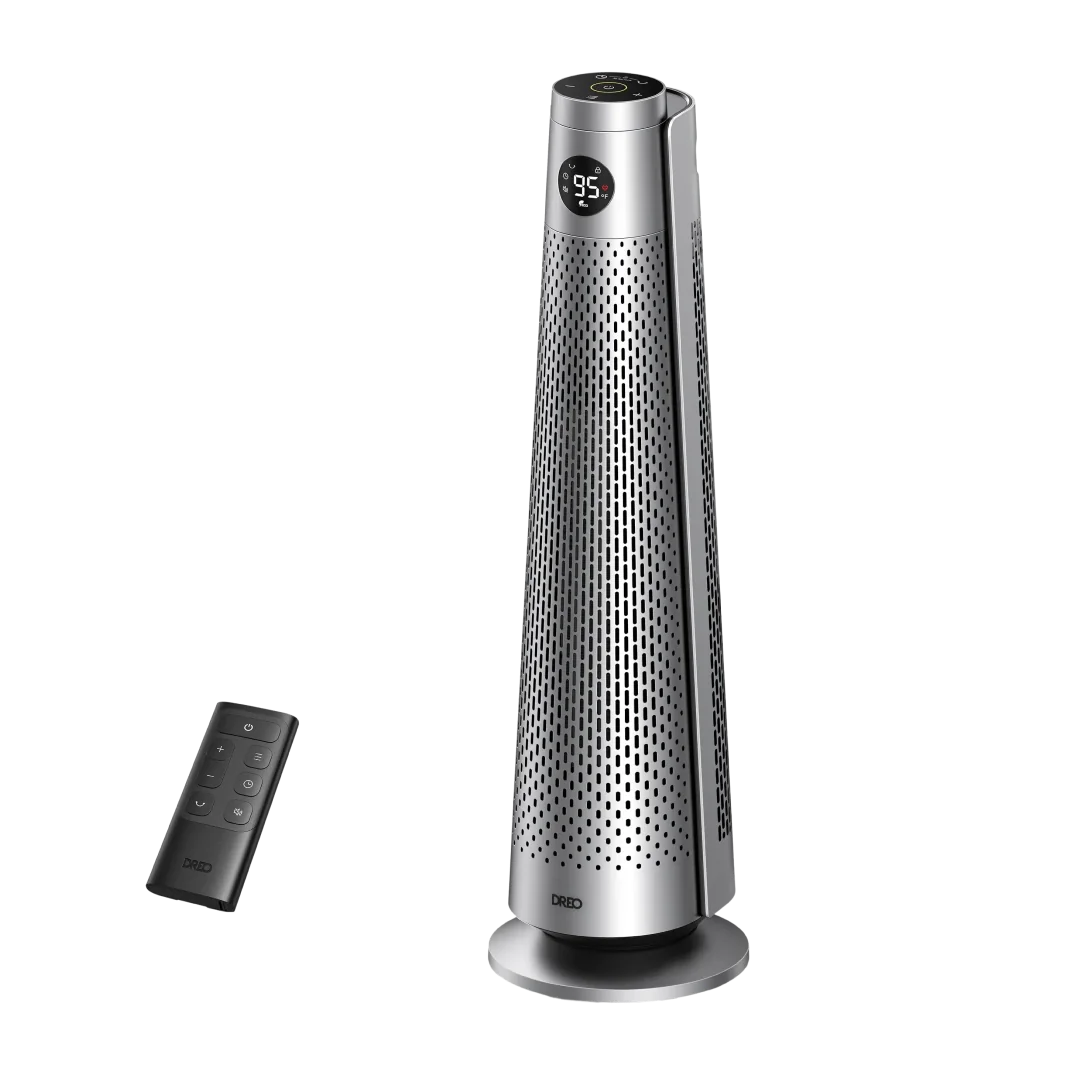
DREO Space Heater Large Room
By DREO · Space Heaters · Home & Workspace · More from DREO
- 1500W max heating power
- 300 sq.ft heating coverage
- 120° oscillation
- 29.7 in height
- 5 heat settings
Price not listed
- DREOView at DREO
- eBayView at eBay
- AmazonView at Amazon (paid link)
- eBay (used) eBay: used, open-box, refurbishedView at eBay (used)
Stores are listed in a fixed order, never by price or commission. Prices are snapshots. Check the current price with the store.
Summary
A 29.7-inch freestanding PTC ceramic tower heater that puts out up to 1,500 W, with five heat levels, a handheld remote and oscillation up to 120°.
Strengths
- Bob Vila’s hands-on test raised a 216 sq ft room from 60 °F to 70 °F in just under 30 minutes in mild weather.
- WIRED measured about 38–42 dB and found the case approachable to the touch away from the hot outlet.
- Five manual heat levels let you choose the output yourself instead of leaving it to the thermostat.
- Four oscillation angles, up to 120°, spread the air across a wide arc.
- Fan-only mode moves air without powering the element.
- One WIRED sample was still working in its third heating season.
Weaknesses
- The built-in thermostat drew opposite verdicts: WIRED called it inaccurate and erratic, Bob Vila’s tester found it matched a separate monitor.
- Two owners report that heat leaves only part of the tall front grille, not the full height.
- No app, Wi-Fi or voice control; the remote needs line of sight.
- Several owners on DREO’s own site say the room stayed cold for what they paid.
- The lowest heat step is 700 W in the manual and 750 W according to WIRED.
- ECO cuts out and restarts around the setpoint, which can read as a fault.
Verified specifications
| Model | DREO Solaris 718, also sold as Tower Heater 718; the user manual is for DR-HSH008. |
|---|---|
| Electrical | 120 V AC, 60 Hz, maximum rated power 1,500 W, about 12.5 A at full output. |
| Element | PTC ceramic electric resistance heater with a fan; plug-in unit, no assembly needed. |
| Heat levels | manual H1 700 W, H2 900 W, H3 1,100 W, H4 1,300 W, H5 1,500 W; WIRED lists the lowest step as 750 W. |
| Fan-only | three fan speeds, F1, F2 and F3. |
| ECO setpoint | 41–95 °F, switching the element on and off around the setpoint rather than holding a laboratory-grade temperature. |
| Oscillation | 30°, 60°, 90° or 120°, with 60° as the default. |
| Timers | 0–12 h off timer; a separate 24-hour continuous-run auto-off exists but is off by default; about 30 seconds of fan cooldown after power-off. |
| Errors and locks | tip-over error P4, overheat error FF, temperature sensor open E1 and short E2; buttons can be child-locked; auto-brightness, an ambient-temperature colour indicator and a button-sound mute. |
| Dimensions | 7.9 × 7.9 × 29.7 in; about 8 lb; floor-standing. |
| In the box | remote control and user guide; the remote runs on one CR2025 3 V coin cell. |
| Controls | buttons on the unit plus a handheld remote; WIRED lists a remote and no app, and an owner complains about missing Wi-Fi. |
| Noise | DREO advertises 25 dB; WIRED measured about 38–42 dB. |
| Coverage claim | up to 300 sq ft. |
| Warranty | 12 months of limited coverage for the original purchaser with proof of purchase; registration is advertised as extending coverage, but the longer period is not stated. |
Full research notes and sources
Heat output and warm-up time
Bob Vila’s tester warmed a 216 sq ft room from 60 °F to 70 °F in just under 30 minutes with the heater on the highest setting and oscillation running, on a day when it was 65 °F outside. That is a fair result for a closed room, but it is one test in mild weather. WIRED’s point matters more for your expectations: standard 1,500 W resistance heaters all turn roughly the same electricity into roughly the same heat, so a bigger body does not deliver more warmth. Price buys quiet running and better controls, not extra output.
DREO advertises coverage of up to 300 sq ft. Treat that as a vendor rating, not a promise. The same square footage heats very differently depending on insulation, drafts and how cold it is outside, and the heater is meant to top up a room rather than heat a house. Two of those owners also say the hot air leaves only part of the tall front grille, which is a perception rather than a measured fault, but it matters if you are buying for a full-height column of warm air.
The thermostat and ECO mode
WIRED found the built-in thermostat inaccurate and erratic and preferred picking one of the five fixed output levels. Bob Vila’s tester found the displayed temperature lined up with a separate air-quality monitor during its run. Nobody has published a calibrated error figure, so accuracy probably depends on where the unit sits, on drafts and on the room itself. Until you have tried it, the fixed heat levels are the safer setting.
ECO mode runs from 41–95 °F and switches the element on and off around the setpoint instead of holding a steady temperature. When it stops, the setpoint is doing its job, not a fault. The manual describes on/off behaviour at the setpoint, and the fan keeps running for about 30 seconds after a power-off, which looks like the unit is still working.
Noise, safety and placement
DREO’s own marketing puts the 718 at 25 dB. WIRED measured about 38–42 dB in its test conditions, which is still quiet for a bedroom. The same review found the case comfortable to the touch away from the outlet and praised an oscillation that did not squeak, but the air outlet itself runs hot.
The manual documents the protections: tip-over error P4, overheat error FF, and temperature-sensor faults E1 for an open sensor and E2 for a short one. P4 and FF mean the unit has shut itself down and needs cooling and better placement. E1 and E2 mean unplugging it and contacting DREO rather than bypassing the protection. Keep at least 3 ft of clearance in front of the heater, keep furnishings away from the sides and rear, and use a wall outlet: no power strip, no extension cable, and no damp bathroom.
Remote, running costs and upkeep
There is no app, no Wi-Fi and no voice control, just the buttons on the unit and a handheld remote. The remote’s symbols carry no explanatory words, which one reviewer found less intuitive than text-labelled buttons, and it needs a clear line to the heater. A 12-hour off timer covers everyday use, the optional 24-hour continuous-run cutoff can be switched on but ships disabled, and the last mode, temperature and oscillation setting are remembered.
Electricity is the running cost. Using the manufacturer’s own framing as a worked example rather than a local rate: 3 heater-on hours a day over 120 heating days on the 1,500 W setting at $0.20 per kWh works out to 540 kWh, which is $108 a year. On the lowest manual step of 700 W the same pattern gives 252 kWh and $50.40 a year. Fan-only and standby draw are not included, and ECO changes the real total with insulation, weather and duty cycle. No published measurement of this heater’s standby draw or of a full winter trial was found, and no manufacturer-prescribed battery replacement cycle exists. Apart from electricity and an occasional coin cell, scheduled spending is $0 a year.
Parts are thin. The original remote takes a CR2025 3 V coin cell, and a Panasonic two-pack of CR2025 cells was offered at $5.99 by Panasonic Energy through Walmart. DREO also lists a separate replacement remote for serial fans and heaters at $9.99 with an $8 shipping surcharge, but it was sold out when checked, its updated version takes AAA cells, and its page does not certify it for DR-HSH008. Confirm with DREO before buying one. There are no filters, oils or refill cartridges to replace; the upkeep DREO asks for is checking and cleaning the outside and the inlet at least once during the heating season and before storage, with the unit unplugged and cool. No verified spare part numbers were found for the element, motor, thermistors, main board or base, and the manual limits internal work to authorised providers, so there is nothing there to price. Warranty coverage is 12 months for the original purchaser with proof of purchase, and returns to DREO’s own store are accepted within 30 days of purchase with the customer paying return shipping for a change of mind.
Is it worth it?
DREO’s own US store lists the Tower Heater 718 at $129.98, and WIRED’s September 2026 buying guide put it at roughly $130 direct from DREO. At $90 or less the 718 is an easy buy for anyone who wants the 120° swing and the five fixed output levels; between $90 and $130 it is reasonable if the quiet run and the remote matter more than the price. Above $130 you are paying a premium for those controls rather than for extra heat.
Check what the money buys elsewhere first. DREO’s Solaris Max (2nd Gen.) is $89.99 direct and trades the wide oscillation for 70°. The Honeywell UberHeat 5 is $54.99 at Best Buy for plain local heating in a compact body. DREO’s Solaris 818 showed $109.99 on sale and $129.99 regular at Target, but that is a different 30-inch model with its own controls and footprint, so do not read that sale as a discount on this one.
Which model this is
DREO renamed this heater: the manufacturer’s notice states that Tower Heater 718 and Solaris 718 are the same product, and the manual carries the model number DR-HSH008. Do not confuse it with the Solaris 818, a different 30-inch tower, or with the Solaris Max (2nd Gen.), a 25-inch unit sold as Heater 713 with 70° oscillation.
Sources
Manufacturer:
- Solaris 718 DR-HSH008 user manual
- DREO notice: heater model names updated
- DREO warranty terms and conditions
- DREO replacement remote control for serial fans and heaters
- DREO refund policy
Independent reviews:
Owner reports:
Parts and stores: