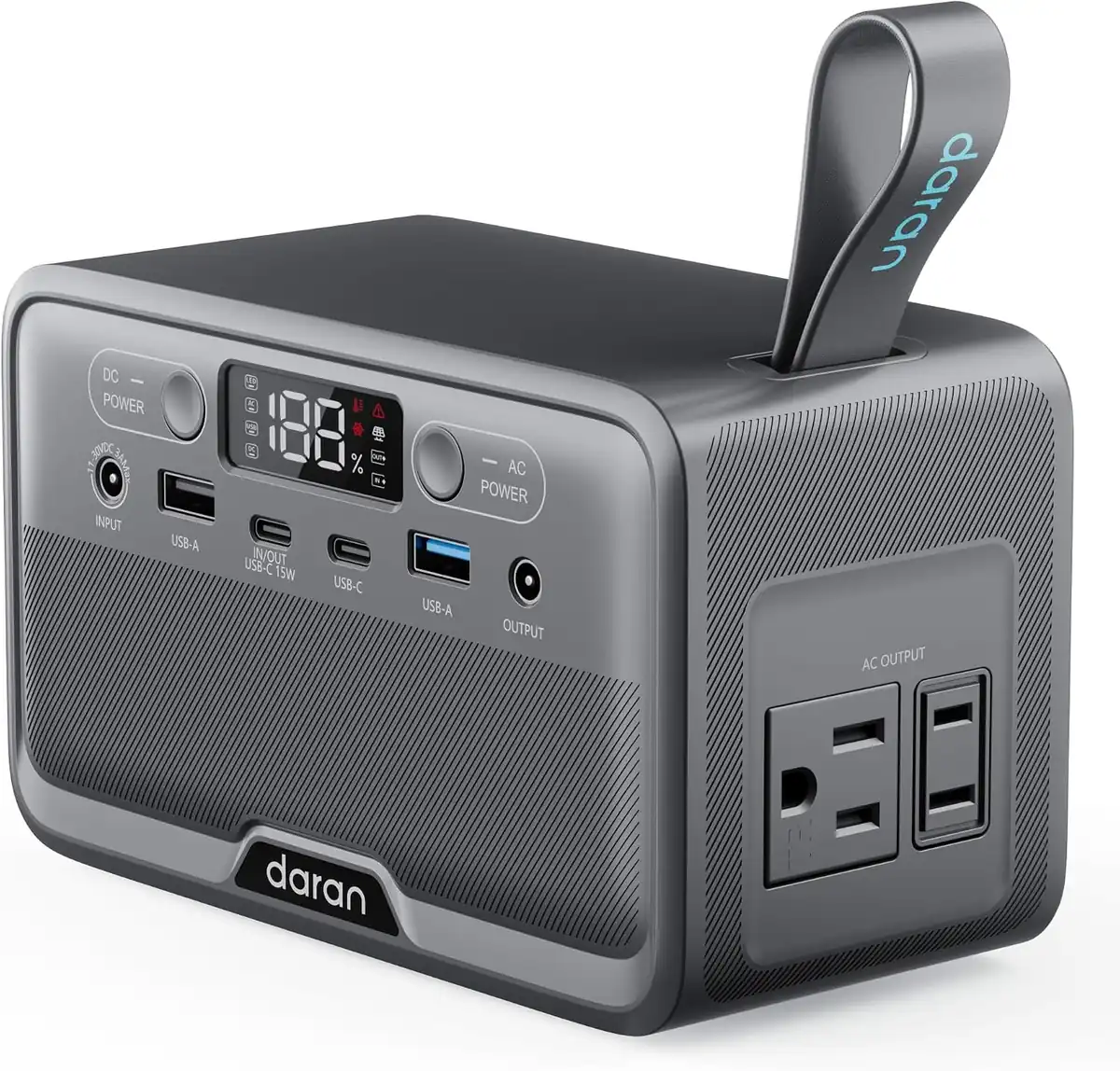
Daran Portable Power Station 89.6Wh LiFePO4 Battery 100W(200W Peak) Solar Power Bank
By Daran · Portable Power Stations · Audio & Electronics
- 89.6Wh LiFePO4 battery (28,000mAh)
- 100W continuous AC output, 200W surge (pure sine wave)
- 7 ports: 2 AC, 2 USB-C (45W/15W), 2 USB-A (18W/15W), 1 DC5521 60W
- 0-80% recharge in 1.5 hours
- 3,500+ cycle LiFePO4 lifespan
Price not listed
- DaranView at Daran
- NeweggView at Newegg
- eBayView at eBay
- AmazonView at Amazon (paid link)
- eBay (used) eBay: used, open-box, refurbishedView at eBay (used)
Stores are listed in a fixed order, never by price or commission. Prices are snapshots. Check the current price with the store.
Summary
A 2.53 lb, 89.6Wh LiFePO4 power bank with two real 100W AC outlets and seven ports, built for travel and flight legality rather than runtime. Check the evidence before you buy: no credible instrumented test exists and owner feedback for this exact model is almost absent.
Strengths
- Two real AC outlets in a 2.53 lb body that fits in a bag.
- 89.6Wh sits under the 100Wh airline carry-on limit, so it is flight-legal.
- Fanless, so it runs silently.
- Recharges from AC, USB-C, car or a 40W solar panel.
- A 4-level LED light with Steady and SOS modes.
Weaknesses
- 89.6Wh is small, so anything beyond phones and lights runs for a short time.
- The 100W AC ceiling rules out kettles, hair dryers, coffee makers, heaters and most tools.
- AC input is capped at 40W, so a 0–80% charge takes about 1.8 hours in practice, not the claimed 1.5.
- No credible instrumented test was found, and exact-model owner feedback is almost absent.
- The unit is sealed and fanless, with no evidence of user-serviceable parts or a parts channel.
- Storage guidance conflicts: 3–6 months, 3 months or 30 days depending on the source.
Verified specifications
| Capacity | 89.6 Wh (marketed as 28,000 mAh). |
|---|---|
| Battery | LiFePO4, rated for 3,500+ cycles to 80% of original capacity. |
| AC output | 100 W continuous, 200 W surge, pure sine wave, 120 V ~60 Hz. |
| Ports | seven in total — two AC (100 W, 200 W surge), two USB-C (45 W / 15 W), two USB-A (18 W / 15 W) and one DC5521 (60 W, 12 V/5 A). |
| USB-C1 | 15 W, two-way input and output. |
| AC input | up to 40 W (100–120 V ~60 Hz). |
| Solar input | up to 40 W (10–30 V DC), MPPT controller; recommended panel 22.5 V 3 A (40 W). |
| DC5521 input | 10–30 V DC, 3 A max (40 W). |
| Recharge | 0–80% in about 1.5 hours. |
| Weight | 1.15 kg / 2.53 lb. |
| Dimensions | 6.5 × 3.3 × 4.0 in (165 × 85 × 100 mm). |
| BMS | yes, marketed with 12 safety protections. |
| Cooling | fanless. |
| LED light | 4-level brightness with Steady and SOS modes. |
| Warranty | 1 year (per a reseller spec sheet). |
| In the box | an AC cable per one reseller; other listings differ, so verify before relying on it. |
Full research notes and sources
Ports and the 100W ceiling
The R100 is a large power bank with real AC outlets, not a small generator. It packs 89.6Wh of LiFePO4 into a 6.5 × 3.3 × 4.0-inch, 2.53 lb body and provides two 100W (200W surge) pure-sine-wave AC sockets plus 45W/15W USB-C, 18W/15W USB-A and a 60W DC5521 port. Seven ports in total.
The 100W AC ceiling is a hard limit: total connected load must stay under 100W, so it will run a laptop, a fan, lights, a router or a small 12V fridge briefly, but not kettles, hair dryers, coffee makers or tools.
Charging and runtime
AC input is capped at 40W, and the manufacturer’s 0–80% in 1.5 hours is optimistic: 80% of 89.6Wh is about 71.7Wh, which is roughly 1.8 hours at 40W before losses. Solar and the DC5521 port each accept up to 40W, and the unit is fanless.
Runtime follows the manufacturer’s estimate of roughly 89.6Wh times 0.90 divided by the device’s draw. At 50W that is about 1.5 to 2 hours.
Evidence and owner feedback
No credible instrumented test from an established outlet was found. All Good Batteries, a spec database, scores the R100 at 56.3 out of 100 and ranks it 156 of 195, and its runtime figures are modeled rather than measured.
Exact-model owner discussion is essentially absent. On the manufacturer page a single user praises festival and outdoor use and the build. The nearest caution is structural, not a defect: 89.6Wh is small, so runtimes for anything beyond phones and lights are short.
Running costs, storage and warranty
There are no consumables and no subscription. The only extras are a compatible solar panel, which is not included, and a faster USB-C charger.
Storage guidance is inconsistent: the manufacturer says charge to 80% every 3–6 months, a reseller says every 3 months, and the brand FAQ says every 30 days. Warranty is reported as one year, and there is no evidence of user-serviceable parts or a parts channel, so treat the unit as sealed.
Is it worth it?
The official DaranEner store lists it at $149.99 (2026-10-20); a duplicate page lists $299.99, which looks like a stale placeholder. Resellers list $184.99 and $198.99 (Electro Energy, 2026-10-20), and deal coverage reported a promotional low around $45-70 (Slickdeals, 2026-05-05).
At $149.99 the cost works out to about $1.67 per Wh, against roughly $0.50-0.67 for same-tier stations (All Good Batteries, 2026-10-20). At the promotional price the small capacity is easy to accept; at $150 or more it is hard to justify on energy per dollar, because the same money buys far more capacity from a budget 200-300Wh station.
Buy it for the size, the AC sockets and the airline compliance, not for runtime.
Which model this is
This page covers the Daran/DaranEner/YOUYO R100, model R100, the 89.6Wh LiFePO4 station with two 100W AC outlets. It is sold under the brand spellings Daran, DaranEner and YOUYO R100, and in Gray, Pink and Yellow.
The Amazon listing for this model is ASIN B0CQT5G1ZR. Don’t confuse it with the R101 Lite, a separate black model with 65W USB-C input, or the larger NEO-series.
Sources
Manufacturer:
- DaranEner YOUYO R100 user manual (Manuals+)
- Daran R100 Portable Power Station (official page)
- DaranEner R100 Portable Power Station (official page)
- Portable Power Station collection
- DaranEner company and support details
Independent reviews:
- DARAN Portable Power Station review (CleanEnergyBusinessCouncil)
- DaranEner YOUYO R100 listing (GEEKMAXI)
- Best lightweight power stations for travel (Wihok)
Owner reports:
- None found for this exact model on Reddit or forums.
- DaranEner vs Bluetti brand discussion (r/CampingGear) — concerns other DaranEner models, not the R100.
Parts and stores: