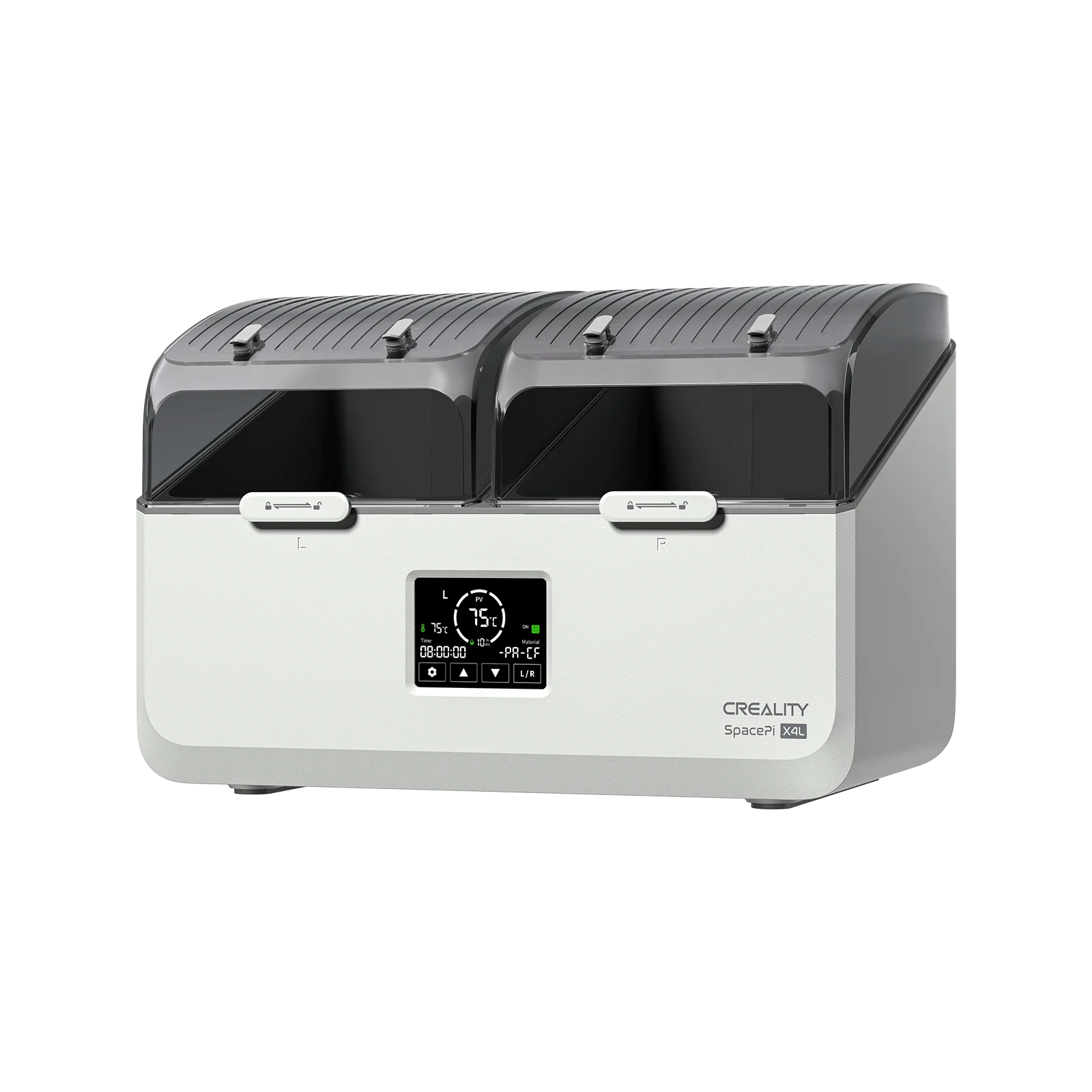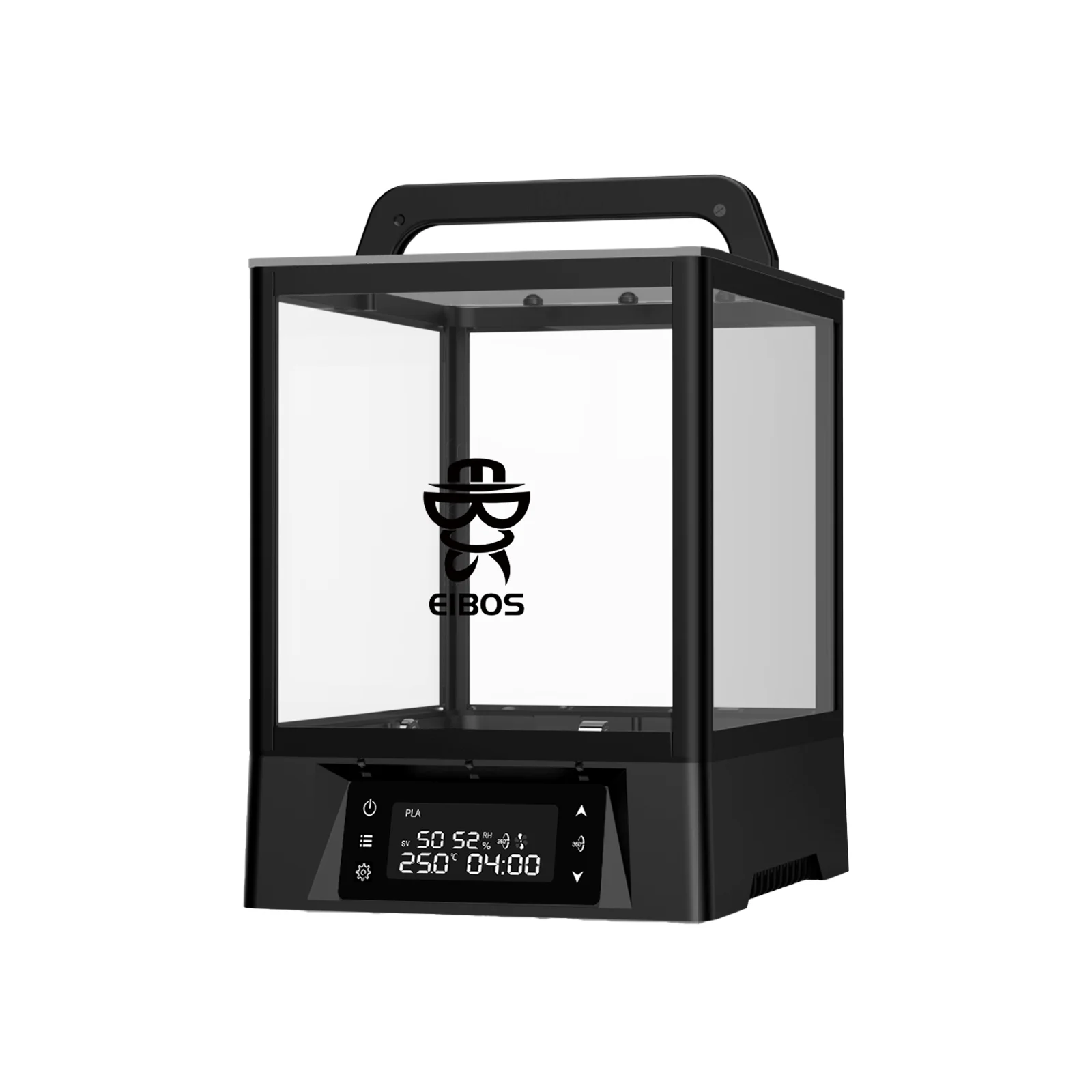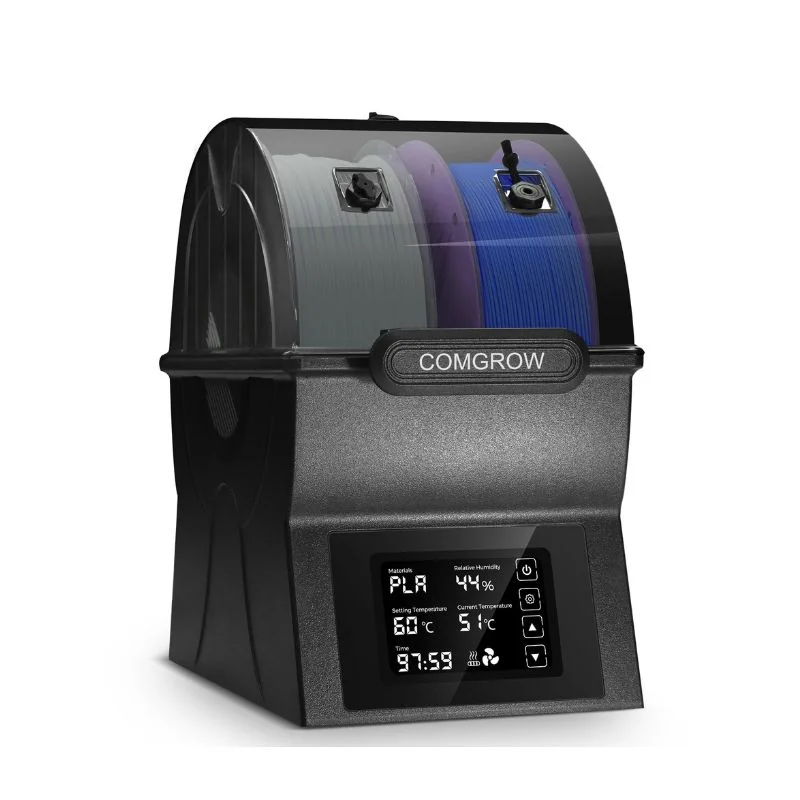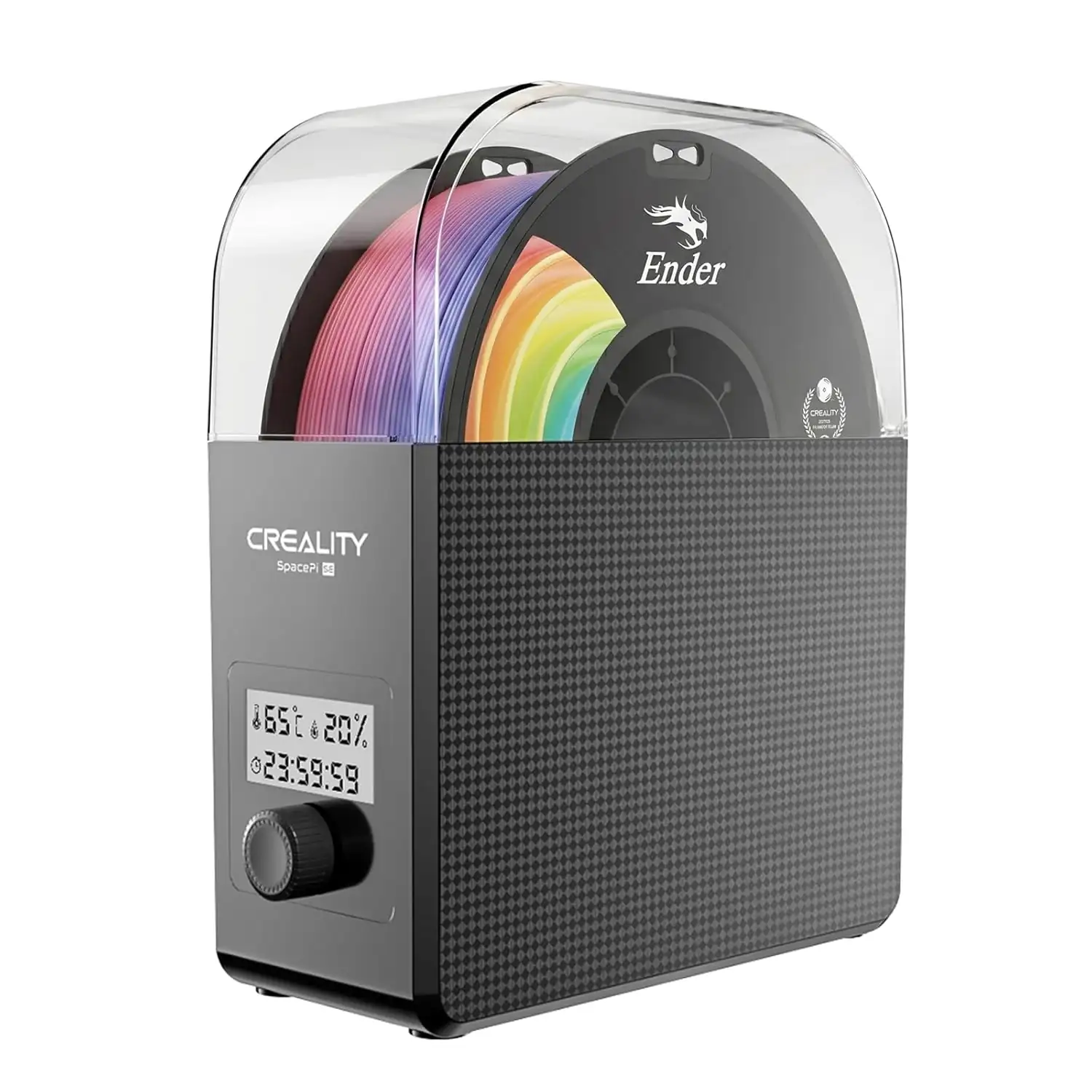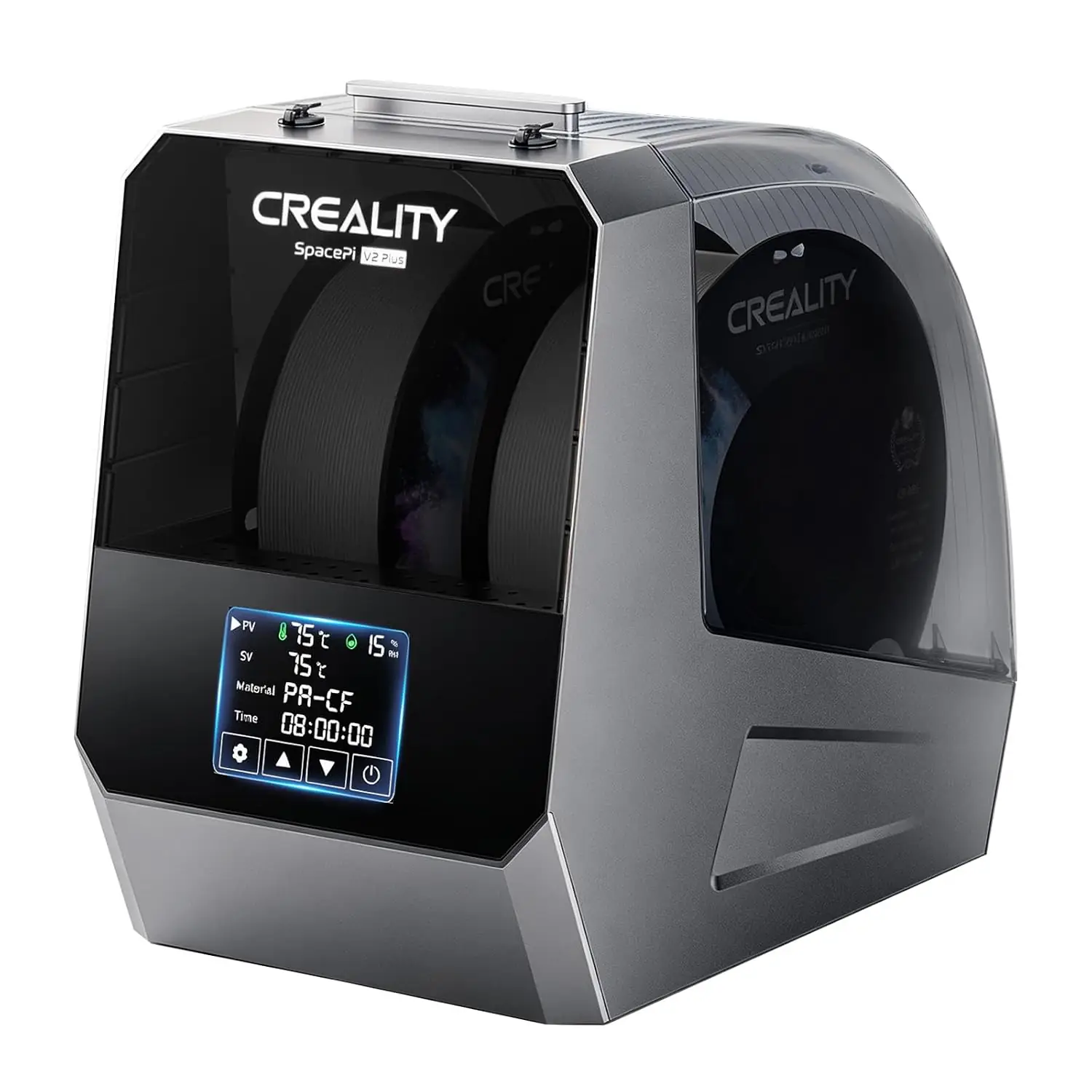
Creality Space Pi V2 Plus
By Creality · Filament Dryers · 3D Printing · More from Creality
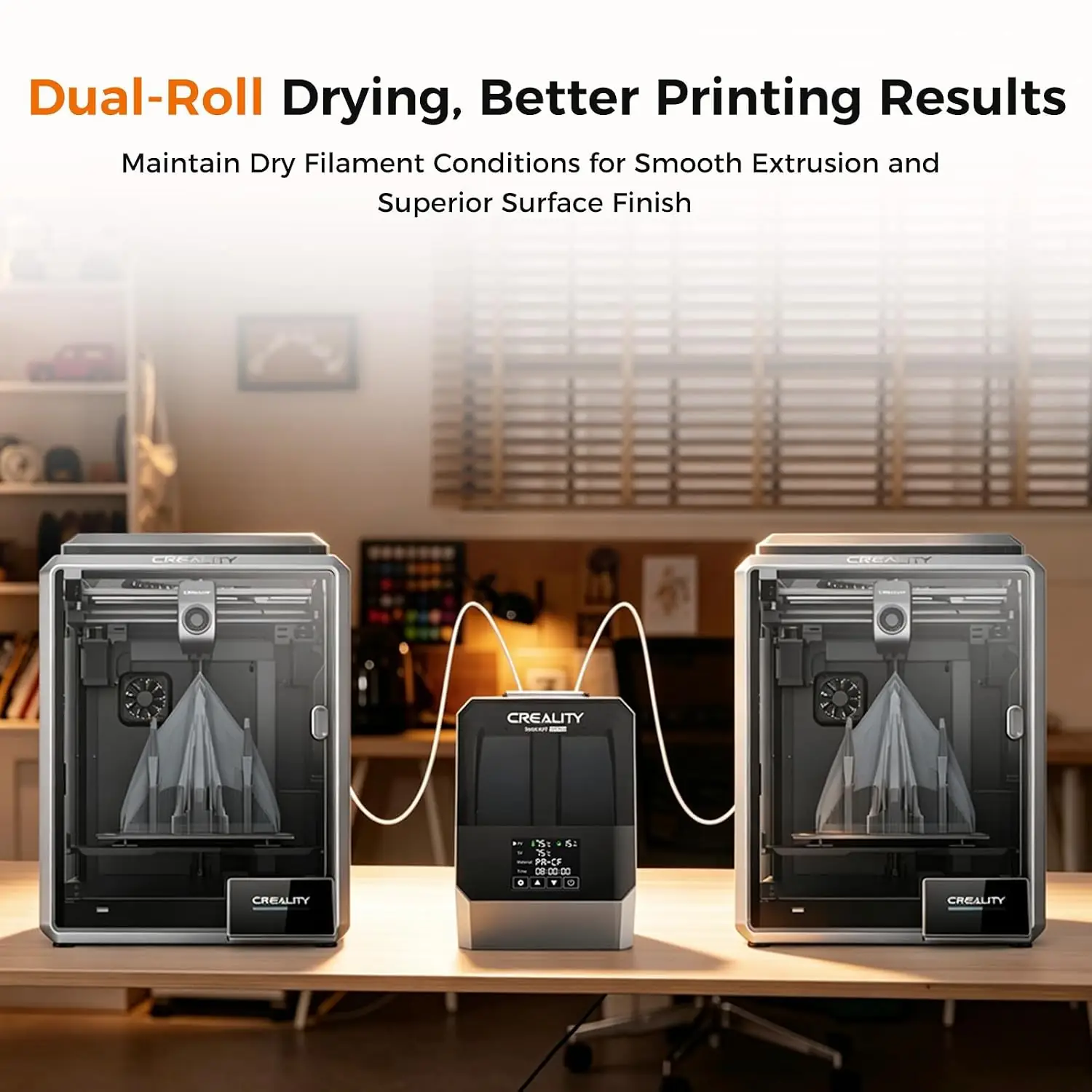
- Two rolls capacity (2x 1kg spools)
- Double PTC 360° hot-air heating
- Max drying temp up to 75°C
- 2nd-gen temp/humidity sensor
- Smart presets & touch control
Price not listed
- CrealityView at Creality
- eBay (used) eBay: used, open-box, refurbishedView at eBay (used)
- eBayView at eBay
- AmazonView at Amazon (paid link)
Stores are listed in a fixed order, never by price or commission. Prices are snapshots. Check the current price with the store.
Summary
A two-spool heated filament dryer with a 75°C ceiling that reaches PC and PA-CF where the older 70°C Space Pi models cannot. Check the exact SKU and the humidity question before you buy: the family’s owners report a chamber floor around 13–15% RH, and no instrumented test of this model exists.
Strengths
- Two 1 kg spools at once, which saves swaps on multi-material or dual-printer setups.
- The 75°C ceiling reaches PC and PA-CF that the 70°C V1 family cannot.
- Dual-duct airflow rated at 12.79 CFM, more than double the V1 Plus claim.
- 12 material presets and an LCD touchscreen showing temperature, time and chamber humidity.
- A 48-hour timer and power-loss memory suit long, unattended prints.
- Dual PTC heating with a second-generation temperature and humidity sensor.
Weaknesses
- No instrumented independent test of this exact model exists.
- V1-family owners report a chamber humidity floor around 13–15%, one as high as 32%, against the roughly 4% some filament makers recommend.
- Two spools share one temperature schedule; there are no independently controlled chambers.
- A V1 owner found the fan loud enough to move the dryer to another room.
- No documented parts channel for the V2 Plus, so spares and repairs are unclear.
- The timer figure conflicts between Creality’s 48-hour marketing and the 1–45 h spec sheet.
Verified specifications
| Model | Creality Space Pi Filament Dryer V2 Plus. |
|---|---|
| Capacity | two 1 kg spools at once. |
| Heating | double PTC ceramic elements, 160 W rated. |
| Airflow | single-fan dual-duct system rated at 12.79 CFM, against 5.98 CFM for the V1 Plus. |
| Temperature range | 45–75°C. |
| Sensor | second-generation temperature and humidity sensor. |
| Presets | 12 filament presets, from PLA at 50°C to PC, PA and PA-CF at 75°C. |
| Timer | 48 hours in Creality’s marketing; the retailer spec sheet lists 1–45 h. |
| Display | LCD touchscreen showing chamber temperature, set temperature, material, remaining time and humidity. |
| Power-loss memory | resumes the last settings after a cut. |
| Electrical | US version 100–120 V; US SKU 4005010154. |
| Spool fit | up to 190 mm diameter and 150 mm width; 1.75 or 2.85 mm filament. |
| Dimensions | 186 × 301 × 278 mm; about 1900 g. |
| Packaging | 343 × 226 × 300 mm, 2500 g gross. |
| Warranty | up to 12 months, with a 14-day return. |
Full research notes and sources
Drying performance and the humidity floor
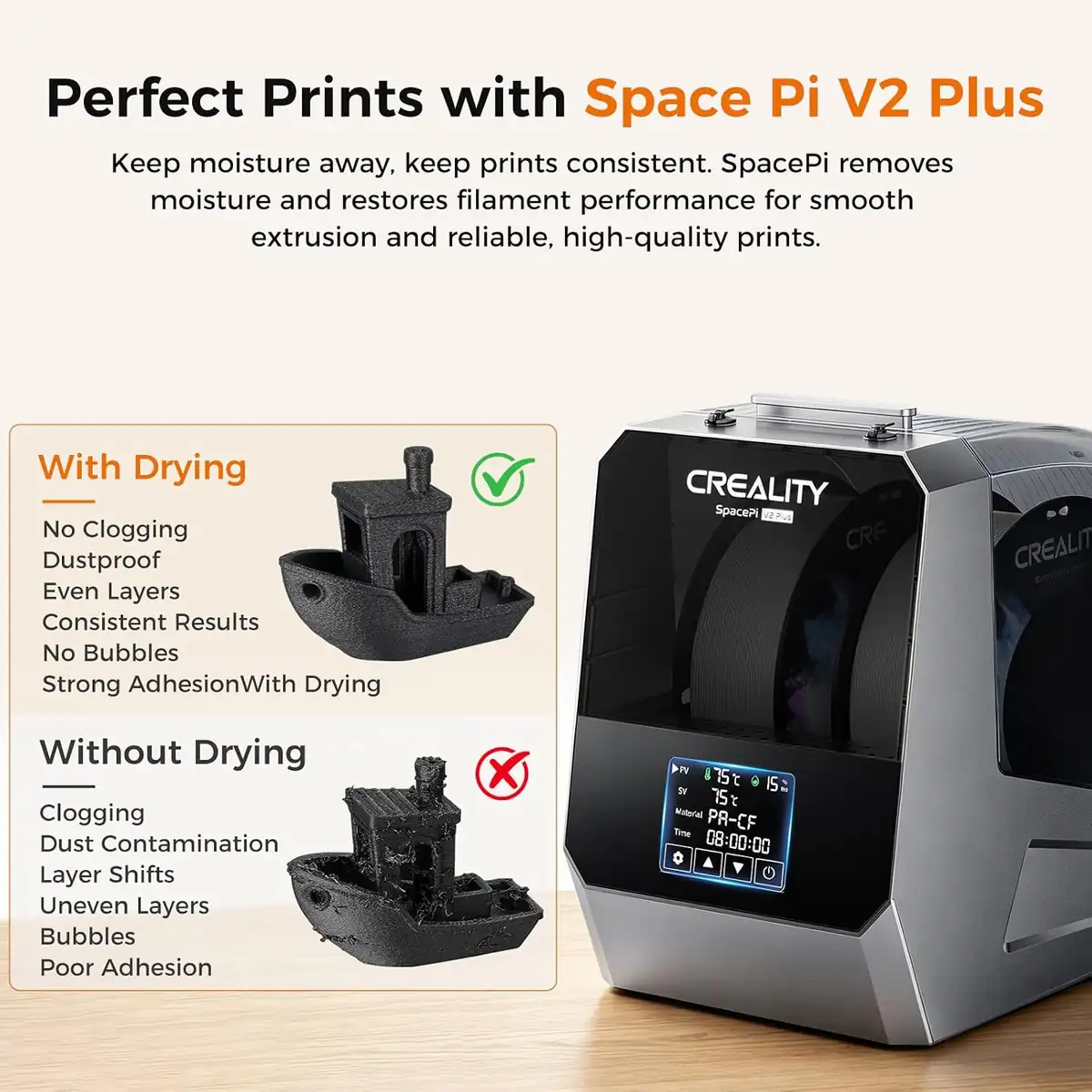
Creality rates the V2 Plus at 45–75°C with dual PTC heating and a single-fan dual-duct airflow of 12.79 CFM, against 5.98 CFM on the V1 Plus. The 75°C ceiling is the real change: it opens up PC and PA-CF that the 70°C V1 family cannot reach. What no source settles is how well it holds humidity down. Owners of the V1 family report the chamber stalling around 13–15% RH no matter how long it runs, one seeing 32%, against the roughly 4% some filament makers suggest; several finish spools in vacuum bags with desiccant. There is no instrumented test of the V2 Plus, so whether the new sensor and dual-duct airflow change that is unknown.
Two spools, one schedule
Two spools is convenient, but they share one chamber and one temperature, not independently controlled zones. If your PLA and PA-CF need different settings, you run separate cycles. The V1-family feed route also has cautions: owners report spool drag, filament tension and a PTFE tube that can slip into the box and brake the spool, so check free-turning rollers and tube seating before a critical print. A V1 owner found the fan noisy enough to relocate the dryer.
Running costs
At the rated 160 W, two eight-hour cycles a week come to about 133.12 kWh a year; at an assumed $0.20 per kWh that is roughly $26.62 a year, or about $0.26 for a single eight-hour session. Creality sells a 1 m PTFE guide tube for $11.58, and a five-pack of rechargeable 100 g desiccant packets ran $14.99 at Walmart in October 2026. There is no subscription or filter to replace.
Is it worth it?
Creality’s US store listed the V2 Plus at $89, marked down from $104.25, with a 14-day return; the VIP Mall listed a US-plug unit at $102.49, and 3DJake listed the EU model at $93.77. Below $90 it is a strong value for a two-spool dryer that reaches 75°C. Between $90 and $110 it stays fair, especially where a US-plug unit is hard to find. Above $110, compare the Sovol SH02 at $59.99 if 70°C is enough, the SUNLU S4 four-spool at $116.99, or Creality’s own SpacePi X4 at $159, which adds four spools and independently heated chambers. Buy the exact SKU and confirm the warranty term with the seller.
Which model this is
This page covers the Creality Space Pi Filament Dryer V2 Plus, the dual-spool second-generation model with a US SKU of 4005010154 and an EU SKU of 4005010153. Creality’s line also includes the single-spool V1 and V2, the dual-spool V1 Plus, the SpacePi SE and the four-spool SpacePi X4; the older V1 models top out at 70°C and are not the same machine. The US listing identifier is ASIN B0H4Z9HDHP.
Sources
Manufacturer:
- Creality US Store — Space Pi Filament Dryer V2 Plus
- Creality VIP Mall — Space Pi V2 Plus
- Creality US Store — SpacePi X4
- Creality US Store — return and warranty policy
- Creality US Store — low-resistance PTFE tube
Independent reviews:
- 3DJake — SpacePi V2 Plus spec sheet
- 3DPrinting.com filament dryer guide
- Filament Fit Lab — Creality Space Pi reference
Owner reports:
- Creality forum — Space Pi Plus humidity thread
- Creality forum — Space Pi Plus humidity not low enough
- Reddit r/3D_Printing — is the Space Pi Plus good?
- Creality forum — older Plus TPU feeding tension
Alternatives: