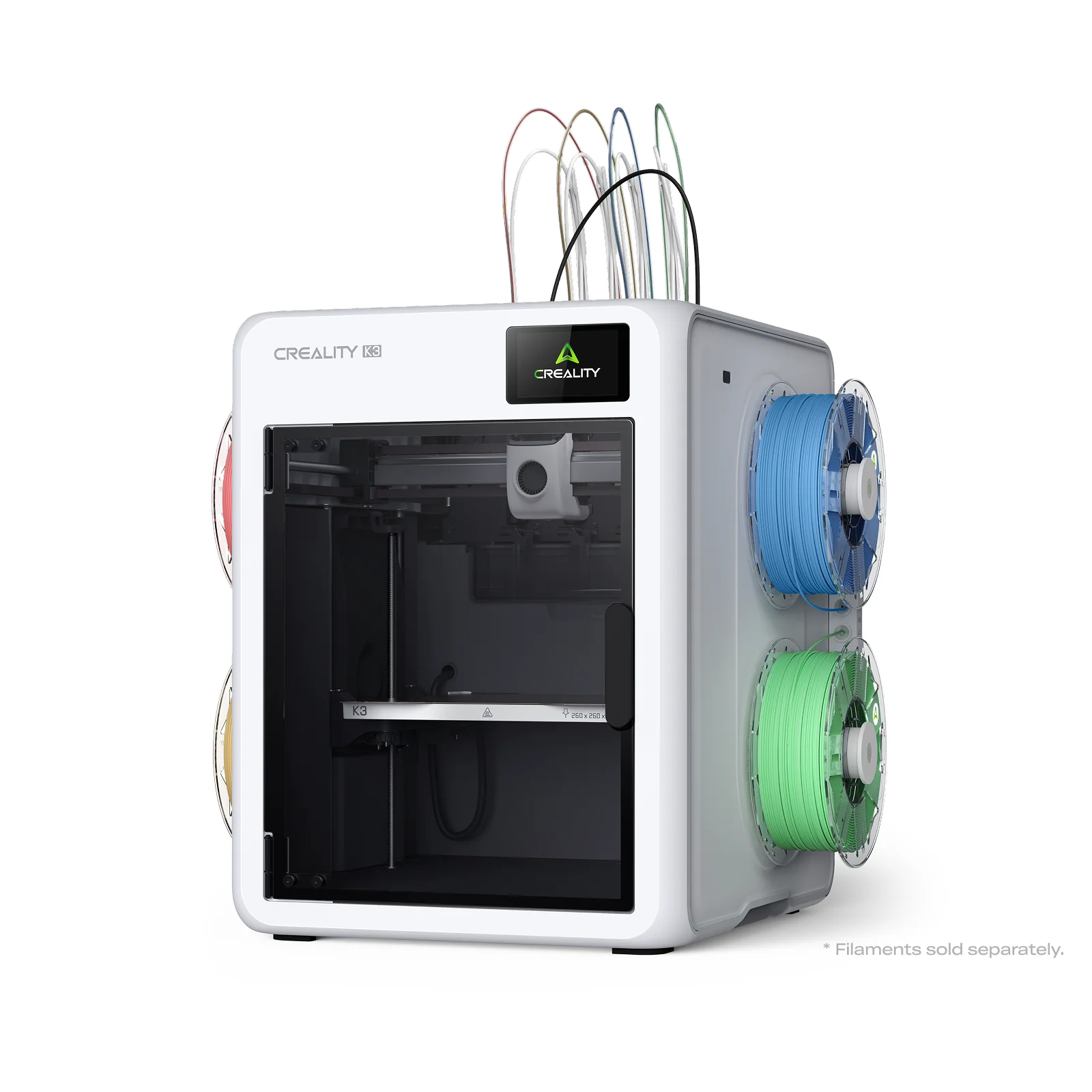
Creality (Pre-order) K3 Multi-Material & Multicolor 3D Printer - K3
By Creality · 3D Printers · 3D Printing · More from Creality
- Build volume 260x260x260 mm
- Max print speed 500 mm/s
- Acceleration 20000 mm/s2
- Nozzle temperature 300 C
- Heated bed 100 C
Price not listed
- CrealityView at Creality
- eBayView at eBay
- eBay (used) eBay: used, open-box, refurbishedView at eBay (used)
Stores are listed in a fixed order, never by price or commission. Prices are snapshots. Check the current price with the store.
Summary
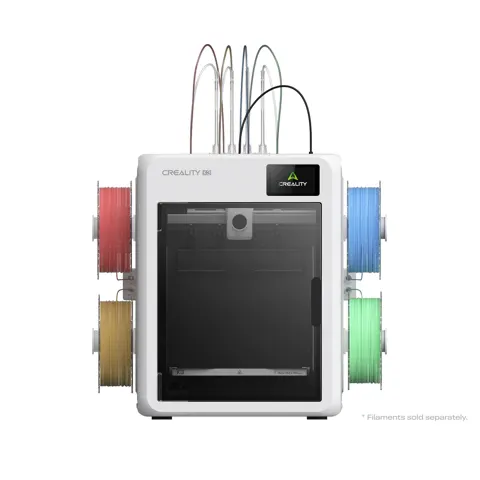
A pre-order CoreXY FDM printer built around Creality’s KliTek four-nozzle system, aimed at people who print multicolor or multi-material parts often. Check the accessory list before you buy: engineering materials, softer TPU and mixed nozzle diameters all need optional kits whose prices are unpublished, and mixed-diameter printing is not enabled in pre-release software.
Strengths
- Four independent nozzles swap in 4.8 seconds, avoiding the purge towers of single-nozzle multicolor systems.
- KliTek keeps each filament in its own hotend, so material changes take about 15 seconds.
- CoreXY frame with a 260 mm cube, 500 mm/s top speed and 20,000 mm/s² acceleration.
- Base materials cover PLA, PETG, PET, PCTG and TPU 95A without extra hardware.
- Klipper firmware with announced Root access and a phased open-source release.
- Each nozzle assembly is secured with two screws and connects by USB-C, so a worn assembly can be swapped without dismantling the printhead.
Weaknesses
- Engineering materials need the optional top cover; softer TPU and soluble supports need the Multi-Material Kit.
- Mixed nozzle diameters are advertised but not yet enabled in pre-release software.
- No independent instrumented test exists; early reviews were on Creality-supplied units.
- The 80% and 85% savings claims are “up to” maxima; Creality’s own table shows 31–75% time savings.
- The store badge and the listing disagree on warranty length: up to 12 months versus a 3-month replacement guarantee.
Verified specifications
| Printing technology | Fused Filament Fabrication (FDM). |
|---|---|
| Motion system | CoreXY. |
| Nozzle system | KliTek, four independent nozzle assemblies; 4.8 s nozzle swap; about 15 s full material change. |
| Nozzle swap repeatability | under 25 µm (manufacturer, XYZ). |
| Build volume | 260 × 260 × 260 mm. |
| Max print speed | 500 mm/s. |
| Acceleration | 20,000 mm/s². |
| Printing accuracy | 100 ± 0.1 mm. |
| Layer height | 0.08–0.35 mm (0.4 mm nozzle). |
| Extruder | hardened steel gear direct drive, step-servo motor. |
| Max nozzle temperature | 300 °C. |
| Heated bed | up to 100 °C, PEI spring steel build plate. |
| Supported nozzle diameters | 0.2 / 0.4 / 0.6 / 0.8 mm; ships with four 0.4 mm hardened steel nozzles. |
| Sensors | 37 total, 12 dedicated to nozzle docking and alignment. |
| Camera | 720p with lighting; spaghetti detection, build plate check, foreign object scan. |
| Display | 3.97-inch touchscreen. |
| Storage | 8 GB. |
| Connectivity | USB drive, 2.4 GHz Wi-Fi, Creality Cloud. |
| Slicing | Creality Print 7.0 or newer; OrcaSlicer compatible. |
| Filament | 1.75 mm, 1 kg spools; four chassis-mounted slots; integrated RFID reader. |
| Air filtration | HEPA plus activated carbon. |
| Chamber | passive; sealed only with the optional top cover; no active heater on the base. |
| Firmware | Klipper-based, with announced native Root access and a phased open-source release. |
| Dimensions | 420 × 482 × 536 mm; 22 kg. |
| Power | 100–127 V / 200–240 V, 50/60 Hz; 480 W (100–127 V) or 950 W (200–240 V); standby about 160 W. |
| Spool compatibility | 1 kg spool, outer diameter 197–202 mm, inner diameter 52–55 mm, spool width 42–68 mm. |
| Warranty | store badge says up to 12 months; the listing also advertises a 3-month replacement guarantee. |
Full research notes and sources
KliTek and the waste question
Creality’s pitch is that KliTek removes the purge waste of single-nozzle multicolor printing. Four filaments stay in four separate hotend and nozzle assemblies, and the active one swaps in 4.8 seconds, with a full material change in about 15 seconds. Creality claims up to 80% less print time and 85% less filament on dense multicolor models, but its own four-model benchmark table shows 31–75% time savings and at least 68% filament savings. Expect model-dependent results, not the headline maxima. The mechanism is also not zero-waste: small priming structures may still be needed.
Materials and the accessory gap
The base machine supports PLA, PETG, PET, PCTG and TPU 95A. Engineering materials such as ABS, ASA, PC, PA and their carbon-fiber variants need the optional top cover, and softer TPU (90A/85A) plus PVA or BVOH soluble supports need the optional Multi-Material Kit. Mixed nozzle diameters (0.2/0.4/0.6/0.8 mm) need a multi-nozzle kit and are advertised but not yet enabled in Creality Print or firmware as of the October 10, 2026 FAQ. Because none of these accessory prices are published, the total cost for engineering-material or soft-TPU printing cannot be calculated yet and may exceed competing machines.
Pre-order status and what is unproven
US pre-orders opened October 12, 2026 at $849, with estimated shipping November 2, 2026; Europe is expected in December 2026 with no euro price yet. A promotion running October 12 to November 30, 2026 includes four free rolls of Hyper PLA and free shipping on Creality’s store. No independent instrumented test of the K3 exists, and the first creator reviews (JJ Shankles, 3D Revolution, TheLayeredWorkshop, 123-3D) were on units supplied by Creality; Domechy and 3DHaber state their pieces are research-based pre-purchase assessments rather than hands-on reviews. There are no retail owners yet because units have not shipped. Community reaction is split: enthusiasm for mixed nozzle sizes (the most-liked YouTube comment, 238 likes, reads “Finally the different sized nozzles are here”) against skepticism about first-batch reliability, after-sales support and the 3-month replacement guarantee. One reviewer’s advice is to “bet on KliTek v2, not v1.”
Is it worth it?
At $849 the K3 sits level with the Snapmaker U1 ($849, shipping now, 270 mm cube), so it must justify an unproven mechanism and a smaller 260 mm cube with mixed-nozzle flexibility, TPU down to 85A and CMYK blending. Value rises for users who print frequent multicolor or multi-material jobs and need those capabilities; it falls for single-color PLA or PETG users, who pay for an unused mechanism. Buyers who need proven reliability should wait for independent tests and accessory pricing. The K3 was named an IFA Innovation Awards 2026 Honoree.
Which model this is
This page covers the first K Series machine, the Creality K3, built around the KliTek four-nozzle system. Do not merge it with the K1 or K2 series, the SPARKX i8/QuarTeks machine, or any K3 Plus or Max variant, which Creality has not announced. A Creality source has suggested larger K3 Pro or Plus versions later, but these are unconfirmed. Hardware is a CoreXY frame with 37 sensors, 12 of them dedicated to nozzle docking and alignment; nozzle assemblies are quoted at about $14 each in one comparison, but retail pricing is not confirmed. No heated chamber on the base unit.
Sources
Manufacturer:
- Creality US store: (Pre-order) K3 Multi-Material & Multicolor 3D Printer
- Creality store: K3 Multi-Material & Multicolor 3D Printer
- Creality: K3 product page
Independent reviews:
Owner reports:
- No retail owner reports yet; units have not shipped.