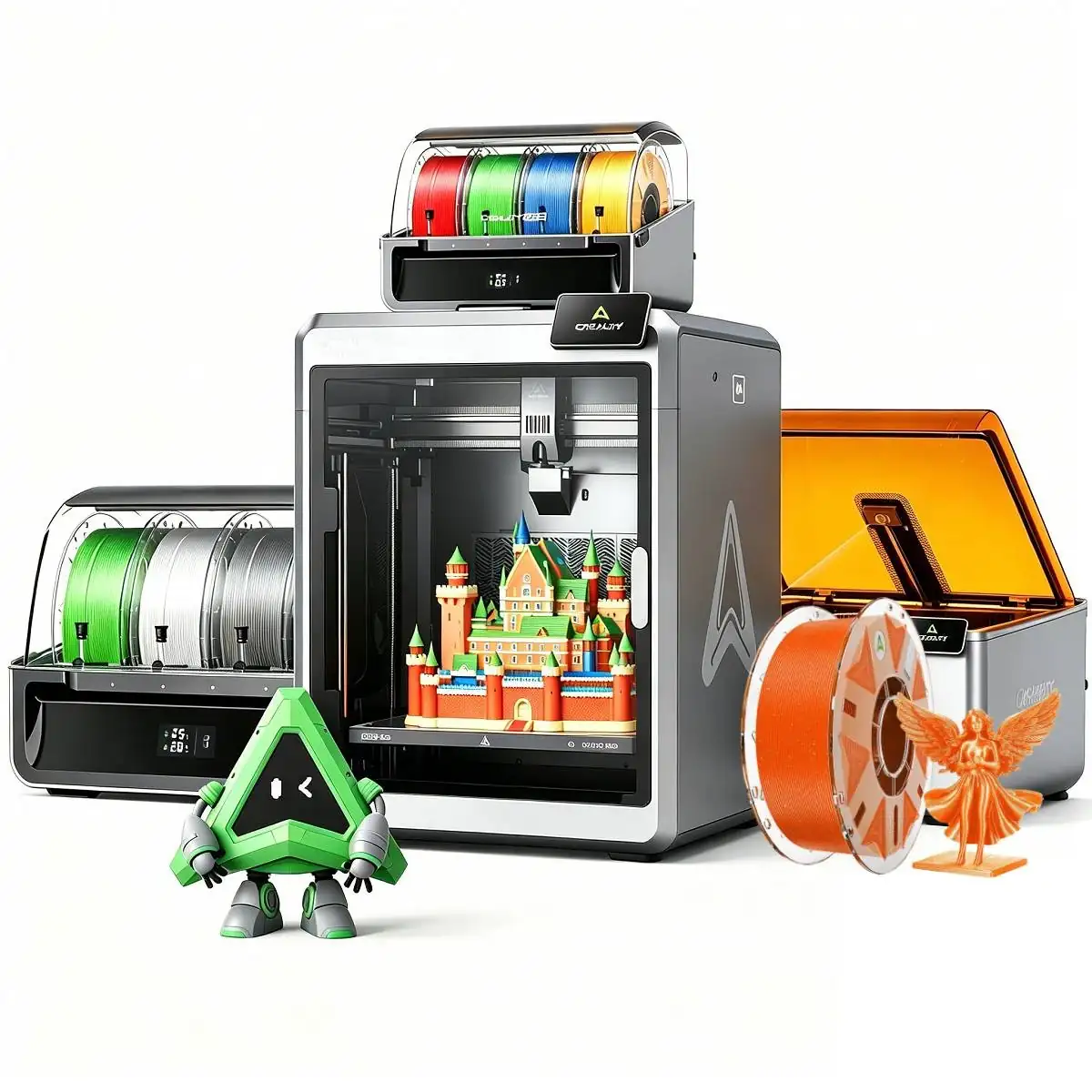
Creality K2 Plus Combo 3D Printer
By Creality · 3D Printers · 3D Printing · More from Creality
- Build volume 350 x 350 x 350 mm
- Max print speed 600 mm/s, acceleration 30,000 mm/s^2
- Rated power 1200 W
- 4.3-inch color touchscreen
- Net weight 35 kg
Price not listed
- CrealityView at Creality
- B&H PhotoView at B&H Photo
- eBayView at eBay
- AmazonView at Amazon (paid link)
- eBay (used) eBay: used, open-box, refurbishedView at eBay (used)
Stores are listed in a fixed order, never by price or commission. Prices are snapshots. Check the current price with the store.
Summary
A large-format, fully enclosed CoreXY printer with a 350 mm cubed build volume, a heated 60 °C chamber and a four-color CFS filament changer. Decide how much multi-color you actually need: it is slow and wasteful, and it is where owner complaints concentrate.
Strengths
- The 350 mm cubed enclosed volume handles large parts and engineering filaments in one machine.
- Active chamber heating to 60 °C makes ABS and ASA easier and less warp-prone.
- Single-color print quality and speed earned strong marks from every outlet that tested it, including an Editor’s Choice from Tom’s Hardware.
- Quiet step-servo motion and full-auto leveling keep setup and day-to-day printing straightforward.
Weaknesses
- Multi-color printing is slow and wasteful: one measured job burned 350 g of purge filament for 83 g of printed parts.
- Owners report CFS feed and retract failures, filament ground up in the hub, and 5-way assemblies that need replacement.
- Firmware updates have broken CFS auto-feed and the camera stream; several owners recovered only by downgrading.
- The heated bed needs a long warm-up before large first layers are reliable, one of the oddest flaws Tom’s Hardware found.
- At 35 kg it needs at least two people to unbox, and its footprint eats bench space.
- Owners describe slow, repetitive support responses and no US phone line.
Verified specifications
| Build volume | 350 × 350 × 350 mm. |
|---|---|
| Dimensions | 495 × 515 × 640 mm for the printer; 495 × 515 × 916 mm with the CFS on top. |
| Weight | 35 kg net; 51 kg combo shipping weight. |
| Motion | CoreXY with five FOC step-servo motors; max print speed 600 mm/s; max acceleration 30,000 mm/s²; typical printing speed 300 mm/s. |
| Nozzle | up to 350 °C with a 100 W hotend. |
| Heatbed | up to 120 °C; 5 mm aluminum alloy with a flexible PEI build plate. |
| Chamber | active heating up to 60 °C. |
| Display | 4.3-inch color touchscreen. |
| Layer height | 0.05–0.3 mm. |
| File storage | 32 GB EMMC; G-code and 3MF files. |
| Connectivity | dual-band Wi-Fi (2.4 GHz and 5 GHz), RJ45 Ethernet, USB drive, Creality 485 port. |
| Power | 1200 W rated; 100–240 V AC 50/60 Hz. |
| Supported filaments | PLA, PETG, PET, ABS, ASA, PLA-CF, PA-CF and PPA-CF. |
| Slicer | Creality Print 5.0 or newer per the product page; the wiki manual says 6.0 and above. |
| CFS | four slots; 379 × 314 × 276 mm; 4.56 kg; 20 W at DC 24 V; desiccant drying with a humidity display and no active heater; up to four units chain for 16 colors. |
| Leveling | full-auto leveling; RFID filament auto-identification with Creality RFID filament. |
| In the box | printer, one CFS, four 500 g RFID filament spools, spool holder, power cable, spare parts, spare PTFE tubes, a spare build plate, assembly screws, Allen wrenches, user manual and quick-start guide. |
Full research notes and sources
Which model this is
The Combo is the K2 Plus printer plus one CFS four-spool filament changer. Sixteen-color printing needs four CFS units chained together, and the extra units are sold separately — the Combo ships with one. Do not confuse it with the smaller K2 (260 mm cubed, 8 GB storage, three step-servo motors) or the K2 Pro (300 mm cubed); only the Plus combines the 350 mm volume with 30,000 mm/s² acceleration, dual-band Wi-Fi, dual air filters, a 100 W hotend and five step-servo motors.
The Amazon listing for this printer is ASIN B0DY119F9G.
Multi-color printing is slow and wasteful
The CFS is a desiccant dry box with a humidity display, not a heated dryer — there is no active heating in the box. TechRadar printed three Benchys in about 30 minutes at standard settings, or about 11 minutes at 600 mm/s with a quality loss, while a four-color Benchy took 8.5 hours. HowToMechatronics measured a multi-color job where three prints totaled 83 g but purge waste hit 350 g, on a print that ran about 14 hours. The CFS also refuses flexible TPU, damp BVOH/PVA and warped cardboard spools, so plan drying and spool choice around it.
CFS reliability and firmware
Owner complaints concentrate on the CFS and on firmware, not on the core printer. Forum threads describe filament failing to return to the CFS hub, filament being ground up by the CFS or the 5-way hub, and retraction faults that repeat even after the tubing and nozzle are replaced. One owner needed a 5-way assembly replacement, with support taking days per reply. Firmware updates have broken CFS auto-feed and thrown repeated error codes, and several owners recovered only by downgrading; the enclosure camera stream on port 8000 stopped for multiple owners after firmware 1.1.5.5, again fixed by downgrading. Another thread describes PETG softening and jamming in the extruder gears after about 15 minutes once the chamber heats up, fixed by running Fan 1 at 100%. Creality publishes a firmware upgrade and downgrade guide and forces a matching CFS update with each printer update; a community maintenance guide covers the cleaning needed to prevent clogs, failed cuts and feed errors. Treat CFS upkeep as part of ownership. These are owner reports, not defect rates — nobody has published a failure rate.
Size, setup and upkeep
The printer stands 495 × 515 × 640 mm and weighs 35 kg; with the CFS on top it reaches 916 mm, and the Combo ships at 51 kg — 3DWithUs reported around 54 kg in the box — so unboxing takes at least two people. The CFS must sit on top of the printer, since the included cords are too short to place it on a table beside the machine, which also makes removing the lid awkward. The heated bed reportedly needs a long soak before large first layers are reliable; Tom’s Hardware listed “long preheat required for some prints” among its reasons to avoid. When the chamber does its job, it does it well: HowToMechatronics printed an ABS bench vise cleanly at a 260 °C nozzle, 100 °C bed and 50 °C chamber. One early owner report cites X-axis trouble and excessive noise.
Upkeep is ordinary: the nozzle is quick-swap, the extruder opens with a few screws, a spare build plate ships in the box, and official replacement PEI build plates run about $25 (3DWithUs, 2025). Creality does not state a warranty term for this model on its product pages, so treat coverage as unconfirmed.
Is it worth it?
Buy the Combo for large, enclosed, single-color printing. The 350 mm volume and heated chamber undercut many large enclosed CoreXY rivals, and the build volume beats the Bambu Lab X1C and P1S (256 mm). Treat four-color printing as a bonus rather than the reason to buy: reviewers measured it as slow and wasteful, and the add-on hardware carries the reliability complaints. If multi-color throughput is your main requirement, or you need proactive manufacturer support, look elsewhere — owners describe slow, repetitive responses with no US phone support. Creality’s own store listed the Combo at $1,299, down from a $1,550 compare-at, on one page in October 2026, and at $989 (from $1,550) on another; Tom’s Hardware’s January 2025 reference was $1,499 for the Combo and $1,299 for the printer alone. One review aggregator expects a successor window and suggests waiting, though nothing is announced and firmware updates still land.
Sources
Manufacturer:
- Creality K2 Plus Combo product page
- K2 series page with K2 Plus differences
- K2 Plus Combo support: firmware, videos and specs
- K2 Plus user manual (Creality Wiki)
- K2 Plus and CFS firmware upgrade guide (Creality Wiki)
- Creality K2 Plus Combo 3D datasheet (PDF)
Independent reviews:
Owner reports:
- CFS feed and retract failures (Creality Community Forum)
- Repeated CFS and PTFE errors (Creality Community Forum)
- 5-way hub replacement and slow support replies (Creality Community Forum)
- Firmware update broke CFS auto-feed; downgrade fixed it (Creality Community Forum)
- Camera stream stopped after firmware 1.1.5.5 (Creality Community Forum)
- PETG jamming in the extruder gears (Creality Community Forum)
- First steps and first problems (r/Creality_k2)
- Honest discussion about the Combo’s issues (r/Creality_k2)
- CFS maintenance guide (community wiki)