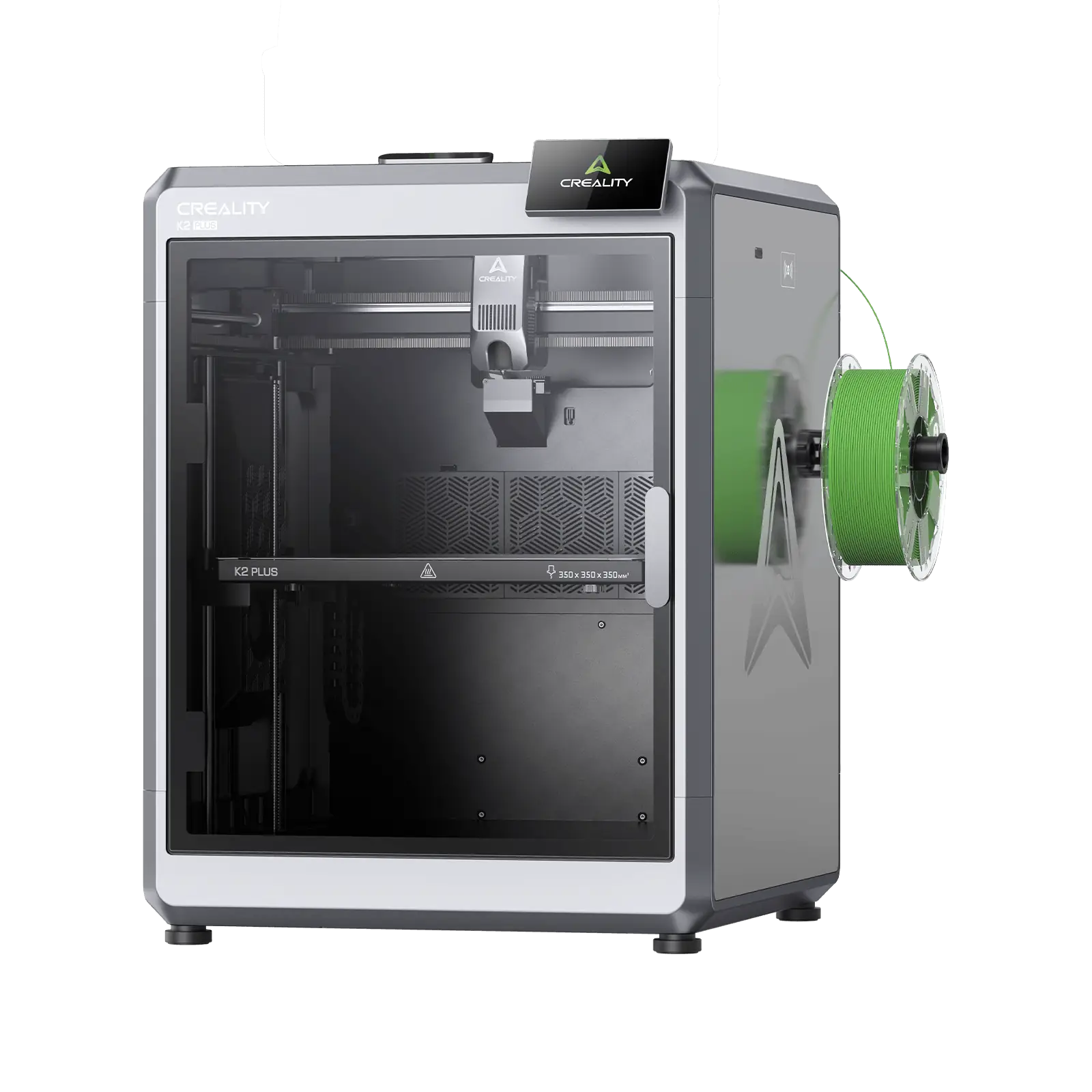
Creality K2 Plus 3D Printer (without CFS)
By Creality · 3D Printers · 3D Printing · More from Creality
- 350x350x350 mm build volume
- <=600 mm/s max print speed
- <=350 C nozzle temperature
- <=120 C heated bed temperature
- 0.05-0.3 mm layer height
Price not listed
- CrealityView at Creality
- eBayView at eBay
- AmazonView at Amazon (paid link)
- eBay (used) eBay: used, open-box, refurbishedView at eBay (used)
Stores are listed in a fixed order, never by price or commission. Prices are snapshots. Check the current price with the store.
Summary
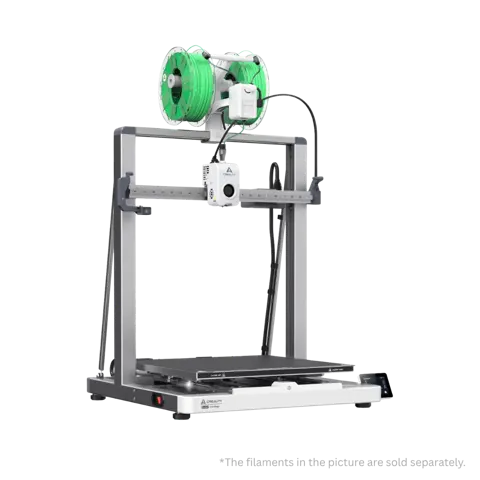
A fully enclosed CoreXY FDM printer with a 350 mm cube build volume, 350 °C hotend, 120 °C bed and 60 °C active chamber, sold without the optional CFS multicolor unit. Check the real cost of multicolor before you buy: CFS color changes share one nozzle and produced 350 g of purge waste against 83 g of printed parts in one test.
Strengths
- Large 350 mm cube build volume suits batch nesting and parts beyond 300 mm machines.
- Enclosed chamber to 60 °C supports ABS, ASA and nylon-type materials.
- Automatic bed leveling, flow calibration and dual cameras reduce manual setup.
- Quiet operation reported by reviewers.
- Good value at sale prices around $759–$999 for large-format or engineering-material work.
Weaknesses
- 600 mm/s and 30,000 mm/s² are vendor ceilings; Creality lists 300 mm/s as typical.
- Multicolor via CFS is slow and wasteful: 8.5 hours for a four-color 3DBenchy vs about 30 minutes single-color; 350 g purge against 83 g of parts in one test.
- Shared nozzle means every color change adds purge, time and failure chances.
- 35 kg machine with large footprint needs two people to lift and dedicated space.
- Community feedback is mixed, with reports of hardware failures, software glitches and difficult setup for some owners.
- No official long-term durability data beyond reviewer test periods.
Verified specifications
| Build volume | 350 × 350 × 350 mm (13.78 × 13.78 × 13.78 in). |
|---|---|
| Motion | CoreXY frame with FOC step-servo motors; direct-drive extruder. |
| Nozzle | 350 °C all-metal hotend, 40 mm³/s high flow; hardened steel; default 0.4 mm, also 0.2, 0.6 and 0.8 mm. |
| Heated bed | 120 °C; 5 mm aluminum with textured PEI flexible plate. |
| Chamber | actively heated to 60 °C. |
| Layer height | 0.05–0.3 mm; claimed accuracy 100 mm ±0.1 mm. |
| Speed | 600 mm/s maximum claimed, 30,000 mm/s² maximum claimed acceleration; Creality lists 300 mm/s as typical. |
| Filament | 1.75 mm; PLA, PETG, ABS, ASA, PA-CF, PLA-CF, PET, PPA-CF, TPU (TPU only via external spool). |
| Cameras | dual AI cameras (tool head and chamber). |
| Connectivity | Wi-Fi (2.4 and 5 GHz), Ethernet, USB flash drive, Creality Cloud; 32 GB on-board storage. |
| Interface | 4.3-inch color touchscreen. |
| Slicing | Creality Print and Ultimaker Cura. |
| Bed leveling | automatic via strain gauge; filament runout sensor. |
| Air purifier | built-in at the rear. |
| Dimensions | 495 × 515 × 640 mm (Tom’s Hardware) or 495 × 515 × 916 mm (TechRadar); about 35 kg. |
| In the box | maintenance tools, side cutters, plastic scraper, USB stick, sample spool of white Creality Hyper PLA, PDF manual, Creality Slicer, sample models. |
| Firmware | V1.1.4.11 (Jan 18, 2026). |
| Warranty | up to 12 months (Creality store). |
Full research notes and sources
Build volume and speed
Creality advertises a 600 mm/s ceiling and 30,000 mm/s² acceleration, but lists 300 mm/s as the typical print speed, so treat the headline figure as a limit, not a promise. The 5 mm aluminum bed needs roughly 15 minutes to heat-soak before large prints, and the default chamber temperature for PLA is 35 °C, which can be too warm for some filaments with the door closed.
Multicolor printing and purge waste
CFS adds up to four units for 16 filament inputs to one nozzle, with moisture-proof storage, temperature and humidity display, automatic loading and RFID detection. Every color change purges through the shared nozzle. HowToMechatronics measured 350 g of purge waste against 83 g of printed parts for three multicolor hearts over about 14 hours, and TechRadar measured 8.5 hours for a four-color 3DBenchy against roughly 30 minutes single-color. Tom’s Hardware measured 121.7 g of waste against 99 g of parts over 206 swaps. Creality Print offers only a purge multiplier, not granular control, and TPU cannot run through the CFS and must use the external spool entry.
Print quality and accuracy
Independent tests report strong single-filament quality on PLA, PETG and engineering materials, with a heated chamber for ABS and ASA. TechRadar measured average dimensional errors of 0.194 mm on X and 0.39 mm on Y, with flow, fine-negative, overhang and bridging scores of 3, 4, 4 and 5 for a total of 24 out of 30, and noise of 45 dB at 300 mm/s. HowToMechatronics reported dimensional accuracy within 5 micrometers on a calibration cube. Tom’s Hardware found the color waste higher than a Bambu printer in its comparison.
Reliability and ownership
Community evidence is mixed. StillPrinting aggregates 147 Reddit and YouTube mentions with a 64 out of 100 community score and 75 percent positive Reddit sentiment, citing frequent hardware failures, inconsistent quality, AI and software glitches, and setup difficulty. One owner reports about 600 hours on a K2 Plus Combo with no problems printing PLA; another reports complete failure within two weeks and a three-month return. No fleet-wide failure rate is available. Routine ownership means heat-soaking the bed, keeping the door open for PLA, cleaning the CFS and tuning prints, and replacing nozzles, which are quick-swap and readily available.
Is it worth it?
At roughly $759 to $999 in base or sale configurations, the K2 Plus offers a 350 mm cube, 60 °C heated chamber, 350 °C hotend, CoreXY motion, dual cameras, auto leveling and optional CFS, which is strong value for large-format or engineering-material work. At $1,199 to $1,499 in Combo or full configuration, it is justified only when the full package is needed. Buyers with parts under 300 mm should consider smaller machines. Compared alternatives include the Creality K2, Bambu Lab H2D and Anycubic Kobra 3 Max.
Which model this is
This page covers the Creality K2 Plus base printer sold without the optional CFS, model family K2 Plus, an FFF CoreXY machine. The base printer and the Combo share the same printer hardware and differ only by inclusion of the CFS unit. Do not confuse it with the smaller Creality K2, K2 Pro, K2 SE, K1 or K1 Max, which have different build volumes and thermal envelopes. Creality’s support page lists firmware V1.1.4.11 dated Jan 18, 2026. Creality’s store lists an up to 12-month warranty. The official US store listed the Combo at $1,199 on Sep 14, 2026, Best Buy at $999 and MatterHackers at $1,499, and the base printer at $759 on a live exclusive promotion.
Sources
Manufacturer:
- Creality K2 Plus Combo support center (specs, firmware, FAQ)
- Creality US store — K2 Plus 3D Printer (without CFS, live exclusive)
- Creality official — K2 Plus Combo product page
Independent reviews:
Owner reports: