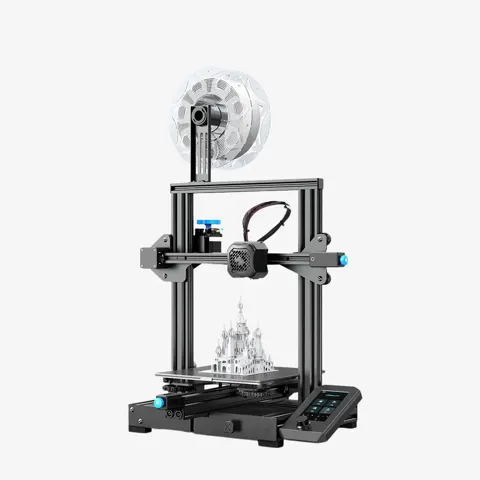
Creality Ender-3
By Creality · Budget 3D Printers · 3D Printing · More from Creality
- 220x220x250 mm build volume
- 0.4 mm nozzle
- 1.75 mm filament
- 100-400 um layer height
- Max print speed 200 mm/s
Price not listed
- CrealityView at Creality
- eBayView at eBay
- WalmartView at Walmart
- AmazonView at Amazon (paid link)
- eBay (used) eBay: used, open-box, refurbishedView at eBay (used)
Stores are listed in a fixed order, never by price or commission. Prices are snapshots. Check the current price with the store.
Summary
An open-frame budget FDM printer with a 220 × 220 × 250 mm build volume, a 0.4 mm nozzle and no auto bed leveling. Check your patience before you buy: every bed level is done by hand with a sheet of paper.
Strengths
- Generous build volume for the price with a solid open frame.
- Capable of detailed prints at 0.1 mm layer height with sharp corners.
- Bed reaches about 110 °C in under five minutes on the 24 V supply.
- Works with flexible filaments as well as PLA.
- Large community knowledge base and upgrade ecosystem.
Weaknesses
- No auto bed leveling; bed leveling is manual with a sheet of paper.
- Tested usable X/Y area is only 200 × 200 mm, not the advertised 220 × 220 mm.
- Smooth bed surface may need a glue stick for reliable adhesion.
- No US-based support; email only.
- No filament runout sensor.
- Single Z-axis screw, with no dual-Z upgrade path in the base model.
Verified specifications
| Build volume | 220 × 220 × 250 mm. |
|---|---|
| Nozzle | 0.4 mm; stated printing accuracy 0.1–0.4 mm. |
| Filament diameter | 1.75 mm. |
| Minimum layer height | 0.1 mm. |
| Maximum print speed reported | up to 120 mm/s; optimal printing speed 50–60 mm/s. |
| Heated bed | up to 110 °C. |
| Maximum nozzle temperature | 250 °C per Creality’s guide; one tester reported 285 °C. |
| Rated power | 270 W; DC 24 V; adjustable 115/230 V input. |
| Motion | single Z-axis screw; no dual Z. |
| Auto bed leveling | none. |
| Filament runout sensor | none. |
| Power-resume after outage | yes. |
| Continuous printing | up to 200 hours. |
| Materials | PLA, TPU and ABS per one tester; Creality’s guide also lists carbon fiber and other linear filaments. |
| Computer compatibility | Windows XP/Vista/7/10, Mac, Linux. |
| Bed temperature gradient measured by one tester: 4.4 °C. | |
| Dimensions | 43.9 × 43.9 × 46.5 cm (17.3 × 17.3 × 18.3 in). |
Full research notes and sources
Print quality and speed
TechGearLab scored the base Ender-3 58/100 overall, with print quality 6.1, ease of use 5.2, print capabilities 6.0 and support 6.0. The tester’s calibration cube was nearly flawless and the Tower print showed sharp corners with minimal wobble, but extrusion and retraction control produced fine strands, wall-thickness inconsistency and overhang slumps. A Benchy took about two hours at 0.25 mm layer height, and the bed showed a 4.4 °C temperature gradient. The extruder reached 285 °C in testing, and the machine handled PLA, TPU and ABS.
Creality’s own guide puts optimal printing speed at 50–60 mm/s, so treat 200 mm/s marketing claims with caution.
Bed leveling and adhesion
There is no auto bed leveling, so leveling is done by hand with a sheet of paper. The print bed is smooth and one tester needed a glue stick for reliable adhesion. The bed is held by four binder clips, which intrude on the build area and contributed to a tested usable X/Y limit of 200 × 200 mm. The Y-moving bed and manual leveling make first-layer consistency a persistent challenge.
Owner problems and upkeep
Owner data aggregated across Ender-3 variants ranks the most common problems: first layer not sticking (404 posts), stringing (277), under-extrusion (274) and layer shift (238). Causes cited include manual bed leveling with a moving bed, belt tension issues as belts age, and over-retraction advice that can cause grinding, heat creep and clogs on the Bowden extruder. Maintenance means keeping belts tensioned, cleaning the bed, and tuning temperature, retraction, cooling and flow before re-leveling. The machine is open and simple, so repairs are approachable, but no manufacturer parts catalog for the base model was verified. Creality support is email-based with no US office. Warranty terms for the base Ender-3 were not verified from a manufacturer page.
Is it worth it?
At or below about $189, the Ender-3 is a reasonable tinkerer’s entry machine: large build volume, 0.1 mm capability, a 110 °C bed, fast 24 V heating and a huge community support base. Above that, or for buyers who do not want to level a bed by hand and tune slicer settings, newer variants (Pro, V2, Neo, S1, V3) offer auto-leveling and better extruders and are likely better value. The tested 58/100 score and the 200 × 200 mm usable X/Y limitation mean it should not be bought for its headline 220 mm or 200 mm/s numbers. List price shown by TechGearLab is $189. Recurring ownership costs are filament, occasional nozzles and bed surfaces, and glue stick for adhesion; there is no subscription or consumable lock-in.
Which model this is
This page covers the original base Ender-3 only, not the Ender-3 Pro, V2, Neo, S1, V3, V4 or other variants, which differ in extruder, bed, auto-leveling and frame. The Creality download center lists an “Ender-3 3D Printer User Manual” dated 2022-11-28, but the file served at that link was an Ender-3 S1 quick-start guide, so an original Ender-3 manual was not verified in this run. The Amazon listing for this model is ASIN B07D218NX3.
Sources
Manufacturer:
- Creality Ender-3 product page
- Creality Ender-3 downloads center
- Creality store guide to Ender 3 operation
Independent reviews:
Owner reports: