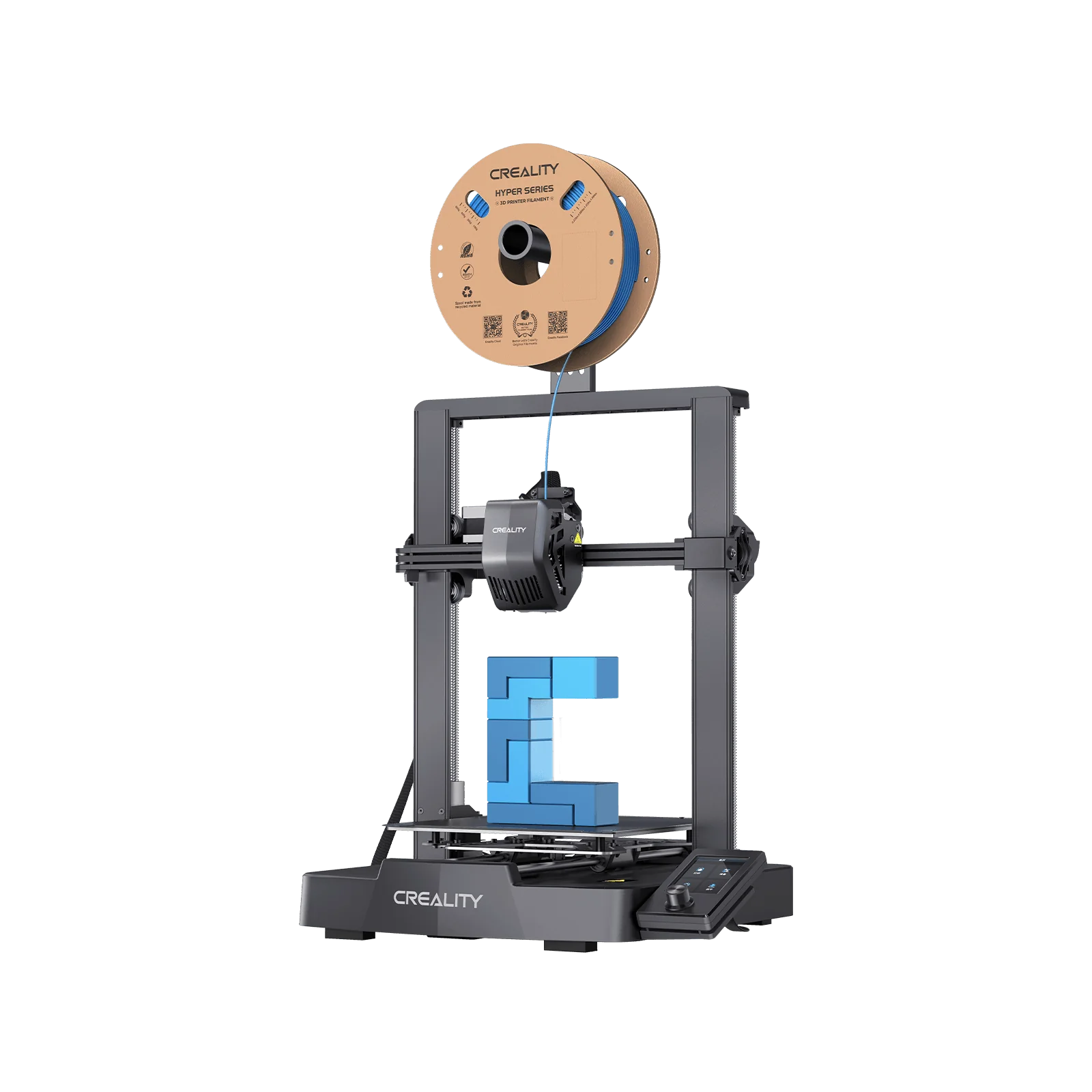
Creality Ender-3 V3 SE 3D Printer
By Creality · 3D Printers · 3D Printing · More from Creality
- 250mm/s max printing speed
- 2500mm/s² max acceleration
- CR Touch auto leveling
- Sprite direct extruder (PLA/PETG/TPU)
- dual Z-axis
Price not listed
- WalmartView at Walmart
- eBayView at eBay
- AmazonView at Amazon (paid link)
- eBay (used) eBay: used, open-box, refurbishedView at eBay (used)
Stores are listed in a fixed order, never by price or commission. Prices are snapshots. Check the current price with the store.
Summary
A compact, mostly pre-assembled entry-level FDM printer with a 220 × 220 × 250 mm build volume, Sprite direct drive and CR Touch auto leveling.
Strengths
- Low price for a direct-drive printer with auto leveling.
- Fast setup, about 15–30 minutes.
- Reliable auto leveling with CR Touch plus strain-sensor Z offset.
- Genuine TPU capability at this price.
- Simple Marlin-based UI; broad slicer compatibility.
- Good test results: TechRadar scored 26.5/30 with 0.054 mm average dimensional error and perfect overhang and bridging scores.
Weaknesses
- No filament runout sensor on the base unit.
- 260°C nozzle ceiling rules out ABS, nylon and PC.
- PC plate can bond to PETG and wear over time.
- Strain-gauge Z offset misfires on a dirty nozzle or plate.
- First-layer inconsistency and stringing reported by owners.
- Layer shifts tied to dry or debris-contaminated Y rods.
Verified specifications
| Model | Ender-3 V3 SE; FDM/FFF Cartesian bed-slinger, open frame. |
|---|---|
| Build volume | 220 × 220 × 250 mm. |
| Max print speed | 250 mm/s; typical 150–200 mm/s. |
| Max acceleration | 2,500 mm/s². |
| Layer height | 0.1–0.35 mm. |
| Nozzle | 0.4 mm brass, high-flow; max 260°C. |
| Bed | PC-coated spring steel, heated; max 100°C. |
| Extruder | Sprite direct drive, dual-geared. |
| Materials | PLA, PETG, TPU (95A). |
| Auto bed leveling | CR Touch mesh plus strain sensor for auto Z offset. |
| Filament runout sensor | none on base unit (Filament Detector Kit sold separately). |
| Power-loss recovery | yes. |
| Connectivity | SD card and USB Type-C. |
| Interface | 3.2-inch color screen with knob. |
| Slicing | Creality Print, Cura, PrusaSlicer compatible. |
| Firmware | Marlin-based; V1.1.0 (2025-05-11). |
| Power | 350 W rated; 100–120 V or 200–240 V, 50/60 Hz. |
| Dimensions | 349 × 364 × 490 mm (Tom’s Hardware); 365 × 345 × 458 mm (TechRadar); 420 × 370 × 490 mm (makerspecs). |
| In the box | tools, side cutters, metal scraper, nozzle cleaner, spare nozzle, full-size SD card with USB adapter, sample white PLA, manual PDF and assembly video on the SD card, Creality Print slicer. |
Full research notes and sources
Speed and print quality
The 250 mm/s figure is a maximum, not a working speed. Tom’s Hardware assembled a tested unit in about 15 minutes and printed a Benchy in 41 minutes at speed-boat rules; TechRadar scored 26.5/30 with 0.054 mm average dimensional error and perfect overhang and bridging scores, with lower marks for fine flow control and XY resonance. TPU caps at about 40 mm/s.
Materials and limits
The stock 0.4 mm brass nozzle tops out at 260°C and the bed at 100°C, so the printer is suited to PLA, PETG and TPU (95A). ABS and ASA are marginal without an enclosure and nylon and PC are out of reach. The PC-coated spring-steel plate can bond hard enough to tear the coating, especially with PETG; a 235 × 235 mm smooth PEI plate is sold as an optional replacement. No Wi-Fi, camera or touchscreen: file transfer is by SD card or USB Type-C.
Maintenance and reliability
Owners report first-layer inconsistency from strain-gauge Z offset misfire, PC plate adhesion issues, stringing when Bowden-era 4–6 mm retraction is used (correct range 0.5–1.2 mm), extruder clicking at high speed, and layer shifts from dry or debris-contaminated 8 mm Y rods. Maintenance means washing the plate with dish soap and water, cleaning the nozzle tip before leveling, lubricating Y rods and Z lead screws every few months, and drying filament in humid rooms. Nozzles and hotends are consumables; the store sells a print head kit, extrusion kit, filament detector kit and PEI plate. Warranty is up to 12 months on main components, with shorter coverage for wear parts.
Is it worth it?
At or below $160 it is strong value for a beginner, with auto leveling, direct drive and TPU support as the main draw. From $161 to $200 it is good value; compare with faster enclosed alternatives if speed matters. Above $200 it is hard to recommend unless the compact size or Creality ecosystem is specifically needed. The real differentiators are the leveling system, direct drive, build volume and price, not the 250 mm/s headline. Creality’s store listed $179 with $199 struck through in October 2026; Micro Center showed $159 at launch and $169 in-store, and one in-store pickup listing returned $118.09. TechRadar listed $189.99 at Best Buy and $194.91 at Walmart in December 2023.
Which model this is
This page covers the Creality Ender-3 V3 SE, a 2023 bed-slinger with a Sprite direct-drive extruder and CR Touch leveling. Do not confuse it with the Ender-3 V3, V3 KE, V3 Neo, V3 Mega or earlier Ender-3 generations, which differ in firmware, motion system and features. A “Basic Combo” variant bundles a Falcon A1C laser engraver. The Amazon listing for the Ash color carries ASIN B0DD7F2BH9.
Sources
Manufacturer:
- Creality Ender-3 V3 SE official product page
- Creality Ender-3 V3 SE official store
- Creality Ender-3 V3 SE support, firmware and specs
- Creality Wiki: Ender-3 V3 SE manual, maintenance and fault guides
Independent reviews:
Owner reports:
- Problems with a new Ender 3 V3 SE (Creality Community Forum)
- Long-term problems with the Ender 3 V3 SE (r/Ender3V3SE)
- Y-axis bearings and layer shifting (r/FixMyPrint)
- Nozzle misfit and clogs (r/Ender3V3SE)
- Automatic Z-offset drift (r/ender3)
Retailers and parts: