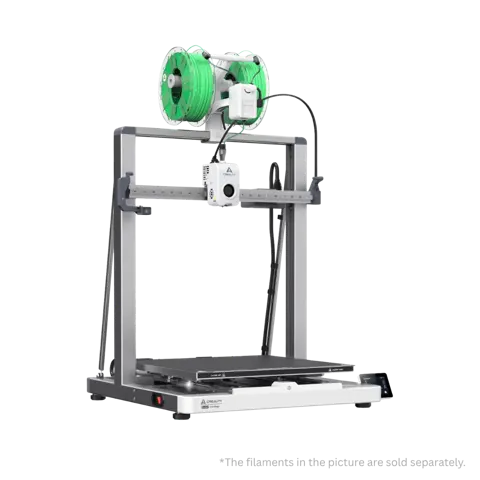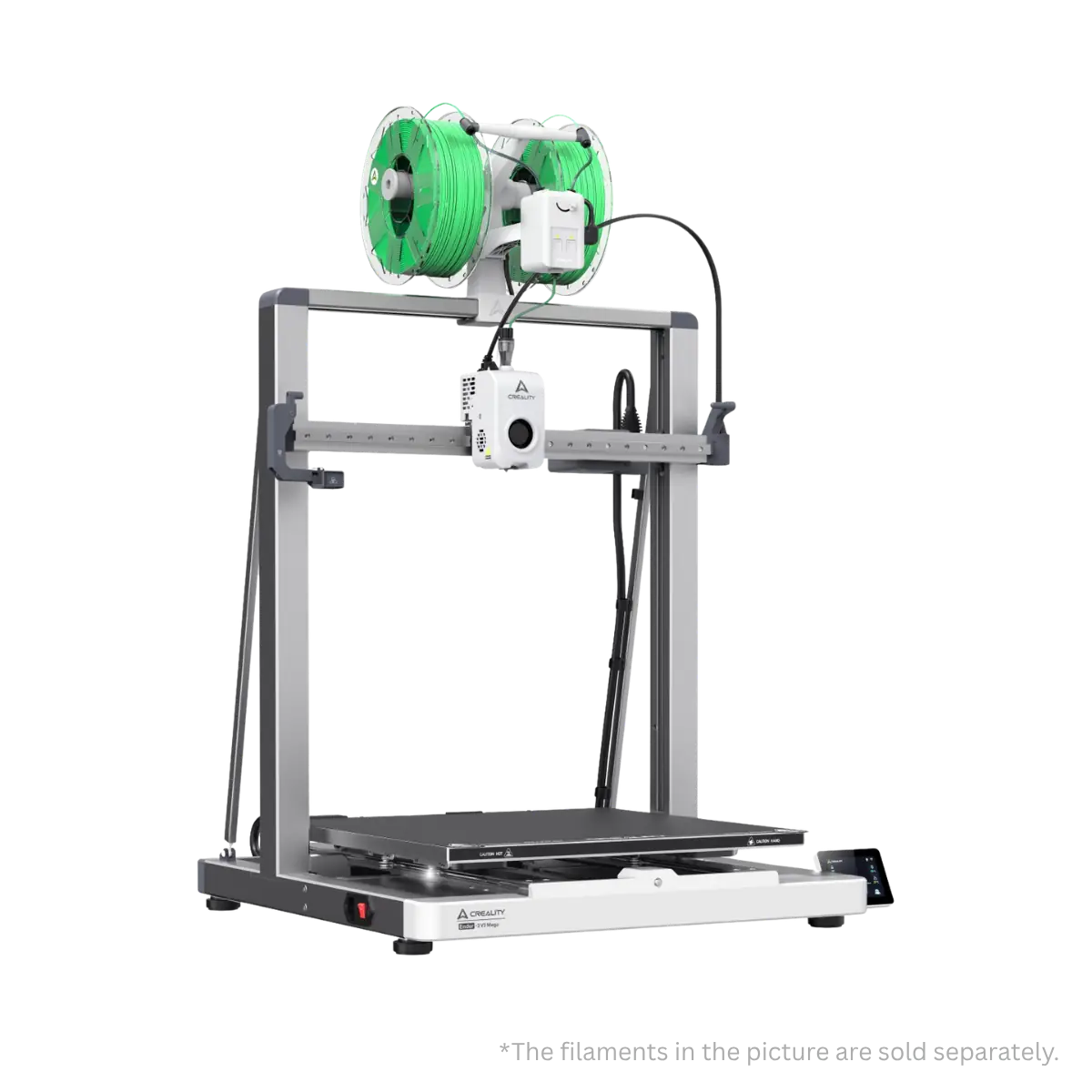
Creality Ender-3 V3 Mega 3D Printer
By Creality · 3D Printers · 3D Printing · More from Creality
- 420x420x420 mm build volume
- 300 mm/s typical speed (max 500 mm/s)
- 81-point auto leveling
- 21.2 kg net weight (standalone)
- 3.2-inch color touchscreen
Price not listed
- CrealityView at Creality
- WalmartView at Walmart
- eBayView at eBay
- AmazonView at Amazon (paid link)
- eBay (used) eBay: used, open-box, refurbishedView at eBay (used)
Stores are listed in a fixed order, never by price or commission. Prices are snapshots. Check the current price with the store.
Summary
A large-format open-frame FFF printer with a 420 × 420 × 420 mm build volume and a direct-drive Sprite 2 extruder rated for 85A–95A TPU, launched in the US on October 15, 2026. Check whether you actually need the 420 mm cube before buying: no independent hands-on test of this exact model exists yet, and the open frame limits large ABS, ASA, nylon and PC parts.
Strengths
- 420 mm cube avoids splitting large helmets, housings and batched parts into glued segments.
- Direct-fed Sprite 2 path targets 85A–95A soft TPU, the machine’s most distinctive capability.
- Dual Y and dual Z drives, vibration compensation, mesh leveling, tangle sensing and backup-spool relay target long-print interruptions.
- Tool-free quick-swap nozzle simplifies cleaning after jams.
- Combo adds four-color CFS Nano for a $100 difference at current store pricing.
- Exact-model firmware and support pages already exist for a printer launched October 15, 2026.
Weaknesses
- No independent hands-on or instrumented test of this exact model exists yet.
- Open frame is not an enclosure; large ABS, ASA, nylon or PC parts can warp or split.
- 500 mm/s is a maximum motion speed, not a promise of good 420 mm parts at that rate.
- TPU cannot use the automatic relay or CFS Nano despite being a headline feature.
- Moving 420 mm bed needs more front-to-back clearance than the chassis figure implies.
- Spare parts and maintenance intervals for this model are not yet documented.
Verified specifications
| Process and frame | FFF, open-frame Cartesian printer with a moving build plate; aluminum alloy gantry, die-cast heated bed, dual Z and dual Y motors, vibration compensation. |
|---|---|
| Build volume | 420 × 420 × 420 mm. |
| Motion | 300 mm/s typical, up to 500 mm/s maximum; 8,000 mm/s² acceleration. |
| Extruder | Sprite 2 direct drive; gear-to-nozzle path about 74 mm, roughly 14% shorter than the K2’s 86 mm. |
| Nozzle | 0.4 mm, up to 300 °C. |
| Heated bed | up to 100 °C, epoxy-coated plate. |
| Materials | PLA, PETG, TPU 85A–95A; also ABS and ASA with an enclosure advised. |
| Leveling | 81-point automatic mesh leveling. |
| Controls | 3.2-inch color touchscreen, 2.4 GHz Wi-Fi, USB flash drive, Creality Cloud, G-code; Creality Print 7.0. |
| Power | 1,150 W rated. |
| Monitoring | filament runout and tangle detection, automatic backup-spool relay; tool-free quick-swap nozzle. |
| Multicolor | CFS / CFS Nano ready with RFID spool recognition; Combo adds CFS Nano for four-color printing. TPU must feed directly and cannot use the relay or CFS Nano. |
| Remote camera | optional Creality Nebula Camera required for live view. |
| Warranty and returns | store advertises “Up to 12-Month Warranty” and “14-Day Return & Refund”. |
Full research notes and sources
Which model this is
This page covers the 2026 Creality Ender-3 V3 Mega, the large-format open-frame bed-slinger with a 420 mm cube, distinct from the smaller Ender-3 V3, V3 Plus, V3 SE, V3 KE, V3 Neo and Ender-5 Max. Two configurations exist: the standalone Mega with a motor-driven Y-flow backup-spool relay, and the Mega Combo which adds a CFS Nano for up to four colors. The Amazon listing for this family is ASIN B0HCYWBGLD. Do not confuse it with the V3 Plus (300 × 300 × 330 mm) or the Neo (220 × 220 × 220 mm).
Speed, accuracy and the missing tests
No independent hands-on or instrumented test of the exact Mega was found. Claims of 300 mm/s typical and 500 mm/s maximum motion remain manufacturer positioning; flow, acceleration, geometry, material, vibration and the heavy moving bed set practical speed. A tall, narrow print may wobble on an accelerated 420 mm platform, and 81 mesh points correct height compensation but do not guarantee even thermal distribution across 420 mm. No measured failure rate, noise figure or full-bed adhesion study exists yet.
Soft TPU and multicolor
TPU must feed directly from a spool and cannot use the automatic relay or CFS Nano, so a multicolor buyer switching to soft TPU changes both feed path and slicer profile. Creality’s claim of 74.5% purge reduction and 7.1% filament-use reduction comes from a specific manufacturer lab batch of 36 multicolor objects on 420 mm versus 250 mm beds; it is not a per-color-switch guarantee, and no third-party Mega measurement exists. The CFS Nano is listed as coming soon in one source while the Combo ships with it, so treat full multicolor as a near-term promise.
Running costs and ownership
The printer has no documented mandatory paid subscription for ordinary G-code over USB or Creality Print. Hyper PLA runs about $19.99/kg and Hyper PETG about $18.99/kg on the Creality store in October 2026; five kg of PLA at that rate is $99.95 and ten kg is $199.90. A 1.5 kg PLA model costs roughly $29.99 in plastic before electricity and labor. Power draw is rated at 1,150 W, but that is a nameplate figure, not a measured average; at an assumed 200 W average over 520 hours a year, electricity would be about $20.80 at $0.20/kWh, and about $41.60 at 400 W. The store advertises a 12-month standard warranty on the complete machine, 3 months on wear parts such as nozzles, belts and the build plate, and no warranty on consumables; returns are 14 calendar days for qualifying unused items and 30 days for qualifying exchanges. Support is reachable at cs@creality.com, Monday to Friday, 7 AM to 5 PM PT.
Is it worth it?
US pricing opened October 15, 2026: $569 standalone (regular $599) and $669 Combo (regular $699), with the Combo early-bird window running October 15 to November 10, 2026. If most parts fit a 220–300 mm bed, a smaller mature machine is the better value; the Mega’s price then buys unused capacity and early-platform risk. At $600 or more for the base machine, Anycubic’s Kobra 3 Max and ELEGOO’s Neptune 4 Max deserve comparison; both offer large beds and longer market history, though neither is proven equal for very soft 85A TPU. The Combo’s $100 premium is defensible only when four-color rigid printing is a genuine use case. Buyers who validate plate-wide first layers and TPU performance on arrival can justify the early-bird Combo at $669.
Sources
Manufacturer:
- Creality Ender-3 V3 Mega product page
- Creality U.S. store listing
- Creality launch release (PR Newswire)
- Creality support page
- Creality firmware downloads
- Creality Wiki: user manual and TPU guide
- Creality return and warranty policy
- Creality warranty and rights inquiry
- Creality Ender-series collection
- Creality editorial: Mega vs Neo
Independent reviews:
- VoxelMatters launch coverage
- PerfectLayer3D specification
- PerfectLayer3D Mega/Neo analysis
- Makers101 early look
- PrinterDrops Creality listed prices
- Anycubic Kobra 3 Max
- Anycubic Kobra 3 Max V2
- ELEGOO Neptune 4 Max
Owner reports: