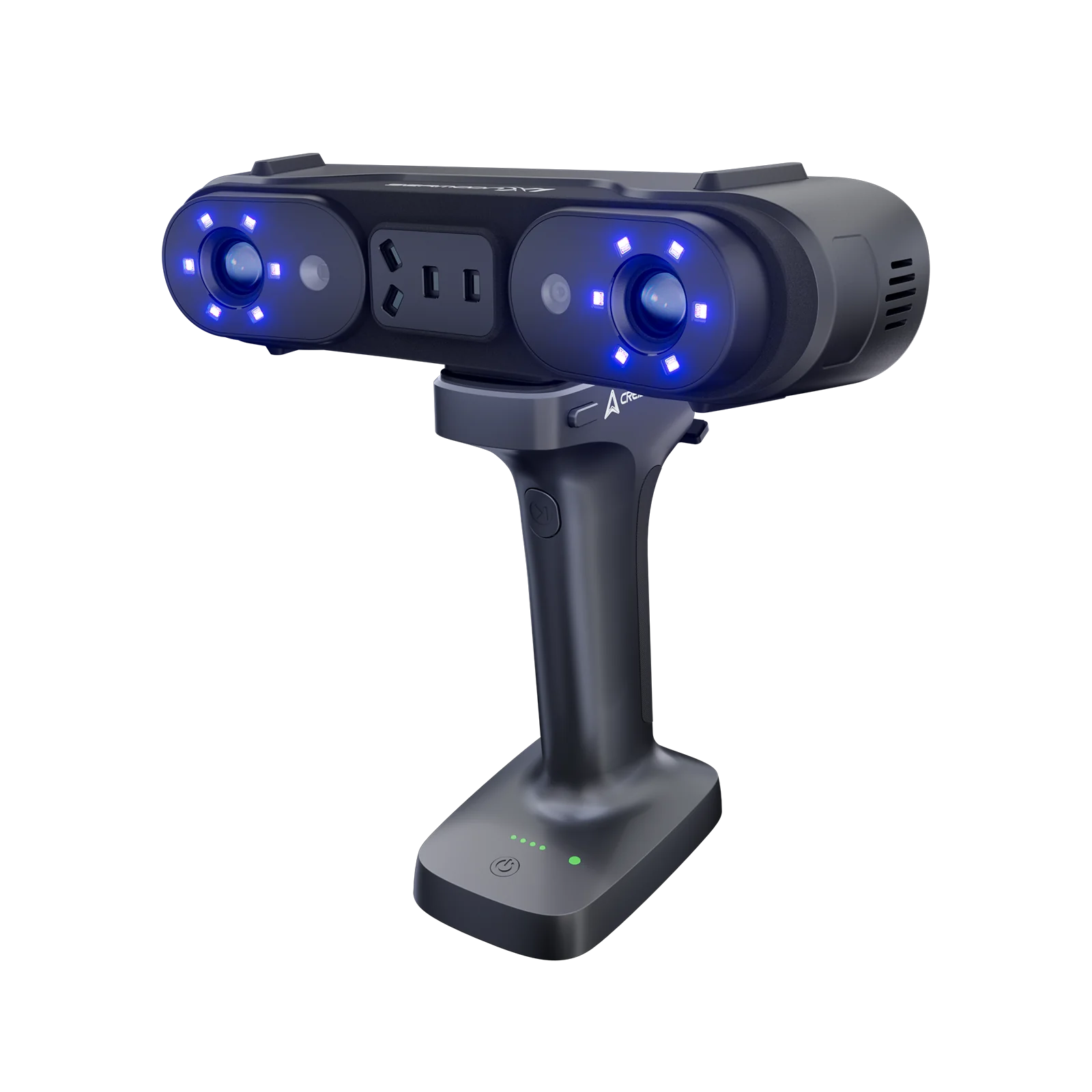
Creality 3D Scanner Collection - Otter Lite
By Creality · 3D Printers · 3D Printing · More from Creality
- 0.05mm accuracy at 100mm
- 30fps scanning speed
- 20mm to 2000mm object range
- NIR binocular structured light
- 300g main unit weight
Price not listed
- CrealityView at Creality
- eBay (used) eBay: used, open-box, refurbishedView at eBay (used)
- eBayView at eBay
- AmazonView at Amazon (paid link)
Stores are listed in a fixed order, never by price or commission. Prices are snapshots. Check the current price with the store.
Summary
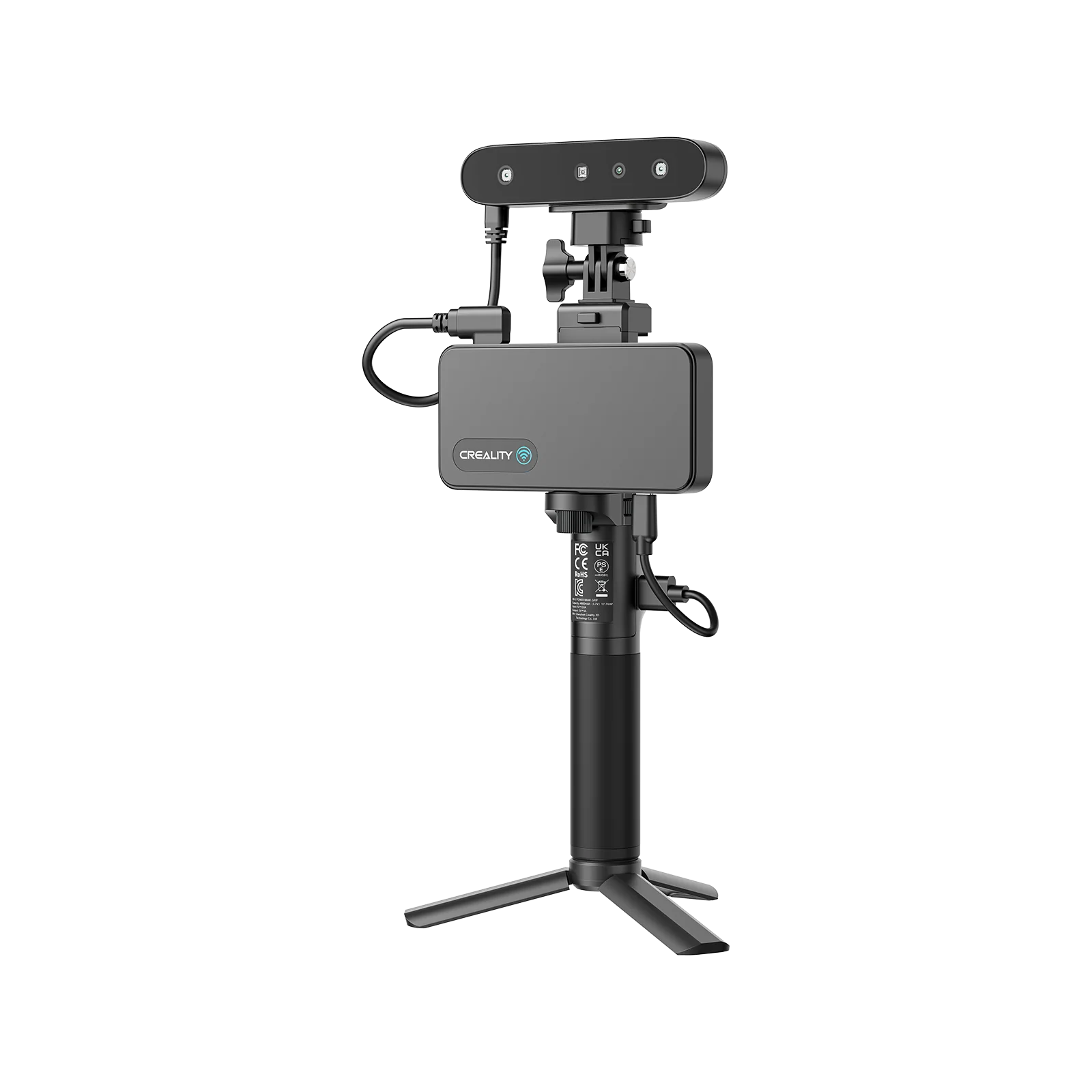
A 300 g handheld 3D scanner that uses near-infrared structured light and comes with a battery handle that streams wirelessly to a phone. It handles people, figures and large objects well for the price, but the companion Creality Scan app is the weak point.
Strengths
- Wireless scanning through the Lite Bridge plus a phone works well in owner hands.
- Good for faces, heads and low-detail large objects.
- Complete package: bridge, turntable, calibration board, markers and case included.
- Wide 20-2000 mm object range from one device.
- NIR scanning needs no visible-light projector.
- Small-object scanning of trinkets and the included OWL test object works wirelessly.
Weaknesses
- Owners report the Creality Scan app crashes when tracking is lost.
- Software is over-simplified, with few manual controls when one-touch processing fails.
- Reviewers call it a poor fit for engineering-grade dimensional work.
- Accuracy falls with distance; 0.05 mm only holds at 100 mm.
- US warranty terms were not found; EU and AU terms differ.
- Needs a fairly modern PC or phone, so it is not a low-end-machine accessory.
Verified specifications
| Model | CR-Scan Otter Lite (sold as the Creality Otter Lite 3D Scanner). |
|---|---|
| Scanning mode | NIR infrared binocular structured light with a 4-lens stereo layout. |
| Accuracy | 0.05 mm at 100 mm working distance (manufacturer figure). |
| 3D resolution | 0.1-2 mm. |
| Scan speed | up to 30 fps. |
| Object range | minimum scan volume 20×20×20 mm, maximum object about 2000 mm. |
| Working distance | 120-1200 mm. |
| Single capture range | close-range 100×62 mm at 120 mm and 160×130 mm at 250 mm; long-range 352×254 mm at 300 mm, 788×509 mm at 600 mm and 1460×1017 mm at 1200 mm. |
| Color and tracking | 24-bit full color; geometry, texture and marker alignment; output in OBJ, STL or PLY. |
| Lighting and safety | 8 NIR LEDs, 2 white supplemental LEDs, Class I eye-safe laser classification. |
| Object classes | small 20-250 mm, medium 250-500 mm, large 500-2000 mm. |
| Wireless | Wi-Fi 6 with 5 GHz support. |
| Interface | Type-C / USB 3.0 / USB 2.0. |
| Power | USB 3.0 5V 3A wired; 12V 2A for wireless through the bridge. |
| Dimensions | main unit 173×39×56 mm; main unit 300 g; Lite Bridge 306 g. |
| PC requirements | Windows 10/11 64-bit (minimum i5-Gen8+ and 8 GB, recommended i7-Gen7+ with GPU and 16 GB+); macOS (minimum Intel i5-Gen8+ and 8 GB, recommended Apple M1/M2/M3 and 16 GB+). |
| Phone requirements | Android 10+ (Snapdragon 888+ and 6 GB+); iOS 15+ (iPhone 13 / A15 or better and 6 GB+). |
| In the box | scanner, Lite Bridge, USB 3.0 data cable, USB 2.0 power cable, glass calibration board, turntable, OWL test object, USB-C adapters, reflective markers, magnetic phone holder, lanyard, cleaning cloth and portable case. |
Full research notes and sources
Software and the app
The hardware gets decent marks, but the app is the recurring complaint. One Reddit owner on a Poco F5 saw crashes when the scanner lost tracking. Another owner called the software a total nightmare, and an in-depth YouTube reviewer said it goes too far in simplifying, so if the one-touch pass fails there is little manual recovery. The same reviewer found wireless scanning and small objects pleasant but judged it awful as an engineering tool. There is no independent instrumented test of accuracy or frame rate, and the 0.05 mm figure is a manufacturer claim measured at 100 mm, with accuracy degrading with distance and time since calibration.
Range and workflow
The appeal is the range: 20 mm small parts up to about 2000 mm objects from one unit, with Wi-Fi 6 streaming to a phone in the magnetic Lite Bridge holder or to a PC over USB. Wired mode runs over USB-C without the bridge. Calibration uses the included glass board and should be repeated after a bump or long use to restore accuracy. Keep the right working distance for tracking. Firmware upgrades over OTA or local files are not supported in the phone app. The manufacturer claims black and metal objects scan without spray, but an owner of the standard Otter still used foot powder on some objects, so treat that as conditional rather than universal.
Warranty and running costs
The EU official shop states a 1-year warranty and a 14-day return window, and the AU store advertises up to a 12-month warranty with 14-day returns. A US-specific warranty statement was not found on Creality’s product page or wiki. Recurring costs are small: replacement reflective markers and calibration boards are sold as accessories, scanning spray may still be needed for some dark or reflective objects, and you need a capable PC or phone. No subscription was found for Creality Scan.
Launch pricing in May 2025 was a planned $759 with an early-bird $699 (All3DP). A 2026 STEMfinity snapshot lists $759, and 3djake lists $636. The EU shop lists €819, and the AU store lists A$839 for the wired Basic and A$1299 for the full Otter Lite. At or below $650 it is defensible for hobby scanning of faces, figures and large objects where 0.05 mm is enough; $651-759 is fair, and you should compare a used standard Otter and the Revopoint Inspire 2, which owners found stronger on small, high-detail work. Above $760 the value is hard to justify against Creality’s own 0.02 mm wired Otter and better-documented competitors.
Which model this is
This page covers the Creality CR-Scan Otter Lite with the Lite Bridge, ASIN B0F6NCMPX9. It is the pared-back, mobile-first sibling of the standard CR-Scan Otter: 0.05 mm at 100 mm versus 0.02 mm at 60 mm, 0.1-2 mm versus 0.05-2 mm resolution, a 20×20×20 mm versus 10×10×10 mm minimum volume, and a 300 g versus 390 g main unit. Creality also sells a wired Otter Lite Basic in some regions, and the Otter Lite is not the Ferret, Raptor or Pika line.
Sources
Manufacturer:
- Creality Otter Lite 3D Scanner product page
- Otter Lite user manual (Creality Wiki)
- Otter Lite first scan guide (Creality Wiki)
Independent reviews:
- Creality introduces the Otter Lite 3D scanner (All3DP)
- 3D scanner Creality Otter Lite (Center3DPrint)
- Otter Lite / Otter Basic 3D scanner (MakerParts 3D)
Owner reports:
- Creality Otter Lite scanner (r/3DScanning)
- I tested Inspire 2 against Otter Lite (r/3DScanning)
- CR-Scan Otter first tests (r/3DScanning)
- Otter or Otter Lite? (r/3DScanning)
Stores: