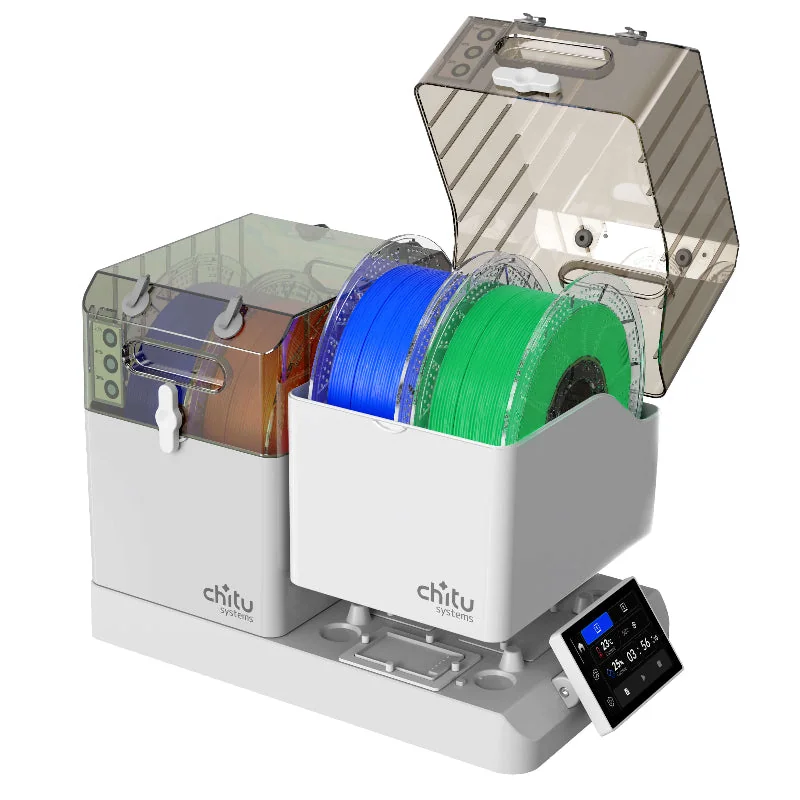
Chitu Systems FilaPartner E1 4-Spool Dual-Chamber Filament Dryer
By Chitu Systems · Filament Dryers · 3D Printing
- Independent 45-70°C (approx 110-160°F) PTC heater per chamber
- Heats 25°C to 55°C in 12 minutes fully loaded
- Auto-dry starts above 50% relative humidity and stops below 25%
Lowest price seen
$139.00
from $139.00 at MatterHackers · Checked Oct 2, 2026
- MatterHackers $139.00View at MatterHackers
- Chitu SystemsView at Chitu Systems
- eBayView at eBay
- eBay (used) eBay: used, open-box, refurbishedView at eBay (used)
- AmazonView at Amazon
Prices are snapshots. Check the current price with the store.
Summary
A 4-spool filament dryer built as a heated base plus two detachable chambers, each with its own heater and temperature setting, so two materials can dry at once and each box doubles as sealed storage. Check the touchscreen side and the checkout price, because the screen cannot be rotated and the store listings for the same configuration have differed by more than $50.
Strengths
- Two chambers run separate temperature and time settings, so two materials dry on their own profiles.
- The boxes unclip into stackable, magnetically sealed storage, so storage scales without a second base.
- Eight filament outputs feed four printers or a multi-material machine straight from the unit.
- Desiccant and humidity cards are reusable and regenerate during drying, so consumable cost stays near zero.
- A measured noise of about 50 dB is comparable to a quiet office.
- The detachable boxes are the single biggest advantage over fixed-chassis four-spool dryers.
Weaknesses
- The touchscreen sits on the side and cannot be rotated 90°, which is awkward on a shelf or under a printer.
- Chitu’s warranty excludes the LCD and calls it a consumable, leaving the only interface uncovered.
- The resistive screen sometimes needs repeated taps, so changing profiles is less polished than on a capacitive display.
- The desiccant bay is small, and owners print their own holders to fit more loose desiccant in.
- Outlet tubes can slip during longer prints and need checking, and the feed path can fight you until it is routed well.
- One owner reported a left chamber that stopped heating, with the local seller refusing warranty service; no failure rate exists.
Verified specifications
| Model | FilaPartner E1. |
|---|---|
| Chambers | two detachable filament boxes, two 1 kg spools per chamber, up to four spools total. |
| Spool fit | standard 1 kg spools up to 200 mm diameter, plastic or cardboard, on internal rollers. |
| Filament outputs | four per chamber, eight in total, with integrated PTFE and silicone outlet tubes. |
| Heating | one PTC heater per chamber, dual 120 W, 240 W combined rating. |
| Temperature | Chitu lists each chamber as 45–70 °C (110–160 °F); the MatterHackers and First Quadcopter tables list a settable range of 0–70 °C (32–158 °F), so the floor is unresolved. |
| Working environment | 5 °C to 45 °C, up to 90% relative humidity. |
| Heat-up | 25 °C to 45 °C in 5 minutes, and 25 °C to 55 °C in 12 minutes with four spools loaded, per Chitu. |
| Energy | 0.92 kWh over 11 days and 0.8 W standby, per Chitu citing 3ddrucklife; not independently verified. |
| Auto-dry | starts above 50% relative humidity and stops below 25%. |
| Silent mode | slower fan and about 30% less heating efficiency; the unit also drops into silent mode once a cycle reaches target humidity. |
| Sensors | a humidity sensor with live per-chamber readout, plus a fan-stall alert. |
| Box detection | presence switches stop heating for a chamber whose box is lifted off; eight alignment pins, four per box. |
| Storage mode | magnetic plates seal the air holes, rubber caps cover the outputs, boxes stack with anti-slip pads. |
| Humidity indication | a three-spot card per box marked 30%, 40% and 50% that goes from brown to teal. |
| Desiccant | reusable silica gel packs regenerated by the heat of a drying run; no replacement schedule published. |
| Controls | 3.5-inch resistive colour touchscreen on the side, tiltable but not rotatable, with presets, four memory slots, a °C/°F toggle, a screen-off timer and the firmware version. |
| Power | rear AC socket with a switch; the USB Type-C port is for firmware only and will not power the unit. |
| Power cord | listed at 1500 mm. |
| Dimensions | base 13.6 × 9.2 × 10.1 in (346 × 234 × 257 mm); each box 9.2 × 6.3 × 8.5 in (234 × 161 × 217 mm). |
| Noise | about 50 dB measured in one review, comparable to a quiet office. |
| Certification | CE, RoHS and FCC. |
| In the box | base unit, two filament boxes, two humidity cards, eight desiccant packs, four magnetic plates, four silicone feed tubes, power cord and quick-start guide. |
Full research notes and sources
Two chambers that turn into storage boxes
The modularity is the reason to look at this one. Each chamber sits on the base, takes two 1 kg spools and has four filament outputs, so a printer can be fed without decanting spools. When the filament is dry you lift a chamber off, snap the magnetic plates over the air holes, fit the rubber caps over the outputs, and the box becomes a sealed storage container with a humidity card and a desiccant pack inside. Chitu sells extra boxes separately, so storage scales without another base.
Owner reports line up with that. One owner in r/prusa3d says it fits exactly on top of a Prusa Core One and names the side-mounted LCD as the drawback; another in r/ElegooCentauriCarbon runs it as an active dryer with multi-channel feeding while printing ABS. Threads in r/3Dprinting show owners expanding the stock desiccant bay with printed parts, and MakerWorld hosts roughly 29 user models in a Chitu E1 collection, including desiccant holders, PTFE tube adapters, a hygrometer holder and a screen cover. The removable boxes are also what one reviewer called the biggest advantage over competing four-spool dryers.
Temperature control and drying behaviour
Independent per-chamber control is the feature that justifies the money, and it only matters if you dry two materials at different temperatures. Chitu lists each chamber as 45–70 °C, while two independent spec tables say 0–70 °C. The 45 °C figure is probably the recommended floor for filament rather than a hard limit, but neither source confirms it, so check the on-device menu before you plan around a low-temperature dry.
The headline speed numbers are Chitu’s own: 25 °C to 55 °C in 12 minutes fully loaded, 0.92 kWh over 11 days and 0.8 W standby, with the energy figures attributed to 3ddrucklife. No US lab has instrumented this model, and that underlying test was not reached. What first-hand evidence exists is modest. One reviewer dried a year-old opened, unsealed PLA spool for five hours and found the heavy stringing and adhesion problems gone afterwards, with no moisture figure published. Another ran PLA and PETG at once and printed from both sides with satisfactory results. The same reviewer who dried the old spool declined to claim the E1 dries better or faster than an ordinary dehydrator, because raising the temperature further risks damaging the filament.
Two daily-use quirks are documented. The resistive touchscreen sometimes needs more than one tap, and Chitu has said it was looking at firmware to improve responsiveness. And the tinted chamber plastic makes it harder to see how much filament is left at a glance. Owner-made screen-relocation brackets exist for the side-mounted display.
Running costs, parts and warranty
Electricity is a rounding error. Chitu’s 0.92 kWh over 11 days works out to roughly 0.08 kWh a day and about 2.4 kWh a month; repeated for a year it would be about 30.5 kWh. At the EIA’s July 2026 US residential average of 18.31 cents/kWh, that is about $5.59 a year. Desiccant packs and humidity cards are reusable and regenerate during a drying run, so there is no scheduled consumable spend. Filament is the real ongoing cost, then storage.
There are no published part numbers for the PTC heaters, fan, touchscreen, sensors or controller. Expansion boxes were $39.00 each as reported in December 2025, and the same page price appears again in October 2026. Chitu runs a product-specific warranty rather than a blanket appliance policy: missing parts ship free; if the team identifies a component-level fault it ships the replacement part free, and the page names the temperature and humidity circuit board; a unit confirmed non-functional is replaced at no cost. You pay return shipping in the first three months, and return shipping plus the part cost from three to twelve months, while boards carry one year. The term to notice is the screen: Chitu states the LCD has no warranty because it is a consumable.
Is it worth it?
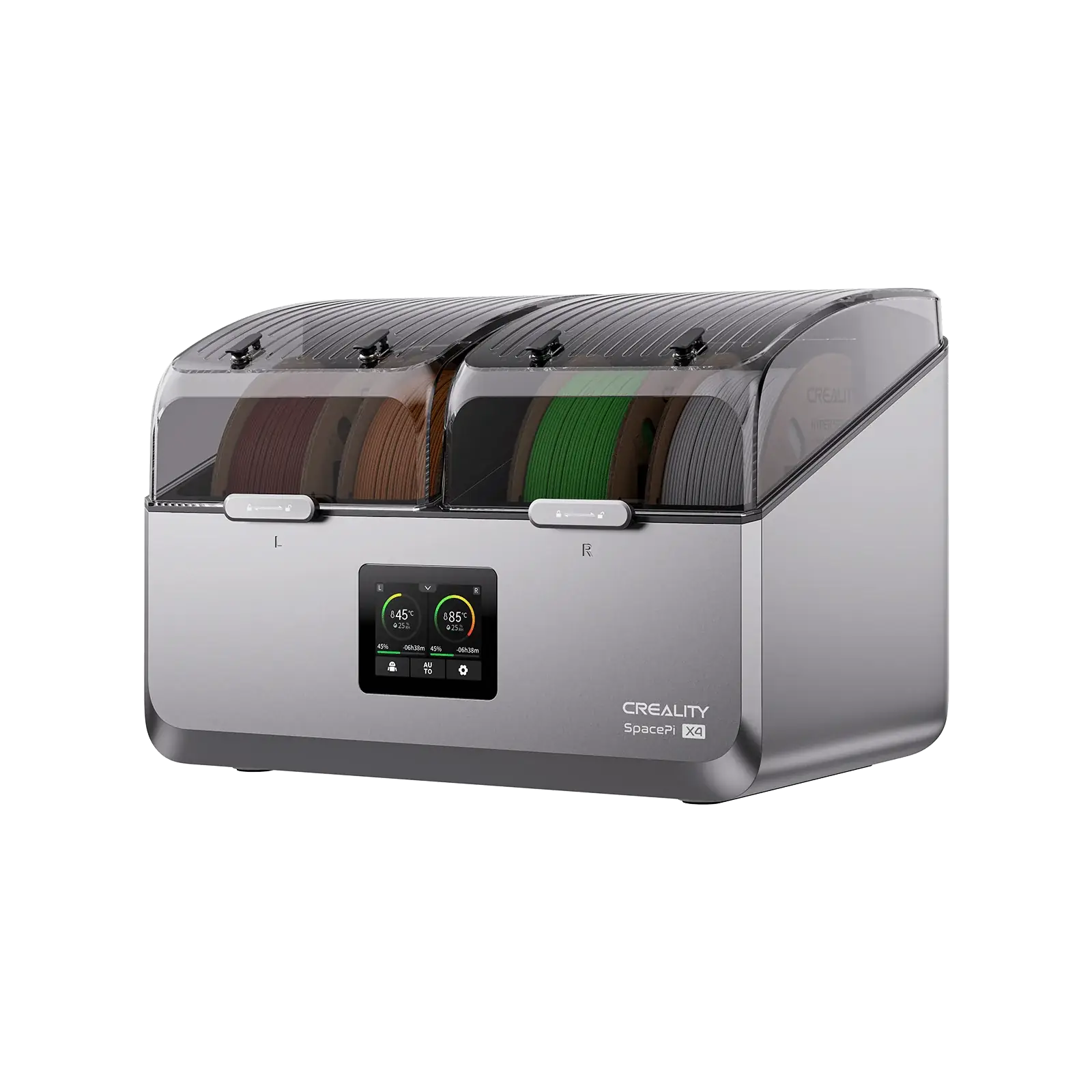
Around $119.99 to $139.00 it is well placed for someone who runs more than one material and wants storage as much as drying. First Quadcopter compared it with the Creality Space Pi X4, Sovol SH03, Sunlu S4, Caydo and BIGTREETECH ViViD, a $66 to $199 band with heaters rated up to 350 W, and none of those have chambers that detach into standalone boxes. The E1’s 240 W sits below the top of that range. More recent checks put the SUNLU FilaDryer S4 at $116.99, the SUNLU S4 Pro at $139.99 with an 85 °C maximum, and the Creality SpacePi X4 at $159.
The price is the whole problem. Checks in October 2026 found the same base-plus-two-boxes configuration at $138.99 reduced from $169.00, at $177.99 reduced from $218.00 on a separate page, at $119.99 to $139.00 indexed on Chitu’s homepage, and at $139.00 at MatterHackers. Above roughly $180 the modularity is being charged for twice, and a single-chamber dryer plus separate dry boxes can cost less. Owners with one material and one or two spools should look at the lower tier or a simpler box. If you already own a plain dehydrator, expect the win here to be storage and reviving wet filament, not speed.
Which model this is
This page covers the FilaPartner E1 4-spool base-plus-two-boxes configuration. Chitu’s documentation names the model string FilaPartner E1, and extra boxes are sold as the separate “One Dryer Box For FilaPartner E1” accessory. Do not confuse it with the single-box E1 Filament Dryer Box accessory or with other Chitu products such as the PlateCycler C1M. The ASIN is B0DYNQC46C.
Sources
Manufacturer:
- FilaPartner E1 4-Spool Dual-Chamber Filament Dryer product page
- E1 Filament Dryer technical documentation
- FilaPartner E1 user guide
- Chitu blog on the E1 drying and storage design
- Chitu warranty and shipping policy
- One Dryer Box For FilaPartner E1 expansion box
Independent reviews:
- Two removable boxes, four spools (First Quadcopter)
- FilaPartner E1 review (Gear Diary)
- FilaPartner E1 review (The Gadgeteer)
- Chitu Systems unveils FilaPartner E1 (All3DP)
- Chitu Systems and the FilaPartner E1 (3DPrint.com)
Retailer listings:
Owner reports: