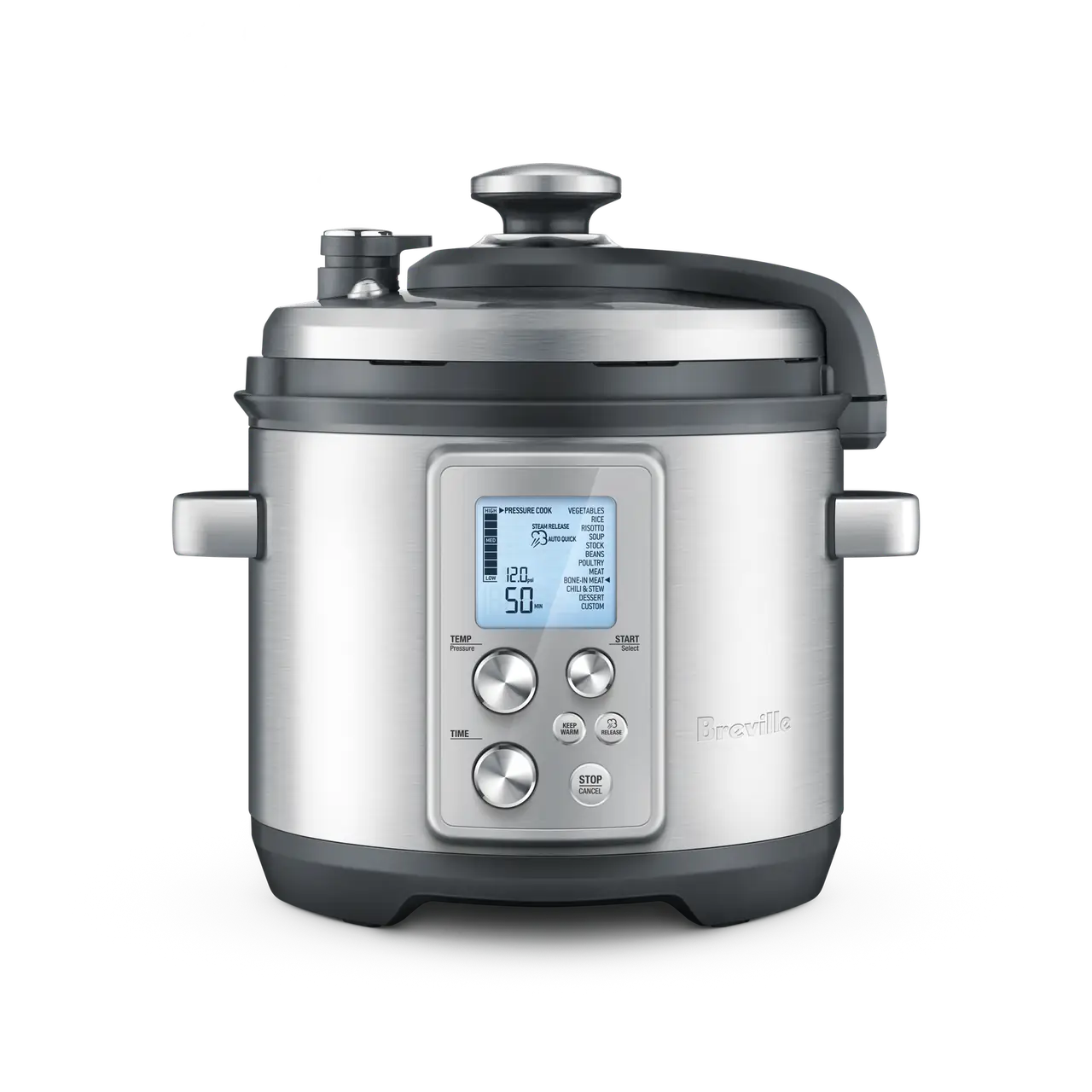
Breville the Fast Slow Pro 6Qt
By Breville · Pressure Cookers · Kitchen & Cooking
- 6 qt ceramic-coated cooking bowl, PFOA- and PTFE-free
- 8 pressure levels from 1.5 psi to 12 psi
- 11 pressure cook settings plus slow cook from high to low
- 12 in W x 12 in D x 13 in H
Lowest price seen
~$329.95 (approx.)
from $329.95 at Amazon
- Amazon ~$329.95 (approx.)View at Amazon
- BrevilleView at Breville
- Salt Kitchen & CoView at Salt Kitchen & Co
- eBayView at eBay
- eBay (used) eBay: used, open-box, refurbishedView at eBay (used)
Prices are snapshots. Check the current price with the store.
Summary
A 6-quart countertop multicooker that runs six automatic modes and starts its own steam release, built for people who mostly want slow cooking, steaming and rice. The thing to check before you commit is whether the screw-down lid seals on your counter: that is the most-documented fault owners report, and it lands on pressure cooking.
Strengths
- Owner scores put slow cooking at 4.8, steaming at 4.5 and rice at 4.2 — not the modes the marketing leads with.
- Steam release is chosen per program and starts itself from a panel button, so you don’t stand over the valve.
- One owner says the rice beats every dedicated rice cooker they have owned; another reports 5-8 uses a week over roughly two years without trouble.
- Owners call the build sturdier than cheaper multicookers, and one swapped out a pressure cooker whose release had broken and found this one still looked new after a year.
- The lid unthreads from a fixed arm, so you lift the top off the bowl instead of tipping a sealed hot pot.
- Altitude compensation to 6,000 ft and a 140°F keep-warm for up to four hours are both documented in the manual.
Weaknesses
- The lid does not hold pressure for a large share of owners: one puts failure at roughly 70% of pressure attempts, another at 80%, another at 5 failures in 8.
- An E0 error that owners trace to a broken wire at the top lid sensor; at least three have resoldered it themselves, one of them an electrician.
- Reaching pressure is slow in owner reports — 15-20 minutes, about 20 minutes before the float pin lifts, and 30 minutes of preheat on one 7.5 psi vegetable cook.
- Breville’s reported answer to that fault was a discount on a new unit once warranty had run out, not a repair.
- The ceramic bowl is the part owners name as the first to go, and Breville reportedly said the smaller Fast Slow Go’s stainless bowl does not fit.
- Nobody has measured this model, and neither the product page nor the 88-page manual publishes a weight or wattage figure.
Verified specifications
| Model | BPR700; US brushed-stainless variant BPR700BSS, 120 V. |
|---|---|
| Capacity | 6 quart (6 L) removable ceramic-coated bowl; the MAX fill marking is 4.5 quarts. |
| Automatic modes | 6 Smart Settings — Pressure Cook, Slow Cook, Steam, Sear, Sauté and Reduce. |
| Pressure levels | 8, from 1.5 psi to 12 psi. |
| Pressure programs | 12 menu entries, each with its own pressure, time and release method — Dessert 3.0 psi, Risotto 6.0, Vegetables and Rice 7.5, Soup and Poultry 9.0, Chili & Stew 10.5, Beans, Meat, Bone-in Meat and Stock 12.0, Custom 1.5. |
| Steam release | 3 methods (Auto Quick, Auto Pulse and Natural), picked when you set the program and started from a panel button; holding RELEASE opens the valve for 30 seconds. |
| Keep warm | holds food at 140°F/60°C or above, 2 hours by default and 4 hours at most. |
| Altitude | adjustable from 1,000 ft to 6,000 ft in 1,000 ft steps; the manual says not to use it above 6,500 ft. |
| Stop/cancel | pauses a cycle for up to 5 minutes, then drops to standby; with pressure still present it switches to Natural release. |
| Sear | 45 minutes maximum per cycle. |
| Fill discipline | the manual sets liquid and solid amounts per program and forbids cooking without liquid. |
| Display | LCD with pressure, temperature, countdown and steam-release indicators; blue when idle, orange when preheating, cooking or keep-warm, and it shows psi. |
| Dimensions | 12 × 12 × 13 in (W × D × H), brushed stainless steel. |
| Lid | stainless steel with a three-way safety system; the hinged lid is removable and dishwasher safe. |
| In the box | stainless steel steamer basket, stainless rack, and a 41-recipe book. |
Full research notes and sources
Lid sealing and the E0 fault
This lid does not flip and lock. You fit a silicone gasket around a wire ring and screw a knurled sealing nut down over it, and after the lid has been through the dishwasher the gasket has to be pressed evenly back into that ring every single time. The manual’s cleaning section is hands-on for exactly that reason: pull the gasket out of its ring, unscrew and wash the sealing nut and the pressure release valve, then inspect the safety locking pin, the pressure release valve and cover, and the pressure safety valve.
Owners describe the result as a sealing problem rather than a cooking problem. Across about seven years of feedback on an Australian review platform, the recurring story is a unit that stops mid-cook and declares the lid not secure, steam escaping at the joint between the lid and the handle arm, and a wobbly lid that gets worse with use. Some owners quantify it: roughly 70% of pressure attempts failing, 80% of the time reaching pressure before a lid-not-secure cutoff, 5 failures in 8 attempts, and one unit that gave up after about ten uses. Replacement gaskets, reseated seals, tightened nuts and aligned pins are reported as fixes that often did not restore sealing. Two workarounds tell you how serious this is — one owner raises the float pin by hand with a chopstick to force pressure, another rocks the lid back and forth to coax a seal after a new gasket did nothing.
The second cluster is an E0 or EU fault. Owners trace it to an open circuit at the top lid sensor, and at least three of them, one an electrician, have opened the lid compartment and resoldered the broken wire themselves, calling it a design flaw because it recurs so often. That is not a service procedure, no Breville page documents it, and the warranty terms void coverage for work done by anyone Breville has not authorized. Reported cases include a unit flashing E0 constantly after about 18 months and around 10 uses, a unit showing EU, and one that would not power on at 14 months. Heating failures sit alongside them: units stuck on preheat across several settings, an element that stopped after two years of light use, and a slow cook that produced lukewarm food. Nobody has published a failure rate for any of it, so treat these as documented patterns rather than odds.
Cook cycles, release and time to pressure
The eight pressure levels are a menu range rather than a measured output. Nothing available measures achieved pressure at any setting, and 12 psi is below the ~15 psi many stovetop pressure cookers reach. What the manual does give you is real differentiation across the levels, with a recommended time and release method on every program: Rice at 7.5 psi for 5 minutes, Soup at 9.0 psi for 15, Beans at 12.0 psi for 20, Stock at 12.0 psi for 60.
Release is the feature nothing else in this class matches. Pick Quick, Pulse or Natural when you set the program, and the unit starts the release itself at the end of the cycle from a button on the front panel. Holding RELEASE opens the valve by hand for 30 seconds. Owners with sealing trouble report falling back to lifting the release valve with a cloth because the automatic release did not work on their unit, and the manual notes that if pressure is present when the unit drops to standby it switches itself into Natural release. The float valve sits recessed in a hole in the handle, which the one hands-on reviewer calls hard to see, and steam occasionally bursts during preheat. The “Easy Clean Moat” is an external channel, not a self-cleaning system.
Time to pressure is the practical cost of the same design. Owners report about 20 minutes before the pin lifts, 15-20 minutes to build pressure, about an hour for 1.5 litres of liquid, and one BPR700BSS owner who measured 30 minutes of preheat on a 7.5 psi, 8-minute vegetable cook and found the vegetables and a litre of water still cold at the end. The same owners report the automatic release dropping from about 80 kPa in roughly 5 minutes. Whether that split is a deliberate pressure-release-versus-pressure-build tradeoff or a design compromise is not settled by any measurement available here.
Running costs, parts and warranty
The gasket, sealing nut, pressure release valve, safety locking pin and the bowl are the wear items the manual expects you to service or inspect yourself. No Breville page confirms which of them you can order for this model or at what US price. One owner was quoted $65-69 for a replacement lid and told the safety-pin seal, roughly a 10-cent part, cannot be sold separately; they declined and kept the original. Another reports a three-month wait for a part under warranty service.
Electricity is unknowable. The product page and the 88-page manual state only that it wants a 120 volt outlet, with no wattage or ampere rating anywhere, so nobody can tell you what one cycle costs to run.
The warranty is published in full except for the one number that matters. Breville’s terms cover only products bought and used in North America, are limited and non-transferable, are void for commercial use, and are void where damage comes from normal wear, from use outside the manual, or from repair by anyone Breville has not authorized. Proof of purchase is a receipt showing model number, payment and date. Breville chooses the remedy — repair, replacement or refund of the original price — and a repaired unit is warranted for the balance of the original term or 90 days, whichever is longer, with stated turnaround of up to 10 business days plus shipping. But no length is given on the warranty page, and the BPR700 product page states none either. One owner reports being told their unit carried a 12-month term, but that is a single Australian account. Ask Breville before you buy rather than assume.
Is it worth it?
Breville lists the Fast Slow Pro at $329.95 direct (October 2026). No third-party US retailer price was verified, so that is the only anchor there is. Check the store panel above for current prices.
Buy it if you mostly want slow cooking, steaming and rice. That is where the owner record is strongest, and the same owners report cooking results good enough for 5-8 uses a week over roughly two years. Treat pressure cooking as a bonus you may or may not get to use.
If pressure cooking is the reason for the purchase, this is not a well-evidenced buy at list. The single independent hands-on test of the exact model was published in October 2017, contains no cook times, no pressure or temperature measurements and no scores, and on-site searches at Tom’s Guide and TechRadar return no pressure-cooker results for it. The Wirecutter’s pressure-cooker guide covers stovetop models only and does not mention Breville. So there is no measured pressure accuracy, temperature stability, time-to-pressure or keep-warm figure to check the machine against.
Value depends on what you pay. At or below about $200 the risk is easy to resolve, because a sealing failure shows up early and you can return the unit. Around $200-260 it is fair if you accept that sealing may need attention. At $260-300 it is weak, because you would be paying near list for the modes owners score lowest and for a lid-wiring fault nobody has put right. Above $300, including the $329.95 Breville charges, the value is poor on the evidence available. Wherever you buy, check the return window, because sealing problems often appear only after the third or fourth cook.
Which model this is
This page covers the US brushed-stainless BPR700BSS, a 120 V machine sold as ASIN B013I40R8E, together with its US/Canada manual. Two neighbours get confused with it: the Sage SPR700 is the same platform sold under a different brand with its own booklet, and the Fast Slow Go is a smaller, later machine with a different capacity and a different bowl, so owners hoping to reuse that bowl are told the parts do not fit. No hardware or control-board revision for this model appears on the manufacturer page, in the manual or in owner discussion, and it is not established whether the US unit and the non-US BPR700 share one bowl, heater and lid-sensor design.
Sources
Manufacturer:
- Breville the Fast Slow Pro instruction manual, US/Canada (BPR700), PDF
- The Fast Slow Pro product page (BPR700)
- Breville’s Limited Product Warranty
Independent reviews:
Owner reports:
- Breville the Fast Slow Pro BPR700 owner feedback (ProductReview.com.au)
- BPR700 owner questions and answers (ProductReview.com.au)
Coverage checks: