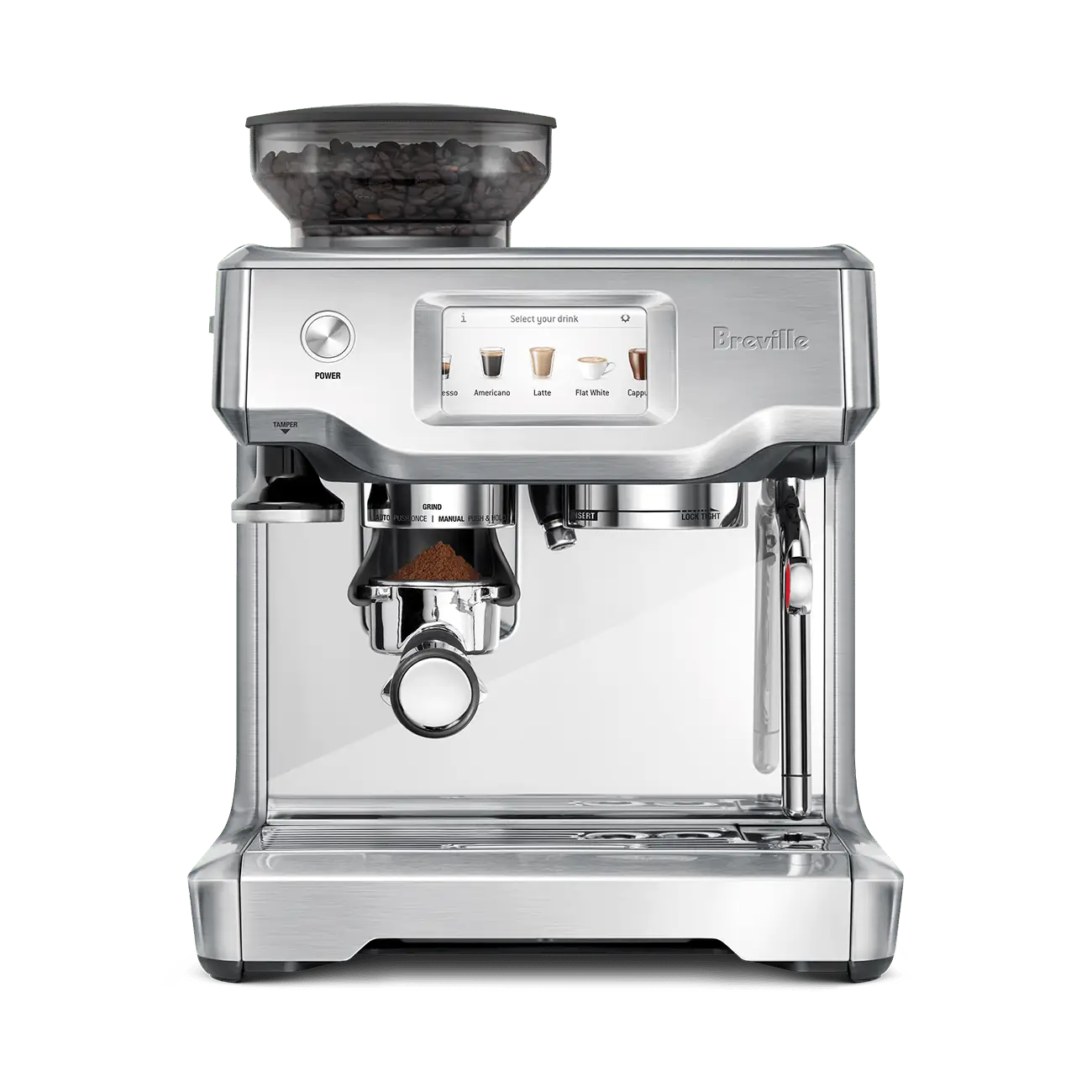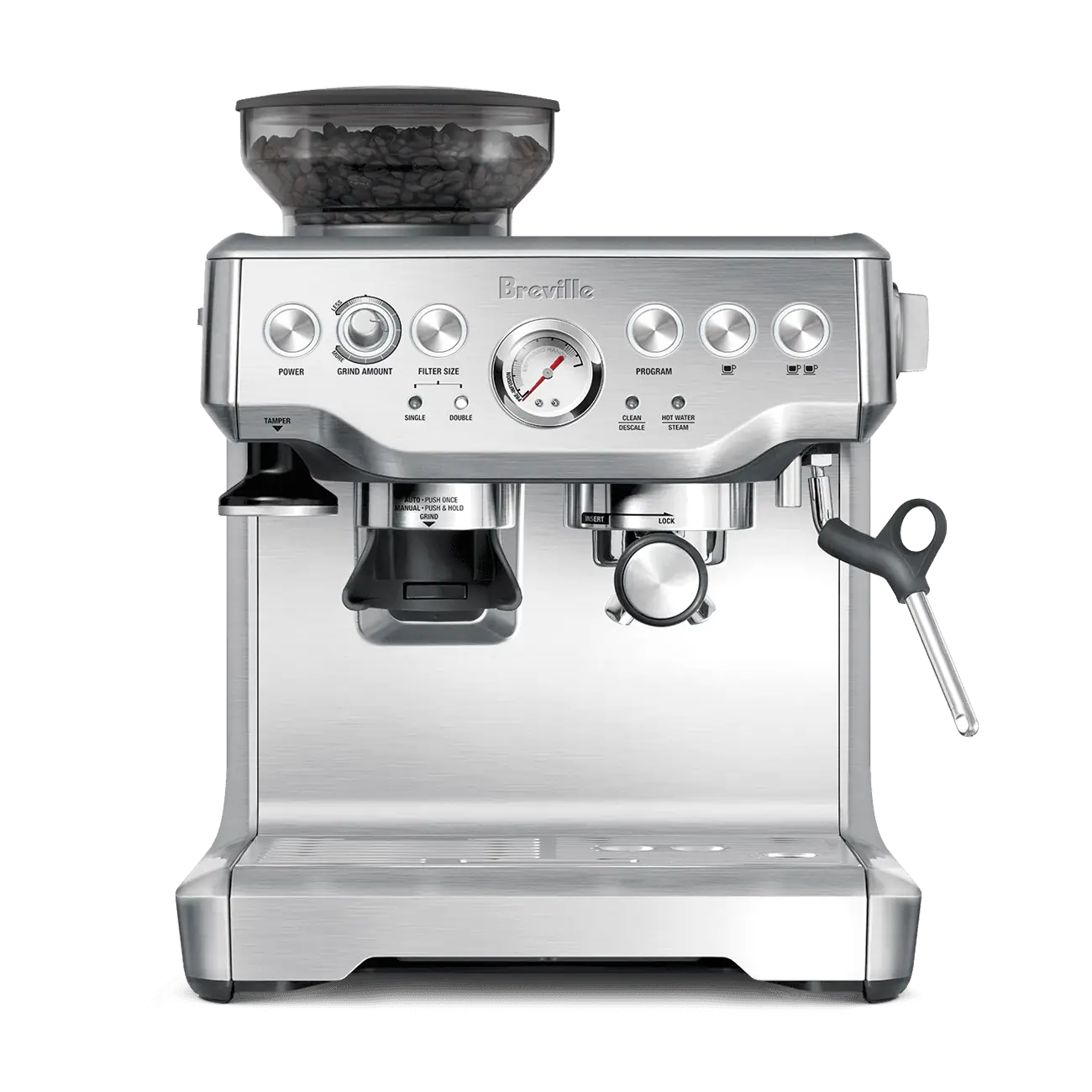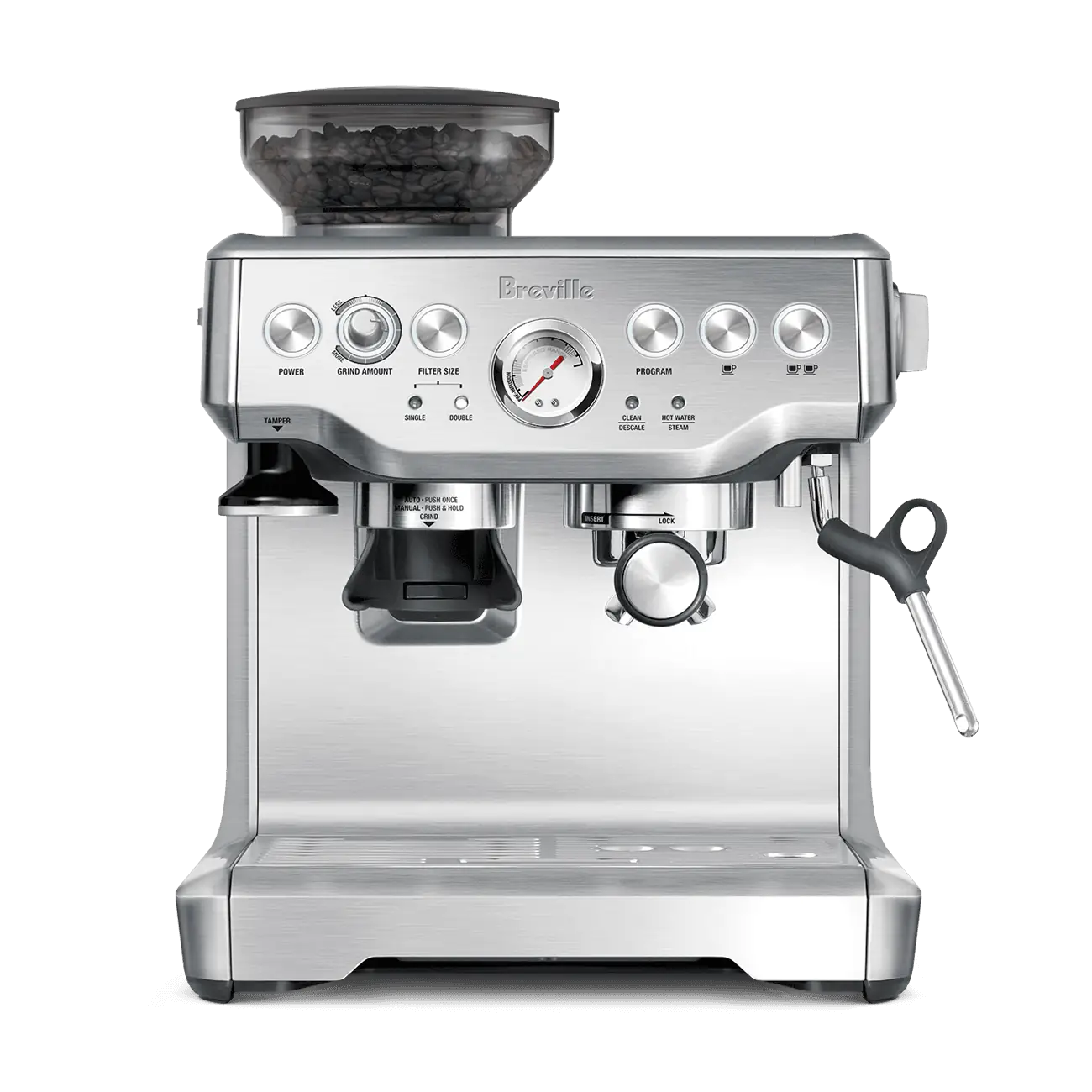
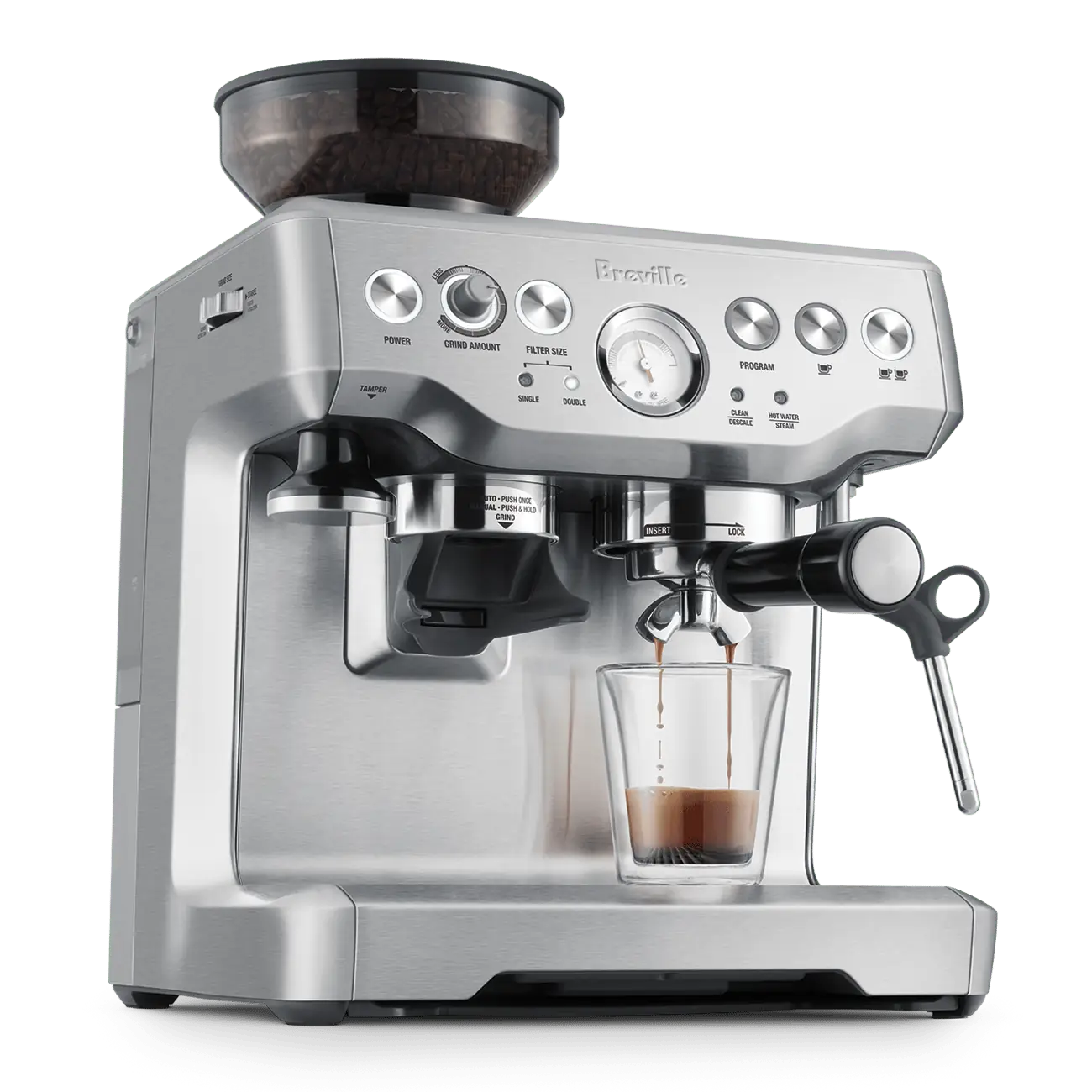
Breville Barista Express Espresso Machine BES870XL
By Breville · Espresso Machines · Kitchen & Cooking
- Integrated conical burr grinder with grind-size dial and dose control (19-22 g)
- 15 bar pump with Thermocoil heating
- Water tank: 67 oz (2 L) removable with water filter
- 4 filter baskets: single/double wall, 1- and 2-shot
Lowest price seen
$499.95
from $499.95 at P.C. Richard & Son · Checked Oct 5, 2026
- P.C. Richard & Son $499.95View at P.C. Richard & Son
- BrevilleView at Breville
- eBayView at eBay
- eBay (used) eBay: used, open-box, refurbishedView at eBay (used)
- AmazonView at Amazon
Prices are snapshots. Check the current price with the store.
Summary
A semi-automatic espresso machine with a built-in conical burr grinder, built for home baristas who want grinder, espresso and steam in one stainless steel body. Check the grinder’s limits and the group-head leak history on 2019-2022 units before you buy.
Strengths
- Tom’s Guide gave it Editor’s Choice for espresso quality and milk frothing.
- Shots improve with practice; a March 2026 specialist review reports balanced, complex results.
- The pressure gauge, adjustable PID and manual steam wand give direct feedback while you learn.
- Everything needed to start ships in the box — grinder, portafilter, tamper, dosing funnel, jug and cleaning supplies.
- Breville sells a full replacement-parts catalog for the model, which is unusual for a consumer espresso machine.
- At the $499.95 sale price it is the cheapest Breville with an integrated grinder.
Weaknesses
- The integrated grinder is the weak spot, with less adjustment resolution than dedicated grinders.
- A 2019-2022 production flaw can cause group-head leaks; the documented repair needs disassembling over 80% of the machine.
- No low-water warning, so the machine runs the tank dry without telling you.
- The stainless body picks up fingerprints and coffee splatter.
- Heat-up and steam transition are slower than on Breville’s newer ThermoJet machines, and it cannot brew and steam at the same time.
- Owners report grinder failures, from a feed that stalls with beans loaded to a motor that quit inside a year; nobody publishes a failure rate.
Verified specifications
| Model | BES870XL, US 120 V, part of Breville’s BES870 family. |
|---|---|
| Dimensions | 15.9 × 13.1 × 12.4 in (W × D × H). |
| Weight | 22.09 lb (10.018 kg). |
| Electrical | 120 V ~ 60 Hz, 1750 W per the instruction book rating plate; Breville’s product page lists 1600 W. |
| Grinder | integrated steel conical burr with 16 external grind settings and an adjustable upper burr. |
| Dose | Breville designs the 54 mm portafilter around a roughly 18 g dose, with grind-and-dose by filter size and a manual override. |
| Bean hopper | 8.8 oz (250 g) with a locking removal system. |
| Water tank | 67 fl oz (2 L) removable, with a replaceable water filter. |
| Pump | 15-bar Italian pump; Breville states a 9-bar extraction after low-pressure pre-infusion. |
| Heating | Thermocoil with PID temperature control targeting 200°F, adjustable in 4°F steps through Advanced Temperature Mode. |
| Baskets | four included — 1-cup and 2-cup, single-wall and dual-wall. |
| Steam and hot water | 360° swivel steam wand and a dedicated hot-water outlet. |
| Included | dosing funnel, Razor dose-trimming tool, integrated tamper, milk jug, cleaning disc and tablets, cleaning brush, tool and Allen key, water-filter holder and filter. |
| Warranty | one year on Breville’s current US product page. |
Full research notes and sources
The grinder question
The brewer side is well regarded; the grinder is not. An r/espresso discussion calls the machine “a great brewer with a sub-par grinder” and the grinder “definitely a weak spot” with part tolerances below dedicated grinders. A specialist reviewer finds the 16-step dial usable but limiting because it lacks fine micro-adjustment between clicks, which makes exact dial-in harder with some beans.
Owner reports in 2026 point at the same part. One owner had a grinder fail inside a year with a high-pitched motor or gear noise; another had a grinder that ran empty but stalled as soon as beans were loaded; a third, on a roughly four-year-old machine, described repeated chute and feed failure despite deep cleaning, burr adjustment, different beans and a new felt washer. Not every stall is a failed motor: Breville’s manual lists oil buildup, blocked chambers and chutes, moisture and burr cleaning as troubleshooting steps.
Group-head leaks and repairs
A parts supplier documents a manufacturing flaw on 2019-2022 units: the five screws holding the group-head collar were fitted without threadlocker, so vibration and pressure loosen them and cause leaks even after a new gasket. The documented repair requires disassembling more than 80% of the machine. A CoffeeSnobs repair thread supports the same mechanism, with one owner saying an authorized Breville repairer referenced a bulletin, tightened the screws, applied Loctite and stopped the leak. A separate JustAnswer case records a machine that kept leaking after an official gasket replacement, with a portafilter that had to be rotated well past the 6 o’clock position to seal. These are signals, not defect rates, but they are the two things an owner should know before buying.
Parts, upkeep and running costs
Breville sells the exact-model parts directly: a shower-head seal for $6.95, a precision burr assembly for $31.95, an upper burr for $19.95, a felt washer for $7.95, a portafilter assembly for $39.95, a water tank for $24.95 and a bean hopper for $19.95 (Breville, 2026). Cleaning supplies run to a six-pack of water filters for $29.95, an eight-pack of cleaning tablets for $14.95, a six-pack of descaler for $19.95 or a twelve-pack for $34.95, a six-pack of group-head cleaner for $11.95 and a six-pack of steam-wand cleaner for $14.95.
The only predictable fixed consumable is water treatment. At Breville’s two-month filter schedule the six-pack covers about a year, so that is roughly $29.95 a year; owners who use filtered or bottled water can remove the internal filter and spend less. Cleaning tablets and descaler are driven by the machine’s indicator light, not a calendar, so a fixed annual figure would be invented. Electricity is small: at the 1750 W rating, ten minutes of full-power use a day works out to about 106.5 kWh a year, roughly $19.49 at the July 2026 US residential average of 18.31 cents/kWh. Beans and milk dominate real operating cost, and there is no capsule or pod lock-in.
Is it worth it?
At $499.95 from Breville and Williams Sonoma (2026) it is the cheapest way into a Breville with a built-in grinder, and a defensible buy for someone who wants one machine and will maintain it. Above about $600 the math changes: the Barista Express Impress is $649.95, and a Bambino Plus at $399.95 plus a Baratza Encore ESP at $199.95 comes to about $599.90 while giving a separate, upgradeable grinder. A Barista Pro is $849.95. Best Buy has indexed the machine between $615.74 and $699.95 and Target lists it at $699.99, so the discount is the whole case. Budget- or counter-limited buyers should pick the Bambino Plus, as Tom’s Guide advises, and anyone who needs quiet operation, a low-water warning or a long-term service-grade grinder should not choose this model.
Which model this is
This page covers the Breville Barista Express BES870XL in brushed stainless steel, US 120 V. Breville also sells a BES870CBXL variant. Do not confuse it with the Barista Express Impress BES876, the Barista Pro BES878, the Oracle or the Bambino. Breville’s current product page puts the warranty at one year, while an older generic North American document says two; for a new purchase, rely on the model-specific page. The instruction book supplied on the US page is a combined EN / FR-CA / ES-MX document.
Sources
Manufacturer:
- Breville the Barista Express BES870 US product page
- Breville Product Hub for the Barista Express — tutorials, cleaning guides, parts and warranty
- Breville Barista Express BES870 instruction book (PDF)
- Breville US Limited Product Warranty page
Independent reviews:
- Tom’s Guide: Breville Barista Express review
- Coffeeness: Breville Barista Express review, March 2026
- WIRED: Breville Barista Express Impress review
Owner reports:
- r/espresso: Advice Needed, Breville BES870xl — grinder critique
- Home-Barista.com: BES870XL grinder jam followed by flashing indicator lights
- Barista Parts: group-head leak on BES870XL from 2019-2022 units
- JustAnswer: repeated group-head leaks on BES870BSS after gasket replacement
- CoffeeSnobs: group-head repair and Breville bulletin report
- r/BrevilleCoffee: BES870XL grinder failed in under one year
- r/BrevilleCoffee: BES870XL grinder stalls under bean load
- r/espresso: four-year Barista Express grinder feed failure
- r/espresso: five years with the Breville Barista Express