BLTouch 3D Touch Sensor Auto Bed Leveling Sensor
By BLTouch · 3D Printing Accessories & Scanners · 3D Printing
- Voltage: 5V
- Operating current: 15mA (standby), max 300mA
- Repeatability standard deviation: ~0.005mm
- Cable length: 150mm
- Net weight: 10g
Price not listed
- BLTouchView at BLTouch
- eBayView at eBay
- AmazonView at Amazon (paid link)
- eBay (used) eBay: used, open-box, refurbishedView at eBay (used)
Stores are listed in a fixed order, never by price or commission. Prices are snapshots. Check the current price with the store.
Summary
A contact, hall-effect auto bed leveling probe for 3D printers that works on any bed surface. Check your wiring before you buy: it runs on 5 V only, and 12 or 24 V destroys it instantly.
Strengths
- Works on any bed surface because it is a contact probe, not inductive.
- Manufacturer-stated repeatability ~0.005 mm; one hands-on test measured ~0.0013 mm.
- A crash snaps the sacrificial polycarbonate pin, which costs $2.99 to $8.99 to replace (reseller listing, 2026).
- Broad board compatibility via RC servo signal.
- Self-test and alarm at power on.
- Long service life reported by some owners.
Weaknesses
- Clone units are common and often inconsistent or non-deploying.
- Not plug-and-play on all boards; firmware configuration required.
- Mounting errors (probe body too low) can drive the nozzle into the bed.
- Electrical noise can cause intermittent triggering when the cable runs with hotend power or fan wires.
- Fixed body, solenoid and PCB are not field-serviceable; only pins and cables are replaceable.
- Solenoid temperature limit ~0-45°C is cited by a comparison site, not the manufacturer.
Verified specifications
| Model | BLTouch Smart V3.1, hall-effect variant. |
|---|---|
| Supply voltage | 4.8-5.1 V (commonly 5 V). |
| Current | 15 mA standby; up to 300 mA peak. |
| Z probe output | open drain (default) or 5 V logic; max 5 V / 300 mA. |
| Repeatability | standard deviation ~0.005 mm (manufacturer). |
| Cable length | 150±5 mm. |
| Weight | 0.35 oz (10 g). |
| Case and push pin | polycarbonate. |
| PCB | OSP, lead-free. |
| Z trigger stroke | up to 1.6 mm longer than V2.0. |
| Solenoid conduction | ~100 ms to deploy/stow; no current to hold position. |
| Logic voltage | 3.3 V or 5 V via EEPROM. |
| Self-test | pin operates 3 times at power on; alarm LED on fault. |
| Bed compatibility | any surface (glass, PEI, metal) via Hall-effect contact sensing. |
| Control | RC servo signal; compatible with most 3D printer boards. |
| Manufacturer | ANTCLABS Inc., Seoul, South Korea. |
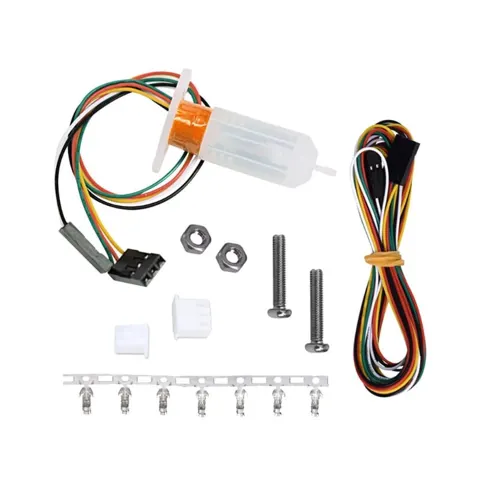
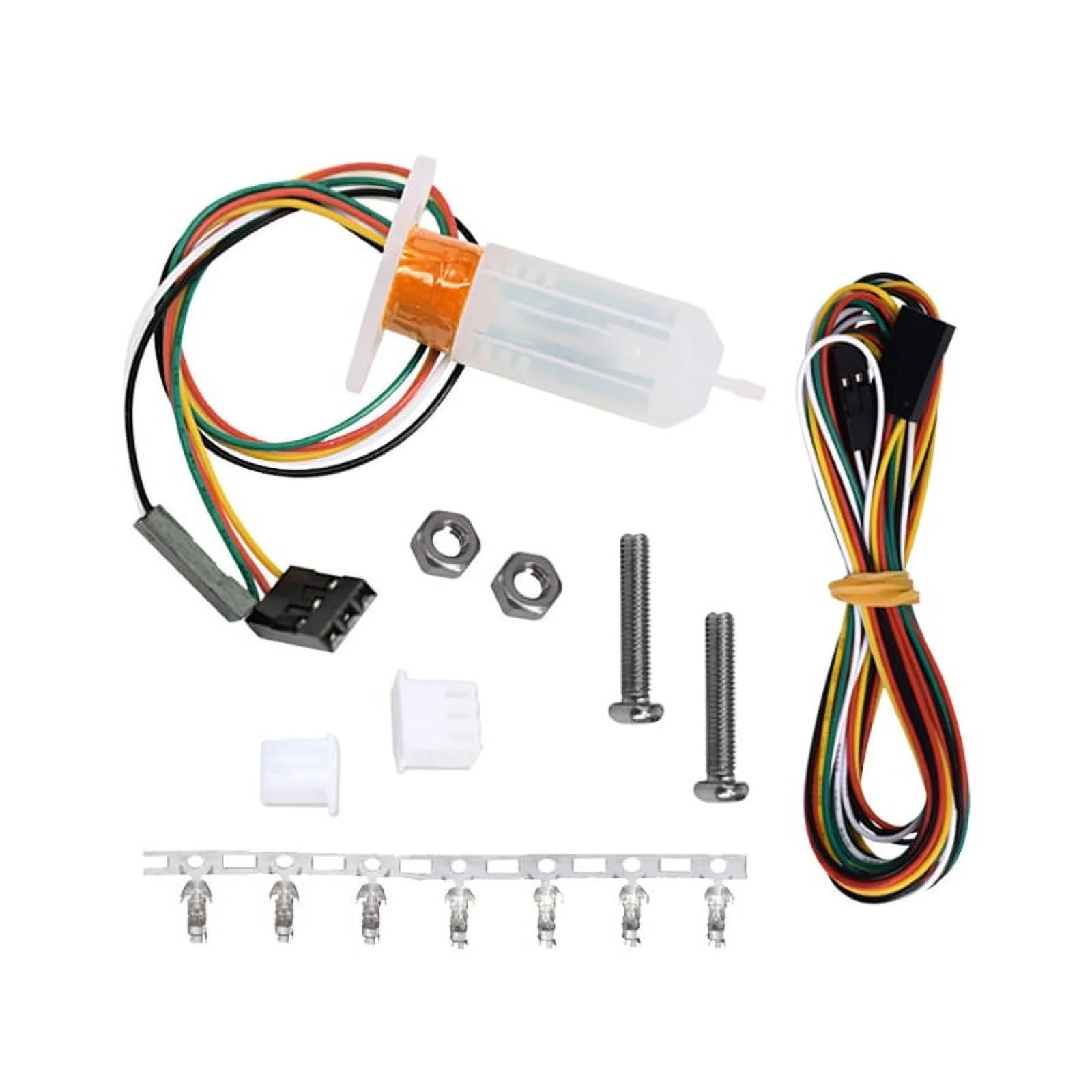
| In the box | 1 BLTouch, 2 screws/nuts/washers, 2 mounting springs, Dupont housing shells (3-pin ×2, 2-pin ×2, 1-pin ×2), 10 Dupont terminals, 1 jumper cap. |
Full research notes and sources
Bed compatibility and repeatability
BLTouch deploys a polycarbonate pin that touches the bed and triggers a Hall sensor, so it works on glass, PEI, metal or any other surface and is unaffected by bed conductivity or temperature the way inductive probes are. ANTCLABS rates repeatability at ~0.005 mm standard deviation. One hands-on tester (The 3D Printer Bee) ran the Marlin M48 probe repeatability test and recorded a mean standard deviation of 0.001293 mm over 5 runs of 10 measurements each on an Ender 3 V2, with no measurable drift after several hundred hours. Sample sizes are small and methods differ, so treat these as signals, not benchmarks. For comparison, UAVMODEL lists BLTouch ±0.005 mm, CR-Touch ±0.005 mm, SuperPINDA ±0.002 mm (metal bed only), Klicky microswitch ±0.001 mm (DIY), and generic inductive ±0.05-0.10 mm.
Setup and common failures
BLTouch is a contact probe: the pin must be perpendicular to the bed, and the probe body must sit 2-3 mm above the nozzle tip so the pin triggers before a crash. It runs on 5 V logic only; wiring to 12 or 24 V destroys the sensor instantly. Common failure modes are bent or stuck pins, dust or dirt, an over-tightened magnetic screw, wiring or connector faults, firmware misconfiguration, defective or clone units, and mainboard faults. Intermittent triggering can come from electrical noise when the cable is routed alongside hotend power or fan wires; ANTCLABS recommends anti-interference (shielded or twisted) cable where noise is expected. Extension cables are often needed because the retail cable is 150±5 mm; many third-party kits add one.
Maintenance, repair and warranty
Keep the pin clean and straight, adjust the magnetic screw in small increments, use M48 to verify repeatability, and clean the pin and case with electronics cleaner; re-magnetize the screw and pin if precision degrades. Repairability is decent for the price class: replacement pins cost $2.99 for a 2-pack to $8.99 single, and extension cables run $4.99 to $8.99 (reseller listings, 2026), but the body, solenoid and PCB are not field-serviceable. ANTCLABS guarantees a 30-day refund after receiving BLTouch for direct purchases; defects are repaired, replaced or refunded through the store of purchase, with liability limited to factory price and disputes governed by Korean law. Direct sales are suspended, so most US buyers depend on reseller return policies. Genuineness can be checked via serial and QR code on the PCB at id2db.com/genuine.php.
Is it worth it?
Genuine BLTouch V3.1 units sell around $35 from US resellers; KB3D lists the V3.1 at $34.99 (out of stock at check). At ~$35 the genuine BLTouch V3.1 is the reference contact probe: it works on any bed surface, carries the manufacturer’s ~0.005 mm repeatability rating, and has a documented genuine-verification path and reseller network. Clones cost less but lack support and consistency. Buy genuine BLTouch when the bed is non-metal or when manufacturer verification matters, and verify genuineness on receipt. Replacement pins run $3 to $9 after a crash, so ongoing cost is occasional pins rather than a subscription.
Which model this is
This page covers the BLTouch Smart V3.1 hall-effect probe, the current standard retail unit from ANTCLABS. BLTouch has multiple revisions (Classic, Smart V1.x, V2.x, V3.0, V3.1) plus a separate optical-sensor variant and other hall variants that are non-orderable or custom. Do not confuse it with clones sold as “3D Touch”/“TL Touch” or with the Creality CR-Touch, which uses an optical sensor and a metal pin with a different connector. Genuine units carry a QR code and serial number on the PCB verifiable via ANTCLABS’s validation tool (id2db.com/genuine.php); clone prevalence is a documented issue. Direct ANTCLABS sales are suspended, so US buyers use authorized resellers. The Amazon listing for this family is ASIN B0FQNLY4BN.
Sources
Manufacturer:
- ANTCLABS BLTouch V3.1
- ANTCLABS BLTouch (general)
- ANTCLABS manual page
- BLTouch Smart V3.1 manual PDF
- ANTCLABS version history
- ANTCLABS legal / warranty
- ANTCLABS store / resellers
- ANTCLABS BLTouch vs other sensors
Independent reviews:
Owner reports:
- EEVblog BLTouch fault thread
- Duet3D BLTouch deploy/retract issues
- Klipper discourse BLTouch clone issues
- Reddit r/ender3 spotting a fake BLTouch
- Reddit r/3Dprinting genuine vs non-genuine BLTouch
- Reddit r/klippers BLTouch accuracy questions
- Reddit r/klippers BLTouch failed to deploy
- Reddit r/ender5plus BLTouch suddenly doesn’t work
Parts and stores: