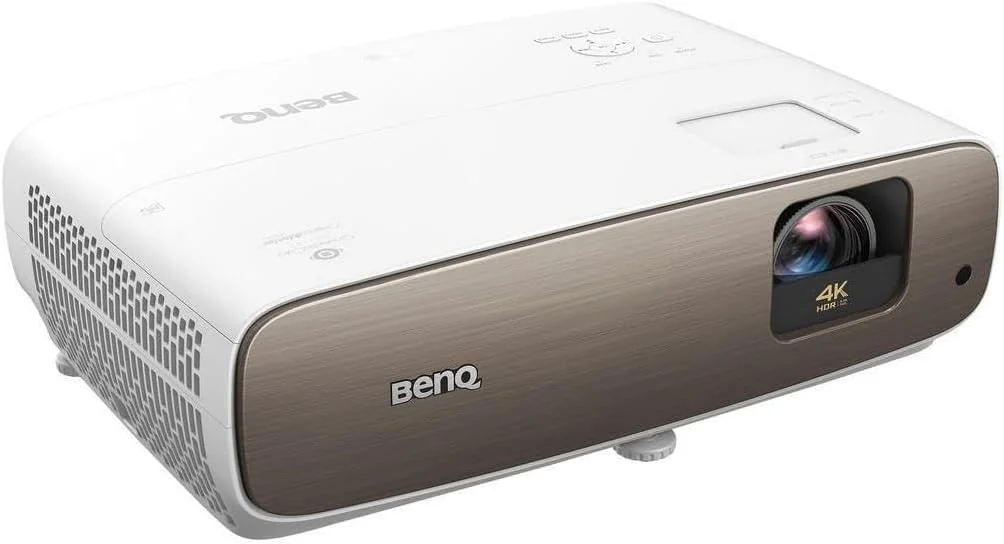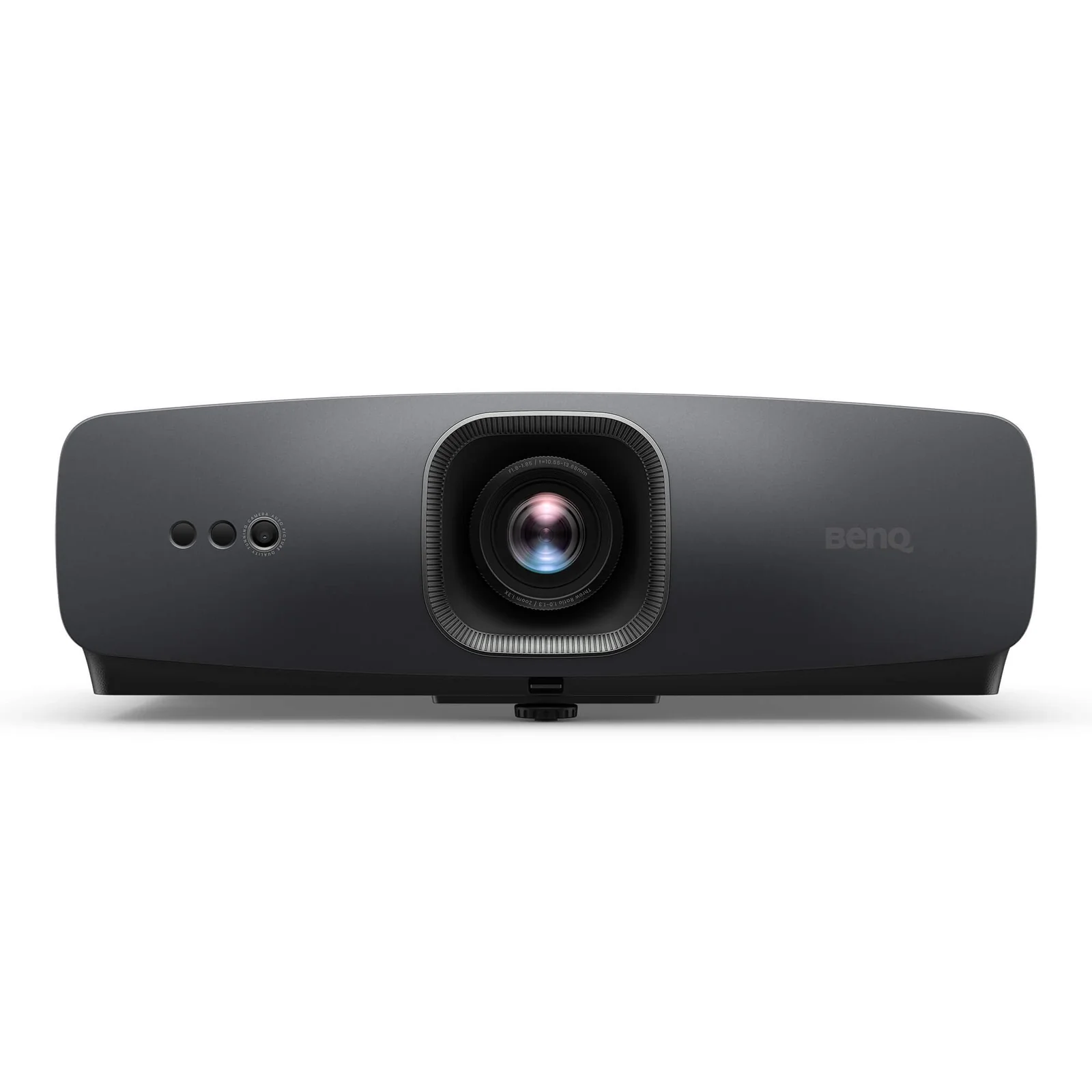
BenQ W2720i Smart Projector
By BenQ · Smart Projectors · Audio & Electronics · More from BenQ
- 2500 ANSI lumens brightness
- 4K UHD native resolution 3840x2160, DLP 4LED light source
- 2,000,000:1 FOFO contrast (with light source dimming)
- Throw ratio 1.0-1.3 with 1.3x zoom, vertical lens shift +/-5%, 120-inch image from 2.7 m
Price not listed
- BenQView at BenQ
- eBayView at eBay
- Best BuyView at Best Buy
- AmazonView at Amazon (paid link)
- eBay (used) eBay: used, open-box, refurbishedView at eBay (used)
Stores are listed in a fixed order, never by price or commission. Prices are snapshots. Check the current price with the store.
Summary
A 4K LED home theater projector with a QS02 Android TV dongle in the box, built for a dark room and for gamers. Check the measured numbers before you buy: 2,500 ANSI lumens only shows up in the green-biased Bright mode, accurate modes land near 1,595 ANSI, and CNET measured 604:1 contrast.
Strengths
- Color accuracy out of the box: ProjectorCentral measured 99.7% xy Rec.709 coverage and 2.7 dE average grayscale in Filmmaker mode.
- No lamp to replace; the LED engine is rated 20,000 hours in Normal and 30,000 in ECO.
- Input lag of 6.5 ms at 1080p/240 and about 18 ms at 60 Hz, measured by PCMag.
- Installation aids: ±5% vertical lens shift, 1.3x zoom, Auto Screen Fit and 8-point Corner Fit.
- Connections for the money: three external HDMI ports, eARC, S/PDIF and 3.5 mm outs, 12 V trigger and RS-232.
- The QS02 Android TV dongle ships in the box, so streaming needs no extra hardware.
Weaknesses
- Accurate modes fall well under the rated brightness: 1,595 ANSI measured against a 2,500 claim, and 1,379 ANSI in the HDR modes.
- Contrast is the weak spot: 604:1 measured in Normal mode against a marketing figure of 2,000,000:1 FOFO.
- The wide-color-gamut (cinema) filter is locked in by picture mode in SDR and costs 14.6% of light output.
- The QS02 dongle stays in HDR mode for SDR content; BenQ’s answer is a color-space setting change, not a firmware fix.
- No Dolby Vision.
- PCMag saw occasional, more-than-usual-obvious rainbow artifacts, while ProjectorCentral saw none in its sample.
Verified specifications
| Projection system | DLP, 0.47-inch TI chip with four-phase pixel shifting from a native 1920x1080 panel to 3840x2160. |
|---|---|
| Light source | 4LED solid-state, one red, one green and two blue channels; no lamp to replace. |
| Brightness | 2,500 ANSI lumens rated; 2,704 ANSI measured in Bright mode and 1,595 ANSI in User/Filmmaker mode (ProjectorCentral, 2025-05-12). |
| Color | 90% DCI-P3 and 98% Rec.709 claimed; ProjectorCentral measured Rec.709 at 99.7% xy / 98.9% uv and DCI-P3 at 92.9% xy / 95.2% uv with the wide-color-gamut filter engaged. |
| Accuracy | Filmmaker-mode grayscale averaged 2.7 dE before calibration and 0.7 dE after. |
| Contrast | 2,000,000:1 FOFO with lightsource dimming claimed; CNET measured 604:1 in Normal mode and 2,228:1 dynamic in High Dynamic mode. |
| Input lag | 17.9 ms at 1080p/60 and 4K/60, 12.8 ms at 1080p/120 and 6.5 ms at 1080p/240 on the spec sheet; PCMag measured 18.1, 18, 12.7 and 6.5 ms, ProjectorCentral 19, 15 and 7 ms with Fast Mode on. |
| HDMI | three external ports at HDMI 2.1 / HDCP 2.3, plus an internal port for the dongle; HDMI-3 takes 4K/120 and downscales to 1080p/120. |
| Audio | 2 × 5 W built-in speakers, HDMI eARC with Dolby Atmos, 3.5 mm and S/PDIF outs. |
| Connections | 2 × USB Type-A (one 1.5 A power/reader/firmware, one 2.5 A power), USB Mini-B service port, RS-232 in (DB-9), DC 12 V trigger (3.5 mm jack). |
| Placement | throw ratio 1.0-1.3, 1.3x manual zoom, ±5% vertical lens shift, auto and manual 2D keystone at ±30 degrees. |
| Light source life | 20,000 hours in Dynamic and Normal, 30,000 in ECO. |
| Power | 241 W maximum, 183 W Normal and 133 W Eco at 220 V, standby under 0.5 W. |
| Noise | 28 dBA typical and 26 dBA Eco on BenQ’s figures; ProjectorCentral measured 36.5-37.6 dBA in Normal and 34.7-36.5 dBA in ECO, in a room with a 33.3 dBA noise floor. |
| Uniformity | 76% on a 100-inch image, with 15% light loss from the widest to the longest zoom position. |
| Dimensions | 16.45 × 5.63 × 12.01 in (420 × 143 × 305 mm); 14.11 lb (6.4 kg). |
| In the box | QS02 Android TV dongle, remote RCI074 with battery, 3.0 m power cord and lens cover. DLP-Link 3D glasses are optional. Backlighting on the remote is disputed: ProjectorCentral calls it backlit, CNET’s spec box says it is not. |
| Warranty | 3 years, parts and labor, no advance replacement; dead-on-arrival within 30 days, shipping damage within seven business days. |
Full research notes and sources
Color accuracy out of the box
BenQ calibrates each unit before it ships, and the instruments agree. ProjectorCentral read Rec.709 coverage at 99.7% xy and 98.9% uv, and DCI-P3 at 92.9% xy and 95.2% uv with the wide-color-gamut filter engaged; with the filter off, coverage fell to 72.6% xy and 71.88% uv. Filmmaker-mode grayscale averaged 2.7 dE, worst case 5.3, the color checker averaged 1.5 dE, and after ProjectorCentral’s own 11-point white balance and CMS work, grayscale dropped to 0.7 dE.
CNET ran the W2720i side by side with a JMGO N1S Pro 4K on a 102-inch 1.0-gain screen and picked the BenQ for color and gamma, even though the JMGO measured 926:1 contrast against the BenQ’s 604:1. PCMag found almost nothing to change. Accurate color out of the box is the reason to buy this projector.
Brightness: the 2,500-lumen claim
ProjectorCentral measured 2,704 ANSI in Bright mode, with a strong green bias, then 1,595 ANSI in User and Filmmaker, 1,406 in Cinema, and 1,379 in AI Cinema and every HDR mode. Switch those modes to ECO and they drop to 2,163, 1,276, 1,103 and 1,125 ANSI respectively. CNET measured roughly 1,003 lumens in Filmmaker by a different method, about 60% under the claim. In any one mode you get accurate color or full brightness, not both. ProjectorCentral also caught random brightness step-ups during HDR playback on one film, so the HDR picture is not perfectly steady.
Contrast, placement and the QS02 dongle
BenQ’s 2,000,000:1 figure describes lightsource dimming, not native contrast. CNET measured 604:1 in Normal mode and 2,228:1 dynamic in High Dynamic.
Placement needs planning. Keystoning costs brightness and adds artifacts, so a 100-inch 16:9 image wants the lens 87.2 to 113.3 inches from the screen, and BenQ quotes a 120-inch image from 2.7 meters. CNET expects a ceiling mount for a 100-inch picture. PCMag calculated that the rated 2,500 lumens should suit a 230-inch 1.0-gain 16:9 screen in a dark room, and reported that its preferred Cinema AI and HDR10 modes filled a 90-inch 1.0-gain screen with rich color in a dark room while still standing up to typical family-room light.
The QS02 dongle is an Android TV 11 box with its own menu, and it defaults to HDR mode even when the content is SDR; BenQ’s workaround is a color-space change to YCbCr444 8bit, not a fix. The projector and the dongle keep separate menus, which PCMag called a little confusing until you learn which one does what. There is no Dolby Vision. AI Cinema Mode is the one feature the three labs disagree on: CNET found it turns on every enhancement setting and over-sharpens the image, ProjectorCentral saw no significant picture change under different lighting, and PCMag preferred Cinema AI in both dark and lit rooms.
Running costs, warranty and what owners asked
There is no lamp to buy and no consumable filter in the parts list; the LED engine is rated 20,000 to 30,000 hours. If the QS02 dongle fails, it can be replaced with other Android TV hardware.
BenQ’s US warranty for this model is three years, parts and labor, with no advance replacement. Dead-on-arrival units have to be reported within 30 days, and shipping damage within seven business days. Depot service covers the continental US, Hawaii and Alaska, and the customer pays the freight to BenQ. BenQ’s US storefront advertises free shipping over $35 and free returns within 30 days, which is the practical way to test your own sensitivity to rainbow artifacts.
Long-term owner evidence is thin. On that last one, your own calibration is saved and the preset picture modes survive a reset.
Is it worth it?
Around $2,000 the W2720i is a fair, well-engineered 4K LED home theater projector: measured color accuracy, low gaming latency and no lamp to replace. ProjectorCentral listed it at $1,966 against a $1,999 MSRP in its 2026-10 price check, and PCMag noted at its 2025-03-24 update that the $1,999 price was slated to rise to $2,199 on tariffs.
Between $2,000 and $2,199 you pay for the LED engine and the short throw, not for image quality. Past roughly $2,200 the comparison set changes: BenQ’s own X3100i is the step-up in the same line, the Epson LS11000 and LS12000 offer better contrast and no rainbow artifacts, and the lamp-based BenQ HT2060 costs about half as much for 1080p. If you want the most accurate picture for the money, the W2720i delivers it; if you want deep blacks, spend elsewhere.
Which model this is
The W2720i is the LED version of BenQ’s lamp-based HT3560 and the newest entry in its 2025 Home Cinema Series, launched in January 2025. It pairs a 4K XPR DLP chip with a 4LED engine, ±5% vertical lens shift, 1.3x zoom and a QS02 Android TV dongle in the box.
Do not confuse it with the W2710i, with refurbished W2720i listings, or with the X500i and X3100i laser models. No W2720i II or other hardware revision is listed on BenQ’s current US pages. The ASIN for this listing is B0DPJDK31N.
Sources
Manufacturer:
- BenQ W2720i user manual and downloads
- BenQ W2720i product overview
- BenQ W2720i full specifications
- BenQ W2720i warranty information
- BenQ W2720i FAQ page
Independent reviews:
Owner reports:
- No owner forum reports were available for this model.