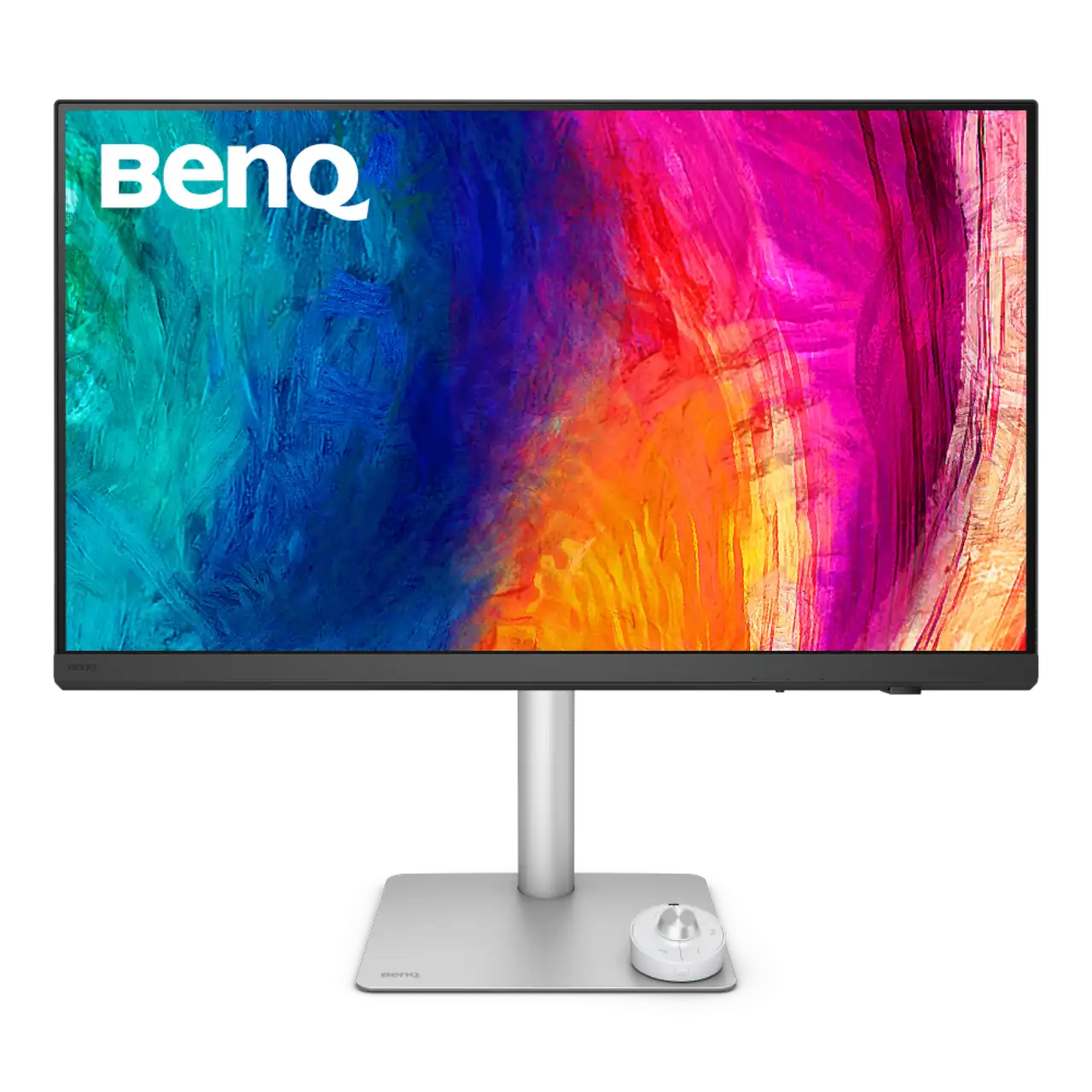
BenQ PD3226G 32” 4K UHD (3840x2160) 144Hz Monitor for
By BenQ · Computer Monitors · Desk & Streaming Setup · More from BenQ
Compare all Computer Monitors side by side →
- 32" 4K UHD (3840x2160)
- 144Hz refresh rate
- IPS panel with 95% P3 color
- Thunderbolt 4 connectivity
- Delta E ≤ 2 color accuracy
Check today's price at the stores
- B&H Photo30-day returns · store policyView at B&H Photo
- BenQView at BenQ
- AmazonView at Amazon (paid link)
More on eBay (1)
- eBayView at eBay
- eBay (used) eBay: used, open-box, refurbishedView at eBay (used)
Stores with a price are sorted lowest first; commission never changes the order. Prices are snapshots. Check the current price with the store.
Summary
BenQ PD3226G is a 32-inch 4K monitor that pairs factory-calibrated color accuracy with a 144Hz refresh rate for creative work and gaming. Check your workflow needs: HDR is entry-level and contrast falls when uniformity compensation is on.
Size in context

71.4 cm · 28.1 in (W) × 24.2 cm · 9.5 in (D) × 49.0 cm · 19.3 in (H) · Drawn to scale from the maker's stated dimensions, next to everyday objects.
Strengths
- Factory calibration lands at Delta E ≤ 0.6, so most buyers can skip immediate professional calibration.
- 99.1% sRGB and 93% DCI-P3 coverage suits photo, design and video work without a separate display.
- 144Hz refresh gives smoother timeline scrubbing and desktop motion than 60Hz panels.
- Thunderbolt 4 carries display and 90W power delivery over one cable for laptop setups.
- Wireless Hotkey Puck puts frequent controls on the desk without reaching for buttons.
- Sturdy stand with 150mm height, tilt, swivel and pivot adjustment fits varied workspaces.
Weaknesses
- Contrast drops from 1,200:1 to 578-590:1 when uniformity compensation is enabled.
- No dedicated Adobe RGB mode out of the box; 90% coverage needs Palette Master Ultimate calibration.
- Premium price: $899.99-$1,299.99 is steep for an IPS panel against OLED alternatives.
- Thunderbolt power delivery may not cover every high-power laptop under sustained load.
- Wireless remote runs on AAA batteries, and some owners report short battery life.
Verified specifications
| Model | BenQ PD3226G, 31.5-inch (marketed as 32-inch) IPS panel with Nano Matte anti-glare coating. |
|---|---|
| Resolution | 3840 × 2160 (4K UHD) at 144Hz; 1ms GTG response time. |
| Color | 10-bit; 99.1% sRGB, 93% DCI-P3, 90% Adobe RGB measured; factory calibration Delta E ≤ 0.6. |
| Brightness | 400 cd/m² manufacturer claim; measured 227-520 nits depending on mode; 520 nits peak HDR10, 450 nits SDR. |
| Contrast ratio | 1,200:1 native; 578-590:1 with uniformity compensation enabled. |
| HDR | DisplayHDR 400, no local dimming. |
| Adaptive sync | VESA AdaptiveSync, AMD FreeSync Premium, unofficial Nvidia G-Sync support. |
| Stand | tilt -5° to 20°, swivel -30° to +30°, 90° pivot, 150mm height adjustment. |
| VESA mount | 100 × 100 mm, bracket included. |
| Dimensions | 714.3 × 242 × 490-640 mm (W × D × H with stand). |
| Weight | 9.7 kg with stand. |
| Speakers | 2 × 3W. |
| Power | 31W at 200 nits. |
| Warranty | 3 years in most markets; some promotional materials mention 2-year coverage. |
| Included | monitor, stand, wireless Hotkey Puck remote, power cable, documentation, quick start guide. |
Full research notes and sources
Color accuracy and calibration
Factory calibration is the headline: Delta E ≤ 0.6, with measurements of 0.5 in sRGB mode and 0.67 in DCI-P3 mode. Coverage reaches 99.1% sRGB, 93% DCI-P3 and 90% Adobe RGB. That is enough for most photo, design and video work; print workflows that need a dedicated Adobe RGB mode require calibration with BenQ’s Palette Master Ultimate, since none ships in the menu. The Nano Matte coating cuts reflections and eye strain during long sessions, though it can soften perceived sharpness next to a glossy panel.
Motion, gaming and connectivity
The 144Hz panel is unusual for a professional display. It smooths timeline scrubbing in video editing and animation and makes general desktop use feel quicker, while 1ms GTG response keeps ghosting low at standard AMA settings; inverse ghosting can appear at the highest overdrive level. Adaptive sync covers VESA AdaptiveSync, AMD FreeSync Premium and unofficial Nvidia G-Sync. Thunderbolt 4 provides display output plus 90W power delivery in one cable, with dual ports for daisy chaining on hosts that support it (Apple Pro, Max and Ultra chips; not base M1 or M2 chips). The monitor also works as a KVM switch for two computers. Panel uniformity varies by sample, and some units show minor backlight bleed in dark rooms.
HDR, contrast and coating
HDR performance is the weak spot. DisplayHDR 400 has no local dimming, and measured peaks reach 520 nits for HDR10 and 450 nits for SDR, below what HDR content needs for punchy highlights. Native contrast is 1,200:1, but enabling uniformity compensation drops it to 578-590:1, which affects dark scenes. The Nano Matte surface also lowers reflections at the cost of some crispness. Buyers focused on HDR or deep blacks should weigh OLED alternatives.
Is it worth it?
Value depends on price. At $800-$900 the combination of color accuracy and 144Hz motion is hard to match. From $901 to $1,000 value is fair; from $1,001 to $1,100 it is weak; above $1,100 OLED or better-HDR alternatives make more sense. The monitor suits photographers, video editors and animators who want smooth motion in their workflow. BenQ markets it as the world’s first 4K 144Hz professional monitor.
Which model this is
This is the BenQ PD3226G, a 32-inch (31.5-inch panel) 4K 144Hz professional monitor in white finish, part of the DesignVue family. Confirm the PD3226G model number on the box; retailer listings sometimes group it with other PD models.
Sources
Manufacturer:
- No manufacturer URL in the research.
Independent reviews:
Owner reports:
- No owner-report URLs in the research.