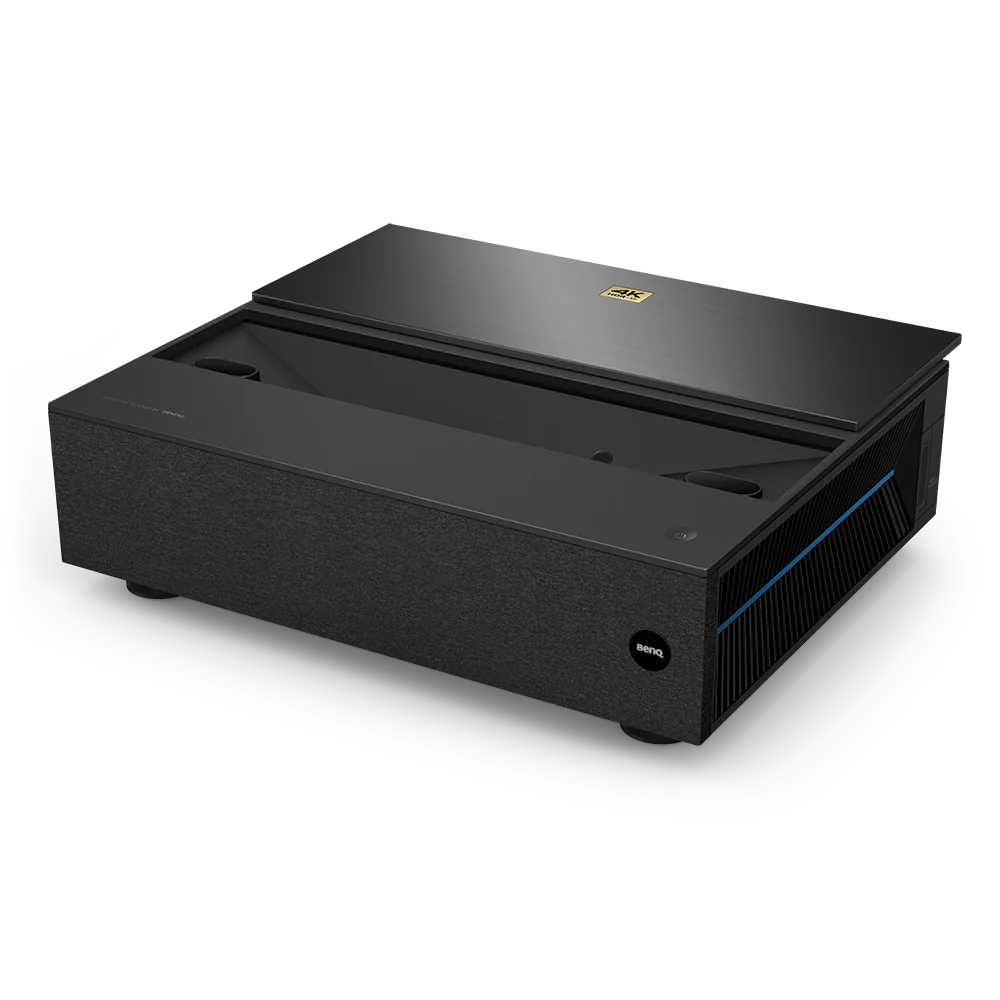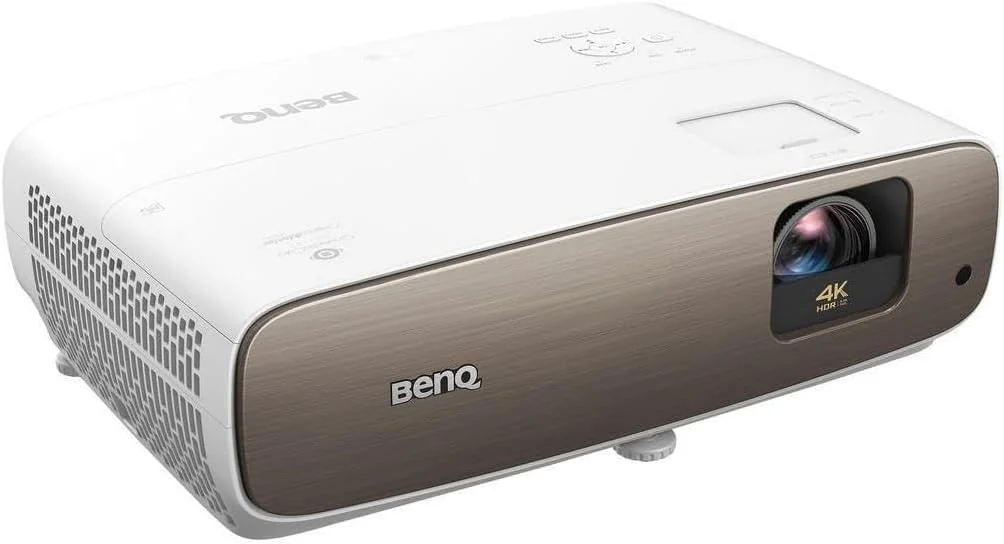
BenQ HT3550 Smart Projector
By BenQ · Smart Projectors · Audio & Electronics · More from BenQ
- Brightness 2000 ANSI lumens (lamp light source, 245W bulb)
- Resolution 4K UHD 3840x2160 via 0.47-inch single-DMD DLP XPR, 8.3 million pixels per frame
- Color 95% DCI-P3 and 100% Rec.709 coverage, factory Delta E<3, ISFccc certified
- Contrast 30,000:1 (FOFO) with Dynamic Iris
- Lamp life 4,000 hrs Normal / 10,000 hrs ECO / 15,000 hrs SmartEco
Price not listed
- BenQView at BenQ
- eBayView at eBay
- AmazonView at Amazon (paid link)
- eBay (used) eBay: used, open-box, refurbishedView at eBay (used)
Stores are listed in a fixed order, never by price or commission. Prices are snapshots. Check the current price with the store.
Summary
A lamp-lit 4K UHD DLP home-theater projector with a pixel-shifted panel, a dynamic iris and color accuracy that measured well out of the box. Check the input lag before you buy: two labs measured 47-63 ms against the 34 ms on the spec sheet, so plan movies, not shooters.
Strengths
- Out-of-box color accuracy with a factory Delta E<3 and lockable ISF Day and Night modes.
- The dynamic iris delivers the black level that Projector Reviews built its review around.
- Measured DCI-P3 coverage of 105% slightly beats the 95% claim.
- Rec.709 color volume measured 97.9% in D. Cinema after calibration.
- A small dark frame, 1.3x zoom and +10% vertical shift make installation easier than on earlier 0.47-inch DLP models.
- At 9.25 lb it moves between rooms without a scaffold.
Weaknesses
- Input lag measured 47-51 ms at 4K and 63 ms in a second lab, and both labs call it a poor choice for serious gamers.
- Calibrated D. Cinema output is 467 lumens, just over 19 ftL on a 90-inch 1.0-gain screen.
- Brightness uniformity of 63% at wide zoom shows as visible falloff toward the edges.
- The dynamic iris pumps visibly in the High and Middle settings and often did not engage at Low.
- No networking, no lens memory, a 1.3x zoom and vertical-only shift limit where it can go.
Verified specifications
| Light source | 245 W lamp, rated 4,000 hours in Normal, 10,000 in ECO and 15,000 in SmartEco. |
|---|---|
| Resolution | 4K UHD 3840x2160 from a 0.47-inch DLP XPR chip shifting four times per frame over a native 1920x1080 panel. |
| Contrast | 30,000:1 FOFO with the dynamic iris active. |
| Color | 95% DCI-P3 and 100% Rec.709 claimed; measured DCI-P3 coverage of 105%. |
| Color depth | 30-bit (1.07 billion colors). |
| Zoom | 1.3x manual zoom, no optional lenses. |
| Throw and placement | 1.13-1.47 throw ratio, +10% vertical lens shift, auto vertical keystone up to ±30 degrees, no horizontal shift. |
| Brightness uniformity | 63% at wide zoom, 67% at full telephoto. |
| Noise | 30 dB typical, 28 dB in Eco mode. |
| Power | 330 W typical at 110 V, under 0.5 W in standby. |
| Audio | 2x 5 W built-in speakers, 3.5 mm audio out, HDMI ARC, S/PDIF output. |
| Connections | 2x HDMI (HDMI 2.0b/HDCP 2.2), 2x USB Type A, 1x USB Mini B, RS232 (DB-9), 12V trigger. |
| Networking | none, wired or wireless. |
| Picture modes | 3D, Bright, Cinema, D. Cinema, HDR, HLG, ISF Day, ISF Night, Silence, User, Vivid TV. |
| Screen size | a 100-inch image at 8.2-10.7 ft, 120-inch at 9.9-12.8 ft, 150-inch at 12.3-16 ft. |
| Dimensions | 14.96 x 4.99 x 10.35 in (380 x 127 x 263 mm); 9.25 lb (4.2 kg). |
| Lamp replacement part | 5J.JKC05.001. |
Full research notes and sources
Picture quality and color modes
BenQ markets 95% DCI-P3 and 100% Rec.709 coverage, and the measurements back up the Rec.709 half of that. ProjectorCentral measured D. Cinema at 89.7% of Rec.709 color volume by default, 121.5% with Brilliant Color off, and 97.9% after calibration with Brilliant Color on, which cost roughly 30% of brightness.
HDR depends on two menu switches. With Brilliant Color on and Wide Color Gamut off, ProjectorCentral measured 59.2% of DCI-P3 color volume in HDR mode; turning Wide Color Gamut on raised that to 76.4%, and turning Brilliant Color off reached 105.6%. Peak white measured 70.7 nits with both settings on and 119.9 nits with Wide Color Gamut off. The headline color numbers only appear in one specific combination of switches.
Video processing is 8-bit at 3840x2160 60 Hz. 16-bit input is accepted only at 24 Hz and 30 Hz, and ProjectorCentral saw faint banding hints in a 10-bit HDR grayscale test animation. Supported HDR formats are HDR10 and HLG; Dolby Vision is not on the list, and 3D is Full HD DLP-Link with glasses not included.
The dynamic iris improves black level, and Projector Reviews made that the headline of its review. The catch is motion: ProjectorCentral saw visible brightness pumping in the High and Middle settings, and the Low setting often did not engage at all. Brightness uniformity measured 63% at wide zoom and 67% at full telephoto. Silence mode turns off pixel shifting and drops the image to the chip’s native 1920x1080, for only a modest noise reduction.
Gaming and input lag
BenQ’s spec sheet lists 34 ms at 4K@60 Hz and 83.34 ms at 1080p@60 Hz, an unusual ordering because the 1080p figure is the higher one.
Gaming projectors built for speed sit at 8-16 ms. Console and casual gaming is fine; competitive shooters are not.
Running costs, lamp and warranty
The lamp is the running cost. Replacement lamp part 5J.JKC05.001 was quoted at $149 in 2019 (ProjectorCentral), and the lamp is rated 4,000 hours in Normal, 10,000 in ECO and 15,000 in SmartEco. Check the lamp-hour counter on any used or old-stock unit, because the hours already on the lamp decide how soon you pay that figure again.
The model was discontinued in July 2023 (ProjectorCentral), so lamp and parts supply for future years is an open question. The manual’s warranty text names the dealer as the first point of contact and covers defects in material and workmanship with proof of purchase, but the section read gives no duration in years.
One owner in the ProjectorCentral thread reports BenQ replaced a malfunctioning DMD chip under warranty on a 16-month-old unit, so the service process does work; that account does not set a general repair timeline. The same owner described a growl lasting 60-90 seconds at startup and a persistent lower growl they attributed to the fan or the pixel-shift mechanism, plus stuck white pixels after 11 months that only a DMD chip replacement cleared.
Is it worth it?
At $1,199 on ProjectorCentral’s model hub (2026-10), the HT3550 is defensible for a dark dedicated room at 90-100 inches: the color accuracy and contrast are measured, and they hold up. Between $1,200 and $1,499 you are paying the 2019 launch price, which both labs called strong value when the projector launched. Above $1,499 the same money buys a brighter machine: the Epson HC4010 lists at $1,999 (Projector Reviews, 2019), the Epson HC5050UB and the Acer VL7860 laser sit at about twice the price with lower input lag or better black levels, and for a bright room the BenQ TK850 or TK850i and the Optoma UHD52ALV are the higher-output options. Below $1,000, check the lamp hours and the condition of the unit first.
Which model this is
The HT3550 is the 4K UHD home-theater model in BenQ’s CinePrime line, sold in the US as a brown/white unit, with a 0.47-inch single-DMD DLP XPR chip and a six-segment RGBRGB color wheel. The shipped manual covers the CinePrime Series W2700 / HT3550, version V1.00. The ASIN for this listing is B07MTY97T2.
Do not confuse it with the TK850 or TK850i, which share the chassis but use a different color wheel for higher light output, with the later HT3560, which one owner reports as quieter and noticeably brighter, or with the step-up HT5550, which adds lens shift and 100% DCI-P3 coverage.
Sources
Manufacturer:
- CinePrime Series W2700 / HT3550 user manual (BenQ US support hub)
- HT3550 product page with 4K UHD, 95% DCI-P3 and ISFccc details (BenQ US)
- HT3550 specifications: brightness, contrast, lag, ports and dimensions (BenQ US)
Independent reviews:
Owner reports: