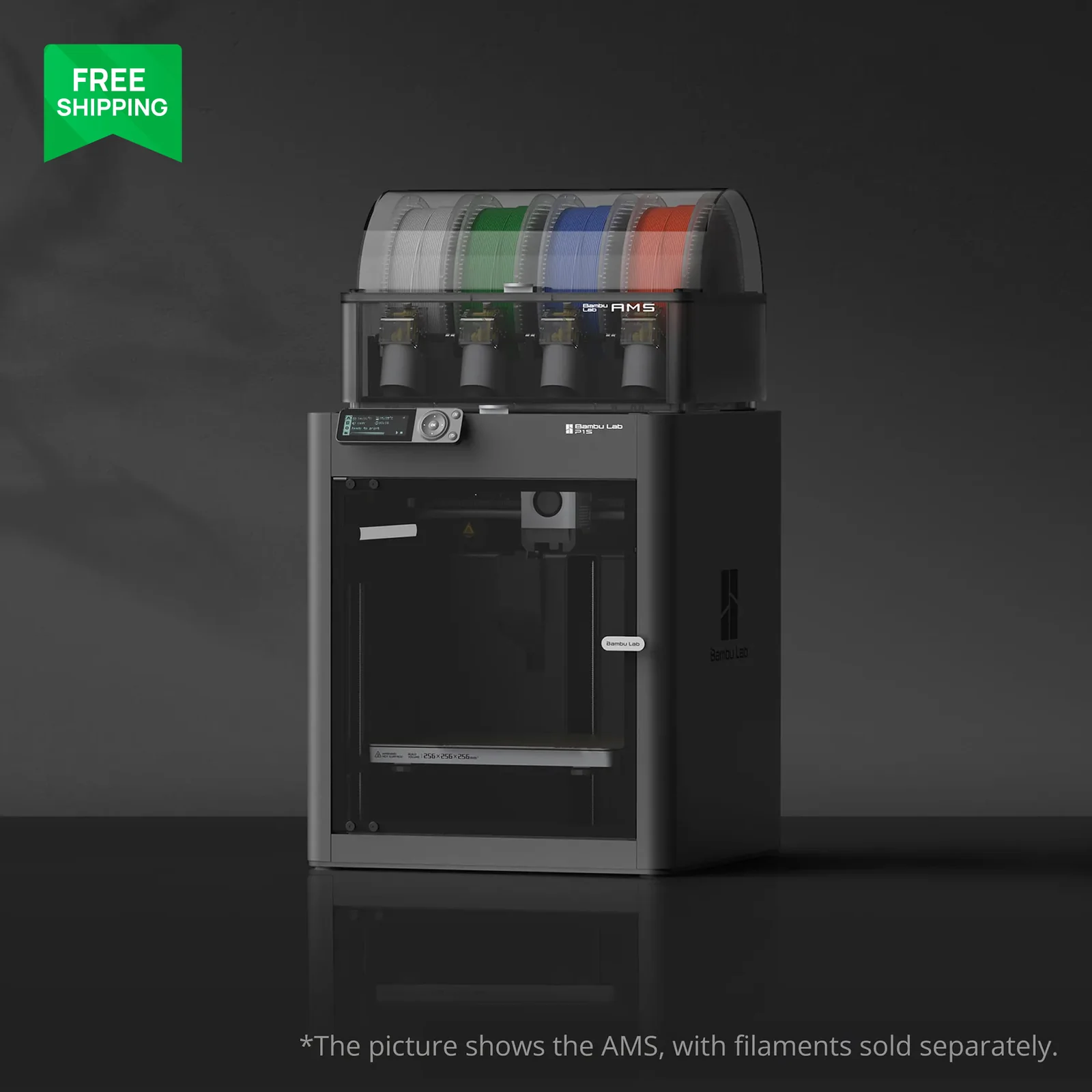
Bambu Lab P1S Combo (P1S + AMS)
By Bambu Lab · Enclosed 3D Printers · 3D Printing
- Fully enclosed CoreXY, up to 500 mm/s and 20,000 mm²
- AMS included: up to 16 colors with automatic filament switching
- Automatic bed leveling, set up in about 15 minutes
- Handles PLA, PETG, TPU, PVA, PET, ABS, ASA
Lowest price seen
$549.00
from $549.00 at Dynamism · Checked Oct 2, 2026
- Dynamism $549.00View at Dynamism
- Bambu Lab US Store (official)View at Bambu Lab US Store (official)
- eBayView at eBay
- Best BuyView at Best Buy
- Micro CenterView at Micro Center
- B&H PhotoView at B&H Photo
- NeweggView at Newegg
- WalmartView at Walmart
- eBay (used) eBay: used, open-box, refurbishedView at eBay (used)
- AmazonView at Amazon
Prices are snapshots. Check the current price with the store.
Summary
The Bambu Lab P1S Combo pairs the enclosed P1S CoreXY printer with a first-generation AMS that feeds four spools and prints in color, but does not dry filament. Check the AMS generation before you buy anything: Bambu’s own store steers shoppers to the newer AMS 2 Pro Combo for active drying.
Strengths
- Enclosed CoreXY chassis with a 300 °C all-metal hotend, so ABS and ASA print without an add-on.
- Four spools feed color changes automatically from the AMS in the box.
- All three fans are closed-loop controlled on this model, including the chamber and control-board fans.
- The activated carbon filter ships inside the enclosure, which matters with ABS and ASA.
- Bed leveling, belt-tension resonance runs and power-loss recovery come as standard.
- The Combo box includes a spare filament cutter, both bus cable types and two sample spools.
Weaknesses
- The AMS in this bundle has no active drying, and Bambu’s own store calls the newer AMS 2 Pro Combo the better value for that reason.
- Only 250 mm of the nominal 256 mm build height is printable by default.
- Bambu says not to print glass- or carbon-fiber-reinforced filament before an extruder and hotend upgrade.
- The 16-color figure needs four stacked AMS units; this bundle includes one.
- The combo box is 585 mm tall and 21.60 kg, taller and heavier than the printer-only package.
- No independent test or owner report backs the speed or setup-time figures; those are manufacturer claims.
Verified specifications
| Build volume | 256 × 256 × 256 mm nominal; Bambu Studio defaults to 250 mm of printable height. |
|---|---|
| Kinematics and speed | CoreXY, 500 mm/s top speed, 20 m/s² (20,000 mm/s²) maximum acceleration. |
| Motion quality | active XY vibration compensation and pressure advance. |
| Hotend | all-metal, 300 °C maximum; 0.4 mm stainless steel nozzle included; 0.2 / 0.6 / 0.8 mm optional. |
| Build plate | 100 °C maximum; Textured PEI Plate, Cool Plate, Engineering Plate and High Temperature Plate listed as compatible. |
| Shell | enclosed, plastic and glass, with an activated carbon air filter fitted. |
| Cooling | closed-loop control of the auxiliary part-cooling fan, the chamber regulator fan and the control-board fan. |
| Camera | chamber monitoring camera, 1280 × 720 at 0.5 fps, timelapse supported. |
| Setup | automatic bed leveling, semi-automatic belt tensioning with a resonance-frequency run at every print, filament run-out sensor, power-loss recovery. |
| Filament | PLA, PETG, TPU, PVA, PET, ABS and ASA listed as ideal; PA and PC as capable. |
| Multi-color | four spools in one AMS; up to 16 colors with four AMS units stacked. |
| Dimensions | 389 × 389 × 458 mm (15.3 × 15.3 × 18.0 in); 12.95 kg (28.5 lb) net. |
| Combo shipping box | 485 × 480 × 585 mm, 21.60 kg gross. |
| Power | 100–240 VAC, 50/60 Hz, listed as 1000 W @ 220 V and 350 W @ 110 V. The 110 V figure is not credible for a heated-bed printer; treat wattage as unverified. |
| In the box | P1S, stainless steel hotend and nozzle, build plate, one spool of Bambu PLA, unclogging pin tool, power cable, accessory box. The Combo adds the AMS, a spare filament cutter, 6-pin and 4-pin bus cables and two random-color sample spools. |
Full research notes and sources
The AMS generation decides this purchase
One AMS holds four spools and multi-color printing works out of the box. Up to 16 colors requires stacking four AMS units, and the AMS’s own dimensions, weight, power draw and noise are not published, so plan the shelf space and the noise yourself. Nobody has published an AMS changeover time or waste rate.
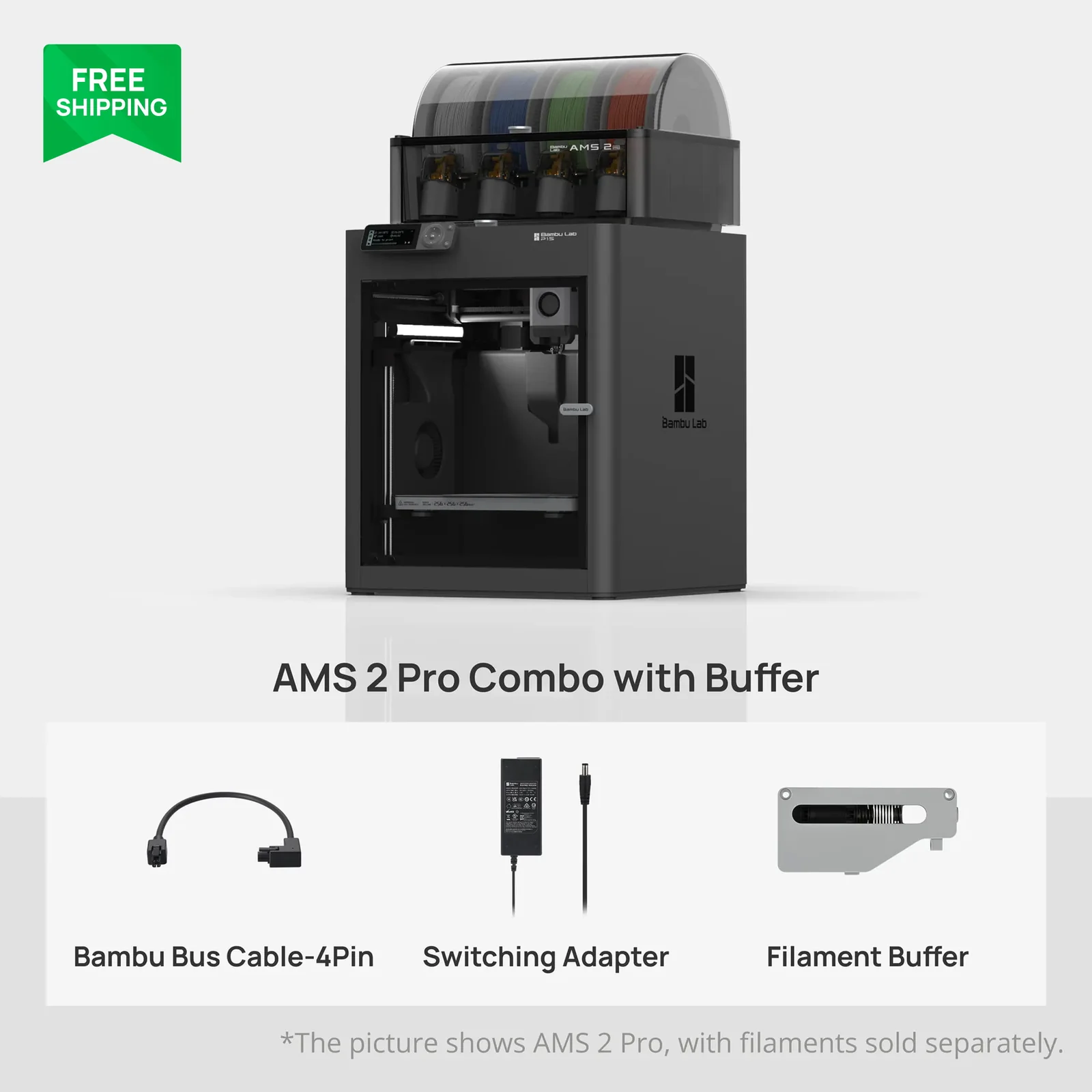
The generation matters more than the color count. Bambu’s store page lists this bundle next to the P1S AMS 2 Combo and the P1S AMS 2 Pro Combo, and recommends the AMS 2 Pro because of its active filament drying function. That means the AMS here does not dry. If your materials are nylon, PC, or PETG sitting in opened spools, that is the feature you are giving up, and it is worth pricing the drying version before you commit.
Material support follows the store’s tiering: PLA, PETG, TPU, PVA, PET, ABS and ASA are ideal on the P1S, with PA and PC capable. One manufacturer warning belongs here rather than in the fine print: Bambu states it is not recommended to print fiber-reinforced filaments such as glass fiber or carbon fiber before an extruder and hotend upgrade. The X1C’s micro lidar first-layer and spaghetti detection are absent here, and that is Bambu’s own comparison, not a lab result.
Build volume and the 6 mm you can’t print
The 256 mm cube is nominal. Bambu sets the default printable height in Bambu Studio to 250 mm to prevent heatbed damage from collisions, and using the last 6 mm means following a separate wiki procedure. In default use this is a 256 × 256 × 250 mm machine, not a taller one.
The speed figures are Bambu’s: 500 mm/s top speed, 20 m/s² acceleration, and a product-page claim that acceleration from zero to 500 mm/s takes 0.025 seconds. The 15-minute unboxing-to-first-print claim on the store page and the 18 mins 24 s Bambu Lab Quality benchmark on the product page are different claims, and neither was measured independently.
Size and mass are worth planning around. The printer is 389 × 389 × 458 mm and 12.95 kg net; the printer-only package is 530 mm tall, and the Combo package is 585 mm and 21.60 kg gross. The chamber camera records 1280 × 720 at 0.5 fps, which is a timelapse monitor, not a supervision feed. Nobody has measured how well the enclosure holds chamber heat, and the published mains figure (“1000 W @ 220 V, 350 W @ 110 V”) is internally inconsistent, so verify wattage against the P1S TDS sheet before you plan a circuit.
Warranty, returns and who pays shipping
Bambu’s US warranty page, last updated September 22, 2026, gives two years for consumers in the United States and Canada and one year elsewhere in its base terms, but it also writes the extension from one year to two years as applying to Bambu Store US and CA purchases. Third-party purchases follow that retailer’s policy and only receipts from Bambu or an authorized distributor count, so confirm the term with the seller if you are not buying direct.
Returns run 30 days, extended from 14 and including unopened, unactivated units. The warranty clock pauses while a unit is in transit for repair, and a replacement part does not reset the original period. Advance Replacement is available against a temporary deposit equal to the store selling price, with the replacement shipped within 0–48 hours of deposit confirmation; the original has to come back within 30 calendar days or the deposit is forfeited. Prepaid return labels are provided for quality claims where available, but if a returned unit tests with no defect Bambu deducts the return shipping fee from the refund, and shipping on a non-defect return inside 30 days is yours.
Read the exclusions before you open the box. The warranty is void for damage from third-party accessories, for unofficial firmware or firmware-modification tools, and for skipped maintenance; returns are refused when accessories, cables, filaments or manuals are missing or the unit shows cracks, dents or scratches. Report shipping damage within 7 calendar days of delivery. Claims have to go through Bambu’s official support page, and unauthorized returns shipped anywhere else are at your risk. The store links a Spare Parts collection, but its contents were not readable, so the breadth of parts is unknown, and fitting free replacement parts yourself needs Bambu’s confirmation first.
Is it worth it?
Two questions settle it: do you want four-spool color printing, and do you need the filament dried. For PLA and PETG multi-color work this bundle is coherent and the specification list is strong on paper. For nylon, PC, or PETG stored open, price the AMS 2 Pro Combo first, because Bambu itself calls that bundle the better value.
On price and on results, be careful. The store page we could read offered four bundles on one product page and did not tie a figure to this one, so check the store panel above before you buy. No independent instrumented test and no owner discussion were available when this was written, which means there is no measured print speed, accuracy, first-layer success rate, noise figure or AMS reliability history behind any of the numbers above.
Which model this is
This page covers the P1S AMS Combo: the enclosed P1S plus one first-generation AMS. Bambu’s US store sells four bundles on one product page — P1S (printer only), P1S AMS Combo, P1S AMS 2 Combo and P1S AMS 2 Pro Combo — so a listing that says “AMS included” does not tell you whether it dries filament. The listing this page covers is ASIN B0CHDS1DMC; the store page does not name that identifier, so match the bundle name rather than the listing when you compare. The P1P shares the platform, with a P1P-to-P1S upgrade kit sold separately, but it is the open-frame version at 9.65 kg. Do not merge this page with the P1P, either AMS 2 bundle, the X1C or the P2S line.
Sources
Manufacturer:
- Bambu Lab P1 Series product page
- Bambu Lab P1S store listing with the P1P/P1S parameter table and box contents
- Bambu Lab US warranty, returns and shipping-damage policy
Independent reviews:
- No independent instrumented test of the P1S or this bundle was available.
Owner reports:
- No owner forum or retailer Q&A evidence was available for this bundle.