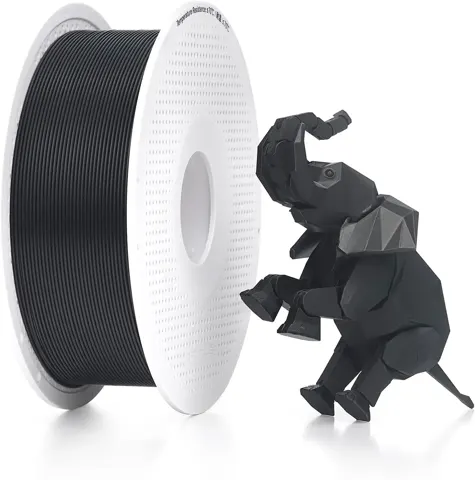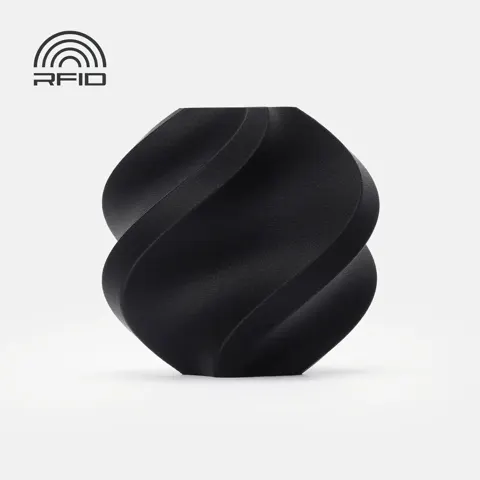
Bambu Lab PLA-CF Carbon Fiber Reinforced PLA
By Bambu Lab · Filament & Resin · 3D Printing · More from Bambu Lab
- Diameter: 1.75 mm +/- 0.03 mm
- Stiffness: 3950 MPa
- Heat deflection temperature: 55 C
- Nozzle temperature: 210-240 C
- Bed temperature: 45-65 C
Price not listed
- Bambu LabView at Bambu Lab
- eBayView at eBay
- AmazonView at Amazon (paid link)
- eBay (used) eBay: used, open-box, refurbishedView at eBay (used)
Stores are listed in a fixed order, never by price or commission. Prices are snapshots. Check the current price with the store.
Summary
A carbon-fiber-reinforced PLA filament for stiff functional and assembly parts with a matte finish. Check your nozzle before you buy: it needs a hardened-steel nozzle, won’t run through a 0.2 mm nozzle, and wet filament snaps in the AMS.
Strengths
- Bending modulus of 3950 ± 190 MPa (X-Y) gives stiff functional parts.
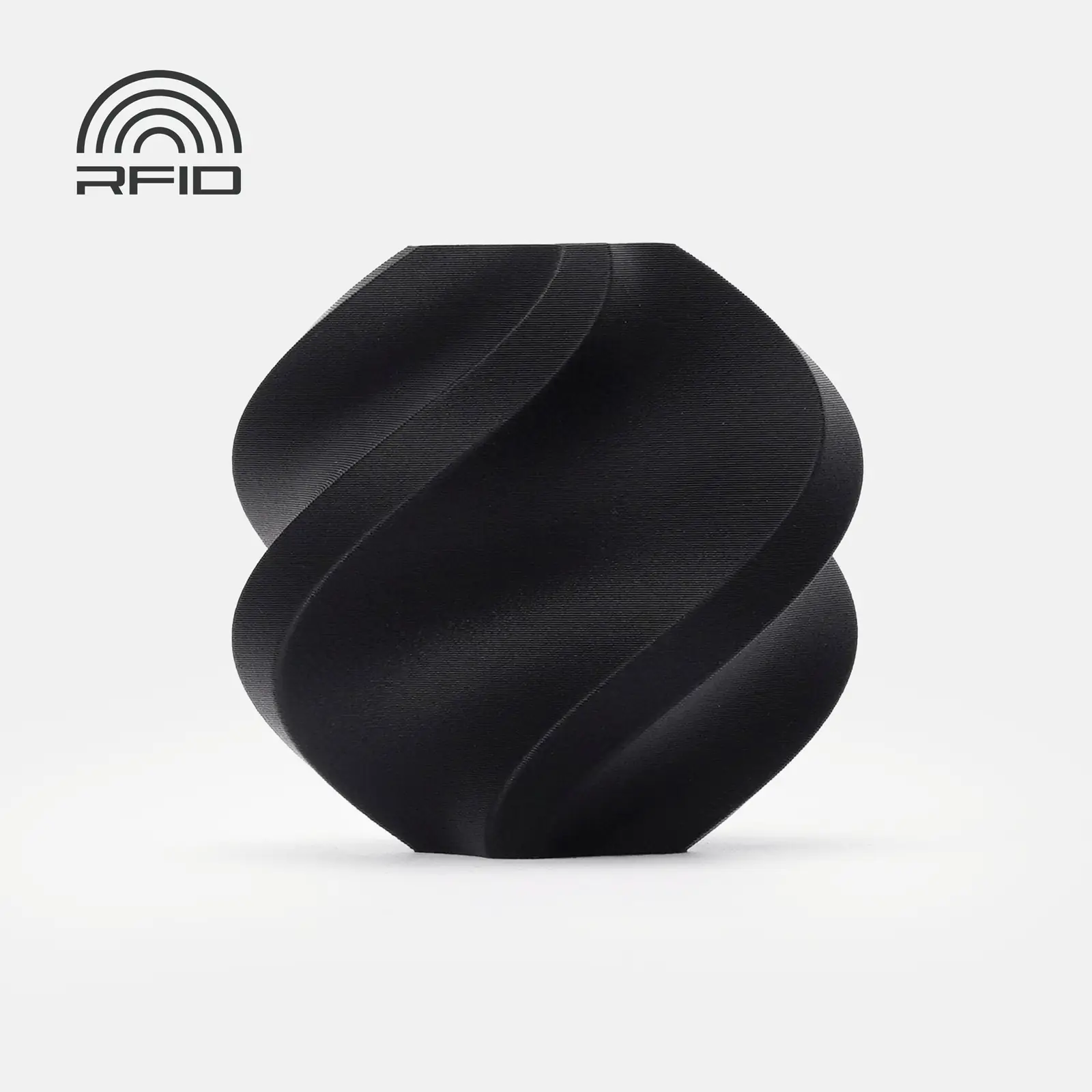
- Matte finish hides layer lines on printed surfaces.
- Prints on PLA-class temperatures with AMS and RFID auto-recognition.
- From $31.99 per 1 kg spool at the Bambu Lab US store (2026).
- Owners report tight-fitting assembly parts and clean outer walls.
Weaknesses
- Abrasive: needs a hardened-steel nozzle; stainless steel and 0.2 mm nozzles are out.
- Wet filament gets brittle and can snap in the AMS; drying is required.
- Z-axis strength is much lower than X-Y, so print orientation matters.
- No independent lab test; FilamentDB and AnHot only reproduce manufacturer data.
- Carbon-fiber debris irritates skin and lungs during handling and sanding.
- Bed temperature and speed specs disagree between the TDS and the store page.
Verified specifications
| Diameter | 1.75 mm (±0.03 mm per store listing). |
|---|---|
| Net weight | 1 kg per spool. |
| Density | 1.22 g/cm³. |
| Glass transition | 63 °C; HDT 55 °C at 0.45 MPa (54 °C at 1.8 MPa). |
| Melting temperature | 165 °C. |
| Vicat softening | 69 °C. |
| Saturated water absorption | 0.42% at 25 °C, 55% RH. |
| Tensile strength (X-Y/Z) | 38 ± 4 / 26 ± 2 MPa. |
| Young's modulus (X-Y/Z) | 2790 ± 120 / 2160 ± 90 MPa. |
| Bending modulus (X-Y/Z) | 3950 ± 190 / 2260 ± 180 MPa. |
| Bending strength (X-Y/Z) | 89 ± 4 / 49 ± 3 MPa. |
| Elongation at break (X-Y/Z) | 8.4 ± 3.2 / 3.6 ± 0.7 %. |
| Impact strength (X-Y) | 23.2 ± 3.7 kJ/m² unnotched, 7.6 ± 2.6 kJ/m² notched. |
| Nozzle | 210–240 °C; sizes 0.4, 0.6, 0.8 mm (0.2 mm not compatible). |
| Bed temperature | 35–45 °C per TDS; 45–65 °C on smooth PEI and 55–65 °C on textured PEI per store tips. |
| Max speed | under 200 mm/s (TDS) or under 250 mm/s (store page). |
| Drying | 55 °C for 8 h in a blast oven, or 65–75 °C for 12 h on an X1 heatbed; store sealed below 20% RH. |
| Annealing | 55–60 °C for 6–12 h. |
| Max overhang | 55°; max bridging: 30 mm. |
| Spool | ABS, 200 mm diameter, 67 mm height, 70 °C temperature resistance. |
| RFID auto-recognition; compatible with all AMS series. | |
| Composition | PLA plus carbon fiber; odorless; not food-grade; flammable. |
Full research notes and sources
Print settings and drying
The TDS and store page disagree on a few numbers, and both are worth keeping in mind. Nozzle temperature is 210–240 °C in both, but AnHot lists 220–240 °C. Bed temperature is 35–45 °C in the TDS, 45–65 °C on smooth PEI and 55–65 °C on textured PEI in the store tips, and 55–70 °C on AnHot. Top speed is under 200 mm/s in the TDS and under 250 mm/s on the store page. Drying is the one step that matters most for quality: 55 °C for 8 h in a blast oven, or 65–75 °C for 12 h on an X1 heatbed, then store sealed with desiccant below 20% RH. Wet PLA-CF becomes more brittle and can snap in the AMS.
Strength and orientation
The headline 3950 MPa figure is bending modulus, not tensile strength; tensile strength is 38 ± 4 MPa (X-Y). Both drop materially on the Z axis (bending modulus 2260 ± 180 MPa), so load-bearing parts should be oriented with the load in the XY plane. Notched impact (7.6 ± 2.6 kJ/m²) is far below unnotched (23.2 ± 3.7 kJ/m²), which is the real number to check for parts with holes or stress risers. Annealing at 55–60 °C for 6–12 h is optional and can warp parts depending on size, structure and infill.
Costs and upkeep
From $31.99 per 1 kg spool at the Bambu Lab US store (2026), with 30-day returns and free shipping on orders over $59. Recurring costs are a hardened-steel nozzle if you do not already own one, desiccant, drying time and replacement nozzles worn by the abrasive fiber. Bambu credits of 32–35 per purchase are offered. No refill pricing relative to spooled pricing was found.
Is it worth it?
A hardened-steel nozzle is a prerequisite cost if you do not already own one, and the drying and safety steps are not optional. No independent third-party mechanical test was found; FilamentDB and AnHot reproduce or aggregate manufacturer data rather than measuring it.
Which model this is
This page covers Bambu Lab PLA-CF, a 1.75 mm carbon-fiber-reinforced PLA sold in 1 kg spools and as refill, with RFID for AMS auto-recognition. The store lists 9 colors, but only Black and Iris Purple are named in the readable page text. The TDS PDF is labeled “Technical Data Sheet V2.0” inside the file while the linked file name and guide read “V3”. The product is not food-grade and is flammable; carbon-fiber debris can irritate skin and lungs, so wear gloves and eye protection when handling, cutting or sanding.
Sources
Manufacturer:
- Bambu Lab US Store — PLA-CF product page
- Bambu Lab US — Ultimate Guide to PLA-CF
- Bambu Lab PLA-CF Technical Data Sheet (PDF)
Independent reviews:
- FilamentDB — Bambu Lab PLA Carbon Fiber (PLA-CF)
- AnHot — Bambu Lab PLA-CF: Filament Specs & Print Profile
Owner reports: