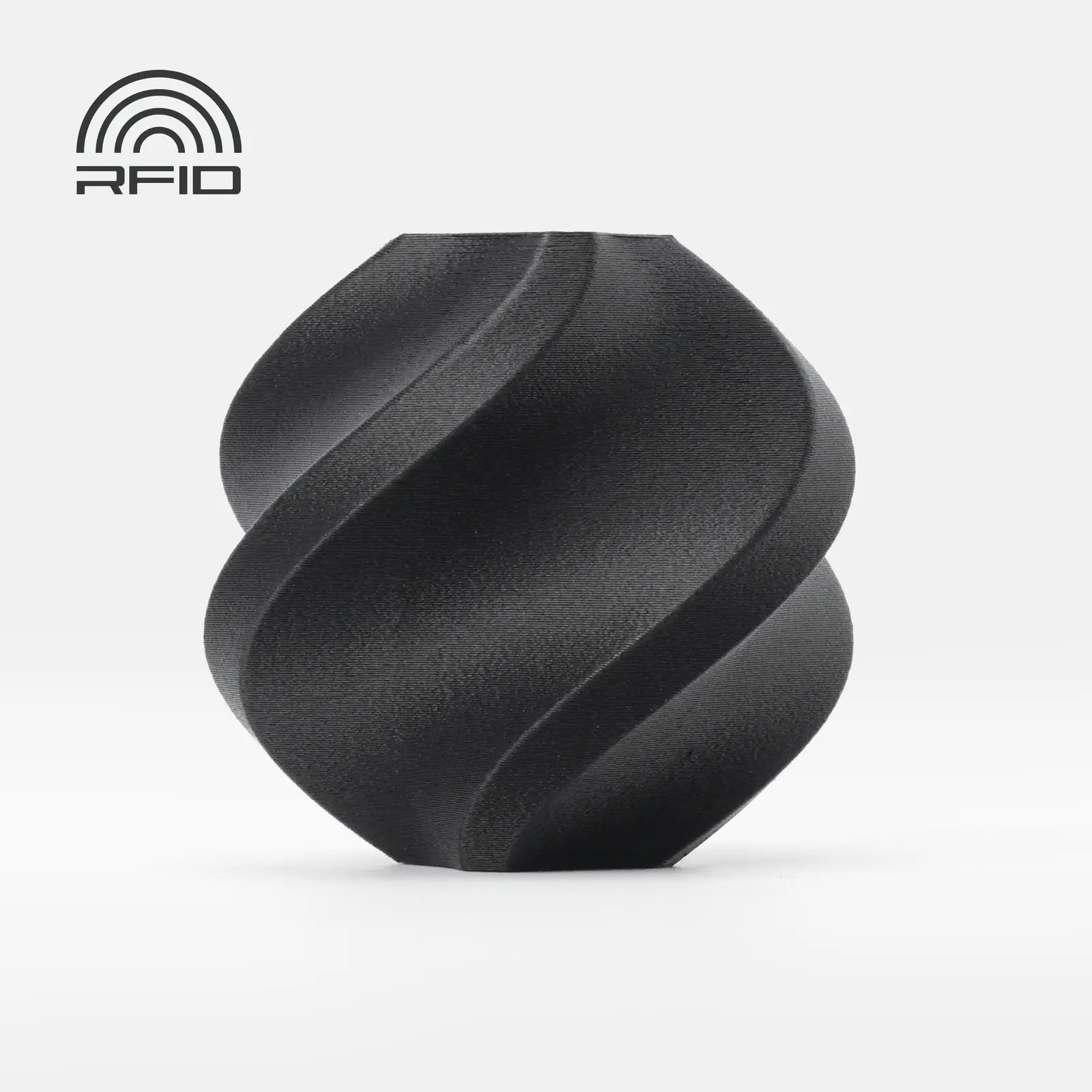
Bambu Lab PETG-CF - Black
By Bambu Lab · Filament & Resin · 3D Printing · More from Bambu Lab
- Nozzle temperature 240-270 °C
- Bed temperature 60-80 °C
- Print speed <200 mm/s
- Drying 65 °C for 8 h
- Part cooling fan 0-40%
Price not listed
- Bambu LabView at Bambu Lab
- eBayView at eBay
- AmazonView at Amazon (paid link)
- eBay (used) eBay: used, open-box, refurbishedView at eBay (used)
Stores are listed in a fixed order, never by price or commission. Prices are snapshots. Check the current price with the store.
Summary
A 1 kg, 1.75 mm carbon-fiber-reinforced PETG for functional 3D prints, sold by Bambu Lab in spools or refills. Check your printer first: it needs a hardened steel nozzle (0.6 mm recommended) and a reliable drying method, and it is not compatible with AMS lite or 0.2 mm nozzles.
Strengths
- Carbon fiber adds stiffness and strength over regular PETG, per manufacturer and store pages.
- Nozzle range covers 0.4, 0.6 and 0.8 mm, with AMS, AMS 2 Pro and AMS HT compatibility and RFID parameter loading.
- Manufacturer TDS publishes full thermal and mechanical data, including density, glass transition and tensile strength.
- Spool and refill options are both sold, with 30-day returns.
- Some owners report excellent wall and top surface quality on first prints.
Weaknesses
- Highly moisture-absorbent; even newly opened spools may need drying before printing.
- Nozzle clumping and clogging are reported, including buildup around and inside the nozzle area.
- Strong bed adhesion can leave white scarring or patch marks on textured PEI plates.
- Tuning difficulty for new users, including pressure advance, speed, layer height and drying.
- Not compatible with AMS lite or 0.2 mm nozzles; a hardened steel nozzle is required.
- No independent instrumented test of this exact filament was found.
Verified specifications
| Material | PETG and carbon fiber. |
|---|---|
| Diameter | 1.75 mm ± 0.03 mm. |
| Net filament weight | 1 kg. |
| Nozzle temperature | 240–270 °C. |
| Bed temperature | 60–80 °C (manufacturer page); 65–75 °C (TDS). |
| Print speed | below 200 mm/s. |
| Part cooling fan | 0–40% (manufacturer page); 0–60% (TDS). |
| Drying | 65 °C for 8 h in a blast drying oven; 75–85 °C for 12 h on an X1 series heatbed. |
| Storage humidity | below 20% RH in a sealed container with desiccant. |
| Nozzle sizes | 0.4, 0.6 and 0.8 mm; 0.2 mm not compatible; stainless steel not recommended. |
| Build plates | Engineering Plate, High Temperature Plate or Textured PEI Plate; glue for surface preparation. |
| Chamber temperature | 35–50 °C. |
| Retraction | 0.8–1.4 mm at 30–60 mm/s. |
| Max overhang angle | about 70°. |
| Max bridging length | about 30 mm. |
| AMS compatibility | AMS, AMS 2 Pro and AMS HT; not AMS lite. |
| RFID | printing parameters embedded in RFID for AMS reading. |
| Density | 1.25 g/cm³. |
| Glass transition temperature | 68 °C. |
| Tensile strength | 35 ± 5 MPa (X-Y), 29 ± 4 MPa (Z). |
| Not food-grade; finished prints should not contact food. | |
| Dimensions | 200 mm diameter × 67 mm height spool (ABS, 70 °C temperature resistance). |
| Returns | 30-day returns (Bambu Lab US store). |
Full research notes and sources
Printing requirements
Carbon fiber is abrasive, so a hardened steel nozzle is required and a 0.6 mm nozzle is recommended to reduce clogging risk. The 0.2 mm nozzle size is not compatible and stainless steel is not recommended. Safety notes from the store page call for ventilation, gloves for loading, cutting, sanding and post-processing, and no food-contact use. The filament should be printed in a well-ventilated area or with filtration or exhaust.
Moisture and drying
The filament is highly moisture-absorbent, and owners report drying for 12–24 hours before reliable printing, even on newly opened spools. Manufacturer guidance calls for 65 °C for 8 h in a blast drying oven, or 75–85 °C for 12 h on an X1 series heatbed. Unused filament should be kept sealed with desiccant in a cool, dark, dry place away from sunlight and high temperatures.
Bed adhesion and surface finish
Strong bed adhesion on textured PEI can leave white scarring or patch marks on the bed-facing surface. Owners report purging or flushing between materials and performing cold pulls with PET when changing materials to reduce clogs. Glue is recommended for surface preparation on the supported build plates.
Is it worth it?
Owners can buy PETG-CF at $31.99 per kg from the Bambu Lab US store (2026-10-26). At that price it is positioned as a lower-cost carbon-fiber PETG for functional parts, but its usable value depends on already having or buying a hardened steel nozzle and a reliable drying method. Inadequate drying or overly fine settings can cause clogging and failed prints, which raises the effective cost for users without drying capability. Users needing AMS lite compatibility or 0.2 mm nozzles should choose a different material.
Which model this is
This page covers Bambu Lab PETG-CF in the black color variant: 1 kg, 1.75 mm, carbon-fiber-reinforced PETG. The same family is sold in multiple colors (the store page states 8 colors; the manufacturer page names only Indigo Blue (31600)) and as both spooled filament and refill; refill requires an existing reusable spool. No black-specific SKU or color code was found in the sources. The TDS download link on the store page is labeled V2 while the PDF header reads V3.0. The bed temperature and part cooling fan ranges also differ between the manufacturer page and the TDS.
Sources
Manufacturer:
- Bambu Lab PETG-CF product page
- Bambu PETG-CF Technical Data Sheet
- Bambu Lab US Store PETG-CF product page
Independent reviews:
- No independent instrumented reviews of this filament were found.
Owner reports: