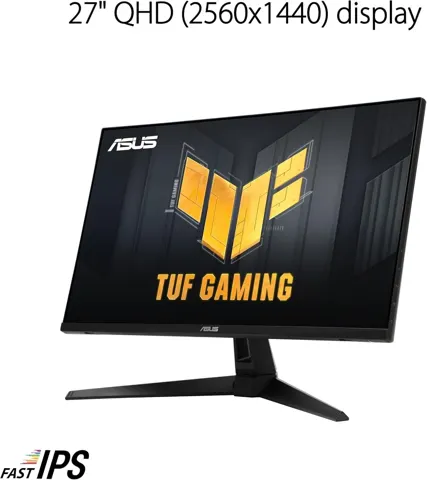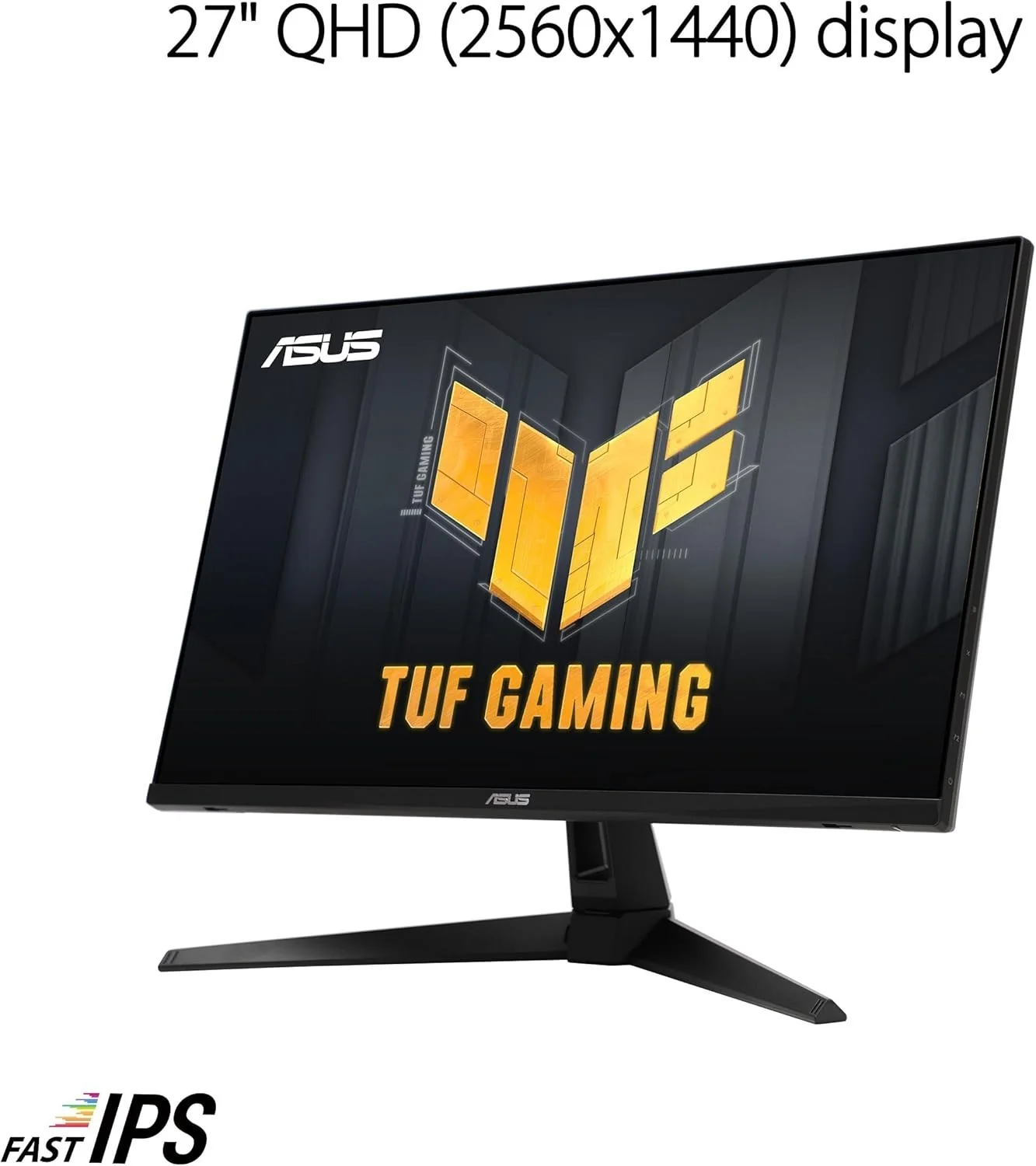
ASUS TUF Gaming 27” 1440P Gaming Monitor
By ASUS · Computer Monitors · Desk & Streaming Setup · More from ASUS
- 27-inch QHD 2560x1440
- 260Hz max (240Hz native)
- 1ms GTG response
- Fast IPS panel
- DisplayHDR 400
Price not listed
- ASUSView at ASUS
- NeweggView at Newegg
- eBayView at eBay
- AmazonView at Amazon (paid link)
- eBay (used) eBay: used, open-box, refurbishedView at eBay (used)
Stores are listed in a fixed order, never by price or commission. Prices are snapshots. Check the current price with the store.
Summary
A 27-inch 2560 × 1440 Fast IPS monitor for PC gaming at 240 Hz native (up to 260 Hz overclocked) over DisplayPort, with a full ergonomic stand and a two-port USB hub. Check before buying: HDMI is capped at 144 Hz, and multiple owners report horizontal lines or panel faults after one to two years.
Strengths
- Native 240 Hz and optional 260 Hz overclock give short frame intervals on a fast PC.
- Measured brightness up to 539 nits SDR and contrast up to 1420:1 on tested samples.
- Full stand adjustments plus VESA mounting and a two-port USB hub.
- Official FreeSync Premium, G-SYNC Compatible and AdaptiveSync certifications.
- Tunable overdrive, with ELMB and ELMB Sync for motion clarity.
Weaknesses
- HDMI is capped at 144 Hz, so consoles and HDMI-only laptops never see 240 Hz.
- 260 Hz is an overclock that can flicker; VRR is documented only to 240 Hz on DisplayPort.
- DisplayHDR 400 does not deliver OLED-grade blacks or strong full-scene HDR.
- Multiple owners report horizontal lines or panel faults after roughly one to two years.
- ASUS may deny a warranty claim for a single stuck subpixel under its dot policy.
- At $369 it is hard to justify against newer 27-inch 1440p alternatives.
Verified specifications
| Panel | 27-inch flat Fast IPS, 2560 × 1440, 0.233 mm pitch (~109 ppi), 16:9. |
|---|---|
| Brightness and contrast | 400 cd/m² typical, 1000:1 static contrast, 90% DCI-P3, 1.0737 billion colors. |
| Refresh | 240 Hz native, up to 260 Hz overclock via DisplayPort; HDMI 48–144 Hz. |
| VRR | FreeSync Premium, G-SYNC Compatible, AdaptiveSync Display 240 Hz; DP 48–240 Hz, HDMI 48–144 Hz. |
| Response | 1 ms GtG (ASUS claim); Variable OD levels 0–5; ELMB and ELMB Sync. |
| HDR | VESA DisplayHDR 400, HDR10. |
| Ports | 1× DisplayPort 1.4, 2× HDMI 2.0, 1× USB 3.2 Gen 1 Type-B upstream, 2× USB-A downstream, audio out. No USB-C. |
| Stand | 130 mm height, tilt -5° to +20°, swivel ±20°, pivot ±90°, VESA 100 × 100 mm. |
| Weight and size | ~6.4 kg with stand, ~4.1 kg without; approx. 614.9 × 533.9 × 213.8 mm. |
| Audio | 2 × 2 W speakers. |
| Power | under 26 W at 200 nits with no USB or audio; under 0.5 W standby; under 0.3 W off. |
| Warranty | 36 months; non-ZBD policy allows up to 3 bright and up to 5 dark subpixels. |
Full research notes and sources
Refresh rate and inputs
DisplayPort is the only way to reach the full 240 Hz or the 260 Hz overclock; HDMI 2.0 tops out at 144 Hz. The manual warns that overclocking can flicker and suggests lowering the maximum if it occurs, and ASUS documents VRR only from 48 Hz to 240 Hz on DisplayPort and 48 Hz to 144 Hz on HDMI, so 260 Hz operation with VRR is not verified. There is no USB-C video input; the two USB-A ports need the Type-B upstream cable connected to a PC, and that upstream cable is part of the US box contents per Newegg’s listing. Cables and accessories are excluded from the LCD warranty.
Motion and HDR
The 1 ms gray-to-gray figure is an ASUS claim, not a measured worst-case transition. Independent testers preferred Variable OD at level 3, found level 4 reduced some visible trails, and considered level 5 unnecessary; ELMB and ELMB Sync add strobing options, but normal Variable OD becomes unavailable with ELMB on. HDR is VESA DisplayHDR 400 with HDR10 processing, on an IPS panel with roughly 1000:1 to 1420:1 measured contrast, so it does not provide pixel-level black control; one tester measured about 440 nits in an HDR mode versus 539 nits at maximum SDR brightness on that sample. sRGB mode locks brightness, contrast, saturation, color temperature, skin tone and ASCR.
Reliability and warranty
Several independent owner reports describe horizontal lines, banding or a failed image appearing after about one to two years, including cases where the defect showed in the monitor’s own on-screen menu with no source connected. A 2024 owner reported a dead pixel inside three weeks and an RMA that took over a month, with a new artifact on the returned panel; a 2026 owner reported ASUS denied an RMA for a single stuck red subpixel, consistent with the published non-ZBD policy of up to 3 bright and 5 dark dots. A Turkish owner reported service replaced the panel. These are small-sample anecdotes, not a proven defect rate or a prediction that all units fail at two years. ASUS offers 36 months of limited LCD hardware warranty from the original purchase with dated receipt, and may use equivalent new or reconditioned parts.
US asking prices checked in October 2026: GTR Simulator lists $369.00, a Newegg marketplace snapshot shows about $366.20, and NVIDIA Marketplace lists $399.99 but is out of stock. Value thresholds from the research: below $180 is potentially attractive if new with a 36-month US warranty and easy returns; $180–$220 only if the USB hub, stand and native 240 Hz matter specifically; above $220–$250 generally avoid, and at $369 skip it. Comparisons listed: LG UltraGear G6 27-inch QHD IPS 300 Hz at $209.99, Acer Nitro KGB271U 27-inch QHD IPS 200 Hz at $149.99, and Acer Nitro VG277U Xbiip 27-inch 1440p QD-OLED 240 Hz at $269. These are retailer offers reproduced by an editorial guide, not verified checkout totals or head-to-head proof of reliability.
Running costs
No subscription or scheduled consumables. Illustrative electricity only: 26 W × 8 hours/day × 365 days = 75.92 kWh/year, about $15.18/year at an assumed $0.20 per kWh. Standby under 0.5 W for the remaining 16 hours/day adds less than 2.92 kWh/year, or less than $0.59/year, for a combined under $15.77/year provided actual active power stays at 26 W. At measured 500-nit-plus SDR, HDR and USB loads, real annual cost may be higher. PC and GPU power are excluded.
Which model this is
This page covers the ASUS TUF Gaming VG27AQML1A: a 27-inch 1440p Fast IPS monitor, not the VG27AQ, VG27AQM1A, VG27AQML5A or VG27AQM5A. Match on the exact model number when buying.
Sources
Manufacturer:
- ASUS VG27AQML1A technical specifications
- ASUS VG27AQML1A user guide (PDF)
- ASUS VG27AQML1A warranty page
Independent reviews:
- Zhihu hands-on test of VG27AQML1A
- SMZDM hands-on measurements (October 2024)
- PC Gamer US gaming monitor deals (October 2026)
Owner reports:
- Horizontal lines after about one year (r/ASUS)
- Lines and banding after about two years (r/Asustuf)
- Dead-pixel RMA and returned panel (r/ASUS)
- RMA denied for a single stuck pixel (r/ASUS)
- Panel replacement reported (Techolay)
Parts and stores: