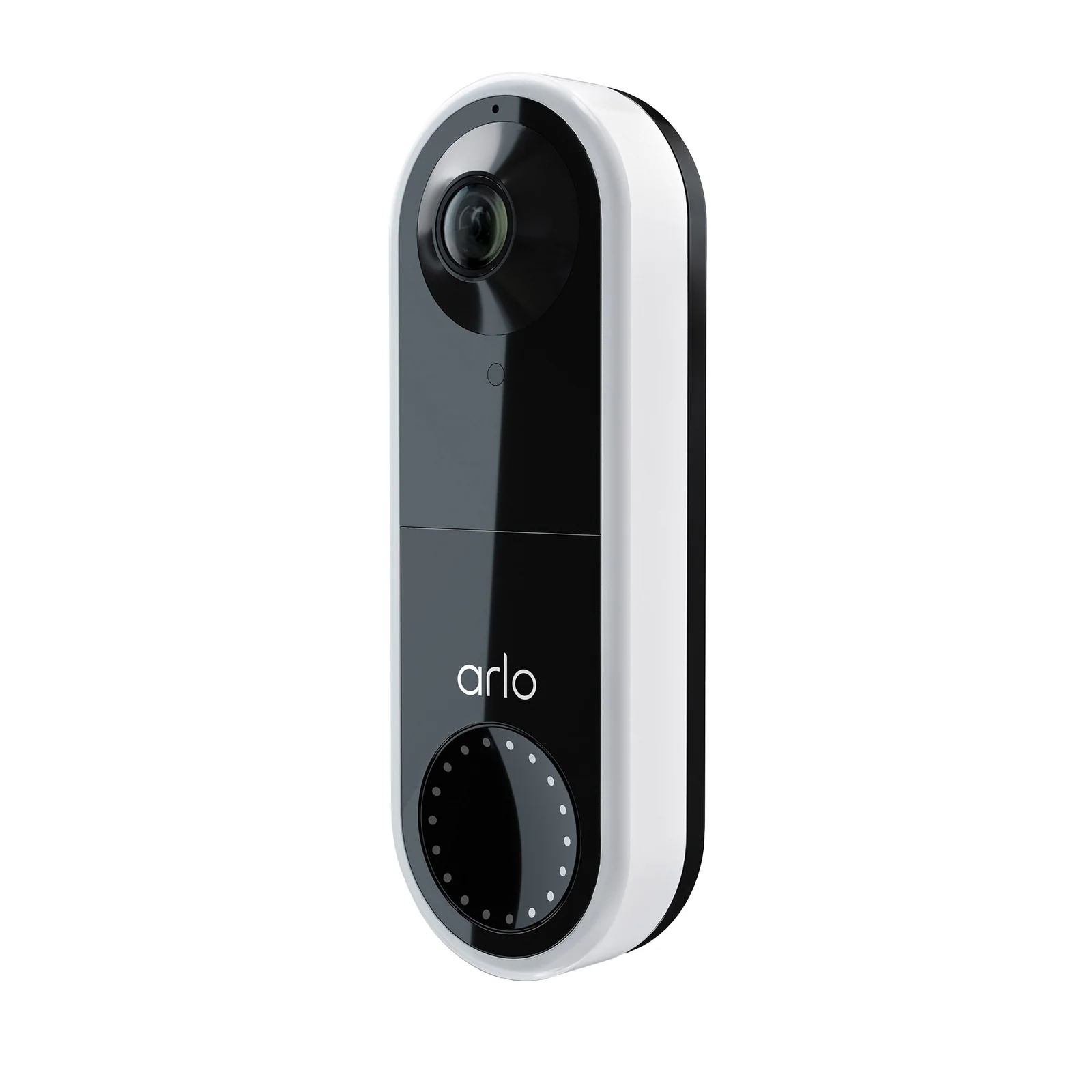
Arlo Essential Wired Video Doorbell
By Arlo · Video Doorbells · Cleaning & Smart Home
- HD video, 180-degree view, color night vision
- Wired install using existing doorbell wiring, direct-to-WiFi (no hub required)
- 2-way audio with pre-recorded quick-reply messages
- Cloud recorded video history requires an Arlo Secure subscription
Lowest price seen
~$34.99 (approx.)
from $34.99 at Amazon
- Amazon ~$34.99 (approx.)View at Amazon
- CostcoView at Costco
- Best BuyView at Best Buy
- eBayView at eBay
- eBay (used) eBay: used, open-box, refurbishedView at eBay (used)
Prices are snapshots. Check the current price with the store.
Summary
A first-generation wired doorbell camera with a square 1536 × 1536 HDR view that frames a visitor head to toe and catches packages at the threshold. It needs existing 16–24VAC doorbell wiring on a 10VA transformer, and its history and detection features run through a paid Arlo Secure cloud plan that costs more over a few years than the doorbell does.
Strengths
- The square 1:1 frame shows a visitor’s face and a package at the same time, which most doorbell shapes cannot do.
- Tom’s Guide found good daytime HDR detail and color, and solid nighttime visitor detail.
- Pre-roll keeps the seconds before detected motion, so visitors do not arrive as a blur.
- Hardwired, so there is no battery to recharge or replace and no charging downtime.
- Owners who value the framing report long happy runs, including one AVD1001 owner close to two years of flawless service.
- It works without a hub, but accepts one if your Arlo setup already has it.
Weaknesses
- Owners on r/arlo repeatedly report disconnect and reconnect cycles and units that stop responding entirely despite strong nearby Wi-Fi.
- Outgoing talk latency is about two seconds in Tom’s Guide’s test; incoming audio arrives in about half a second.
- A 2024 thread has several owners reporting sudden blocky live video and degraded detection after previously good operation, with firmware suspected but unproven.
- It is 2.4 GHz only, and it needs 16–24VAC at10VA minimum — a requirement many generic doorbell listings leave out.
- Chime compatibility is fiddly: Arlo Community threads cover silent digital chimes and chimes that buzz or run hot.
- The sealed outdoor unit has no documented owner-serviceable parts, and the warranty is one year.
Verified specifications
| Video | 1536 × 1536, 1:1 aspect, H.264, HDR. |
|---|---|
| Field of view | 180° diagonal; 12× digital zoom. |
| Night vision | dual 850 nm infrared LEDs, up to 20 ft of illumination. |
| Audio | speaker and microphone, two-way talk, plus prerecorded quick replies and visitor messaging. |
| Motion detection | adjustable to 16 ft. |
| Network | 2.4 GHz Wi-Fi only, up to 300 ft line-of-sight; connects directly to Wi-Fi or through a compatible Arlo SmartHub/Base Station. |
| Power | existing doorbell wiring, 16–24VAC, minimum 10VA transformer. No user-replaceable battery. |
| Operating temperature | −4°F to 113°F (−20°C to 45°C), weather resistant. |
| Warranty | 1 year in the US. |
| Dimensions | 1.77 × 5.11 × 0.98 in (45 × 130 × 25 mm); 0.25 lb (113 g). |
| In the box | doorbell, flat mounting plate, angled mounting plate, power kit, screw kit, security latch release pin, wire extensions, quick-start guide. |
Full research notes and sources
The square view
The “HD” label undersells this camera. It shoots 1536 × 1536 in a 1:1 frame with a 180° diagonal field of view, which is unusual at a front door. That geometry is the reason to buy it: a visitor’s head and a box left at the door both fit in frame, where a wide landscape camera usually gets one or the other. Tom’s Guide rated daytime detail and color very good and nighttime visitor detail good, and Geek Culture independently put overall performance at 7/10 while flagging the same audio delay.
Arlo’s pre-roll buffer is the other quiet strength. It records before the motion event triggers, so the video starts with someone walking up rather than mid-stride at the edge of frame.
Installation and wiring
Budget real time here. The unit runs off existing doorbell transformer wires at 16–24VAC with a minimum of 10VA, and many older chime transformers fall short of that. The included power kit goes on the chime side of the circuit. Arlo’s own knowledge base spells out the transformer requirement, and catalog listings frequently leave it out, so check yours before ordering.
Chime behavior is where installs get stuck. In Arlo Community, owners with this exact model report digital chimes that never sound, chimes that buzz or run hot, and one unit that died during a bench test. Those reports are configuration-sensitive rather than a defect rate, but they mean budget time for troubleshooting if your chime is digital. The angled mounting plate is in the box for a skewed wall.
Connectivity and latency
This is the weak spot. Separate owners of this model describe repeated drop-and-reconnect cycles, a doorbell that stops answering on a network with strong signal a few feet away, and units that fail to come back later in their life. Notification delay and slow live talk recur in the same threads. Nobody has published a failure rate for this model, so treat it as a known annoyance rather than a defect, and plan for the possibility that you will be troubleshooting the app more often than the camera.
Arlo also updated its comparison page to confirm this doorbell can run on direct2.4 GHz Wi-Fi or through a compatible SmartHub/Base Station, so a hub is optional rather than required.
Filters, running costs and upkeep
There are no filters to change and no consumable batteries. Ownership means keeping the lens clean, keeping the Wi-Fi solid, and making sure your transformer and chime stay compatible. The power kit, mounting hardware and transformer are separately serviceable. The sealed outdoor unit is not: no owner-serviceable internal parts are documented, and no teardown or parts catalog exists, so once the one-year warranty is up there is no clear repair path.
Cloud storage and the advanced detection features sit behind Arlo Secure. That plan is priced per year for a single camera, and Arlo’s own pages show different figures depending on billing channel, so check the checkout price rather than trusting a page. Over three years, the plan costs several times what the doorbell costs outright. Whether a SmartHub with local storage changes that depends on the hub you own — confirm before you assume you can skip the subscription.
Is it worth it?
Two separate questions. The physical doorbell is a bargain when you find one cheap as old stock or on sale, given the framing and the pre-roll. The cloud plan is what drags it down, and it costs far more than the doorbell itself over a few years.
Buyers already inside the Arlo ecosystem, or anyone who specifically wants that square head-to-toe view, get the strongest deal here. New to Arlo should weigh the total three-year cost against newer doorbells rather than the clearance sticker. Check the store panel above for the current hardware price.
Which model this is
This page covers the first-generation Arlo Essential Wired Video Doorbell, model AVD1001, white US SKU AVD1001-100NAS, UPC 193108139779, Amazon listing ASIN B089Y6R6B8. The black AVD1001B is the same first-generation wired platform in another color. Do not confuse it with the wire-free AVD2001 or with the second-generation AVD3001 and AVD4001, which are different hardware.
Sources
Manufacturer:
- Arlo — differences between Arlo video doorbells
- Arlo Video Doorbell family datasheet (PDF)
- Arlo support — doorbell transformer requirements
- Arlo Secure plans
- Arlo Secure retail plan page
Independent reviews:
Owner reports:
- New setup dead and reconnecting continuously (Arlo Community)
- Doorbell dropping off Wi-Fi (r/arlo)
- Blocky, pixelated live video after good operation (r/arlo)
- Failure to reconnect later in the doorbell’s life (r/arlo)
- Live talk and notification delay (r/arlo)
- Digital chime not sounding after install (r/arlo)
- Chime buzzing after installation (r/arlo)
- Doorbell stopped working after years of service (r/arlo)
Retail listings: