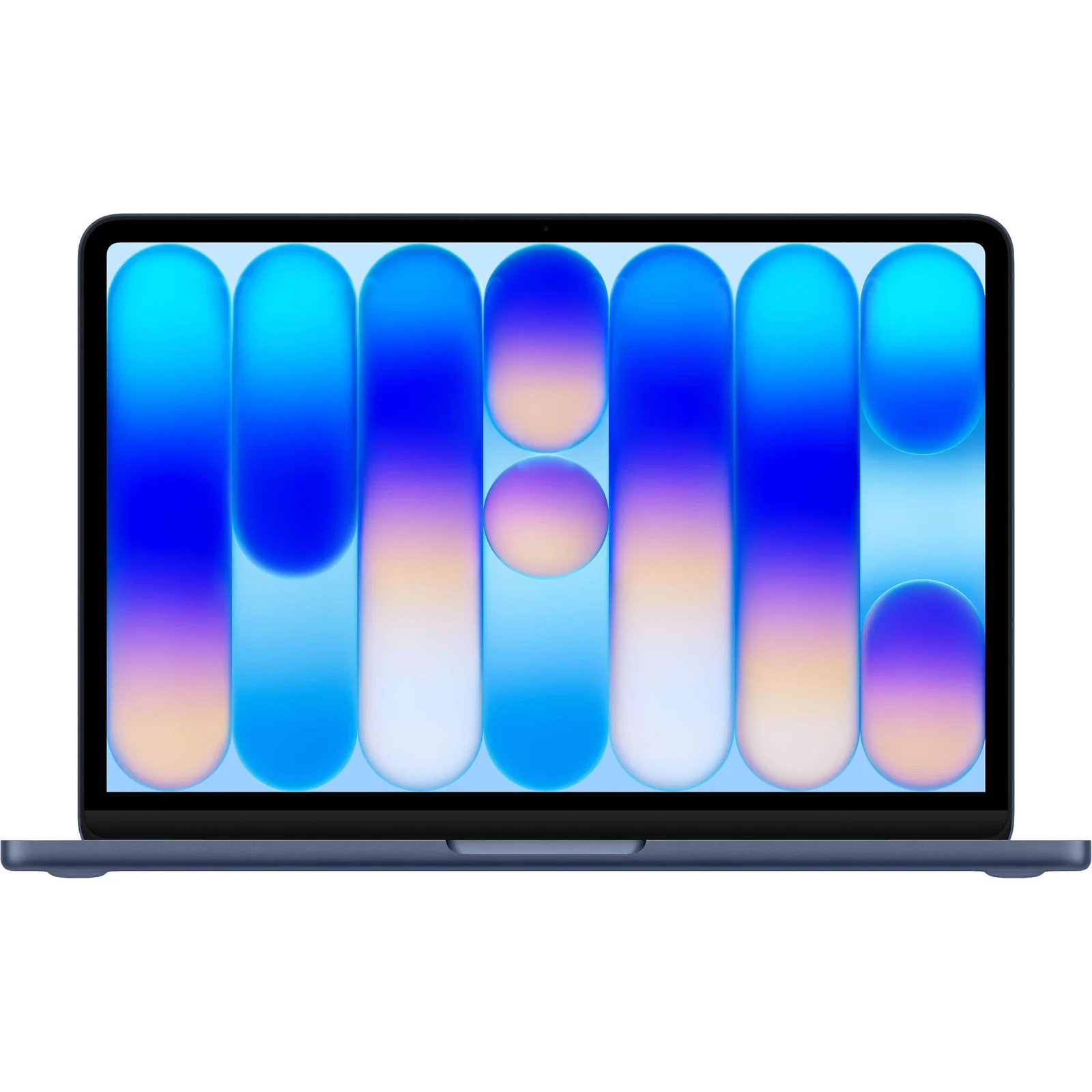
Apple 2026 MacBook Neo 13-inch Laptop with A18 Pro chip: Built for AI and Apple Intelligence
By Apple · Laptops · Phones & Computers · More from Apple
- Apple A18 Pro chip (6-core CPU, 5-core GPU, 16-core Neural Engine)
- 8GB unified memory
- 256GB SSD
- 13.0-inch Liquid Retina display, 2408x1506, 500 nits
- Up to 16 hours battery life
Price not listed
- AppleView at Apple
- B&H PhotoView at B&H Photo
- WalmartView at Walmart
- TargetView at Target
- AmazonView at Amazon (paid link)
More on eBay (1)
- eBayView at eBay
- eBay (used) eBay: used, open-box, refurbishedView at eBay (used)
Stores are listed in a fixed order, never by price or commission. Prices are snapshots. Check the current price with the store.
Summary
Apple’s entry-level 13-inch MacBook with an A18 Pro chip, 8GB of fixed memory and 256GB or 512GB of fixed storage, announced in March 2026, suits writing, browsing, schoolwork and travel with a silent fanless chassis and long battery life. Check whether 8GB and 256GB will last your intended lifetime before buying, since neither is upgradable.
Strengths
- Snappy everyday performance for writing, browsing and light photo work, with a measured 3,535 single-core and 8,920 multicore Geekbench 6 score on Tom’s Guide’s sample.
- Long battery life in light use: 13 hours 28 minutes on Tom’s Guide’s web-browsing test at 150 nits, and RTINGS found it lasts a normal light work or school day.
- Build quality above many budget laptops: rigid aluminum chassis, stable hinge, sharp accurate sRGB panel and a good 1080p webcam, with about 480 nits measured.
- Completely silent under load thanks to the fanless design.
- More repairable than recent Macs: iFixit scored 6 out of 10, its best MacBook result in about 14 years, with a screw-mounted battery tray and accessible parts.
- Apple publishes a model-specific service manual and sells genuine replacement parts for battery, display, trackpad, keyboard, USB-C boards, speakers and logic board.
Weaknesses
- 8GB memory is fixed for the life of the machine and limits heavy multitasking, development and local AI.
- Two USB-C ports look identical but only one supports 10 Gb/s data and an external display.
- No backlit keyboard on either configuration, and no Touch ID on the 256GB model.
- External 4K displays cannot use the usual retina-quality 2560x1440 workspace scaling; options are crowded, tiny or soft.
- The bundled 20W charger is slow: about 0 to 43% in 60 minutes versus 0 to 66% with a 45W charger in Ars Technica’s test.
- IPS panel has modest contrast and no wide-gamut P3 coverage; not a reference display.
Verified specifications
| Chip | Apple A18 Pro with 6-core CPU (2 performance and 4 efficiency cores), 5-core GPU with hardware ray tracing, 16-core Neural Engine, 60 GB/s unified memory bandwidth, plus ProRes and AV1 decode. |
|---|---|
| Memory | 8GB unified memory, the only configuration, not upgradable. |
| Storage | 256GB SSD with standard Magic Keyboard and lock button, or 512GB SSD with Touch ID keyboard. Fixed at purchase. |
| Display | 13.0-inch Liquid Retina, LED-backlit IPS, 2408 × 1506, 219 ppi, 500-nit claimed brightness, 60 Hz, sRGB color. No wide-gamut P3 or True Tone. |
| Ports | two USB-C on the left with different capabilities: rear port is USB 3 up to 10 Gb/s with charging and DisplayPort 1.4; front port is USB 2 up to 480 Mb/s with charging and no monitor output. No Thunderbolt, USB4 or MagSafe. One native 4K at 60 Hz external display alongside the built-in screen. 3.5 mm headphone jack. |
| Camera and audio | 1080p FaceTime HD camera, dual-microphone array, dual speakers with spatial audio, Wi-Fi 6E, Bluetooth 6. No Center Stage. |
| Battery | 36.5 Wh, up to 16 hours video streaming or 11 hours wireless web claimed. Includes 20W USB-C power adapter and 1.5 m USB-C charge cable. |
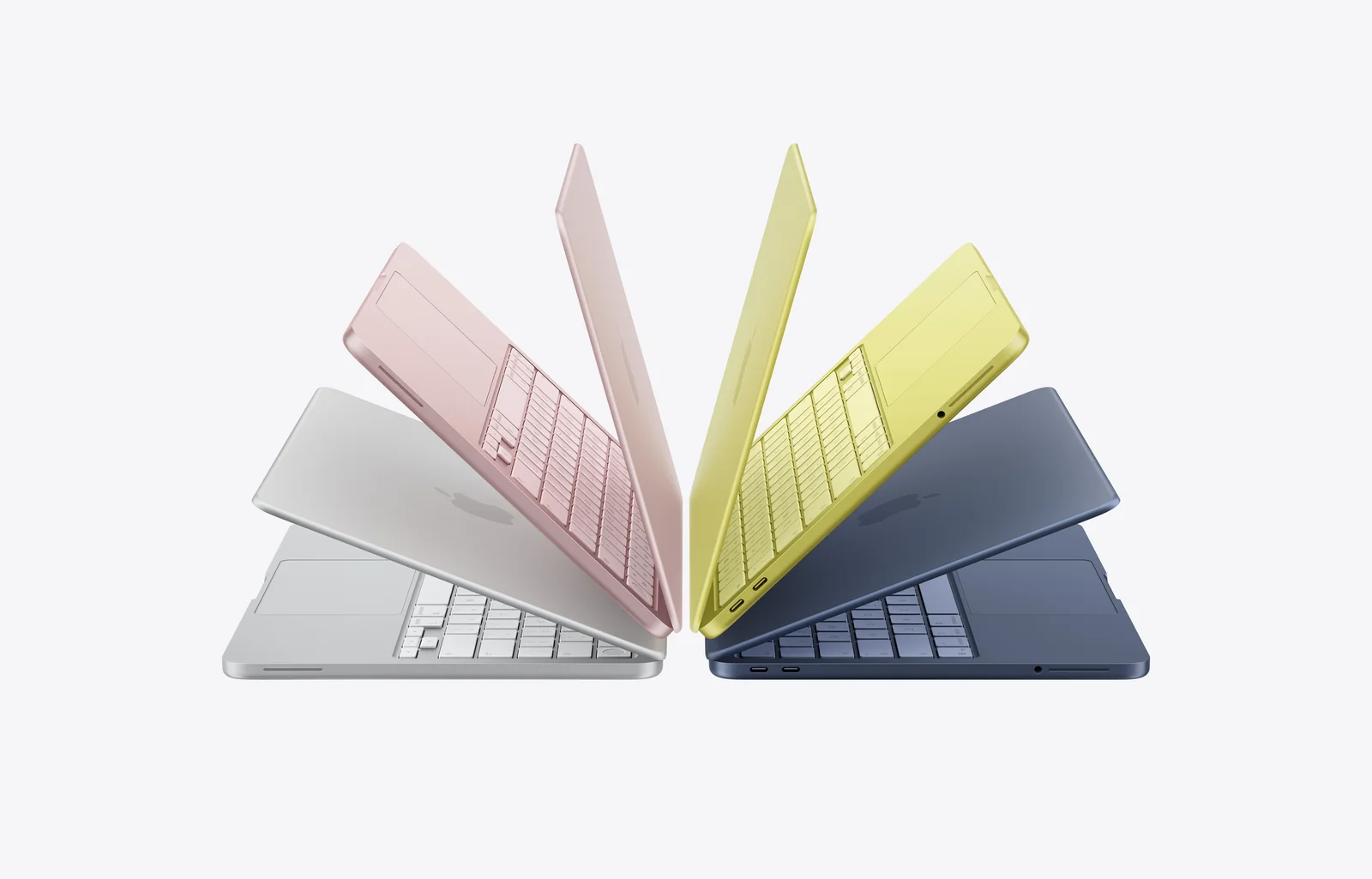
| Size and weight | 2.7 lb (1.23 kg), 11.71 × 8.12 × 0.50 in. Colors: Silver, Blush, Citrus, Indigo. |
| Construction | fanless aluminum, physical-click Multi-Touch trackpad, non-backlit keyboard on both configurations. |
| Software | macOS with Apple Intelligence. Native ARM macOS app compatibility differs from Windows. |
Full research notes and sources
Memory and storage for life
8GB unified memory is the only configuration and cannot be upgraded, and both SSD capacities are fixed. iFixit found memory and storage integrated rather than user-upgradeable. RTINGS and Notebookcheck both treat the 8GB ceiling as the central long-term compromise: fine for writing, browsing and schoolwork, limiting for IDEs, many browser tabs, large photo or video files and local AI. Storage is the other permanent decision. 256GB fills quickly with downloaded media and large app libraries; the 512GB version costs $100 more and adds Touch ID. An external USB SSD works at full speed only on the rear 10 Gb/s port. Choose capacity for your intended lifetime.
Ports and external displays
The two left-side USB-C connectors are not equivalent. The rear port supports USB 3 up to 10 Gb/s, charging and DisplayPort 1.4; the front port supports USB 2 up to 480 Mb/s and charging but no monitor output. A charging cable works in either; a display or fast SSD does not. There is no Thunderbolt or USB4, and Apple officially supports one native 4K at 60 Hz external display alongside the built-in screen. A 5K Studio Display at native 5K is not supported. Ars Technica found that a 4K monitor cannot offer the usual retina-quality 2560x1440 workspace scale on this machine, leaving crowded, tiny or soft options. A Thunderbolt-only dock may fail to connect at all. Budget for a USB-C adapter if you need USB-A, HDMI or SD.
Battery life and charging
Apple claims up to 16 hours of video streaming or 11 hours of wireless web. Tom’s Guide measured 13 hours 28 minutes on a continuous web-browsing test at 150 nits, and RTINGS concluded it could last a normal light work or school day. Endurance falls with higher brightness and heavier work. The fanless design keeps it silent but limits sustained power.
Charging is slow with the included 20W adapter: Ars Technica measured about 0 to 43% in 60 minutes, versus 0 to 66% with a 45W charger. A faster USB-C adapter is optional and does not enable MagSafe, which the Neo does not have. The 36.5 Wh battery stores enough for a day of light use; replacing a full charge daily is about 13.32 kWh a year, or about $2.66 at an assumed $0.20 per kWh, before conversion losses and real-world use.
Reliability and service
The product launched in March 2026, so long-term failure data does not exist yet. Owner reports include a September 2026 case of a display going black about four months after purchase, with a repair taking about a week and the problem recurring about 20 days later; no root cause or warranty outcome was verified. Other owners report idle battery drain ranging from 100% to about 40% in 12 hours, 22% in 24 hours, or 100% to 82% overnight, while some see no meaningful loss. These are self-selected reports, not proof of a common defect. A July 2026 owner reported 50 cycles and 98% capacity after about three months, an ordinary snapshot, not evidence of premature wear. Apple targets up to 80% capacity at 1,000 cycles, not a per-machine promise.
Practical checks for drain: inspect Activity Monitor’s Energy tab, background apps, wake activity and System Settings, update macOS, test sleep with apps closed and no USB peripherals, then use Apple Diagnostics or support if reproducible. For a repeated black screen, back up data and seek warranty diagnosis rather than attempting DIY display replacement while covered.
Running costs, warranty and support
No mandatory subscriptions or annual consumables. macOS and built-in apps require no paid plan; AppleCare+ and iCloud storage are optional. AppleCare+ for new Neo plans was reported in July 2026 at $59.99 a year or $5.99 a month, about $71.88 a year if paid monthly, with Apple able to change pricing. Apple’s published US fee table lists $49 per accidental screen or enclosure incident and $149 for other accidental damage, on top of plan premiums. Covered battery service below 80% capacity carries no extra battery-service fee.
Out-of-warranty battery service was estimated at about $149 in an October 23, 2026 survey, subject to inspection. Apple’s one-year limited hardware warranty covers eligible manufacturing defects; accidental damage, ordinary battery aging and cosmetic wear should not be assumed covered. Apple’s service site says it must inspect the device to finalize an out-of-warranty repair price, and shipping may add fees.
Replacement parts give this machine a better repair outlook than many Macs: a 1.5 m USB-C charge cable at $9.99, a 20W USB-C power adapter at $14.99, USB-C ports at $16.99, trackpad at $64.99, full display assembly at $259.99, upper case with keyboard at $199.99, battery at about $111.75 in an April 2026 Apple self-service survey with a $22.50 returned-part credit, logic board at $249.99, speakers at $19.99 each, dual-mic assembly at $19.99, headphone jack at $13.99 and lower case at $32.99. Apple’s April 2026 survey also listed a standalone keyboard at $113.52 with a $26.40 conditional return credit, and a genuine display part at $219.12 with an $88 returned-part credit. Apple’s out-of-warranty battery service estimate was about $149. These are parts and channels with different conditions; confirm exact SKU, color, Touch ID and tools before ordering.
Is it worth it?
Apple’s US new list price as of late June 2026: $699 for 8GB/256GB and $799 for 8GB/512GB with Touch ID; the March launch prices of $599 and $699 are no longer current. Education pricing for the 256GB model was $649 after the October 28, 2026 increase. Authorized retailers: B&H Photo listed $689 for 256GB Indigo and $799 for 512GB Silver; Costco online showed $689.99 and $789.99. Apple Certified Refurbished listed $599 for 256GB with a one-year warranty and 14-day returns, with $679 tracked for 512GB on October 29.
Editorial thresholds: 256GB new at $599 or less is a particularly good deal against the $699 list price; $600 to $650 is favorable; $651 to $699 is ordinary October retail; above $699 is poor value unless extras are included. A $599 refurbished unit is attractive compared with $689 to $699 new if condition and warranty terms are acceptable. For 512GB, under $699 new is strong, $700 to $790 is reasonable, and $799 or more should prompt serious consideration of a more capable machine if 8GB memory is already limiting.
Alternatives: the 13-inch MacBook Air with M5 starts at $1,299 with 16GB memory and 512GB storage, a faster chip, better screen and camera, backlit keyboard and Touch ID, but it is a large price jump. The Lenovo IdeaPad Slim 3x 15.3-inch with Snapdragon X, 16GB and 256GB showed a $549.99 promotional offer at Best Buy in late October 2026, though promotion duration was not reliably verified; it suits Windows workflows and larger screens, with ARM compatibility caveats.
Which model this is
This page covers the 2026 MacBook Neo, 13-inch, hardware model A3404, with A18 Pro and 8GB of memory, in Silver, Blush, Citrus and Indigo. Do not confuse it with the MacBook Air or MacBook Pro, which use different chips, more memory and different ports.
Sources
Manufacturer:
- Apple MacBook Neo technical specifications
- Apple MacBook Neo product page
- Apple MacBook Neo Repair Manual
- Apple Mac notebook service and repair
- Apple US AppleCare+ fees and deductibles
- Apple batteries service and recycling
Independent reviews:
Owner reports:
- Black screen and repeat warranty repair (r/MacbookNeo)
- Idle battery drain discussion (r/MacbookNeo)
- 100% to 40% closed-lid drain (r/MacbookNeo)
- October 17 closed-lid drain (r/MacbookNeo)
- MacRumors forum owner complaints
- DisplayLink Xebec tri-screen issue
Parts and stores: