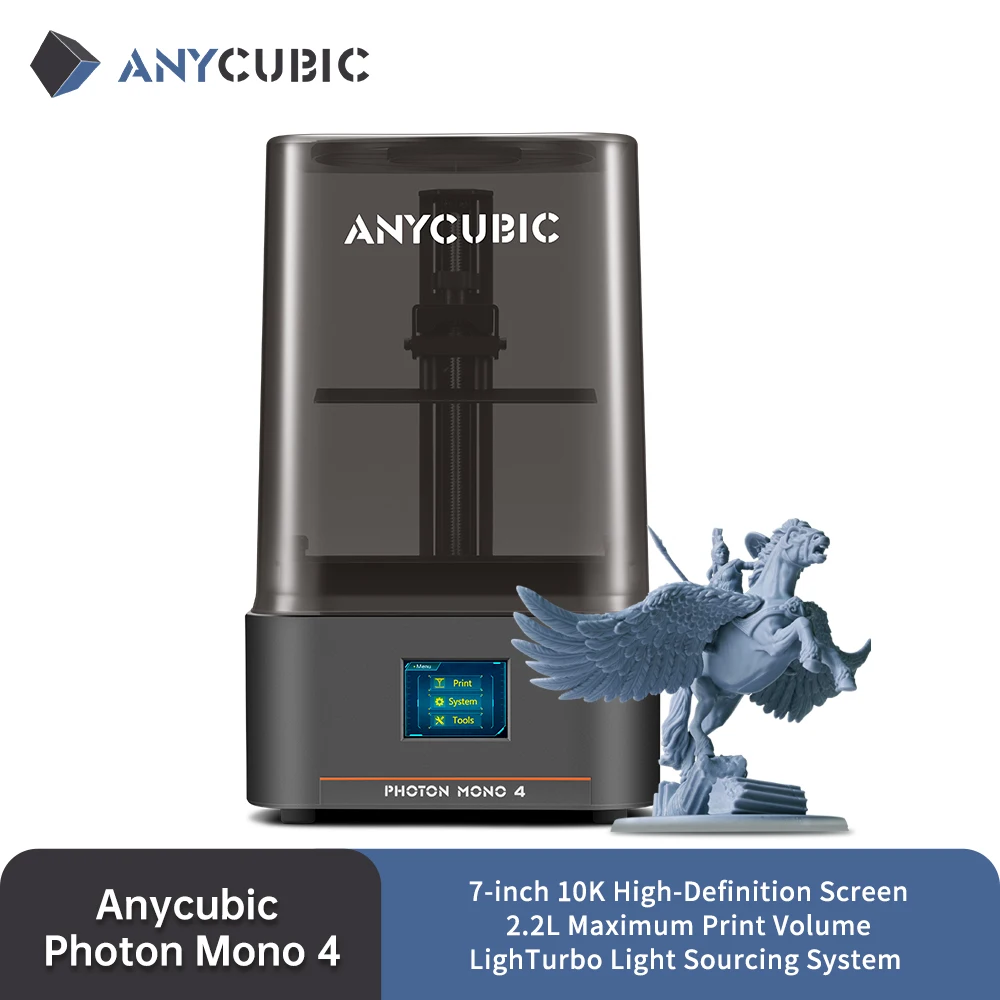
ANYCUBIC Photon Mono 4 Ultra 10K
By ANYCUBIC · Enclosed 3D Printers · 3D Printing · More from ANYCUBIC
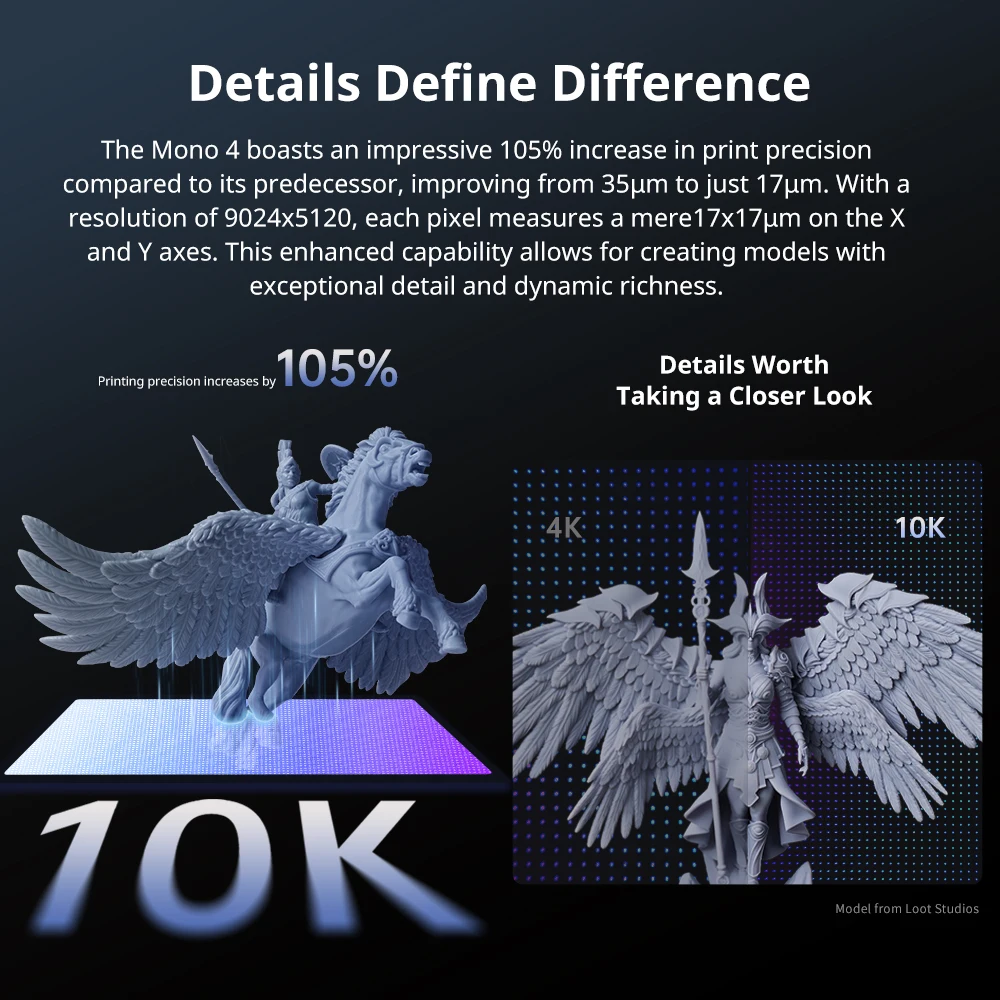
- 7 inch 10K LCD (9024x5120, 17x17μm pixel)
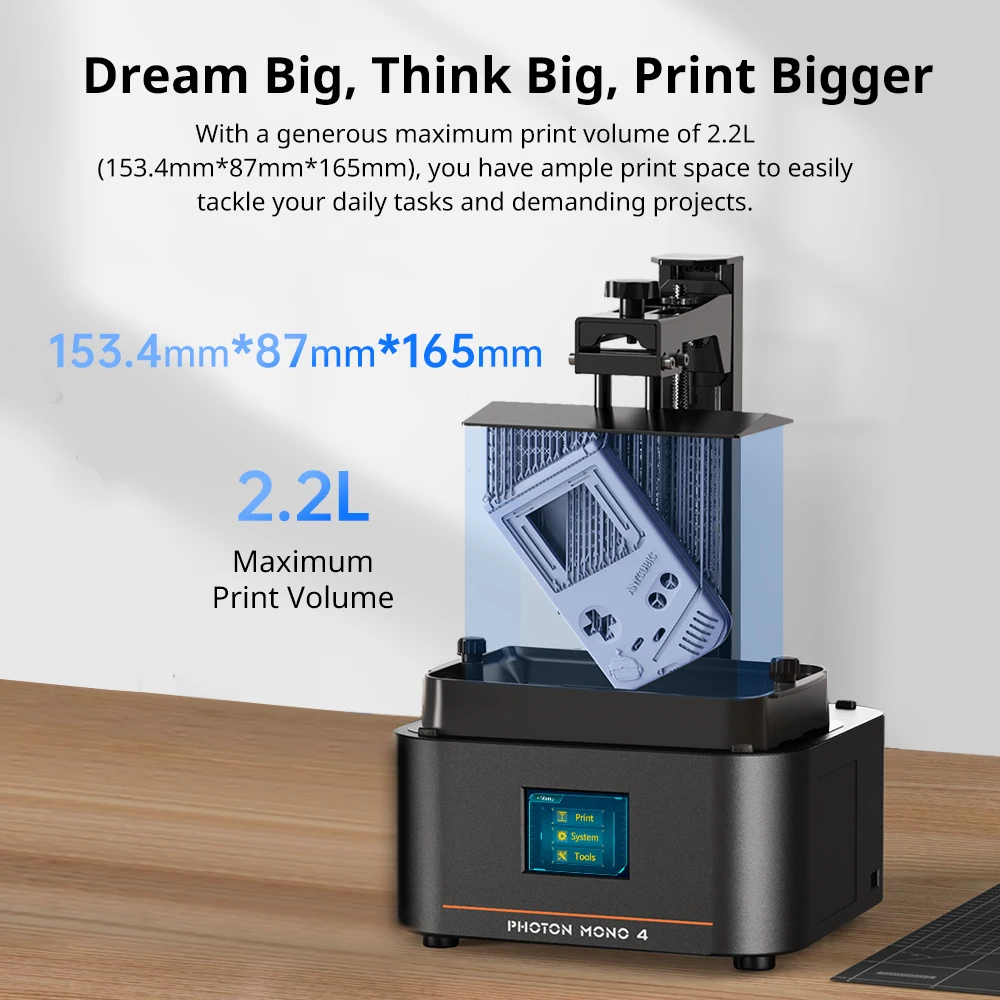
- Build volume 153.4x87x165mm (2.2L)
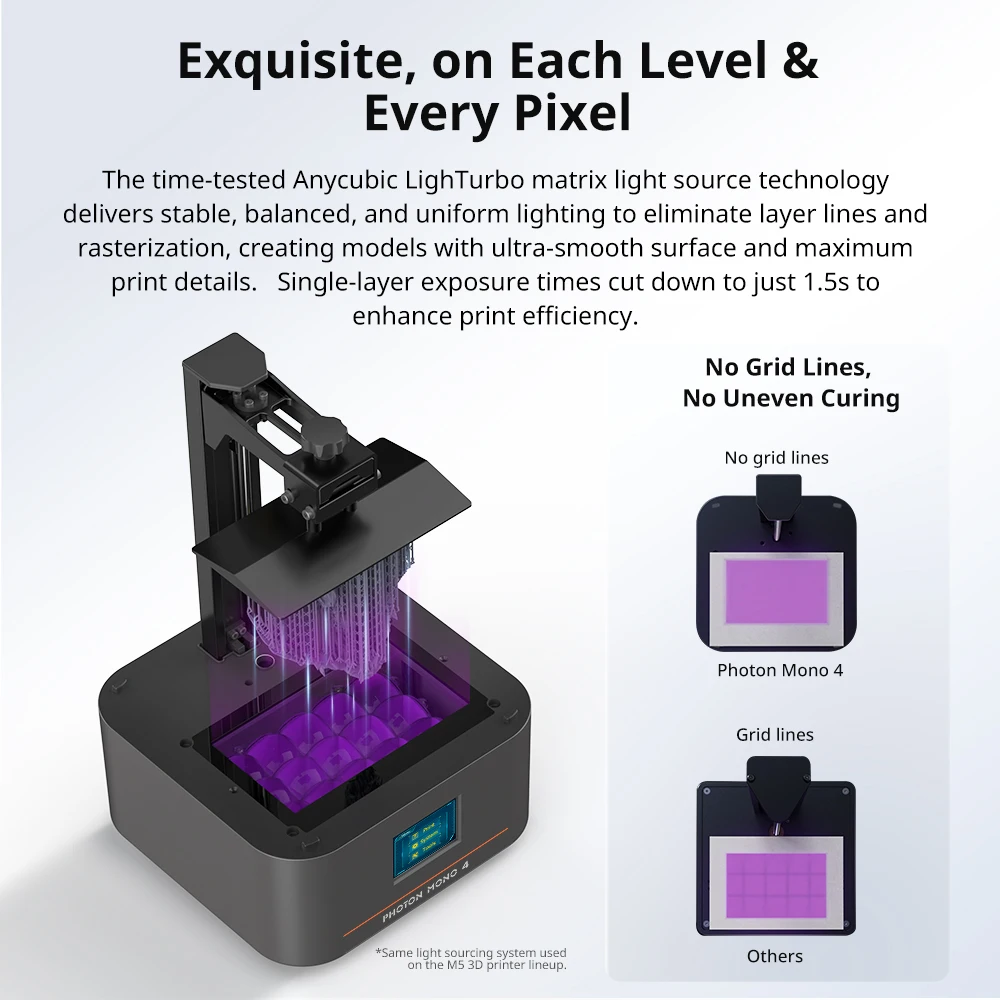
- COB light source with Fresnel lens
- Print speed up to 120mm/h (High Speed Resin 2.0)
- Layer height 0.02-0.15mm
Lowest price seen
$195.49
from $195.49 at AliExpress · Checked Oct 19, 2026
- AliExpress ANYCUBIC OVERSEAS Store $195.49View at AliExpress
- Anycubic Global Store $299.00View at Anycubic Global Store
- ANYCUBICView at ANYCUBIC
- eBayView at eBay
- AmazonView at Amazon (paid link)
- eBay (used) eBay: used, open-box, refurbishedView at eBay (used)
Stores are listed in a fixed order, never by price or commission. Prices are snapshots. Check the current price with the store.
Summary
A compact MSLA resin 3D printer with a 7-inch 10K monochrome LCD (9024×5120, 17×17 µm pixels) and a 153.4 × 87 × 165 mm build volume, built for miniatures, jewellery and small high-detail parts. Check the build volume before you buy: 2.2 L rules out batching and large terrain, and the advertised 120 mm/h speed only happens with High Speed Resin 2.0 at 0.1 mm layers.
Strengths
- 10K resolution at 17×17 µm pixels delivers exceptional detail on miniatures; owners call it precise enough for small gears at 30 µm layers.
- Fast for its class: up to 120 mm/h with High Speed Resin 2.0 and 80 mm/h with standard resin.
- ACF release film, a 4.3-inch touchscreen, Wi-Fi/LAN and the sensor suite are real upgrades over the plain Mono 4.
- Owners report reliable, forgiving operation and easy dial-in with Lychee resin profiles.
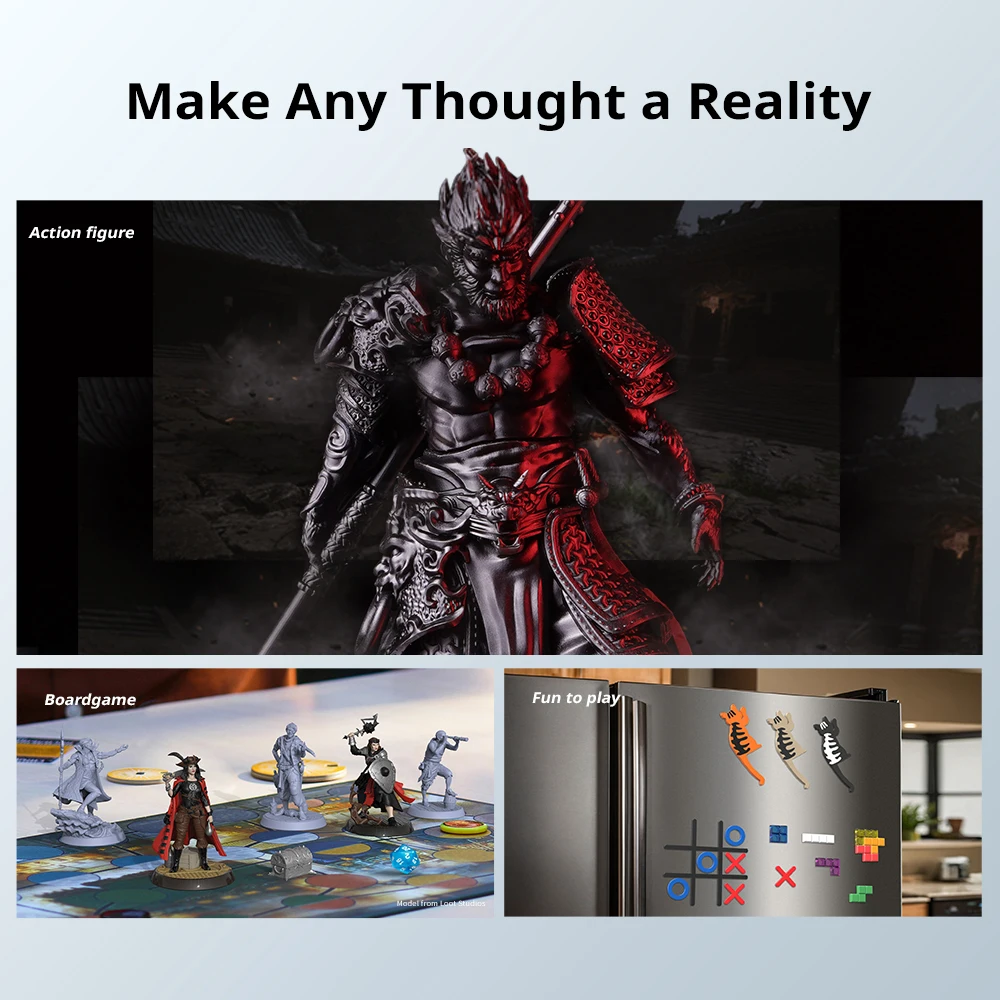
- The 2.2 L volume is adequate for miniatures and jewellery.
Weaknesses
- The 2.2 L build volume rules out batching miniatures or printing large terrain; the larger M7 is the closer fit for those jobs.
- The advertised 120 mm/h speed is conditional on High Speed Resin 2.0 at 0.1 mm layers; standard resin tops out at 80 mm/h.
- The stock ACF film is speed-oriented and slightly softer than PFA, and owners report inconsistent underside quality.
- Manual 4-point levelling is required, there is no vat or chamber heating, and resin condensation fogs the lid.
- Anycubic quality control is a recurring community concern, and US warranty terms are unconfirmed in the sources read.
- No instrumented test has measured accuracy, light uniformity, noise or long-term reliability for this exact model.
Verified specifications
| Technology | MSLA resin (LCD). |
|---|---|
| LCD | 7-inch 10K monochrome, 9024×5120, XY pixel 17×17 µm. |
| Light source | 405 nm COB + Fresnel lens; manufacturer uniformity ≥90%, intensity ≥3500 µW/cm². |
| Build volume | 153.4 × 87 × 165 mm (2.2 L). |
| Layer height | 0.02–0.15 mm. |
| Print speed | up to 120 mm/h with High Speed Resin 2.0; 80 mm/h with standard resin. |
| Exposure (third-party figure) | 2.6 s with standard resin at 0.05 mm; 1.8 s with high-speed resin at 0.1 mm. |
| Release film | ACF stock; the vat also takes Mono 4 PFA film. |
| Vat capacity | ~0.39 L. |
| Levelling | 4-point manual; the machine does not ship pre-levelled. |
| Screen | 4.3-inch TFT colour touchscreen. |
| Connectivity | USB drive, Wi-Fi, LAN mode. |
| Enclosure | lift-off protective cover; no vat or chamber heating. |
| Intelligent features | resin-level, zero-position, failed-print and film-use detection, plus a force-controlled dynamic Z lift. |
| Dimensions | 231 × 236 × 430 mm (H×W×D). |
| Weight | ~5 kg (11.0 lb). |
| In the box | paper manual, screen protector, leveling paper and a USB drive with RERF exposure test files; a wash-and-cure station is not included. |
| Power | no rated-wattage figure was confirmed in the sources read. |
Full research notes and sources
Print quality and detail
“10K” is a resolution label, not a measure of print detail: pixel size (17 µm), light-source quality, film behaviour and exposure tuning decide real sharpness. 3DWork, in a test published 2024-12-23, printed with Anycubic Texture, Bio and Rigid resins at 0.05 mm layers and reported “sensational” detail on 25 mm-base figures, with some platform adhesion failures that re-levelling and first-layer tuning fixed. Both are enthusiast publications; neither published measured accuracy, light-intensity maps, noise or reliability data, and no mainstream lab test was found.
Speed and the small-format trade-off
Anycubic advertises up to 120 mm/h with High Speed Resin 2.0 and 80 mm/h with standard resin, and the 120 mm/h figure is conditional on High Speed Resin 2.0 at 0.1 mm layers. Third-party exposure figures are 2.6 s with standard resin at 0.05 mm and 1.8 s with high-speed resin at 0.1 mm. The small format is a deliberate trade-off, not a defect: FauxHammer explicitly warns buyers to choose intentionally rather than because “small” sounds beginner-friendly. The 2.2 L volume limits batching miniatures and larger terrain, and the lid is a lift-off cover, not a sealed or heated chamber.
Leveling, film and upkeep
The stock ACF film is speed-oriented and slightly reduces detail versus PFA — FauxHammer says swapping to PFA gives marginally sharper prints at the cost of speed, and the vat shape matches the Mono 4, so Mono 4 PFA film fits. The manual’s troubleshooting covers non-sticking models (increase bottom exposure, add a raft), flakes in the tank (shorten exposure times) and layer separation (check release-film tension, tighten the platform and vat, reduce lift speed, vent hollow models).
Running costs
Resin is the recurring cost: Anycubic High Speed Resin 2.0 for the 120 mm/h claim, or standard or 14K texture resin. You also need isopropyl alcohol or water-wash resin, nitrile gloves, and a wash-and-cure station, which is not included. A replacement release film — ACF stock, or PFA for sharper detail — is a consumable. No resin or consumable prices were given in the sources read.
What owners say
RedDB aggregates 47 Reddit opinions at 59.3/100, with 34 positive and 13 negative; print quality and value skew positive, while build quality and volume skew negative. StillPrinting reports 80% positive Reddit sentiment and quotes users calling the printer precise enough for small gears at 30 µm layers and easy to dial in with Lychee resin profiles. One owner compares it favourably to Elegoo’s auto-leveling approach and calls it “way faster and better”. The recurring cautions are inconsistent underside quality — one beginner reported a washed-out underside on the test print — conditional advertised speed, and general Anycubic quality-control concern. These are signals, not defect rates; the evidence does not support a prevalence estimate.
Is it worth it?
At the street prices tracked in October 2026 it is a reasonable miniature and jewellery machine: 10K/17 µm resolution, COB + Fresnel light, ACF film, Wi-Fi and the sensor suite are real features for the size. The lowest tracked offer at the October 2026 check was $202.28 on AliExpress, before any shipping fees. At $299 from Anycubic’s own store the case weakens: the same money reaches larger-volume machines, and Anycubic’s own M7 offers a similar feature set with more build area. Buy it for miniatures, jewellery and small high-detail parts; do not buy it expecting to batch-print or print large terrain.
Which model this is
This page covers the Anycubic Photon Mono 4 Ultra, the higher-end sibling of the Photon Mono 4 (non-Ultra), which shares the build volume and 10K screen but uses a different light source, FEP instead of ACF film, a smaller 2.8-inch screen, and no Wi-Fi or intelligent assistance. Do not merge it with the Photon Mono M7, M7 Pro, M7 Max, or the Photon P1 and P1 Max. The panel is 7-inch; FauxHammer calculates the effective printable diagonal from the 153.4 × 87 mm build area as 6.9 inches, so treat 7-inch as the panel spec. The US retail listing is ASIN B0DB88XY7X.
Sources
Manufacturer:
- Anycubic Photon Mono 4 Ultra user manual (Manua.ls)
- Photon Mono 4 Ultra user manual PDF (Anycubic Wiki)
- Anycubic Photon Mono 4 Ultra product page
- Anycubic Photon Mono 4 Ultra · Anycubic Wiki
- Anycubic official store — Photon Mono 4 Ultra
Independent reviews:
Owner reports:
Specifications: