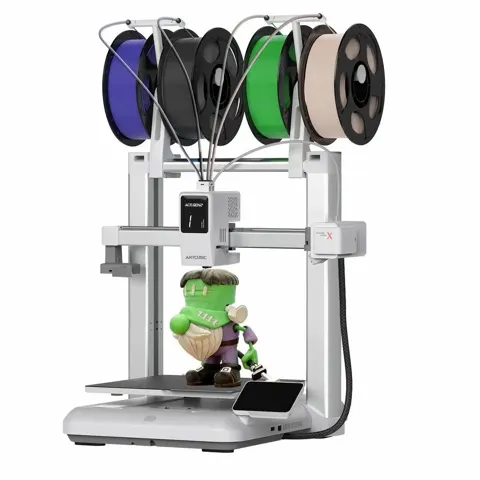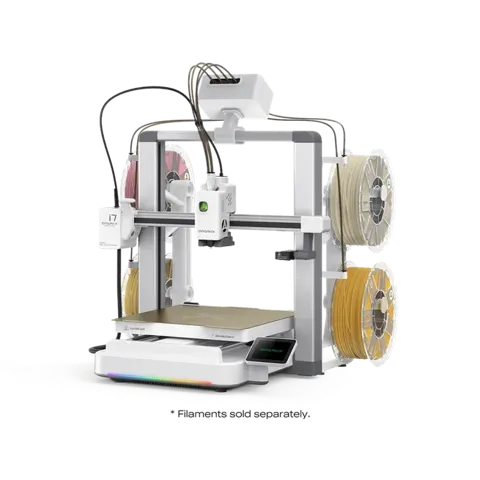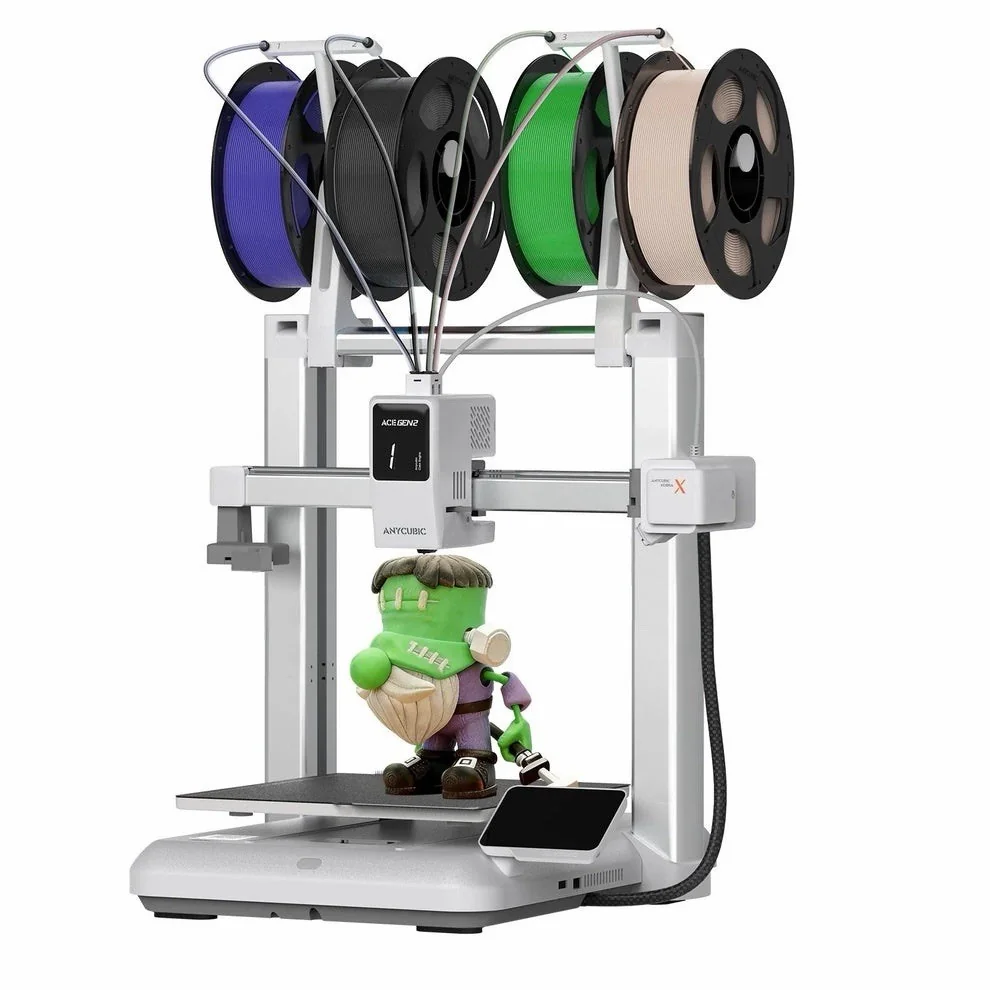
ANYCUBIC Kobra X 3D Printer
By ANYCUBIC · Budget 3D Printers · 3D Printing · More from ANYCUBIC
- Build Volume: 260 x 260 x 260 mm
- Print Speed: up to 600 mm/s (max)
- Nozzle: 0.4 mm hardened steel, 300°C max temp
- Hotbed: PEI spring steel, 100°C max temp
- Filament: native 4-color / up to 19-color via ACE 2 Pro
Lowest price seen
$469.00
from $469.00 at Anycubic Store (US) · Checked Oct 27, 2026
- Anycubic Store (US) $469.00View at Anycubic Store (US)
- ANYCUBICView at ANYCUBIC
- eBayView at eBay
- AmazonView at Amazon (paid link)
- eBay (used) eBay: used, open-box, refurbishedView at eBay (used)
Stores are listed in a fixed order, never by price or commission. Prices are snapshots. Check the current price with the store.
Summary
A 260 mm-cube bedslinger with four-color printing built into the toolhead, aimed at hobbyists who want multicolor PLA and PETG without an external box. Check whether you need active drying and an enclosure before you buy: the base unit has neither, and open-frame printing limits large ABS, ASA and polycarbonate parts.
Strengths
- Four-color printing is built into the toolhead, so no external box is needed for the base machine.
- Tom’s Hardware measured about 35 seconds per color swap against 90-plus seconds on a Bambu Lab A1.
- Direct drive handles TPU (95A and 85A) and flexible filaments well in tests.
- LeviQ 3.0 leveling was flawless in Tom’s Hardware’s testing.
- The printer arrives fully assembled; beginners can start printing quickly.
- A 260 mm cube gives more room than a mini printer for larger parts.
Weaknesses
- Every color change still purges plastic; Tom’s Hardware measured 150 g purged plus a 42 g tower for a 31.74 g model.
- The open frame means large ABS, ASA and polycarbonate parts can warp; no enclosure is included.
- The base unit has no active filament drying; humidity-sensitive materials need an external dryer.
- Spool loading is awkward due to short guide tubes, and spools can unwind between swaps.
- Long-term reliability data does not exist yet; reviews cover the launch period only.
Verified specifications
| Model | ANYCUBIC Kobra X, open-frame Cartesian bedslinger with direct-drive extrusion. |
|---|---|
| Build volume | 260 × 260 × 260 mm (about 10.23 in cube). |
| Print speed | 300 mm/s recommended, 600 mm/s maximum. |
| Acceleration | 10,000 mm/s² recommended, 20,000 mm/s² maximum. |
| Nozzle | 0.4 mm hardened steel, 300°C maximum; optional 0.25 mm brass and 0.6 and 0.8 mm hardened steel. |
| Bed | PEI spring steel, 100°C maximum. |
| Materials | PLA, PETG, TPU (95A, 64D, 68D), PVA, PLA-CF, PETG-CF, ASA; multicolor PLA plus TPU, PLA plus PVA, TPU plus TPU. |
| Leveling | LeviQ 3.0, 49-point, with Z-offset; rechecks at the start of every print. |
| Multicolor | native 4-color; expandable to 19 via hubs and up to four ACE 2 Pro units. |
| Drying | not supported on the base unit; requires ACE 2 Pro. |
| Detection | filament runout, entanglement detection, AI spaghetti detection, power-loss resume, object skip, area leveling. |
| Screen and OS | 3.5-inch color capacitive touchscreen, Kobra OS. |
| Camera | 720p with privacy cover and LED light. |
| Noise | no more than 48 dB (manufacturer, measured at 1 m). |
| Connectivity | printer, slicing software, Anycubic app, USB (print only); LAN, cloud and app; 5 GHz Wi-Fi. |
| RFID | works with Anycubic filament only. |
| Dimensions and weight | 455.4 × 445.3 × 461.3 mm; about 9.5 kg. Package 560 × 540 × 330 mm, 13.2 kg. |
| Warranty and returns | 1-year warranty on 3D printers; 14-day no-reason return; 30-day after-sales guarantee (Anycubic US store). |
| In the box | printer fully assembled, two spool holders, small trial PLA roll, power cord, PTFE tubing, grease, PEI sheet, small tools (per 3D Printer World). |
Full research notes and sources
Color swaps and waste
ACE Gen 2 puts four filament paths in the toolhead with the cutter about 10 mm from the melt zone, cutting swap distance from about 160 mm to about 30 mm. Tom’s Hardware measured about 35 seconds per swap against 90-plus seconds on a Bambu Lab A1, and a roughly 10-hour advantage on a four-color print with 776 swaps. The 600 mm/s figure is a motion ceiling, not a practical print speed; quality printing lands around 250 to 350 mm/s.
The shorter path reduces waste but does not remove it, because one nozzle still purges old color. Tom’s Hardware measured 150 g purged plus a 42 g tower for a 31.74 g model; 3D Printer World measured about 49 g of waste for a 51 g model; 3D Tech Valley measured about 8 g on a Benchy. At Anycubic’s listed $15.99 per kg (2026-10-27), that Tom’s Hardware print used about $3.58 of filament, of which about $3.07 was waste. Figures vary with model and slicer settings, so compare slicer previews rather than headline efficiency claims.
Nineteen-color expansion needs three 8-color hubs plus one 2-color hub and up to four ACE 2 Pro units. Anycubic’s US store listed the Combo at $469 for 7 colors, $688 for 11 and $1,126 for 19 on 2026-10-27, against $279 for the base machine.
Open frame and materials
A 300°C nozzle and hardened steel do not make this a heated-chamber printer. Large ABS, ASA and polycarbonate parts remain problematic, and ventilation matters for fumes. The base unit has no active drying, so store and dry PETG, TPU and nylon externally. TPU printing works in tests but needs careful profiles for softness and routing.
The camera is useful for monitoring but its angle is poor for time-lapse. RFID recognition works only with Anycubic-tagged filament; third-party spools load with manual material and color selection. Spool holders are top-mounted, and full-size spools in the inner two holders are a tight fit.
Reliability and support
Other owners report hundreds of successful hours, and one June 2026 case ended with support sending a replacement head. No defect-rate data or population study exists, so treat these as caution signals rather than a measured failure rate.
Warranty terms are shorter than the headline. Anycubic’s US policy lists printhead, hotend, extruder, magnetic platform, cutter and gears at 3 months, heated bed at 6 months, most other main FDM parts at 12 months, and separately purchased nozzles as consumables with no warranty. The store also offers a 14-day no-reason return and a 30-day after-sales report window. Support experiences in owner reports are mixed, from parts shipped to repeated instructions and small goodwill offers.
Is it worth it?
Anycubic’s US store listed Kobra X at $279 with a $399 reference price on 2026-10-27, with free express shipping promoted and tax added at checkout. At $279 to $300 delivered, the base machine is strong value for four-color work given the measured swap speed, 260 mm cube, direct drive and one-year warranty. At $300 to $350 it is still defensible, but compare the Flashforge AD5X at $349. At $360 to $400, check the Bambu Lab A1 Combo, tracked around $359 on Black Friday and $399 otherwise, which carries a longer independent review history and a maker-announced two-year US warranty. Above $400 for the base machine, value drops unless a bundle adds useful items.
Competitor context from the same period: Bambu Lab A1 printer-only at $299, and Flashforge AD5X four-color at $349 with a 220 mm cube. Replacement parts are available but priced as accessories: quick-change nozzles at $15.99, a complete ACE Gen 2 toolhead at $90.00, a magnetic plate at $45.99 (Anycubic global store, 2026). Replacement intervals are not published.
Which model this is
This page covers the base ANYCUBIC Kobra X, the open-frame bedslinger with native four-color ACE Gen 2. Do not confuse it with the Kobra X Combo (adds ACE 2 Pro for up to 7 colors with active drying), the Kobra X All-in-One Bundle, the incompatible first-generation ACE Pro, or the older Kobra 3, Kobra 3 V2 and Kobra S1. The Amazon listing for this model is ASIN B0GQGHVJBS.
Sources
Manufacturer:
- Anycubic Kobra X US store product page
- Anycubic Kobra X global store product page
- Anycubic Kobra X wiki
- Anycubic US nozzles (Kobra X compatibility)
- Anycubic Kobra X accessories catalogue
- Anycubic PLA Basic 1 kg
- Anycubic US refund and warranty policy
Independent reviews:
Owner reports:
- Filament loading errors and error 11854 (r/anycubic)
- Trapped filament in heatsink (r/anycubic)
- Filament stuck in heatsink (r/AnycubicOfficial)
- Repeated printhead failures (r/AnycubicKobraX)
- Post-update nozzle and bed collision (r/AnycubicKobraX)
- TPU entanglement and clog report (r/AnycubicKobraX)
Parts and stores: