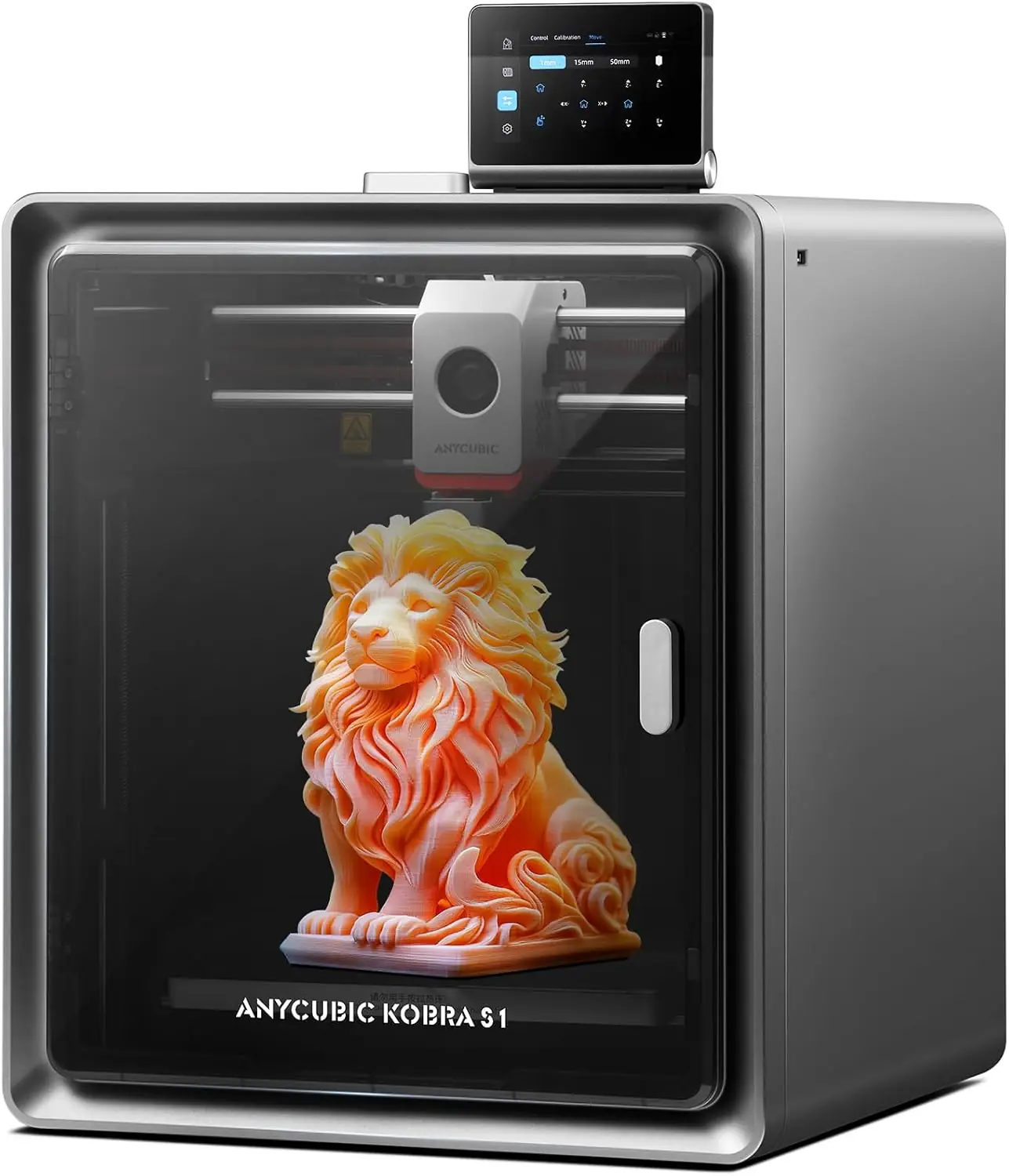
Anycubic Kobra 2
By Anycubic · Budget 3D Printers · 3D Printing · More from Anycubic
- 250 x 220 x 220 mm build volume
- 250 mm/s max print speed
- 0.1 mm layer resolution
- PEI spring steel bed
- 18.5 lbs weight
Price not listed
- AnycubicView at Anycubic
- Best BuyView at Best Buy
- eBay (used) eBay: used, open-box, refurbishedView at eBay (used)
- eBayView at eBay
- AmazonView at Amazon (paid link)
Stores are listed in a fixed order, never by price or commission. Prices are snapshots. Check the current price with the store.
Summary
The Kobra 2 is a 2023 open-frame FDM printer with a 220 x 220 x 250 mm build area, a direct-drive dual-gear extruder and LeviQ 2.0 25-point auto-leveling.
Strengths
- Prints clean layers and handled PETG and TPU well at full speed in testing.
- Easy assembly, about 20 minutes from two main sections.
- The flexible PEI spring-steel plate makes parts easy to remove.
- Modular design with a replaceable nozzle, and spare parts are cheap.
- A good entry printer when priced well below its launch figure.
Weaknesses
- There is no input shaping, so large or tall fast prints show ringing and ghosting.
- Auto-leveling is not hands-off: PCMag had to remove the extruder casing and adjust a stopper.
- Shipping can loosen wheels, belts and connectors, so first-layer and Z-offset tuning is common.
- Fans are noisy and the extruder area runs hot.
- Anycubic’s own guides cover recurring layer-shift and leveling problems.
Verified specifications
| Model | Anycubic Kobra 2, the base model of the 2023 Kobra 2 series. |
|---|---|
| Technology | FDM, open frame. |
| Build volume | 220 x 220 x 250 mm (also listed as 250 x 220 x 220 mm in HWD order). |
| Layer thickness | 0.05 to 0.3 mm; top resolution listed as 100 microns (0.1 mm). |
| Positioning accuracy | 0.0125 mm in X and Y, 0.0025 mm in Z. |
| Nozzle | 0.4 mm, replaceable; maximum 260°C. |
| Hotbed | maximum 110°C. |
| Print speed | 300 mm/s maximum and 200 mm/s typical with firmware V3.0.6 or newer; the launch figure was 250 mm/s maximum and 150 mm/s typical. |
| Acceleration | 3000 mm/s². |
| Extruder | direct drive, dual gears. |
| Bed leveling | LeviQ 2.0 25-point automatic leveling with smart Z-offset. |
| Build plate | PEI magnetic spring-steel sheet. |
| Filament runout sensor | included. |
| Control panel | 4.3-inch color LCD touchscreen. |
| Connectivity | microSD card and USB Type-C. |
| Power | 110/220 V AC, 50/60 Hz, 400 W. |
| Materials | PLA, ABS, PETG, TPU. |
| Dimensions | 440 x 435 x 486 mm. |
| Weight | about 8.4 kg (18.5 lb). |
| Warranty | one year parts and labor. |
Full research notes and sources
Speed and print quality
At launch the base Kobra 2 was rated 250 mm/s maximum and 150 mm/s typical; the current manufacturer page raises it to 300 mm/s maximum and 200 mm/s typical, but only with firmware V3.0.6 or newer, so the headline speed depends on firmware. Tom’s Hardware measured the payoff directly: a 3DBenchy in 30 minutes, and a print that took 17 hours 53 minutes at 150 mm/s versus 47 hours 10 minutes on the older Kobra Neo. Print quality was smooth with tidy overhangs, but large or tall high-speed prints showed visible ringing and ghosting that worsened with height, which the reviewer tied to the lack of input shaping.
Leveling and the tuning tax
Anycubic publishes dedicated leveling-calibration and leveling-fix guides for the Kobra 2, blaming loose V-slot wheels, bearing wheels, belts and connectors after shipping, plus wear and firmware, and walking owners through tightening eccentric spacers and belts before trusting auto-leveling. PCMag’s review unit would not auto-level until the extruder casing was removed and a stopper adjusted. Owner threads add layer shifting tied to belt tension and a Z-offset that jumps between too high and too low. The loudest frustrated threads are about the Kobra 2 Max, not this base model, so they should not be read as base-model defects.
Parts, warranty and running costs
Anycubic sells a Kobra 2-series hotend assembly (0.4 mm, 24 V ceramic heater, thermistor and silicone sock, from $5.88 against a stated $16.81 original) and 5-packs of brass 0.4 mm nozzles, and publishes a hotend-replacement guide. The replacement hotend fits the whole Kobra 2 series but not the original Kobra, Go, Neo or Max. The machine warranty is one year, but coverage is uneven: the print head and hot end, extruder assembly, magnetic platform, cutter and extruder gear get only 3 months, the heated bed 6 months, and other main components 12 months; separately sold nozzles are consumables with no warranty. Anycubic also advertises a 14-day no-reason return and a 30-day after-sales window. Running costs are filament, spare nozzles and occasional mechanical parts, with no vendor lock-in on materials.
Is it worth it?
At its $279 launch price the Kobra 2 was a strong budget pick: PCMag scored it 4.0 and named it an Editors’ Choice for budget printers, and Tom’s Hardware called it a speedy i3-style machine with improved leveling. By 2026 it is an older design in a market full of faster, self-calibrating printers, so it makes sense at a clear discount from that figure and little more. Tom’s Hardware saw it around $189 and $209 during its review period and quoted $269 in the text.
Which model this is
This page covers the base Kobra 2, not the Neo, Pro, Plus or Max. The base model is set apart by a 4.3-inch touchscreen, a direct-drive dual-gear extruder, two Z threaded rods, LeviQ 2.0 25-point leveling and a standard filament runout sensor; the Neo has a 2.4-inch knob screen, a single Z rod and only an optional filament detector. It is an open-frame bed-slinger, not the original Kobra, Kobra Go or Kobra Max. The listing maps to ASIN B0C1G93GLQ.
Sources
Manufacturer:
- Anycubic Kobra 2 product page
- Anycubic Kobra 2 user manual
- Anycubic Kobra 2 series specs and features comparison guide
- Kobra 2 leveling calibration guide (Anycubic wiki)
- Anycubic after-sales service and refund policy
Independent reviews:
Owner reports:
- Kobra 2 issues (r/anycubic)
- Layer shifting issues with the Kobra 2 (r/anycubic)
- What does everyone think about the Anycubic Kobra 2? (r/3Dprinting)
Parts and stores: