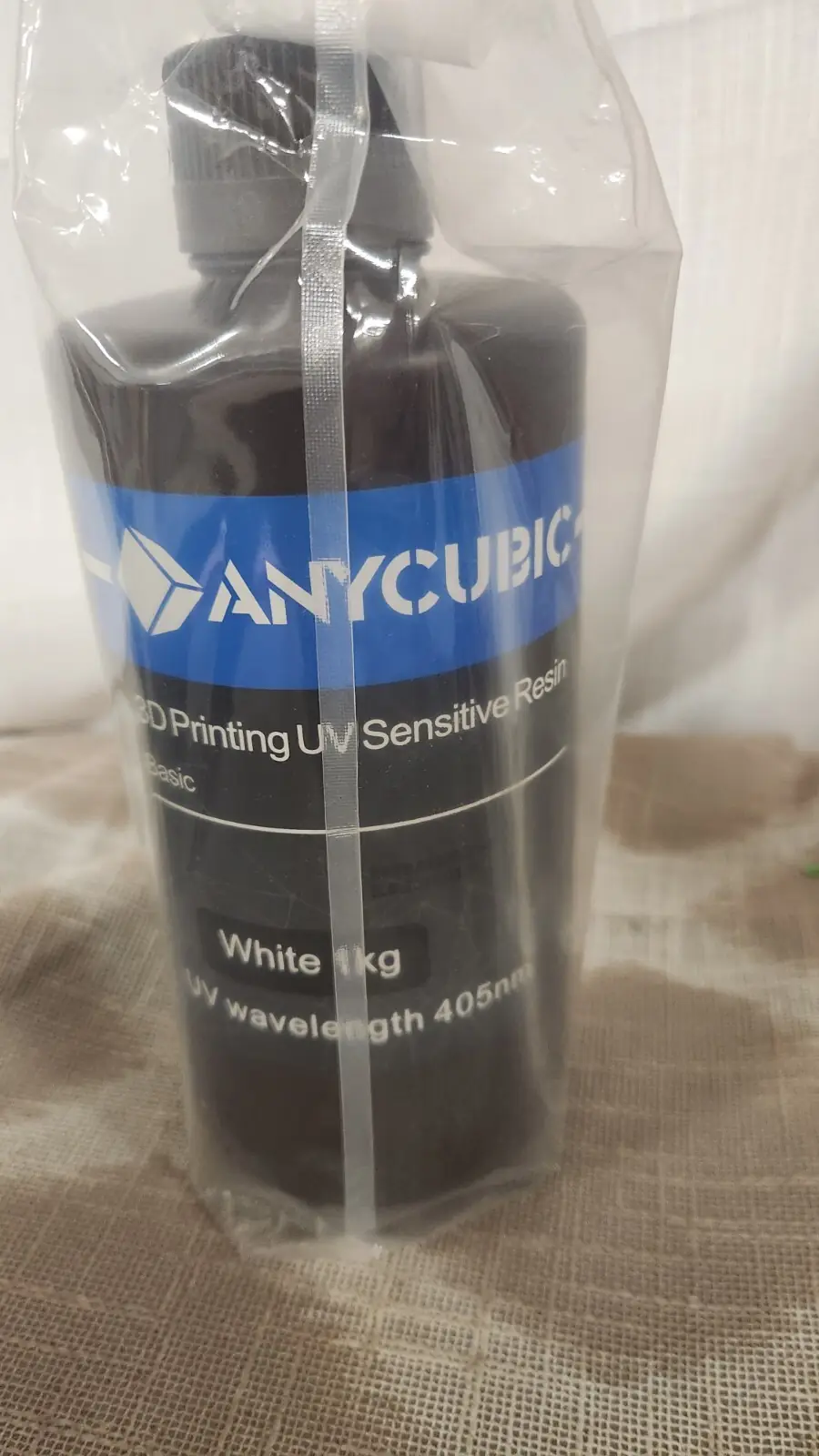
ANYCUBIC 3D Printer Resin 405nm High Precision Fast
By ANYCUBIC · 3D Printing Accessories & Scanners · 3D Printing · More from ANYCUBIC
- Wavelength 365-405 nm
- Viscosity 200-230 mPa·s (25°C)
- Density 1.13 g/cm³
- Hardness 84-86 Shore D
- Tensile strength 40-50 MPa
Lowest price seen
$21.99
from $21.99 at Anycubic US Store · Checked Oct 25, 2026
- Anycubic US Store $21.99View at Anycubic US Store
- ANYCUBICView at ANYCUBIC
- eBayView at eBay
- AmazonView at Amazon (paid link)
- eBay (used) eBay: used, open-box, refurbishedView at eBay (used)
Stores are listed in a fixed order, never by price or commission. Prices are snapshots. Check the current price with the store.
Summary
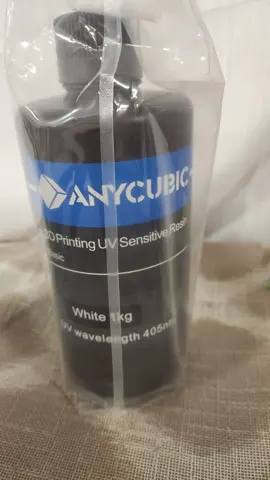
Anycubic’s original Standard Resin in Gray, a 1 kg bottle of 405 nm photopolymer for LCD and MSLA printers, not a printer and not the newer V2, Standard+, ABS-Like or High Speed formulations. Check brittleness against your use case and calibrate exposure for the exact printer, color and room temperature.
Strengths
- Fine decorative detail for miniatures, busts, ornaments and appearance prototypes, with attractive Gray surfaces reported by an independent review.
- Common printer workflows: supported on Anycubic Photon printers and other compatible 405 nm LCD printers, with a downloadable original user guide and exposure table.
- Washable with common solvent: standard IPA or ethanol works; the resin is not water-washable.
- Documented baseline: the original manual and 2024 SDS are obtainable without depending on anonymous seller listings.
Weaknesses
- Brittle miniature limbs and weapons: owner reports of breakage during basing and handling; these are anecdotes, not controlled tests.
- Color-to-color transfer failure: Gray settings may not match light beige, black or clear, and recheck plate setup, supports and temperature.
- Poor bed adhesion or pieces stuck to release film can occur; the manual advises checking leveling, film condition and bottom exposure.
- Sticky or whitened prints after washing and UV cure if solvent residue remains; transparent and white colors can yellow with prolonged cure.
- Uncured resin chemical exposure: the SDS warns of dermatitis, sensitization, eye and airway irritation and aquatic harm; ventilation and suitable gloves are needed.
- Variation and no reliable rate data: owner outcomes vary, and no manufacturer-verified failure percentage was found.
Verified specifications
| Product and package | Anycubic Original Standard Resin, also sold as Standard Colored UV Resin; 1 kg bottle, Gray (#7E93A7). Other colors are selectable on the original product page. HD Gray is a separate color choice, not proof of Standard V2. It is a liquid photopolymer for compatible 405 nm LCD/MSLA and DLP machines, not FDM. |
|---|---|
| Cure wavelength | manufacturer states 365-405 nm in the current technical specification; 405 nm as the nominal wavelength in the older original-resin manual. |
| Current product-page data, not independently laboratory-verified: viscosity 200-230 mPa.s at 25 C, density 1.13 g/cm3, hardness 84-86 Shore D, tensile strength 40-50 MPa, elongation at break 12-16%, claimed volume shrinkage 4.5-5.5%, Young’s modulus 1600-1800 MPa, Izod impact strength 103 J/m. | |
| Manufacturer-source discrepancy | the downloadable original Standard Resin manual instead specifies viscosity 150-200 mPa.s, density 1.05-1.25 g/cm3, hardness 82 Shore D, tensile strength 36-45 MPa, elongation 8-12%, flexural strength 50-65 MPa, flexural modulus 1200-1600 MPa, notched impact strength 25 J/m, and the same 4.5-5.5% volumetric shrinkage. The web product page has a likely reversed flexural strength/modulus labeling, so those two displayed page values must not be trusted without corrected data. |
| Print window | ambient preparation 20-40 C; normal layer exposure 2-3.6 seconds; bottom-layer exposure 20-40 seconds. Official printer-specific 0.05 mm examples include Photon Mono M5s at 2.8 seconds normal / 25 seconds bottom, Photon Mono 4 at 2.8 / 30, and Photon Mono X2 at 2.5 / 20. |
| Temperature sensitivity | the original manual recommends 25-30 C ambient; for 15-20 C it suggests increasing normal exposure 30% and slowing lift 30%. |
| Post-processing | manufacturer specifies 95%+ isopropyl alcohol or ethanol washing, with at least 3 minutes as an indicative cleaning duration, complete drying before UV post-cure, and about 3-5 minutes surface post-curing in the original manual. It warns not to soak in solvent over 30 minutes. |
| Shelf life | the older original manual publishes a 1 year shelf life. Check the actual printed batch manufacture and expiry on the bottle. |
| Hazard classification | the Anycubic Standard Resin SDS dated October 14, 2024 identifies skin irritation (H315), allergic skin sensitization (H317), serious eye irritation (H319), possible respiratory irritation (H335), and chronic aquatic harm (H412). The marketing phrase “low-odor” or “zero irritation” is not a toxicological safety exemption. |
Full research notes and sources
Brittleness and handling
In a March 2024 r/resinprinting report, an owner using Anycubic Standard Gray with an Anycubic Mono 6K reported that 7 of 10 game miniatures had limbs or hands break during basing after approximately 20 minutes of UV curing. This is an individual post with an unusually long post-cure; it does not demonstrate that 70% of prints from this product break. Another March 2024 owner described models shattering after desk bumps, and a November 2024 owner called Anycubic Standard too fragile for regular miniature handling. Compare shorter correctly tested cure cycles or select a tougher resin rather than promising a guaranteed fix from changing cure time alone. One commenter in the same discussion said they used the same resin heavily without notable brittleness, whereas others reported breakage.
Exposure and temperature
In September 2024, one owner said light beige Anycubic Standard printed reliably on a Photon Mono X2, but a newly purchased Gray Standard bottle produced missing limbs, deformed figures and pieces attached to FEP, with 13 of 23 miniatures printing properly on one reported plate at 2.5 seconds normal exposure. This is a single user setup, not a verified batch defect: recheck plate setup, support geometry, temperature and Gray-specific exposure. The resin also thickens in cold conditions; test a small exposure coupon at actual print temperature before risking a large full plate.
Washing, curing and safety
Washing, drying and post-curing are a three-stage wet workflow, slower and messier than removing an FDM part. Keep wash containers sealed and store uncured resin away from light. Contaminated IPA, wipes and uncured resin must not be poured down a sink or drain; the original guide suggests UV-curing residues and reusing filtered alcohol, with local hazardous-waste requirements taking precedence. Disposable gloves must be compatible with acrylate resin and IPA for the duration of contact; a generic nitrile package is not automatically tested for prolonged solvent immersion. The manufacturer advertises “zero irritation,” while its own SDS formally says it can cause skin allergy and eye and airway irritation; treat the SDS as authoritative for handling.
Running costs
- Resin itself: at $21.99 per kg, 1 kg per year is $21.99 and 5 kg per year is $109.95 before shipping and tax. These are usage scenarios, not measured average annual consumption.
- Illustrative 5 kg per year hobby scenario: five $21.99 resin bottles ($109.95) plus two $11.99 32-ounce IPA bottles ($23.98) plus one $11.97 100-count glove pack equals $145.90 per year. This assumes exactly those replacement amounts, not a known real consumption rate. It excludes printer electricity, cleaning tools, UV-curing machine, air extraction, waste treatment, FEP, replacement LCD and safety gear beyond that pack.
- Electricity depends on the owner’s exact MSLA printer, lamp, heater, wash and cure station, layer count and durations. No valid resin-only wattage or annual kWh figure exists because the resin is not an electrical appliance.
- Waste and labor may exceed material value for failed long builds, disposable towels, spoiled resin and IPA and disposal. Reliable numerical US household disposal cost, average resin recovery percentage and consumed solvent volume per liter resin were not found.
- Mandatory subscription: none for purchasing or using Standard Resin itself.
Is it worth it?
- At or below $15 per 1 kg new, with verified expiry, genuine formulation and reasonable shipping: attractive for display or calibration print volume; no verified unconditional single-bottle US official offer at $15 was established.
- $16-20: decent for a trusted, fresh original Standard bottle if decorative prints dominate. Above $19.99 an in-stock ELEGOO Standard V2.0 is worth comparing on a printer-specific profile basis.
- $21-22: normal official direct price; buy only if you already have a working profile or value its colors.
- At $23 or more: favor Anycubic Standard Resin V2 at $23.99 for buyers primarily concerned with brittleness. For frequent miniature handling where toughness is crucial, consider Anycubic ABS-Like Resin Pro 2 at $28.99 or ELEGOO ABS-Like V2.0 at $26.99 rather than spending nearly the same on original Standard.
Which model this is
This page covers Anycubic’s original Standard Resin, also sold as Colored UV Resin, Gray, 1 kg bottle. It is not the newer Standard Resin V2, Standard+, 16K Standard, ABS-Like or High Speed formulation, and HD Gray is a separate color choice rather than proof of Standard V2. No independently verified unique SKU or GTIN identifying every US bottle was found; inspect the label before purchase.
Sources
Manufacturer:
- Anycubic main storefront: original Standard Resin variations and bulk options
- Anycubic US: official resin manuals, SDS and Standard Resin printer-specific settings
- Anycubic official Standard Resin User Manual V1.0 (PDF)
- Anycubic: Standard Resin Safety Data Sheet dated Oct 14, 2024 (PDF)
- Anycubic US: Standard Resin V2 Gray 1kg pricing and claims
- Anycubic US: ABS-Like Resin Pro 2 Gray 1kg pricing
- Anycubic: refund, after-sales and hardware warranty policy
Independent reviews:
Owner reports:
- r/resinprinting: original Standard Gray miniatures brittle after long UV cure (Mar 2024)
- r/AnyCubicPhotonMonoX: original Standard brittle for game miniatures (Mar 2024)
- r/PrintedMinis: Anycubic Standard too fragile, comparisons for minis (Nov 2024)
- r/AnycubicPhoton: light beige to Gray resin swap and failed models (Sep 2024)
- r/resinprinting: original Standard Gray post-cure color and handling discussion (Jun 2024)
Parts and stores: