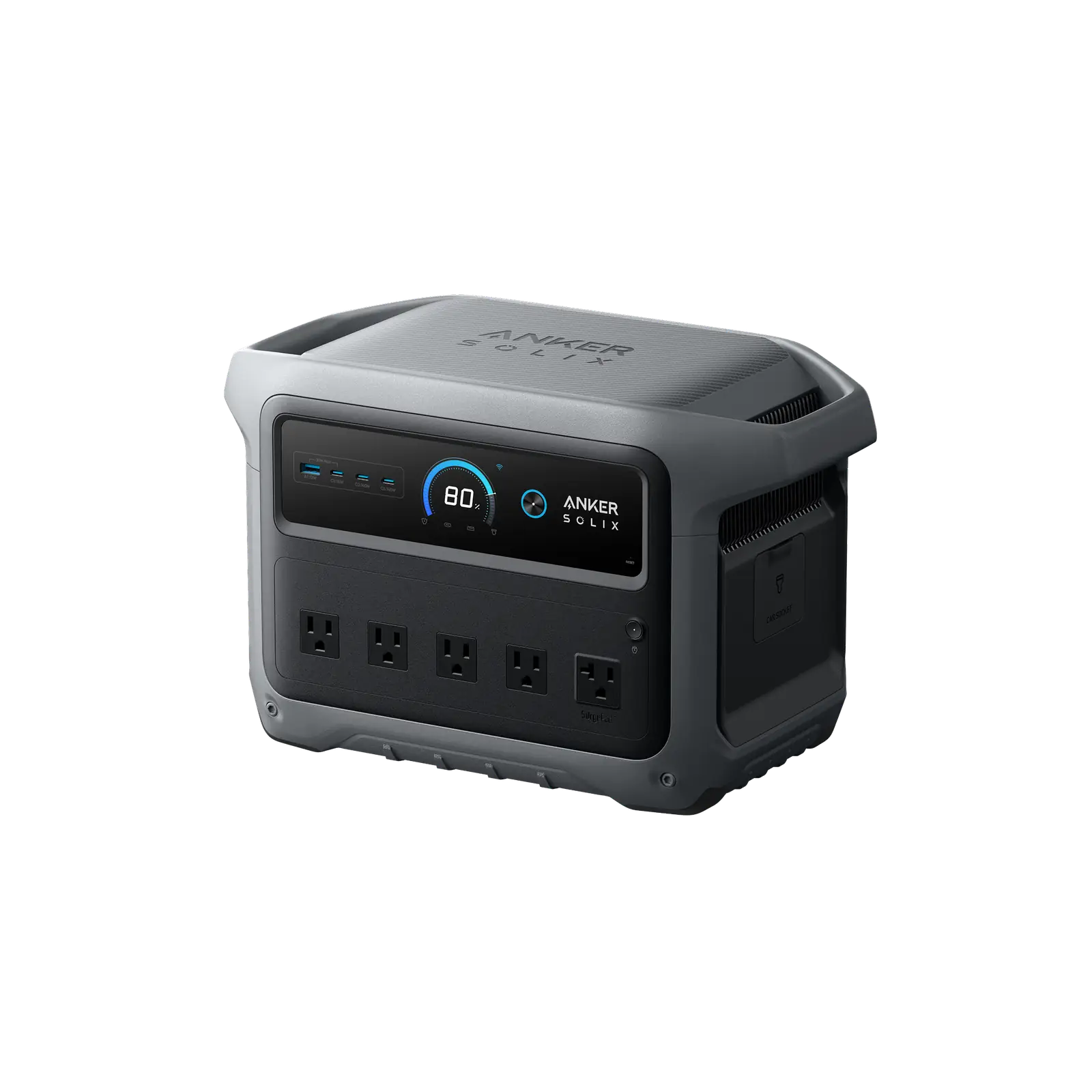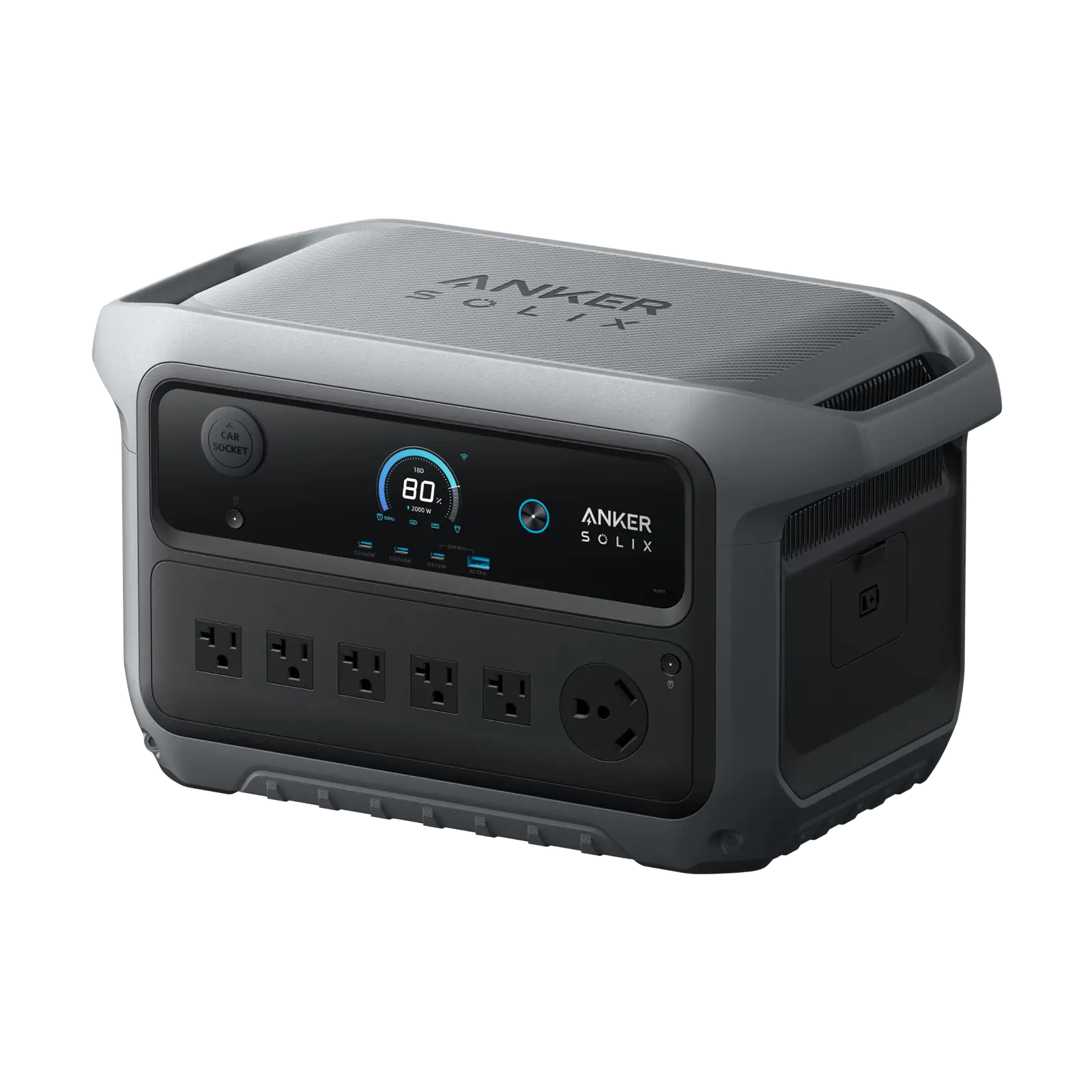
Anker SOLIX F2000
By Anker · Portable Power Stations · Audio & Electronics · More from Anker
- 2,048 Wh LFP battery (51.2 V)
- 2,400 W continuous AC output
- 4,000 W peak surge output
- 800 W solar input
- 4,000 cycles rated (brand page)
Lowest price seen
~$1,999.00 (approx.)
from $1,999.00 at Amazon
- Amazon ~$1,999.00 (approx.)View at Amazon
- AnkerView at Anker
- eBay (used) eBay: used, open-box, refurbishedView at eBay (used)
- eBayView at eBay
- WalmartView at Walmart
- NeweggView at Newegg
Prices are snapshots. Check the current price with the store.
Summary
A 2,048Wh LiFePO4 portable power station with 2,400W continuous AC output, five AC outlets including an RV TT-30 socket, and a wheeled trolley design. Check expansion battery compatibility before you buy: the BP2000 (Gen 2) is not compatible with this model, and the original F2000 product page now redirects to the newer C2000 Gen 2.
Strengths
- Measured AC energy delivery is respectable: StorageReview got 1,870Wh from the inverter before cutoff, and Notebookcheck measured about 1,800Wh (~88% of nominal) on a European unit.
- The 2,400W continuous inverter handles many microwave, tool, RV and short-duration heating loads.
- Wheeled trolley design with telescoping handle makes 67.2 lb manageable on the ground.
- Fast U.S. grid charging: up to 1,440W, with Anker promoting 0–80% in about 1.4 hours.
- Expansion options: BP2000 adds 2,048Wh, BP2600 adds 2,560Wh.
- 5-year warranty for qualifying new original-purchaser units.
Weaknesses
- AC inverter failure under substantial load: one r/AskElectronics owner lost AC output after about 15 minutes under a 2,000W load, with burnt inverter semiconductors.
- After a full drain to zero, AC output may stay off after solar refills the battery until someone presses a button — a problem for unattended refrigeration.
- Bluetooth and app connections drop and require local reactivation; not suitable for remote administration of an unattended cabin.
- Fan noise under high load: European units measured 57.5 dB at 1 m under heavy load (Allround-PC) and up to about 55 dB during fast charging (Notebookcheck).
- The BP2000 (Gen 2) expansion battery is not compatible with F2000 despite the similar name.
- No charging below 32°F (0°C), which limits winter outdoor use even though colder-temperature discharge is rated.
Verified specifications
| Model | Anker SOLIX F2000, formerly PowerHouse 767, A1780 (U.S. 120V/60Hz version). |
|---|---|
| Capacity | 2,048Wh LiFePO4 (LFP). |
| Cycle life | 3,000 full equivalent cycles to approximately 80% capacity. |
| AC output | 2,400W continuous (not per socket); peak/surge up to 3,600W. |
| AC outlets | four regular sockets plus one TT-30R RV socket (five AC connections total). |
| USB | three USB-C up to 100W per port, two USB-A up to 12W per port. |
| 12V | two 12V 10A automotive sockets. |
| Total output connections | twelve. |
| AC input | up to 1,440W U.S. wall charging. |
| Solar input | up to 1,000W via XT60; 11–32V at 10A max, 32–60V at 20A max. |
| UPS switchover | 20ms; 1,440W AC bypass-mode limit. |
| Expansion | BP2000 / Anker 760 2,048Wh adds to 4,096Wh; BP2600 2,560Wh makes 4,608Wh. |
| BP2000 (Gen 2) is not compatible with F2000. | |
| Temperature | discharge -4°F to 104°F (-20°C to 40°C); charge 32°F to 104°F (0°C to 40°C). |
| Not rainproof. | |
| Weight and dimensions | 20.7 × 15.5 × 9.8 in; 67.2 lb (30.5 kg). |
| Warranty | 60 months (5 years), not transferable. |
| Refurbished warranty | 6 months. |
Full research notes and sources
Measured capacity, output and solar
StorageReview measured 1,870Wh of AC output from the U.S. F2000 before inverter cutoff. Notebookcheck, testing the European PowerHouse 767 at a ~250W load, got approximately 1,800Wh, or about 88% of nominal capacity. These are two distinct tests, not a promise under every workload. The advertised 2,048Wh is battery capacity, not wall-outlet energy delivered.
StorageReview also recorded 2,300Wh (2.30kWh) taken from the wall to refill a fully emptied station, and 1,870Wh AC output from that recharge — a measured wall-to-load round-trip of about 81% for that test. Do not assume the full nominal 2,048Wh can be delivered to appliances.
The U.S. F2000 provides four regular AC sockets plus one TT-30R socket — five AC connections — with a total continuous inverter output of 2,400W, not 2,400W per socket. The TT-30-style RV connector is a connector convenience, not a promise of 3,600W continuous RV input. Manufacturer separately advertises a peak/surge mode up to 3,600W; don’t size continuous appliances against that temporary figure. Three USB-C ports deliver up to 100W per port, two USB-A up to 12W per port, and two 12V 10A automotive sockets round out twelve output connections. USB-C sockets are output-only, not input charging.
Solar input reaches up to 1,000W on XT60 if the full array is configured within the manufacturer’s voltage/current envelope: 11–32V at 10A maximum, 32–60V at 20A maximum. Do not exceed the voltage limit even under cold-weather solar-panel open-circuit conditions. Charging from one panel is much slower and weather dependent; Allround-PC saw about 143W from an approximately 200W panel in a March test. Owners have reported unexpectedly low generation when pairing nominal 200W/400W panels, especially below the unit’s 32V threshold where the current input is restricted to 10A.
Noise, app and reliability
Under high load or fast charging the fan is the main complaint. Allround-PC measured 57.5 dB at 1 m under heavy load and 44 dB while charging on a European unit; Notebookcheck measured up to about 55 dB during fast charging. These are independent European-unit observations, not controlled U.S. noise figures. DC-only or light use can be much quieter.
The app connects via Bluetooth, not Wi-Fi, making it unsuitable for reliable remote administration of a weeks-unattended cabin. Several owners report dropped connections and the need to reactivate pairing locally. Notebookcheck independently noted that connection can expire after inactivity or distance from the phone. For an off-grid cottage, assume an operator may have to be physically present to reset outputs. The manual says enabling Power Saving may disconnect outputs when devices finish charging; it recommends disabling it for CPAP or continuous tiny loads. An AC port without a detected connected plug will shut off after 15 minutes even with power saving off.
One r/AskElectronics owner described losing AC output after about 15 minutes under a reported 2,000W load, later inspecting burnt inverter semiconductor devices. Anker reportedly replaced the station through warranty; the owner’s attempted component-level repair did not fully restore operation. This is a documented anecdote, not a measured defect rate.
An April 2026 r/SOLIX owner reports that after an off-grid cabin’s F2000 drains to zero, AC output stays off after sunlight refills the battery until someone presses a button. Other owners say their solar charging resumes normally each morning, so the distinction is charging resumption versus AC-output reactivation. The failure to restart AC matters greatly for a refrigerator in an empty cabin; no manufacturer-guaranteed automatic AC restart was found. A January 2025 owner reported that after extended time at 0% with little winter sun, the F2000 would not wake or collect solar until connected to mains and reset. The manual itself warns prolonged low-charge storage can prevent normal operation, and gives a reset method.
In an October 2024 Reddit discussion, at least two owners mentioned an E4 USB-A overload warning on new units with nothing attached. One participant later reported that warnings ceased after a full solar charge. This is insufficient evidence of a common hardware failure or a universally valid fix. No controlled owner-failure survey, defect percentage, median age of inverter failure, or official repair-life study for A1780 was found.
Running costs, parts and warranty
StorageReview measured 2,300Wh (2.30kWh) taken to refill a fully emptied station. At an assumed $0.20/kWh all-in tariff, each comparable full recharge costs about $0.46; 12 complete recharges per year is about $5.52/year, weekly (52) about $23.92/year, and daily (365) about $167.90/year. Different temperatures, charge limits and transfer losses change the actual wall draw. Electricity consumed while powering devices during bypass or while idling is extra.
There are no scheduled consumables — no fuel, oil, air filter or fluid replacement. Battery wear, optional solar hardware and potential out-of-warranty repairs remain real but unquantified costs. Storage requires periodic checks and recharging: Anker recommends weekly checks, 30%-minimum intervention, and a full charge every three months.
The legacy BP2000 / Anker 760 2,048Wh expansion battery is listed at $799.99 (Anker, October 2026) and adds total capacity to 4,096Wh. The BP2600 2,560Wh is listed at $999.99 (Anker, October 2026) and makes 4,608Wh nominal when used with F2000. The BP2000 (Gen 2) is incompatible with F2000 despite the similar name; a separate current manufacturer listing shows $699.99 at a promotional price, but do not buy it for A1780.
Anker’s accessory listing describes an MC4-to-XT60 0.5m cable at $29.99, a 33ft solar MC4 charging cable at $59.99 and a 3-port solar connector at $39.99. A 12V car-outlet-to-XT60 charge lead (A17U5, 10ft) was displayed at $34.99 but the individual item page currently says Sold Out. A 6-circuit transfer-switch kit with cable was previously listed at $399 (Anker); installation requires a qualified electrician and installation labor is not included.
The current U.S. SOLIX warranty schedule lists 60 months (5 years) for F2000/A1780, starting at retail purchase; coverage is for eligible original buyer/purchases from authorized dealers. The warranty is not transferable. Anker can repair or replace with a new/refurbished equal-value product, with replacement coverage lasting the longer of remaining original warranty or 90 days. If no repair/replacement is available, policy mentions a prorated partial refund. Required: dated receipt, serial number/evidence, completed troubleshooting, and possibly return inspection. Not covered: unauthorized repairs, misuse, incompatible accessories, moisture damage, unauthorized resellers. Authorized Anker refurbished products carry a separate six-month warranty. Return policy for direct website purchases is typically 30 days; non-defect returns can carry buyer shipping cost. Shipping a 67.2 lb battery is costly and subject to special handling and manufacturer RMA instructions.
Is it worth it?
A verified historical promotional range of $599–$899 was recorded in May–June 2026: May 27 at $799 shipped from Anker with an exclusive promotional code (expired by 9to5Toys), June 26 at $749 direct from Anker versus a $899 regular direct price (TechRadar), and a June 26 deal listing at $599 after a $150 coupon. These are past offers, not available October 2026 quotes.
Up to about $550 new from an authorized U.S. seller, with a receipt and an actual 5-year warranty, is a strong F2000 clearance deal. $550–$650 is conditional: consider it for the unique 2,400W + TT-30 + built-in wheels combination, but shop the newer S2000 first if loads are below 1,500W. Above $650, Anker’s own S2000 unit-only listing was showing $649.99 on October 11 (promotion expiring October 14): 2,010Wh, 1,500W continuous, 35.7 lb, without expansion support. It is better for smaller AC loads and frequent lifting, not a substitute for 2,400W tools/RV or an external battery.
At roughly $700 or more, compare the newer C2000 Gen 2 before buying old-stock F2000. The manufacturer’s current page and specs show 2,048Wh, 2,400W continuous, 41.7 lb, 1,800W AC input, and a 10ms UPS rating versus F2000’s 67.2 lb, 1,440W and 20ms. A $699.99 offer appeared in Anker’s new-model product context, but a trustworthy live F2000-to-C2000 in-cart price comparison could not be completed; confirm the final C2000 Gen 2 price.
Used/refurbished: no sufficiently verified current F2000 U.S. resale-price distribution was found to claim a typical price. Manufacturer terms exclude warranty transfers to subsequent owners; a cheap used purchase must be discounted for cycle history, potential repairs and heavy return shipping.
Which model this is
This page covers the Anker SOLIX F2000, formerly PowerHouse 767, model A1780 — the U.S. 120V/60Hz version. The European F2000/767 is documented at 230V, 2,300W AC and about 2,200W charging, which must not be mistaken for U.S. specifications. The catalog’s manufacturer URL https://www.ankersolix.com/products/f2000 now redirects to the different SOLIX C2000 Gen 2 (A1783/A1785). The surviving official page for the target F2000 is https://www.ankersolix.com/f2000. Do not transplant the C2000 Gen 2’s much lighter weight, 10ms UPS rating, charging specs or newer battery compatibility onto A1780.
Sources
Manufacturer:
- Anker SOLIX F2000 / PowerHouse 767 official U.S. model specifications
- Anker official F2000 (PowerHouse 767) user manual, FAQ and U.S. specifications
- Anker SOLIX official U.S. warranty and refund policy, model A1780 60 months
- Original Anker BP2000 / Anker 760 compatible expansion battery
- Anker BP2600 2560Wh F2000/F2600 expansion battery
- Anker BP2000 (Gen 2) compatibility warning explicitly excluding F2000
- Anker SOLIX S2000 official U.S. current product price, watts, weight and October offer
- Anker SOLIX C2000 Gen 2 official model and F2000 comparison
- Anker official compatible 6-circuit manual transfer switch and installation requirements
- Anker SOLIX refurbished products warranty (separate 6-month term)
- Anker SOLIX U.S. expansion-battery collection prices, October 2026
- Anker SOLIX U.S. accessories catalog with prices
- Anker SOLIX A17U5 automotive-to-XT60 10-foot cable listing and availability
- Former official F2000 product URL, now redirecting to C2000 Gen 2 (observed 2026-10-11)
Independent reviews:
- StorageReview hands-on SOLIX F2000 review, capacity recharge/discharge test (2023)
- Notebookcheck PowerHouse 767 hands-on measurements, European unit (2023)
- Allround-PC German PowerHouse 767 lab review, temperature and noise measurements (2023)
Owner reports:
- Reddit r/AskElectronics: firsthand F2000 inverter MOSFET failure and Anker warranty replacement
- Reddit r/SOLIX: April 2026 unattended F2000 AC-output restart problem
- Reddit r/anker: 2023–2024 solar resume versus AC-output restart reports
- Reddit r/anker: January 2025 deep solar discharge recovery after AC reset
- Reddit r/anker: October 2024 unsolicited E4 USB-A overload error discussion
- Reddit r/anker: Bluetooth pairing/disconnection complaints on 767/F2000
- Reddit r/SolarDIY: F2000 pair-of-panels PV charging result and troubleshooting
Reported deals: