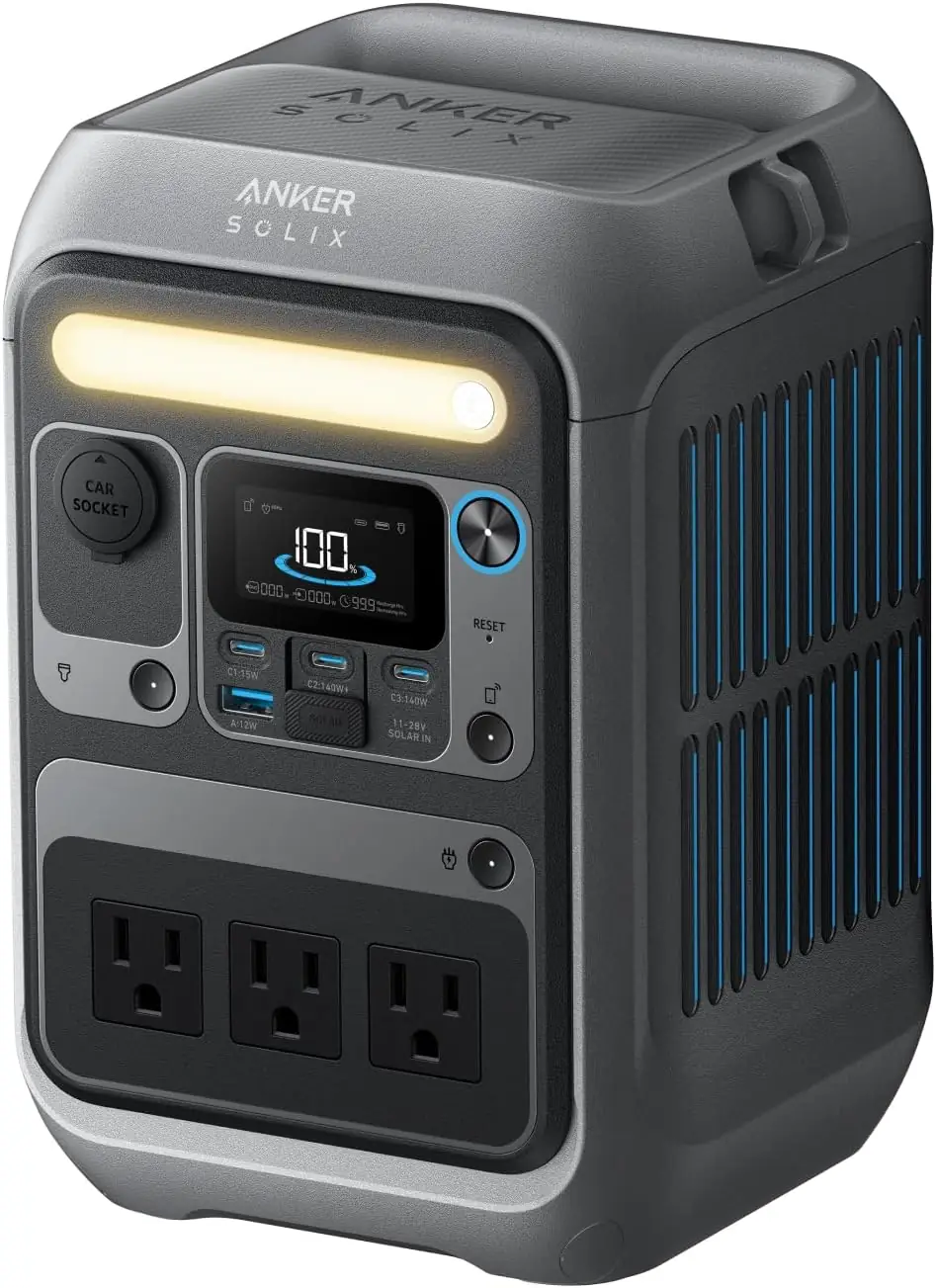
Anker SOLIX C300 Portable Power Station
By Anker · Portable Power Stations · Audio & Electronics · More from Anker
- 288Wh LiFePO4 battery
- 300W output (600W surge)
- 140W two-way USB-C
- 100W solar input
- recharge to 80% in 50 min
Price not listed
- AnkerView at Anker
- eBayView at eBay
- AmazonView at Amazon (paid link)
- eBay (used) eBay: used, open-box, refurbishedView at eBay (used)
Stores are listed in a fixed order, never by price or commission. Prices are snapshots. Check the current price with the store.
Summary
A 288 Wh LiFePO4 power station built for phones, laptops and small camping gear rather than household backup. Check the sustained AC output before you buy: Anker rates it at 300 W, but a bench test reported the sample cutting out at a sustained full 300 W load and running faultlessly at 255 W and below.
Strengths
- It is light and easy to carry at 9.1 lb, with a compact 6.5 × 6.3 × 9.5 in body and a moulded carry handle.
- The 140 W two-way USB-C port can charge a laptop and recharge the unit itself.
- The included AC charger refills it to 80 % in about 50 minutes, and a full charge takes about 1.1 hours.
- A built-in light, a 120 W car outlet and a mix of AC and DC sockets cover most small-device jobs.
Weaknesses
- A bench test reported the sample would not hold a sustained full 300 W AC load and cut out, running faultlessly at 255 W and below.
- Usable energy falls short of the 288 Wh nameplate: CNET measured 68.71 % round-trip efficiency and 238.14 Wh, and OutdoorGearLab measured 230 Wh.
- Solar input is capped at 100 W, so a full solar refill takes about 4 hours even under ideal conditions.
- The shoulder strap ($29.99) and protective case ($59.99) are separate purchases, and so are the car and solar charging cables.
- At 288 Wh it exceeds the 100 Wh airline carry-on limit, so it cannot be flown with.
- Owners report the unit cannot be switched off while it is actively charging.
Verified specifications
| Model | Anker SOLIX C300, AC + DC outlets, model number A1722. |
|---|---|
| Battery | LiFePO4 (LFP), 288 Wh (90,000 mAh). |
| AC output | 300 W rated, 600 W surge via SurgePad; all AC outlets support SurgePad. |
| Total output | 360 W. |
| AC input | 120 V ~ 3.5 A max, 60 Hz; 330 W max charging; 380 W max in bypass mode. |
| Solar input | 11–28 V, 8.2 A, 100 W max, XT60 connector. |
| USB-C2 input | 140 W max (9 V / 15 V / 20 V / 28 V). |
| Outputs | USB-A 5 V ⎓ 2.4 A (12 W); USB-C1 5 V ⎓ 3 A (15 W); USB-C2 140 W max; USB-C3 140 W max; USB-A + USB-C1 combined 20 W max; car outlet 12 V–10 A (120 W). |
| Port count | 7 device charging ports (3 AC, 1 USB-A, 3 USB-C, 1 car outlet). |
| Recharge | 80 % in 50 minutes from a wall outlet; about 1.1 hours to 100 %. |
| Noise | 25 dB measured from 3.3 ft / 1 m. |
| UPS cutover | 10 ms. |
| App | Anker app over Bluetooth and Wi-Fi. |
| Warranty | 5 years for the C300; 3 years for the C300 DC in EU and CA listings. |
| Dimensions | 6.5 × 6.3 × 9.5 in (16.4 × 16.1 × 24.0 cm); 9.1 lb (4.13 kg). |
| In the box | unit, AC charging cable, important safety instructions, warranty card and user manual. |
Full research notes and sources
Battery and charging
The pack is LiFePO4, rated 288 Wh (90,000 mAh) and 3,000+ cycles to 80 % capacity, which Anker markets as roughly a 10-year service life. On the included AC charger it reaches 80 % in about 50 minutes and 100 % in about 1.1 hours. The 140 W USB-C input is much slower in practice; CNN, testing the C300 DC with a 20 W adapter, measured about 18 hours to full. The 100 W solar cap makes a full solar refill slow, about 4 hours under ideal conditions. Owners report standby draw around 0.1 W.
Output and efficiency
Anker advertises 300 W continuous AC with 600 W surge. Efficiency is the bigger issue. CNET’s lab measured 68.71 % round-trip efficiency and 238.14 Wh of active energy from the 288 Wh pack, and OutdoorGearLab measured 230 Wh usable (80 %), scored the unit 50/100 and ranked it 13th of 14, calling the battery efficiency “underwhelming” and the screen “small”. Neither figure is close to the advertised 288 Wh.
Firmware and owner complaints
Most owner friction reported so far is on the C300 DC variant. Reddit owners report that DC output ports auto-shut-off below about 100 mA after two hours with no configuration option, that after a firmware update one unit’s charging was limited to about 5 W, and that a 140 W charger throttled to about 100 W after roughly 30 minutes of heat. On the AC side, owners report the unit cannot be switched off while it is actively charging, and that the app may need an internet connection for basic status even though it also connects over Bluetooth. One poster says support told them the UPS switchover may be 20 ms rather than the 10 ms in the manual. None of these establish a failure rate.
Is it worth it?
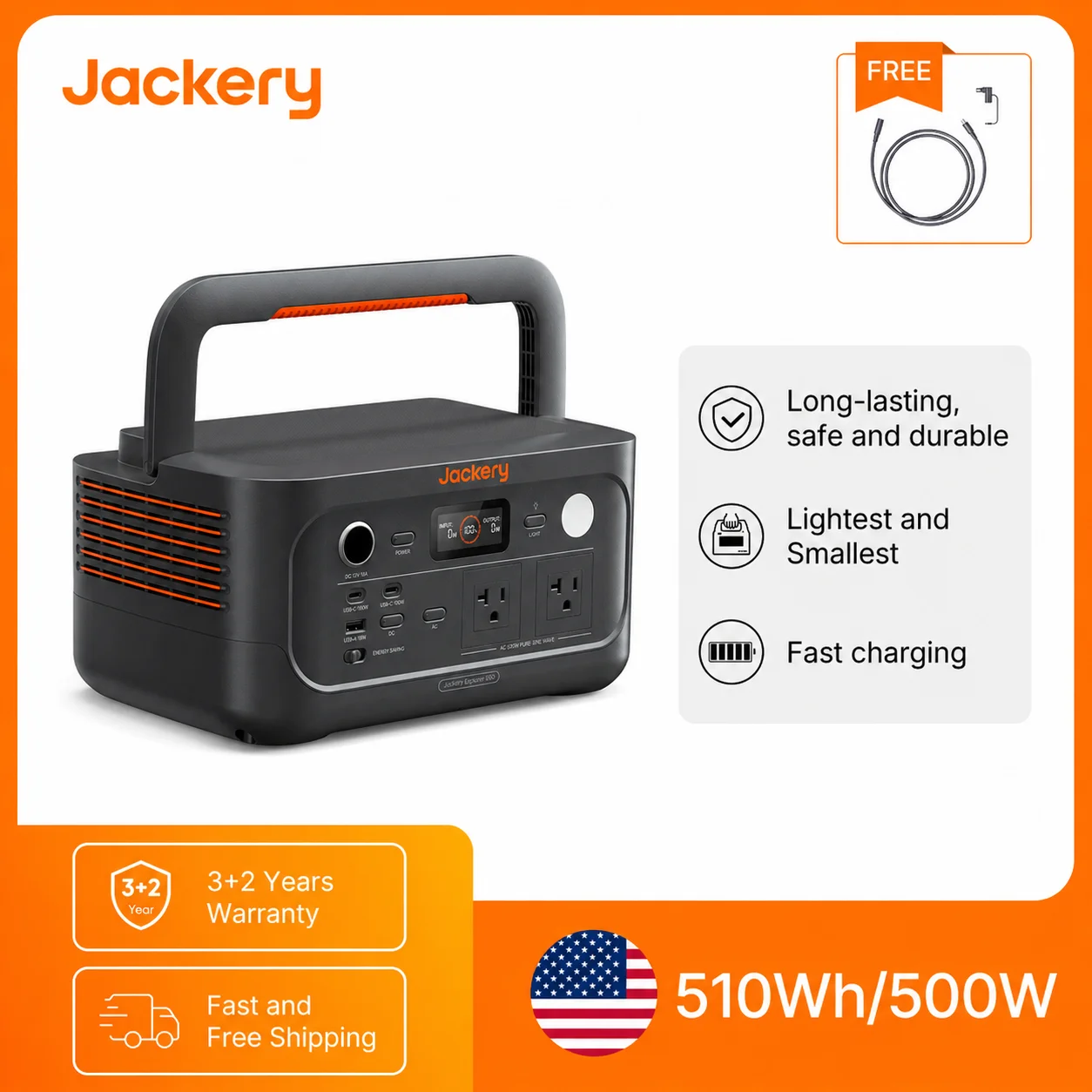
Price is the deciding factor. OutdoorGearLab lists the C300 at $300, and CNET says it is often on sale for less than $200. Costco sold the same-hardware C300X at $149.99, down from $159.99. PCMag reported a 26 % discount in August 2025, and Mashable reported it on sale under $250 in July 2026. Anker’s own US page shows it sold out, with an indexed snapshot at $329.99, which is well above what the lab results support. Under $200 the package is reasonable for a light, portable device-charging station. Near $300 it is weak, because the same money buys larger and more efficient stations, and the 300 W rating is not reliably sustained. The adjustable shoulder strap ($29.99) and protective case ($59.99) are separate purchases, and the car and solar charging cables are sold separately too. OutdoorGearLab named the Jackery Explorer 300 as the better-value option at the time.
Which model this is
This page covers the Anker SOLIX C300, the 288 Wh AC + DC version, Anker model number A1722. The Amazon listing for it is ASIN B0D62GMQ3F.
Three SKUs share the 288 Wh family. The C300 is the one with AC + DC outlets. The C300 DC has no AC sockets, a larger pop-up light and a 3-year warranty in EU and CA listings. The C300X is the same hardware in black with an included shoulder strap; on Anker’s UK page the identical station is badged C300X (model A1723).
Sources
Manufacturer:
- Anker SOLIX C300 Portable Power Station (US)
- Anker SOLIX C300 Portable Power Station spec sheet
- Anker SOLIX C300 DC Portable Power Station (US)
- Anker SOLIX C300 Portable Power Station (UK)
Independent reviews:
- Best portable power stations for hurricane season (CNET)
- Anker Solix C300 deal (PCMag)
- Anker Solix C300 deal (Mashable)
Owner reports: