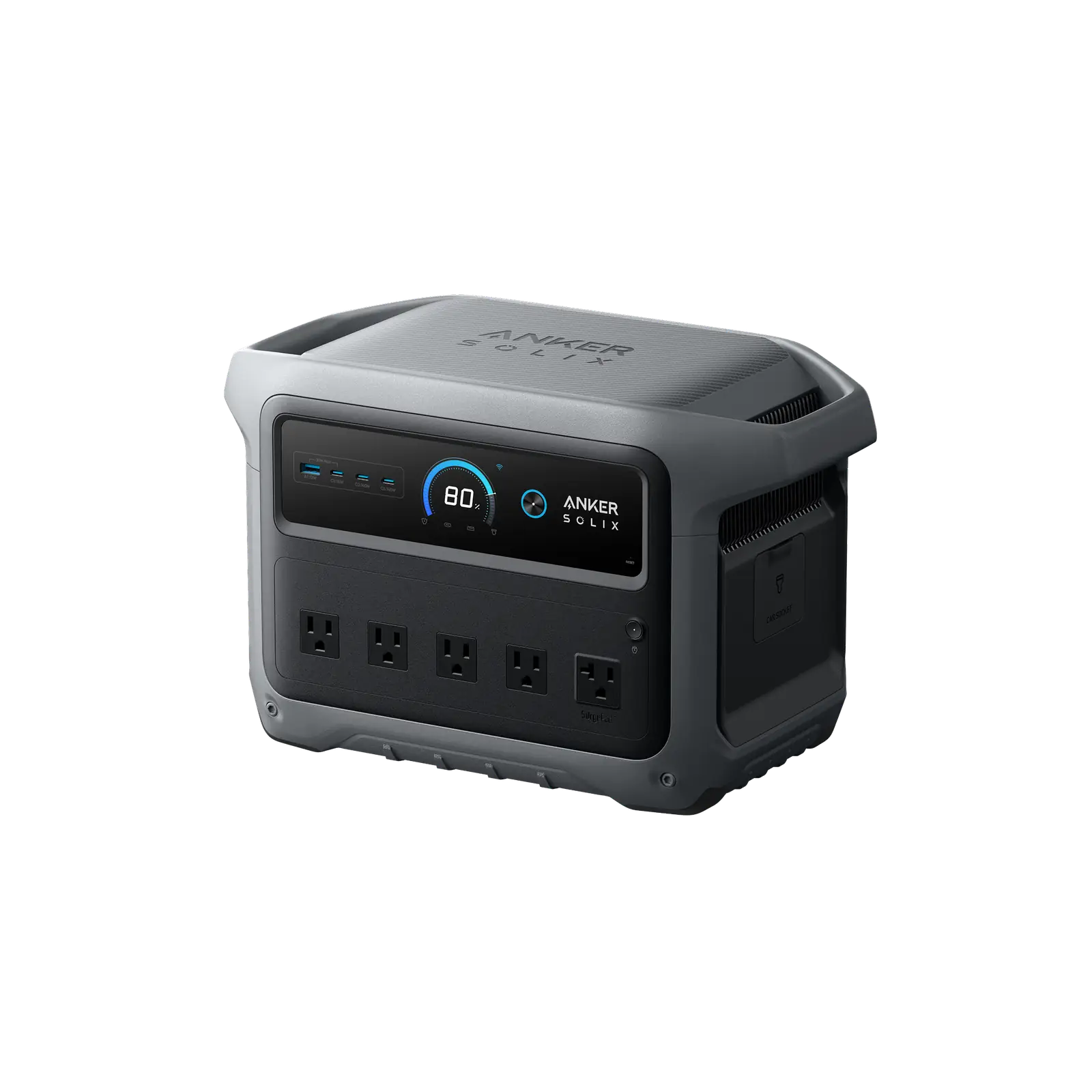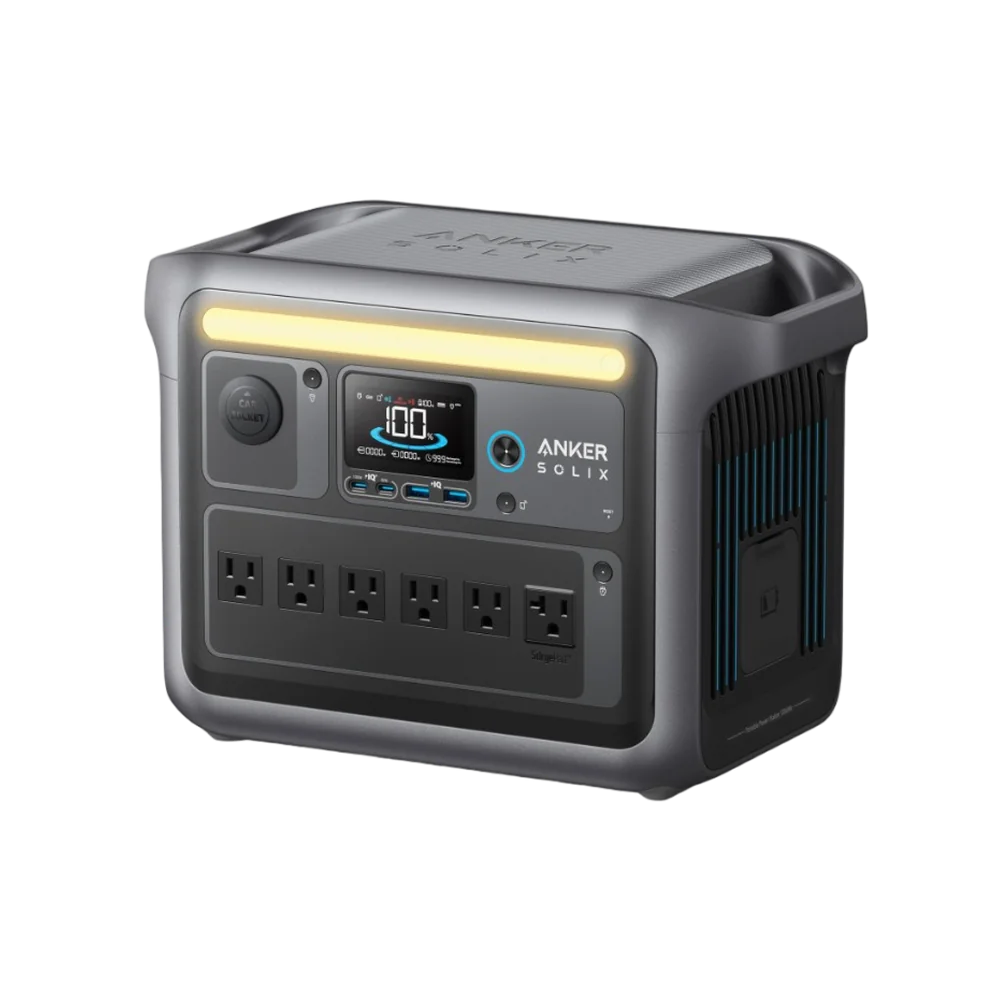
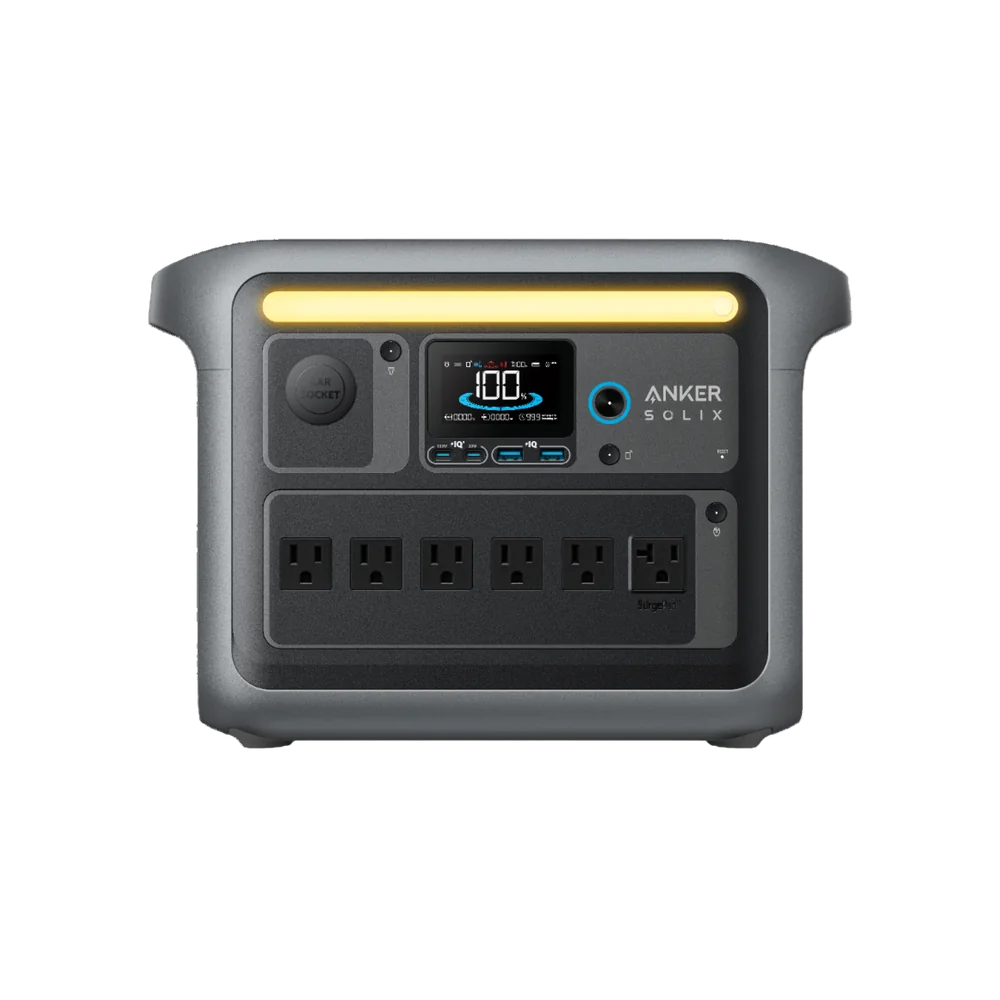
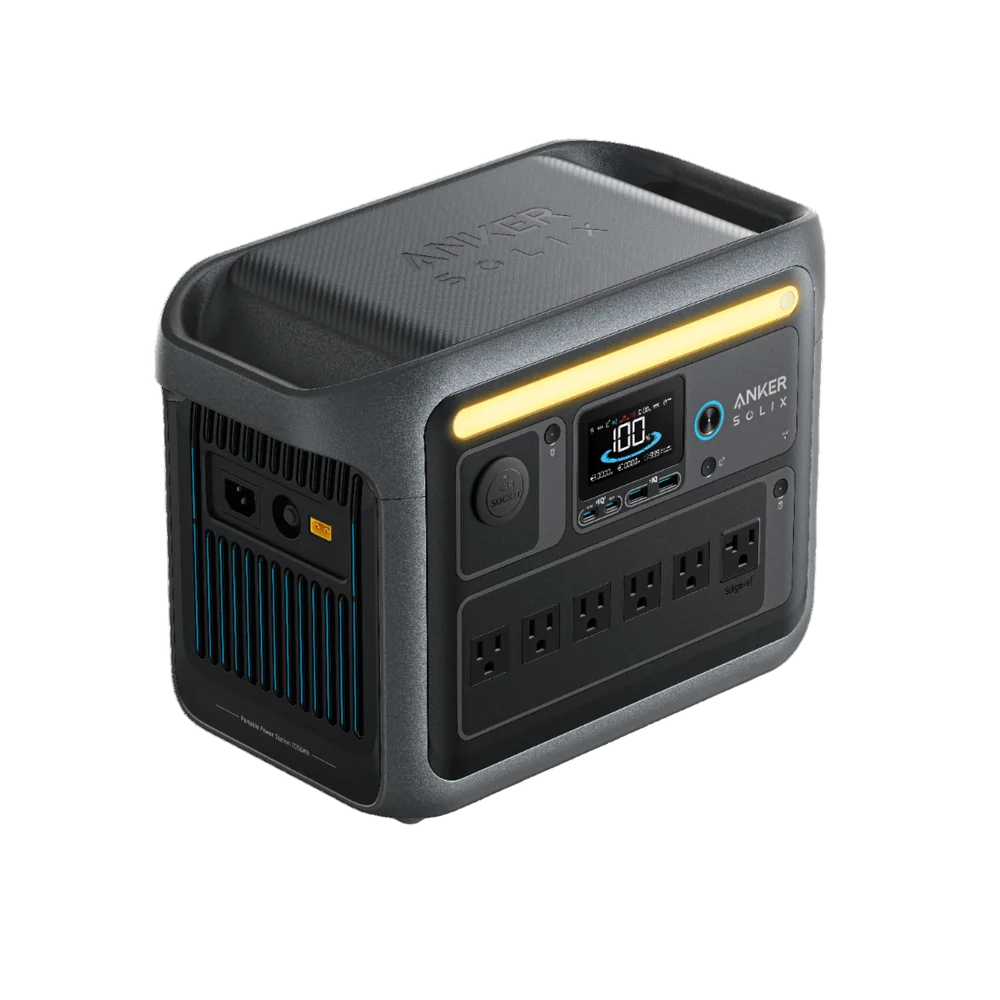
Anker SOLIX C1000 Portable Power Station
By Anker SOLIX · Portable Power Stations · Audio & Electronics
- 1,056Wh LiFePO4 capacity, expandable to 2,112Wh with expansion battery
- 1,800W pure sine wave AC output with 2,400W SurgePad peak
- 80% charge in 43 minutes via AC (UltraHyperFast), full charge in under an hour
- 600W max solar input (11-60V MPPT) for a 1.8-hour solar recharge
Lowest price seen
~$469.99 (approx.)
from $469.99 at Amazon
- Amazon ~$469.99 (approx.)View at Amazon
- Anker SOLIXView at Anker SOLIX
- WalmartView at Walmart
- eBayView at eBay
- eBay (used) eBay: used, open-box, refurbishedView at eBay (used)
Prices are snapshots. Check the current price with the store.
Summary
A 1,056 Wh LiFePO4 power station with a 1,800 W pure-sine inverter that can be expanded to 2,112 Wh with a second battery. Plan around roughly 85% of the nameplate as usable AC energy, and around 60 to 90 minutes for a full wall charge rather than the advertised 43 minutes.
Strengths
- Six front AC outlets with enough spacing for large plugs, plus two USB-C and two USB-A ports.
- Expandable to 2,112 Wh with the BP1000 battery, which the newer Gen 2 cannot do.
- Fast wall charging: 65 minutes to full with UltraFast mode enabled in the app.
- A bright LCD readable in direct sunlight and a warm-yellow light bar that is gentler than many rivals’ white lights.
- One reviewer ran a full home-office UPS load, including docks, laptops, a NAS and network gear, through simulated outages.
- Five-year warranty on new units and four UL certifications from SGS.
Weaknesses
- Charging is slower than advertised: Anker claims 80% in 43 minutes, while OutdoorGearLab measured 88 minutes to full on the included cable.
- Usable AC capacity is about 85% of nameplate, 897 Wh measured from the advertised 1,056 Wh.
- The fan is among the loudest in OutdoorGearLab’s test group at maximum load.
- No way to set a maximum charge percentage, so you cannot hold the battery at 80% for longevity.
- Bypass mode is capped at 1,440 W, SurgePad does not work in it, and inductive loads like pumps and saws can trip the inverter at startup.
- No replacement-parts channel was found, so a failure means a warranty claim on a sealed unit.
Verified specifications
| Model/part number | A1761. |
|---|---|
| Capacity | 1,056 Wh LiFePO4, 3,000 cycles to 80% capacity. |
| AC output | 1,800 W continuous pure sine wave, 2,400 W SurgePad surge. |
| AC outlets | 6 in the US configuration. |
| USB | one 100 W and one 30 W USB-C, two 12 W USB-A. |
| Car socket | 120 W, 12 V / 10 A. |
| Solar input | 600 W max, 11-60 V MPPT; the manual splits it into 11-32 V at 10 A and 32-60 V at 12.5 A on an XT-60 connector. |
| AC recharge | 1,300 W max UltraFast, 1,000 W max normal. |
| UPS switch time | under 20 ms. |
| Expansion | up to 2,112 Wh with the BP1000 battery. |
| Connectivity | Wi-Fi and Bluetooth through the Anker app. |
| Operating temperature | discharge -4 °F to 104 °F, charge 32 °F to 104 °F. |
| Dimensions | 14.8 × 8.07 × 10.5 in (37.6 × 20.5 × 26.7 cm); 28.44 lb. |
| In the box | the power station, an AC charging cable, a car charging cable and a user manual. |
Full research notes and sources
Charge time you can actually expect
Anker’s headline is 80% in 43 minutes and a full charge in under an hour, and both assume UltraFast mode switched on in the app. OutdoorGearLab, the one outlet found with instrumented testing of this exact unit, measured 88 minutes to full on the included 1,300 W cable and 65 minutes with UltraFast enabled, and an owner discussion on Reddit attributes 88 minutes to AC-only charging. Plan on 60 to 90 minutes from a wall socket, not 43. One reviewer advises reserving UltraFast for occasional use because it can accelerate battery degradation.
Capacity and what it can run
OutdoorGearLab pulled 897 Wh out of the advertised 1,056 Wh through the AC inverter, about 85%, and expects more from the DC outputs. A separate review puts usable AC output at 850-900 Wh, so size loads against that band, not the number on the box. The inverter is a hard 1,800 W continuous ceiling: large space heaters and some hair dryers exceed it, and Anker’s own FAQ warns that inductive and compressor loads such as water pumps and electric saws may exceed the startup limit. At full continuous output the unit ran 33 minutes before shutting down in OutdoorGearLab’s test, among the shorter maximum-load runtimes they recorded and a trade they accepted against the recharge speed.
The UPS role and one owner’s failure
TechRadar’s reviewer ran the C1000 as a home-office UPS with the expansion battery attached, reaching 2,112 Wh, and powered multiple docks, laptops, a Mac mini, a NAS, a space heater and network gear through simulated outages without trouble. A blog owner attempting the same setup reports the opposite: the unit stopped charging and fell to 78% over about two weeks, a firmware update from the phone app failed while a router, access point and switch were plugged in, and about a week later all AC output and app control stopped. A paper-clip reset through the documented reset hole and firmware 1.4.3 restored it, but that owner no longer trusts it as the UPS for basic infrastructure. One account is not a failure rate, but it is specific and dated, and it is the most serious negative report found. If you plan to hang a router or a NAS off this unit, test that during the return window.
Ports, solar and the Gen 2 question
The C1000 accepts 600 W of solar at 11-60 V; the 1.8-hour solar claim assumes that much panel behind it, and one owner reports 2 to 2.5 hours to full instead. A panel array whose open-circuit voltage exceeds 60 V will damage the unit, and AC and DC cannot charge at the same time. Six AC outlets, two USB-C, two USB-A and a car socket give it one of the wider port spreads in the class, with room to space out large plugs.
The C1000’s case has narrowed since launch. Anker’s own C1000 Gen 2 lists at $499.99 with 2,000 W output, 4,000 cycles, a 49-minute recharge and 24.9 lb, but no expansion port and no front light bar. Two independent sources say the Gen 2 is the better buy at similar money unless you specifically want the expansion battery, and OutdoorGearLab has switched its own recommendation to it. At check time Anker’s store showed the original C1000 at $429.99 against a $449.99 reference, and an independent review puts the street band at $429-479. Buy the C1000 around that band if you want the expansion path or the built-in light; otherwise compare the Gen 2 first, and do not pay list. Check the store panel above for current prices.
Which model this is
This page covers the original 2023 C1000, part number A1761. Don’t confuse it with the C1000 Gen 2 (1,024 Wh, 2,000 W, 4,000 cycles, 24.9 lb, no expansion port), the C1000X jobsite variant covered by the same user guide, or a refurbished C1000, which carries a six-month warranty against five years on a new one. The US listing is ASIN B0GR9H79KS.
Sources
Manufacturer:
- Anker SOLIX C1000 official US product page
- Anker SOLIX C1000/C1000X user guide (A1761, US)
- Anker SOLIX C1000 with 100 W solar panel bundle
- Anker SOLIX C1000 Gen 2 US product page
- Anker SOLIX C1000 refurbished listing
Independent reviews:
- OutdoorGearLab instrumented C1000 review
- TechRadar C1000 review
- Off-Grid Gear Review: the Gen 2 changes the math
- T3 C1000 review
- Creative Bloq C1000 review
- Notebookcheck C1000 Gen 2 review
Owner reports: