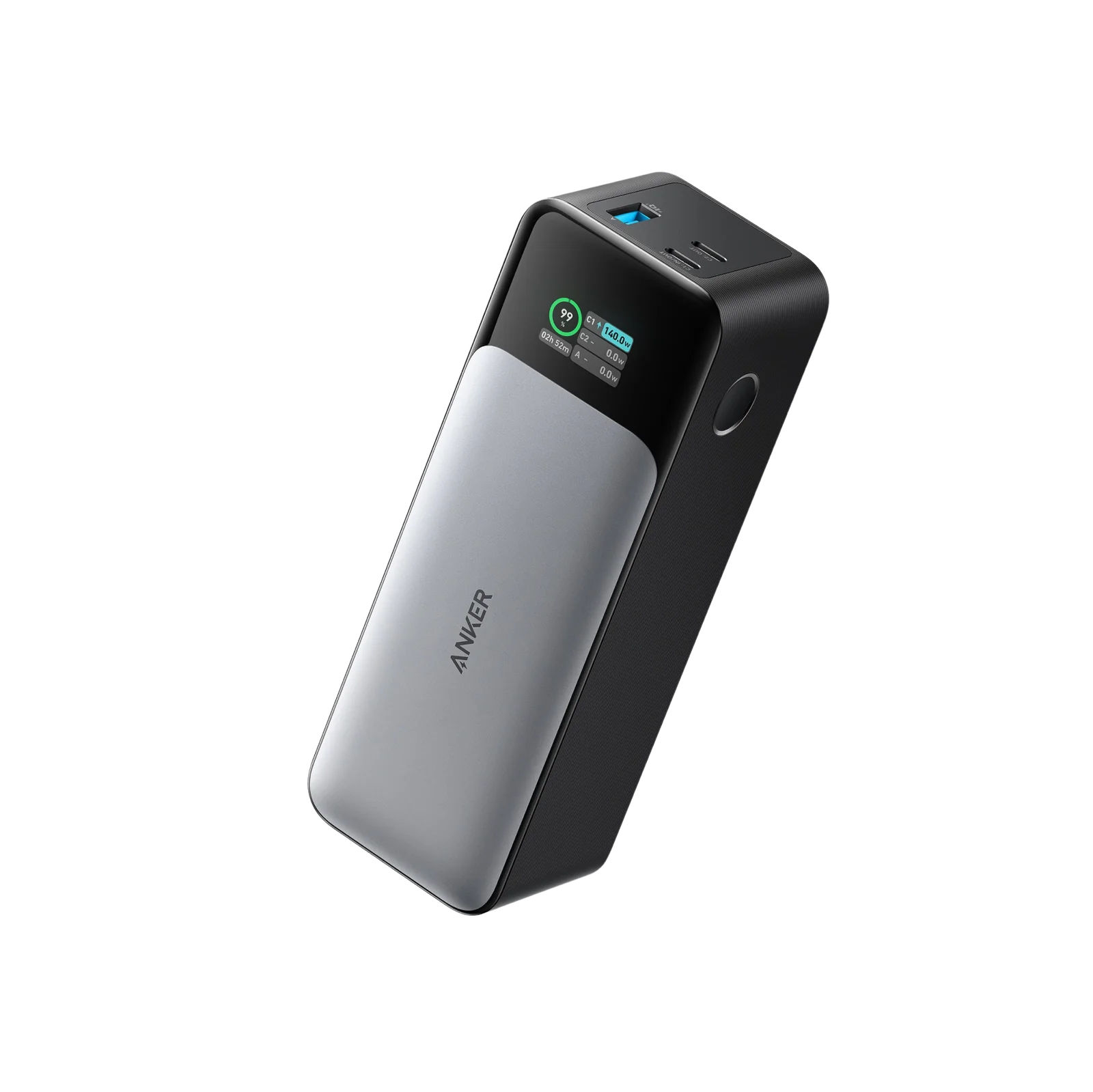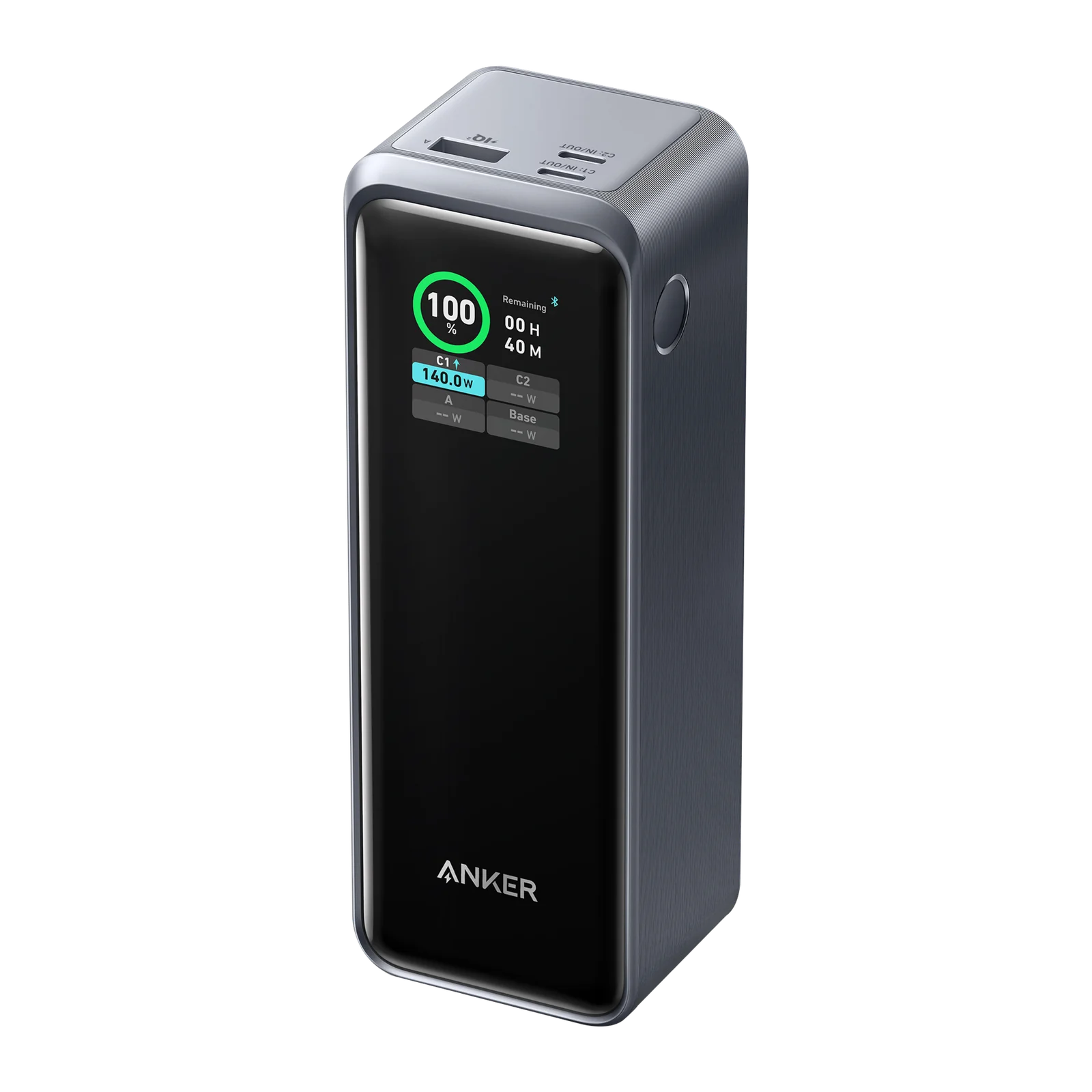
Anker Prime 27,650mAh 3-Port 250W Laptop Portable
By Anker · Power Banks · Audio & Electronics · More from Anker
- 27,650mAh capacity
- 250W total max output
- 2 USB-C + 1 USB-A ports
- 170W input, full recharge in 43min
- 2.24 x 1.96 x 6.37 inches, 665g
Lowest price seen
~$179.99 (approx.)
from $179.99 at Amazon
- Amazon ~$179.99 (approx.)View at Amazon
- AnkerView at Anker
- WalmartView at Walmart
- Best BuyView at Best Buy
- eBay (used) eBay: used, open-box, refurbishedView at eBay (used)
- eBayView at eBay
Prices are snapshots. Check the current price with the store.
Summary
A 99.54Wh USB-C power bank that can deliver up to 140W from a single port and 250W across three ports, built for charging a laptop, tablet and phone at the same time. Check your laptop’s USB-C Power Delivery compatibility before you buy: the full 140W needs a PD 3.1 EPR device and cable, and the 250W total is shared across all ports.
Strengths
- ComputerBase measured 78.7Wh delivered at 15W and 85.2Wh at 90W — 79.1% and 85.6% of the 99.54Wh nameplate, respectively.
- Each USB-C port delivers up to 140W, enough for a 16-inch MacBook Pro at full speed.
- Three ports charge simultaneously: 140W + 92W + 18W = 250W under supported conditions.
- The color display shows live wattage, remaining runtime and battery health without needing the app.
- At 99.54Wh it fits under the FAA’s 100Wh carry-on limit for power banks.
- Android Central’s reviewer used it daily for four months across phones, laptops and tablets without issues.
Weaknesses
- The 250W total is shared: no two ports deliver 140W each at the same time.
- At 665 g it is heavy and thick — a laptop-bag item, not a pocket battery.
- A fully discharged unit will not start charging on the 100W pogo-pin dock; you need to revive it via USB-C first.
- The full 170W recharge needs two separate chargers and only works above 55% battery.
- Owners report units arriving dead, boot-looping, or showing E107 undervoltage errors on multiple cables.
- The battery is not user-swappable; Anker does not sell a replacement pack or publish a service price.
Verified specifications
| Model | A1340 (Anker Prime 27,650mAh 250W). |
|---|---|
| Capacity | 27,650mAh, 99.54Wh from seven 3,950mAh cells. |
| Ports | two bidirectional USB-C (C1, C2) and one USB-A. |
| USB-C output | up to 140W per port (28V/5A, PD 3.1 EPR). |
| USB-A output | up to 65W for compatible proprietary protocols (SuperVOOC). |
| Combined output | up to 250W shared across all three ports. |
| Input | each USB-C up to 140W; dual USB-C input up to 170W peak (above 55% battery). |
| Recharge time | 37 minutes with dual chargers, 43 minutes with a single 140W charger. |
| Charging base | 100W pogo-pin dock (A1902, sold separately). |
| Display | color screen showing state of charge, runtime estimate, port wattage, battery health and temperature. |
| Connectivity | Bluetooth with Anker app; no Wi-Fi or cellular. |
| Low-current mode | double-press the button for trickle charging. |
| Dimensions | 6.37 × 2.24 × 1.96 in (161.7 × 57 × 49.7 mm). |
| Weight | 665 g. |
| In the box | power bank, 0.6 m USB-C cable (140W-rated), travel pouch, quick-start guide. |
| Not included | wall charger, charging base. |
| Air travel | 99.54Wh, below the FAA 100Wh carry-on threshold. |
| Warranty | 24 months (US, original purchaser). |
Full research notes and sources
What the independent tests found
ComputerBase tested this exact model in August 2025. At a sustained 15W output it delivered 78.7Wh — 79.1% of the 99.54Wh nameplate. At 90W it delivered 85.2Wh (85.6%). A full recharge drew 107.4Wh from the wall, making the 90W cycle 79.3% efficient. These numbers are more useful than assuming all 99.54Wh reach your laptop’s USB-C port.
Macworld’s May 2024 review found the A1340 especially useful for 16-inch MacBook Pro fast charging, but noted that Apple’s 140W charging may require Apple’s own USB-C-to-MagSafe 3 cable rather than an arbitrary USB-C cable. Check your specific MacBook generation’s fast-charge port requirements.
Ports, power and the 250W question
Each USB-C port supports 5V/3A, 9V/3A, 12V/3A, 15V/3A, 20V/5A and 28V/5A. The USB-A port supports up to 65W for compatible proprietary protocols like SuperVOOC, plus ordinary 5/9/12V profiles. The 250W figure is the maximum combined output across all three ports — 140W + 92W + 18W under supported conditions. No layout gives you 140W + 140W at the same time.
At 99.54Wh, the bank cannot sustain 250W for an hour: 99.54Wh ÷ 250W = 0.398h, about 24 minutes before losses and thermal limits. This is not a substitute for hours of laptop operation at 250W.
Recharging and the dock
Each USB-C port accepts up to 140W input. Dual USB-C input is promoted at up to 170W peak, but Anker says that peak normally occurs above 55% battery remaining and input varies to protect the cells. The advertised 37-minute recharge requires two suitable chargers; a single 140W charger takes about 43 minutes. The 100W pogo-pin dock (A1902, $109.99) is slower and cannot start charging a completely discharged bank — ComputerBase found you need to restore some energy via USB-C first.
Owner reports: problems and failures
In r/anker and r/computers threads, owners describe units that arrived unresponsive, showed 100% only while connected to input, or boot-looped when a device was attached. One owner reported repeated E107 undervoltage errors on both USB-C ports when charging an iPhone 15 Pro. Another saw the displayed charge jump from 74% to 85% without charging, or drop from 99% to 0% during phone charging.
These are individual anecdotes, not a failure rate. Nobody has published a defect percentage, swelling rate or mean time to failure for this model. If a symptom recurs with a known-good charger and cable, stop relying on it and request warranty service.
One owner reported that the standard “C1-to-C2 loop” reset advice did not work; a hold-button-for-5-seconds-then-press-five-times sequence was reported by multiple commenters to succeed. This is community experience, not an Anker service bulletin.
Running costs and parts
A full recharge draws 107.4Wh from the wall. Charging once a week costs about 5.58kWh/year — roughly $1.40/year at $0.25/kWh. Daily charging would be about 39.20kWh/year, or $9.80/year. These figures come from a test bench, not from every user’s charger efficiency or aging pack.
The battery is not user-swappable. Anker does not sell a replacement seven-cell pack, publish a service price, or provide approved DIY replacement instructions. A swollen or failed pack should go through manufacturer service or recycling. The 24-month warranty covers the original purchaser; Anker’s policy allows refurbished replacements when new units are unavailable, and the A1340 is sold out direct.
The A1902 100W charging base costs $109.99 from Anker’s US catalog. A 140W 4-port charger (A2697) is available from Anker but was not price-checked for this review. The bank includes a 0.6m 140W-rated USB-C cable; replacement cables should be PD 3.1 EPR 28V/5A-capable.
Is it worth it?
The A1340 is sold out on Anker’s own US site. Best Buy lists a marketplace offer at $179.99 sold by third-party AnkerDirect, but a separate Best Buy catalog route says the item is no longer available in new condition. Walmart lists the same SKU at $179.99 but out of stock. eBay completed sales in September 2026 ranged from $70 (plus $5.93 shipping) to $112.50 (plus $17.56 shipping) for used units.
For a verified new full-warranty unit, under $135 is attractive and $135–$165 is reasonable if you need its exact port layout. At $179.99 or above, compare the newer Anker A110A 26K 300W at $229.99 direct — $50 more for a current in-stock model with 300W combined output and 600g weight. The A1695 25K/165W is cheaper in some listings and has integrated cables, but its single USB-C tops out at 100W, so it cannot replace the A1340 for 140W EPR laptops.
Which model this is
This page covers the Anker Prime 27,650mAh 250W power bank, model A1340, including the US black retail variant A1340011. It is a 2023-generation 99.54Wh lithium-ion USB battery, not a 250Wh portable power station. It is distinct from the Anker 737 PowerCore 24K (A1289, 140W total), the Anker Prime 26,250mAh 300W (A110A), and the 250W Anker Prime desktop wall charger.
Sources
Manufacturer:
- Anker USA — A1340 Prime Power Bank 27K/250W official specs
- Anker — A1340 Quick Start Guide (PDF)
- Anker support — A1340 port ratings and user manual
- Anker USA — A1902 100W charging base
- Anker USA — refund/warranty policy
- Anker USA — product recall notices
- Anker USA — A110A 26K 300W power bank
- Anker USA — A1695 25K 165W power bank
- Anker USA — A2697 140W 4-port charger
- Anker USA — A1289 PowerCore 24K
Independent reviews:
- ComputerBase — August 2025 power bank lab test
- Android Central — A1340 review, January 2025
- Macworld — A1340 MacBook Pro review, May 2024
- Gadgetoid — A1340 hands-on review, April 2024
- Consumer Reports — A1340 listing
Owner reports:
- A1340 shows 100% on charger but no output (r/anker)
- A1340 boot-loops and won’t power devices (r/computers)
- A1340 fails recharging; warranty replacement (r/anker)
- Inconsistent displayed charge after idle (r/anker)
- A1340 suddenly shows 0% during phone charging (r/anker)
- E107 low-voltage complaint and cross-border support (r/anker)
- A1340 reset sequence and owner outcomes (r/anker)
- Firmware update blocked by active trickle mode (r/anker)
- Date clock bug and firmware version (r/anker)
- Slower recharge and 45°C anecdote (r/anker)
Parts and stores: