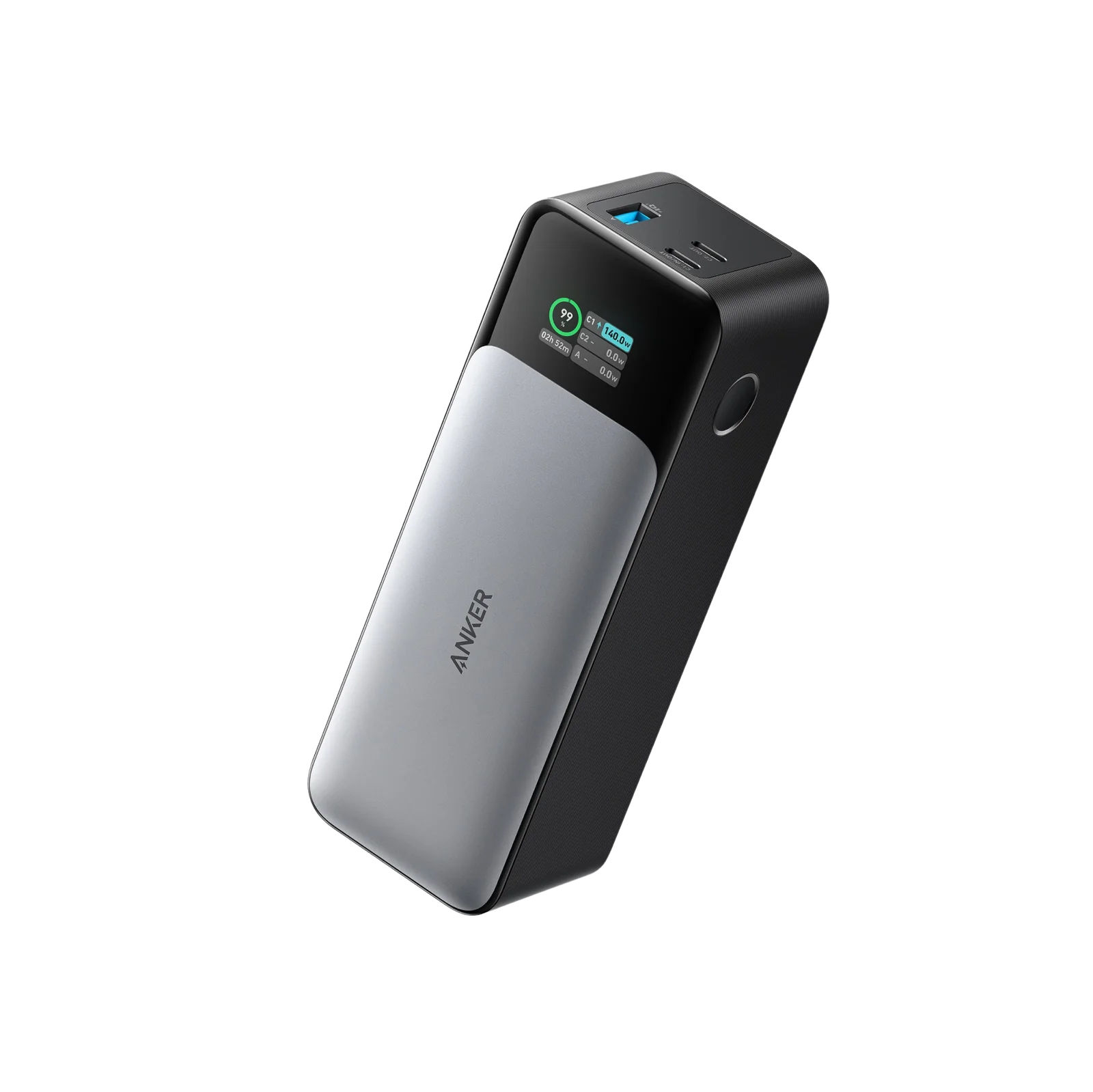
Anker Laptop Power Bank 25K 165W with Built-in USB-C
By Anker · Power Banks · Audio & Electronics · More from Anker
- 25,000mAh capacity
- 165W total output
- Triple 100W USB-C ports
- Dual built-in USB-C cables
- 100W max input
Price not listed
- AnkerView at Anker
- WalmartView at Walmart
- eBay (used) eBay: used, open-box, refurbishedView at eBay (used)
- eBayView at eBay
- AmazonView at Amazon (paid link)
Stores are listed in a fixed order, never by price or commission. Prices are snapshots. Check the current price with the store.
Summary
A 25,000mAh (90Wh) laptop power bank with two built-in USB-C cables, one of them retractable, plus a standalone USB-C port and a 33W USB-A port. Check the cables before you buy: owner reports and a 2026 press story describe failed built-in cables, and the unit is not repairable.
Strengths
- Two built-in USB-C cables, one retractable, so you can leave the house without packing a separate cable.
- Charges laptops fast on one or two devices; Best Batteries measured 96W to a single device.
- The smart display shows per-port watts, temperature, cycle count and battery health.
- 90Wh sits inside the 100Wh carry-on limit.
- Anker lists an 18-month warranty and a 30-day money-back guarantee.
- A high-wattage charger refills it in about two hours.
Weaknesses
- Built-in cable failures are the dominant caution: owners report a side cable outputting only 0.1W, cracked solder, and a failed cable reported to have damaged a MacBook Pro mainboard.
- The 165W total is conditional, needing two devices and more than about 78% charge.
- Three or four devices share only about 30W beyond the priority port; Best Batteries measured 57W for the priority port and about 7W each to the rest.
- Neither built-in cable is replaceable and the unit is glued shut, so a cable failure is effectively terminal.
- Self-recharge peaks near 90–92W, not the claimed 100W, then drops to a roughly 50W plateau.
- It is heavy and thick at 595 g, closer to a food tin than a phone.
Verified specifications
| Model | A1695. |
|---|---|
| Capacity | 25,000mAh; stored energy 90Wh at 3.6V. |
| Battery pack | 5,000mAh, 18VDC / 90Wh, five 21700 cells in series. |
| Total output | 165W maximum. |
| USB-C output | up to 100W per cable or port (5-11V/3A, 5V/3A, 9V/3A, 10V/2.25A, 12V/3A, 15V/3A, 20V/5A). |
| USB-A output | up to 33W. |
| USB-C input | up to 100W per cable or port. |
| Ports | three USB-C (two built-in cables plus one standalone port), one USB-A. |
| Charging protocols | PD3.0, QC3.0, PPS, SCP, UFCS, AFC, Apple 2.4A. |
| Pass-through charging | yes, with a charger rated 20W or higher. |
| Recharge time | about 2 hours with a 100W-or-higher charger at 25°C. |
| Built-in cables | retractable 27.6 in (70cm) and non-retractable lanyard 11.8 in (30cm). |
| Display | real-time smart colour display with battery percentage, per-port watts, temperature, cycle count and health. |
| Dimensions | 6.18 × 2.12 × 1.93 in (156.97 × 53.85 × 49.02 mm); 21.0 oz (595 g). |
| Flight approval | within the 100Wh carry-on limit. |
| Warranty | 18 months. |
Full research notes and sources
How much power you actually get
Anker’s own distribution table says 165W is a combined maximum for two devices, dropping to 130W with three or four, and the headline figure is only reachable above roughly 78% charge. Best Batteries’ lab testing showed the practical result: with three devices connected the priority port kept 57W while the others got about 7W each, and with four devices the extras got 7W/12W/7W. Delivered energy measured about 74Wh of the 90Wh stored, so plan on roughly one full large-laptop charge plus part of a second.
Self-recharge and thermal limits
The claimed 100W input is not achieved in practice: Macworld could not measure more than 90W, and Best Batteries measured a 92W peak held for only about 22 minutes before it dropped to a roughly 50W plateau. A full recharge took about 1h57m in the lab and just under 1h35m in Macworld’s testing. Anker’s thermal modes throttle the bank: below 36°C it runs at 100W, from 36°C to 38°C it drops to 52W recharge and 65W discharge, and above 39°C it stops charging to protect itself.
The cable failures
The significant risk is the built-in cables. A 2026 heise online report describes several owner posts about defective cables and a YouTuber’s case in which a failed cable was reported to have damaged a MacBook Pro mainboard, which then lost charging and GPU-core function; Anker said it was investigating but issued no recall for this model. A thread on r/powerbanks blames the solder connecting the side lanyard cable, and an r/anker owner reports the side cable outputting only 0.1W after about a month. The A1695 is not part of the September 2025 CPSC recall, which covered other models.
Repairs, parts and running costs
The bank is glued and not designed to be opened, and neither built-in cable is user-replaceable, so a failed cable cannot be serviced economically. There are no consumables, and the built-in cables mean no cable to buy separately, but a 100W-or-higher USB-C charger is effectively required to hit the two-hour recharge. Warranty is 18 months per Anker’s own documentation, though some third-party aggregators list 12 months.
Is it worth it?
At $90–100 it is a strong buy for someone who charges a laptop and one other device away from a wall. Anker’s US store lists it at $119.99, it launched at $99.99 at CES 2025, and the UK price often sits near £66 against an £89 RRP. Near or above $120, rivals with faster self-recharge and higher total output become competitive, and the case rests on the two always-attached cables.
Which model this is
This page covers the Anker A1695, sold as the Anker Laptop Power Bank (25K, 165W, Built-In and Retractable Cables) in Space Black and Silver. Do not confuse it with the Anker Prime Power Bank (26K, 300W, A110A) or the Anker 737, which are different models.
The Amazon listing for this model is ASIN B0DV566P15.
Sources
Manufacturer:
- Anker Laptop Power Bank (25K, 165W, Built-In and Retractable Cables) — Anker US
- Specification of Anker Power Bank (25K, 165W) — Anker Support
- Anker Power Bank (25K, 165W) User Guide (A1695) — Anker Support
- How Power is Distributed in Anker Power Bank (25K, 165W) — Anker Support
- Modes of Anker Power Bank (25K, 165W) — Anker Support
Independent reviews:
- Anker Laptop Power Bank review — TechRadar
- Anker Powerbank: User reports damaged MacBook mainboard after charging — heise online
Owner reports: