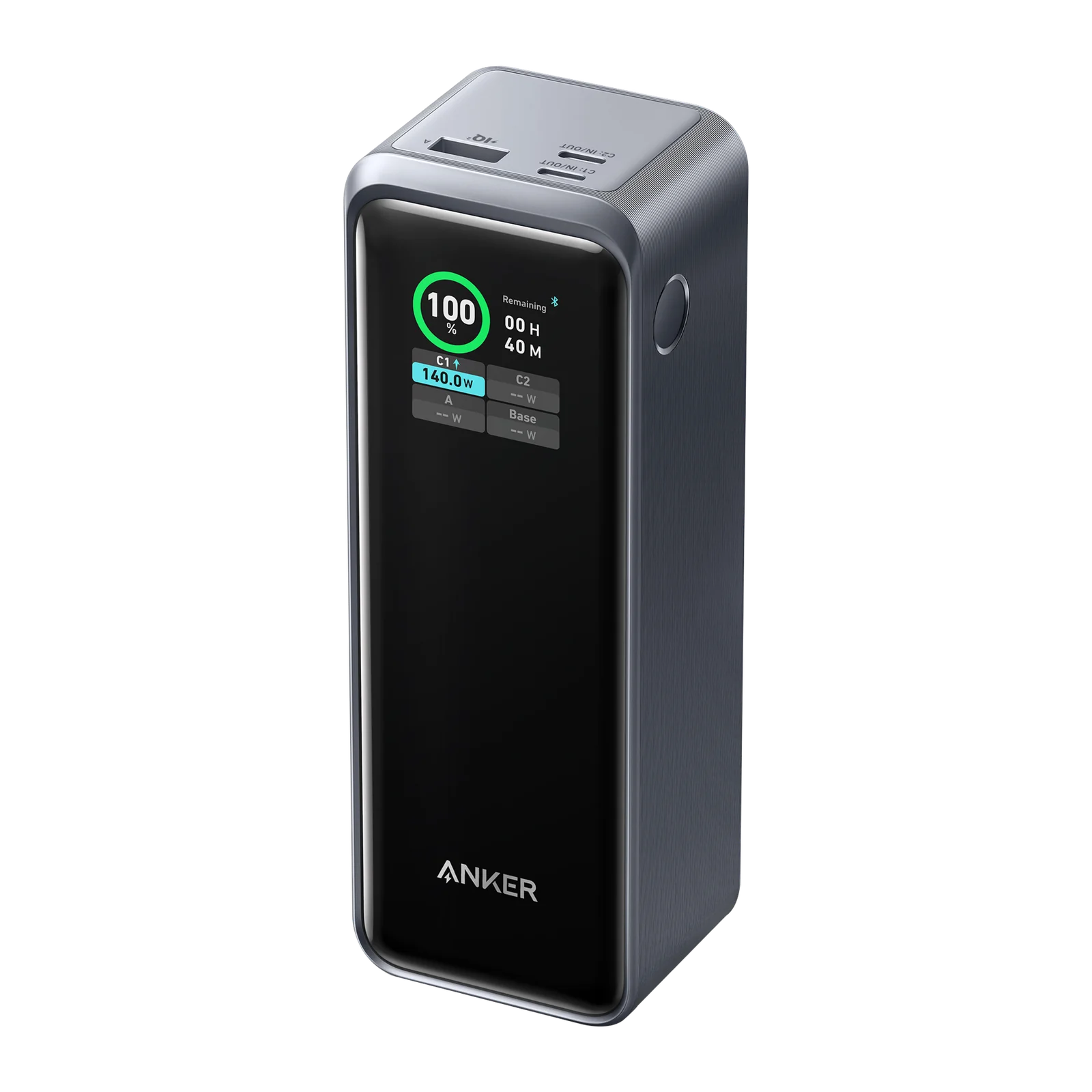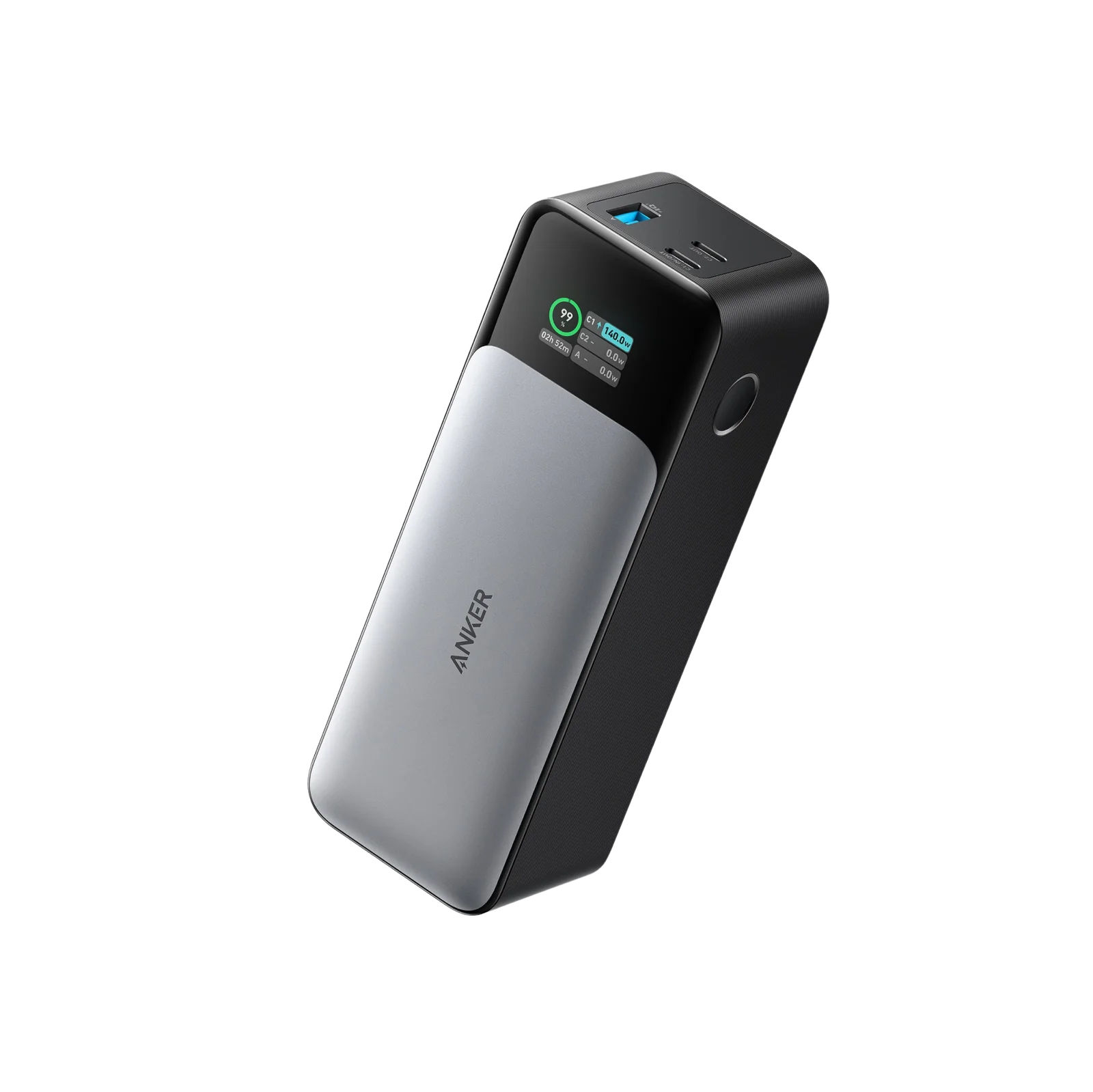
Anker 737 Power Bank
By Anker · Power Banks · Audio & Electronics · More from Anker
- 24,000mAh capacity
- 140W max output
- 2x USB-C ports, 1x USB-A port
- 6.13 x 2.15 x 1.95 inches
- 22.22 oz (630g)
Lowest price seen
~$109.99 (approx.)
from $109.99 at Amazon
- Amazon ~$109.99 (approx.)View at Amazon
- AnkerView at Anker
- eBay (used) eBay: used, open-box, refurbishedView at eBay (used)
- eBayView at eBay
Prices are snapshots. Check the current price with the store.
Summary
A 24,000mAh (86.4Wh) USB-C battery that can push up to 140W into a single PD3.1 laptop and shows live watts, remaining charge and cycle count on a color screen. Check your laptop and cable really support 28V/5A before buying: 140W needs USB Power Delivery 3.1, and a 100W cable or a 20V-only laptop will negotiate less.
Strengths
- TechRadar measured 70.5–77.1Wh of usable output, most of the 86.4Wh rating.
- It held stable voltage driving a 140W (28V/5A) load in testing.
- The color screen shows watts by port, time remaining, cycles and health.
- It recharges itself in about an hour on a 140W PD3.1 charger.
- A 2022 teardown found proper protection circuitry and a USB PD controller.
- One long-term owner reported 113 cycles and 90% screen-reported health.
Weaknesses
- Heavy at about 630g and 6.13in long; this is a bag battery, not a pocket one.
- All ports share one 140W ceiling, so three devices do not get 140W each.
- The always-on screen draws about 0.36W, which Anker says can drain roughly 15% of the pack a day.
- It is not a UPS: passthrough is limited and there is no guaranteed transfer mode.
- Owners report undervoltage shutdowns, battery-health display drops and a black-screen no-output fault.
- No owner-replaceable battery and no published replacement part or price.
Verified specifications
| Capacity | 24,000mAh from six internal 4,000mAh cells, rated 86.4Wh at a 3.6V nominal basis. |
|---|---|
| Ports | USB-C1 bidirectional input/output, USB-C2 output only, USB-A output only. |
| USB-C output | 5V/3A, 9V/3A, 15V/3A, 20V/5A, 28V/5A, up to 140W on one port with a PD3.1 source and cable. |
| USB-A output | 5V/3A, 9V/2A or 12V/1.5A, max 18W. |
| Total output | all ports combined are capped at 140W, not 140W per port; USB-C1 input is up to 140W. |
| Recharge time | about an hour at 140W, or 1.5–2 hours from a suitable 96W PD charger. |
| Display | real-time watts by port, remaining percent, estimated time remaining, charge cycles and a battery-health estimate. |
| Dimensions | 6.13 × 2.15 × 1.95 in (155.8 × 54.5 × 48.8 mm); about 630g (22.22 oz). |
| Travel | 86.4Wh sits under the 100Wh US carry-on spare-battery limit, and power banks are carry-on only. |
| In the box | one 0.6m USB-A-to-USB-C cable and a manual; no wall charger. |
| Cells | a teardown found six Lishen LR2170LA 21700 cells; the pack is not user-swappable. |
| Warranty | 24 months for the A1289. |
Full research notes and sources
Power and ports
Both USB-C ports carry the same 5V/3A, 9V/3A, 15V/3A, 20V/5A and 28V/5A profiles, and either can hit 140W on its own with a PD3.1 source and a 5A EPR cable. The catch is the shared ceiling: every port together is capped at 140W, so adding a second device splits the power and a 140W laptop can briefly drop as the split changes. USB-A is limited to 18W.
A 100W cable or a 20V-only laptop negotiates less than 140W, and Anker’s own FAQ excludes some Lenovo Legion 140W laptops and DJI Mini Pro variants. One owner reported only about 50W of recharge from a high-power wall charger with a third-party cable, then about 92.6W once they used the original short charging cable. Match the cable to the job before blaming the pack.
Running costs and upkeep
Electricity is the only routine cost. A full pack is 86.4Wh; one recharge a week is about 5.62kWh a year at the wall, roughly $1.40 a year at $0.25/kWh, and a daily recharge is about $9.86 a year. To charge at 140W you need a PD3.1 wall charger, which Anker sells as the A2697 140W four-port unit for $89.99, and a 240W/5A EPR USB-C cable, which Best Buy listed at $24.99 for an Apple 240W cable. The included cable is only USB-A-to-USB-C and cannot deliver 140W.
The battery is sealed. There is no owner-replaceable cell, no published replacement price and no service interval, so internal work means opening a protected multi-cell pack and risking the warranty. Recycle a depleted or swollen unit rather than shipping it as ordinary luggage.
Owner reports and failures
Owner reports are mixed. One r/anker owner in October 2025 described a unit shutting off at an indicated 30–35%, and an April 2024 thread described reported battery health dropping from 100% to 5%. A 2023 owner had a black screen and no output even at 98–100% indicated charge, and a USB-C1-to-C2 reset did not fix it.
Others report a 2021 Asus ROG Strix laptop cycling between battery and PD with the 737, even though a different PD wall charger worked. A June 2026 owner reported 113 cycles and 90% health after heavy screen use, so long service is possible too. Nobody has published a failure rate, so treat these as known possibilities rather than a defect you should expect.
What it costs and alternatives
Anker’s own store and Best Buy both listed the black A1289 at $109.99 in October 2026, and Best Buy’s Open-Box Excellent example was $76.99. If you need more ports, the Anker A1695 25K 165W is $119.99 with two built-in cables, though each USB-C tops out at 100W, so it gives up the 737’s single-port 140W. A phone-first buyer can spend $49.99 on a 20,000mAh 30W Anker bank at Best Buy.
Which model this is
This page covers the Anker 737 Power Bank (PowerCore 24K), product family A1289; Best Buy’s US black variant is A1289011, SKU 6553403, and a refreshed manual calls it the Anker Power Bank (24K, 140W). Don’t confuse it with the 737 GaNPrime wall charger, the Prime 20K 200W, the newer Prime 24K, or the A1695 25K 165W with built-in cables.
Sources
Manufacturer:
- Anker 737 Power Bank (PowerCore 24K)
- Anker support: introduction to the 737 Power Bank 24K (A1289)
- Anker support: A1289 specifications and manuals
- Anker user guide for the A1289
- Anker refund and warranty policy
- Anker product recall list
- Anker 140W 4-port charger (A2697)
- Anker A1695 25K 165W power bank
Independent reviews:
- TechRadar review: measured capacity, charge rates and port generations
- US Best Batteries review with a high-power protocol caveat
- ChargerLAB teardown of the 737 PowerCore 24K
- FAA PackSafe: lithium power banks
Owner reports:
- Undervoltage shutdown around 30–35% (r/anker)
- Battery health display collapse and support replies (r/anker)
- Black screen and no output at 98% charge (r/anker)
- ROG Strix laptop PD cycling (r/anker)
- Recharge bottleneck solved with a better cable (r/anker)
- Used 737 cycle, health and screen-use stats (r/anker)
- Real-world charge count on a modern phone (r/powerbanks)
Parts and stores: