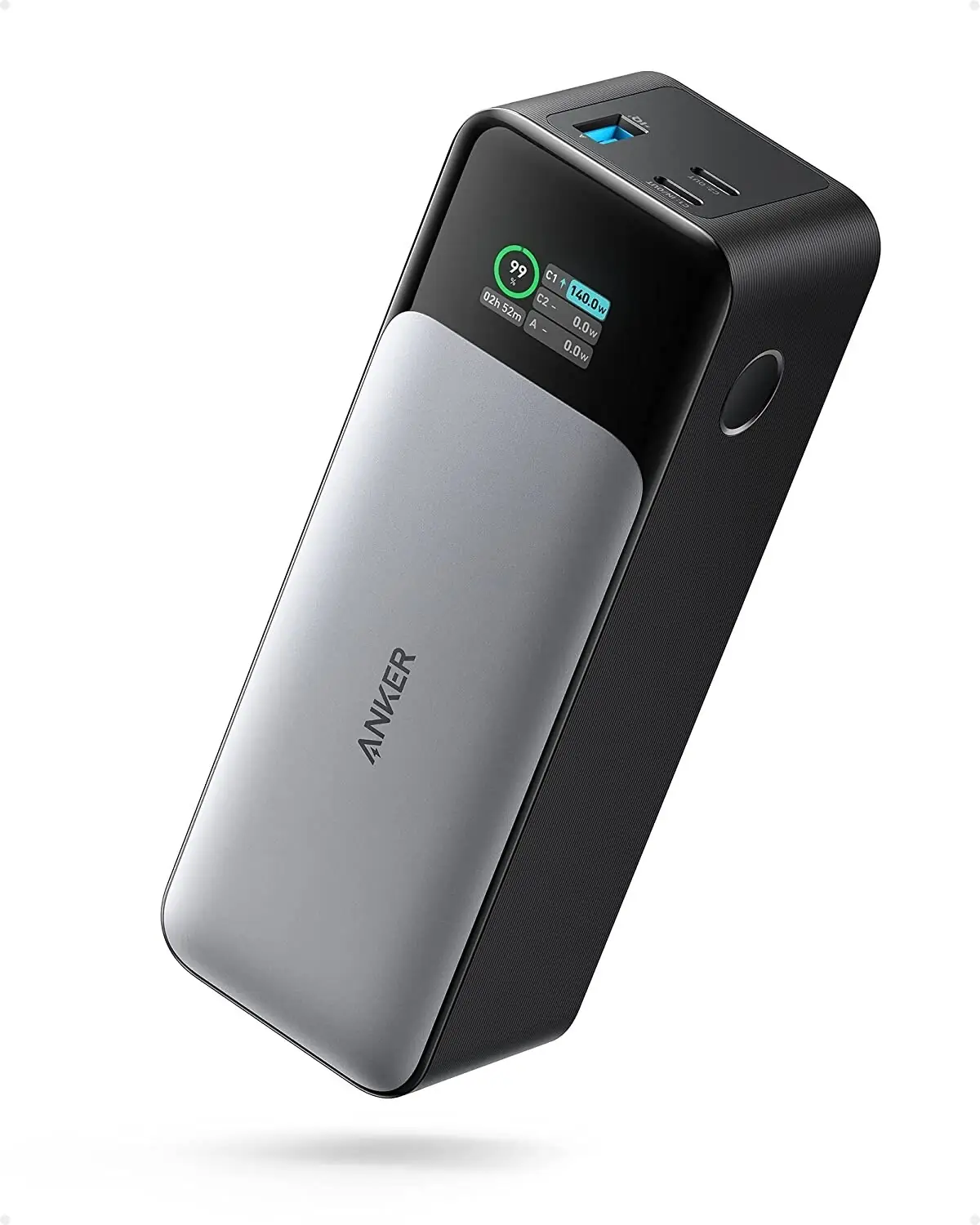
Anker 737 Power Bank (PowerCore 24K)
By Anker · Power Banks · Audio & Electronics · More from Anker
- 24,000mAh (86.4Wh) capacity
- 140W max output
- 2x USB-C + 1x USB-A ports
- 6.13 x 2.15 x 1.95 in dimensions
- 22.22 oz (630 g) weight
Price not listed
- AnkerView at Anker
- eBayView at eBay
- AmazonView at Amazon (paid link)
- eBay (used) eBay: used, open-box, refurbishedView at eBay (used)
Stores are listed in a fixed order, never by price or commission. Prices are snapshots. Check the current price with the store.
Summary
A 24,000 mAh / 86.4 Wh laptop power bank that can genuinely charge a laptop at up to 140 W, with a colour display that shows per-port wattage and battery health. The catch is bulk: about 630 g and a thick chocolate-bar body, and only one USB-C port recharges the unit.
Strengths
- The colour display shows per-port wattage, battery health, temperature and cycle count, a real diagnostic rather than a gimmick.
- Self-recharge is fast for a bank this size: about 1 h 49 min in CHIP’s test.
- CHIP measured 20,307 mAh / 73.1 Wh usable and rated the unit 2nd of 28 power banks.
- A 24-month warranty is longer than most power banks carry.
Weaknesses
- Large and heavy: about 630 g and a thick chocolate-bar body, so it is a bag bank, not a pocket one.
- Only USB-C1 recharges the unit; USB-C2 and USB-A are output-only, and the labels are printed black-on-black.
- 140 W is the total maximum, so with both USB-C ports in use the power is split, not delivered to each.
- Pass-through works only over USB-C and USB-A will not output during it; there is no UPS mode.
- Anker’s always-on display costs 0.36 W and drains about 15% of the battery in roughly 24 h.
- A handful of single-case reports describe dead units or screen and wattage glitches, though the sample is too small to estimate a failure rate.
Verified specifications
| Model | A1289, sold as Anker 737 Power Bank (PowerCore 24K); US listing variant ASIN B0BYSRY6CZ. |
|---|---|
| Capacity | 24,000 mAh nominal; 86.4 Wh rated. |
| Measured usable capacity | 20,307 mAh / 73.1 Wh (CHIP Testcenter, 2023). |
| Total output | 140 W maximum, split across ports, not per port. |
| Ports | 2x USB-C plus 1x USB-A; one USB-C is input/output, the other output-only. |
| USB-C output | 5 V⎓3 A / 9 V⎓3 A / 15 V⎓3 A / 20 V⎓5 A / 28 V⎓5 A. |
| USB-A output | 5 V⎓3 A / 9 V⎓2 A / 12 V⎓1.5 A (18 W maximum). |
| Input | USB-C1 up to 28 V⎓5 A (140 W). |
| Display | colour screen showing remaining capacity, per-port wattage, battery health, temperature, cycle count and estimated charge time. |
| Low-current mode | yes, by double-pressing the power button. |
| Recharge time | about 1 h 49 min in CHIP’s test; Anker claims under an hour with a 140 W PD charger; about 1.5 h at 100 W. |
| Pass-through | yes, USB-C only, up to about 90 W; no UPS mode. |
| Wireless charging, MagSafe, solar, Lightning input and Quick Charge: no. | |
| Dimensions | 6.13 × 2.15 × 1.95 in (155.7 × 54.6 × 49.5 mm); 22.22 oz (630 g). |
| Warranty | 24 months. |
| Box contents vary by seller | Anker’s store copy lists a 140 W USB-C-to-C cable and a carry pouch, while its support page lists a short USB-A-to-C cable. No mains charger is included. |
Full research notes and sources
Power, ports and the display
140 W is the system maximum, not per port. With both USB-C ports in use Anker divides the output and cannot deliver 140 W to each; TechRadar measured about 140 W on the main USB-C and up to 100 W on the second. Only USB-C1 recharges the bank, and USB-C2 and the USB-A port are output-only. When the 18 W USB-A port is in use, USB-C total output drops to 100 W.
Pass-through charging works only over USB-C, up to about 90 W, and USB-A will not output while pass-through is active; there is no UPS mode. Gadgetoid observed that reconnecting the upstream power briefly interrupts the downstream supply. One owner reports that pass-through power bypasses the battery and the bank does not speed up its own charging once connected devices reduce their draw. To reach 140 W you need a PD 3.1 cable and a device that accepts PD 3.1 input, such as a 2021 MacBook Pro 16.
The colour screen is the most praised feature: it shows remaining capacity, per-port wattage, battery health, temperature and cycle count. TechRadar and Gadgetoid both call it a genuine diagnostic rather than a gimmick. Anker’s FAQ says the always-on display consumes 0.36 W and drains about 15% of the battery in about 24 h, so turn it off if you want every watt.
Size, weight and the box
Every source describes the 737 as large and heavy: about 630 g and roughly 156 × 55 × 50 mm, shaped like a thick chocolate bar. Box contents vary by seller. Anker’s store copy lists a 140 W USB-C-to-C cable and a carry pouch; its support page lists a short USB-A-to-C cable instead. No mains charger is included, so a sufficiently powerful USB-C PD charger (Anker recommends at least 87-100 W, ideally 140 W) is an extra cost.
Reliability and warranty
Anker’s troubleshooting page treats screen glitches, units switching off at certain charge levels and “dead when unplugged” as behaviours you should reset before declaring the unit defective. The reset is to plug both ends of a cable into the input and output ports for 3-5 seconds until the percentage reappears, then recharge and discharge again. Anker also says the screen can under-report wattage while the unit still charges at full speed.
No official user-serviceable parts exist for the A1289, so repair runs through Anker’s warranty or an RMA rather than owner-replaceable parts. The stated warranty is 24 months, with US support at 1-800-988-7973, Monday to Friday, 6 AM to 5 PM PT, plus support@anker.com.
Reliability signals are thin but not reassuring. A BleepingComputer forum thread and a YouTube repair video report dead battery cells and balancing failures, and a Reddit thread titled “So basically Anker 737 Power Bank is garbage” exists, though its excerpted text also carries positive owner comments. These are single cases and do not support a failure-rate estimate.
Is it worth it?
The honest framing is to pay for the 140 W output, the display and the 24-month warranty, and to accept the bulk and the pass-through limits. Anker’s US store lists the 737 at $109.99 (October 2026), with a bulk price of $94.99 each for ten or more. TechRadar lists a $149 list price and says the unit is often discounted by up to 30%.
At or below about $80 the 737 is strong value for a laptop-capable bank; roughly $81-110 is a fair-to-good band if you actually need 100 W or more and want the display; $111-130 is weak-to-fair unless a strong coupon applies; above about $130 it is poor value against newer 250 W alternatives. Wirecutter’s 2026 laptop-bank guide does not recommend the 737, though it falls within its stated criteria. The decision driver is not the 24,000 mAh number but the combination of 140 W output, the display, fast self-recharge and the warranty at a discounted price.
Which model this is
This page covers the Anker 737 Power Bank, model A1289, sold as PowerCore 24K, with 24,000 mAh / 86.4 Wh and 140 W output. The US listing variant is ASIN B0BYSRY6CZ; older coverage references B09VPHVT2Z, also an A1289 listing, and no page ties the two to distinct hardware revisions. TechRadar distinguishes a Gen 1 unit that does not output 12 V from the USB-C ports and a Gen 2 unit upgraded with 12 V/3 A, while Anker’s current US page advertises 12 V only on the USB-A port, so the generation of this listing is unconfirmed.
Do not merge it with the newer Anker Prime 27,650 mAh (A1340), the Anker 733 (PowerCore 65 W) or the PowerCore 26K-for-laptop model. Anker has also begun rebranding the 737 as “Anker Power Bank (24K, 140W)” in some non-US storefront copy.
Sources
Manufacturer:
- Anker 737 Power Bank (PowerCore 24K) — Anker US product page
- Anker 737 support product description and manuals
- Introduction to the Anker 737 Power Bank 24K (A1289)
- Anker 737 common problems and troubleshooting
- Anker 737 special issues and troubleshooting FAQs
- Anker 737 Power Bank (24,000mAh, 140W, 3-Port) — Anker NZ
- Anker 737 Power Bank (PowerCore 24K) — Abt
- Common issues and troubleshooting for PowerCore
- Portable power banks — Anker US collection
Independent reviews:
Owner reports: