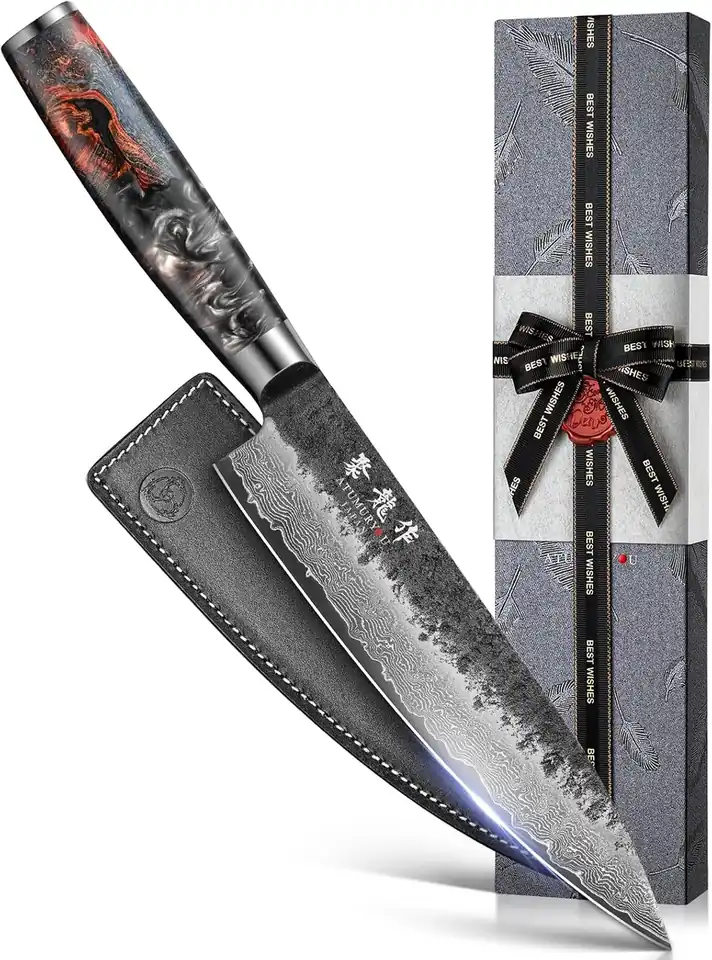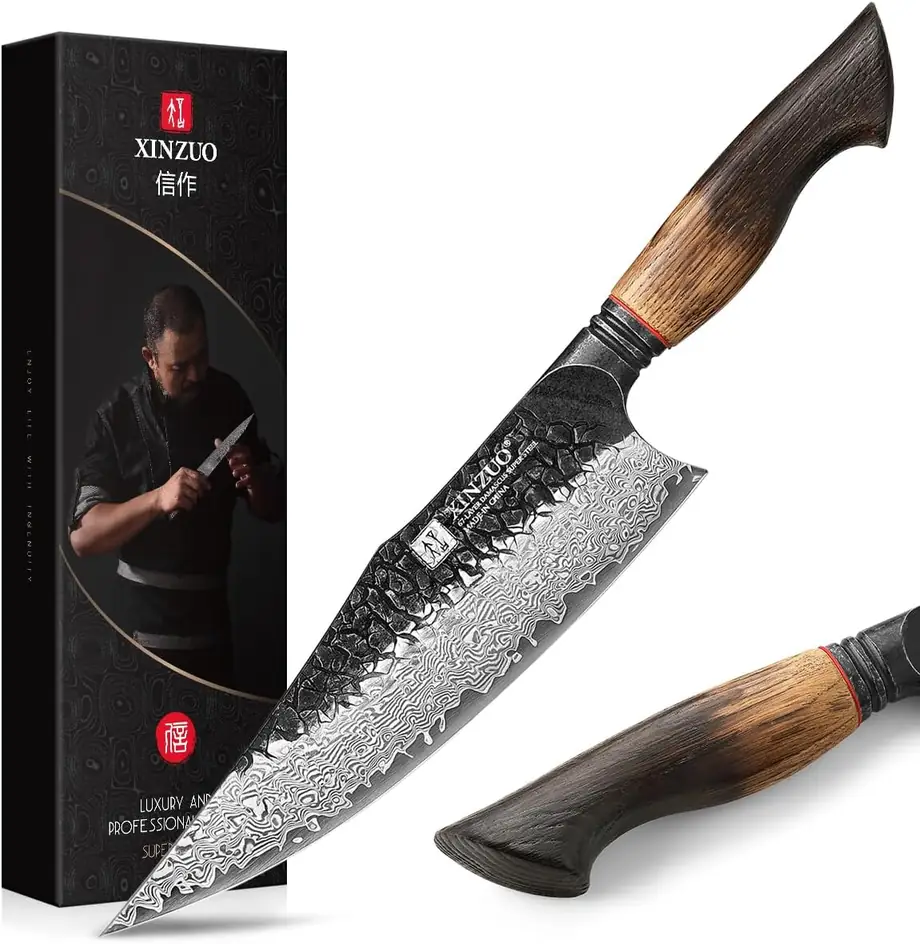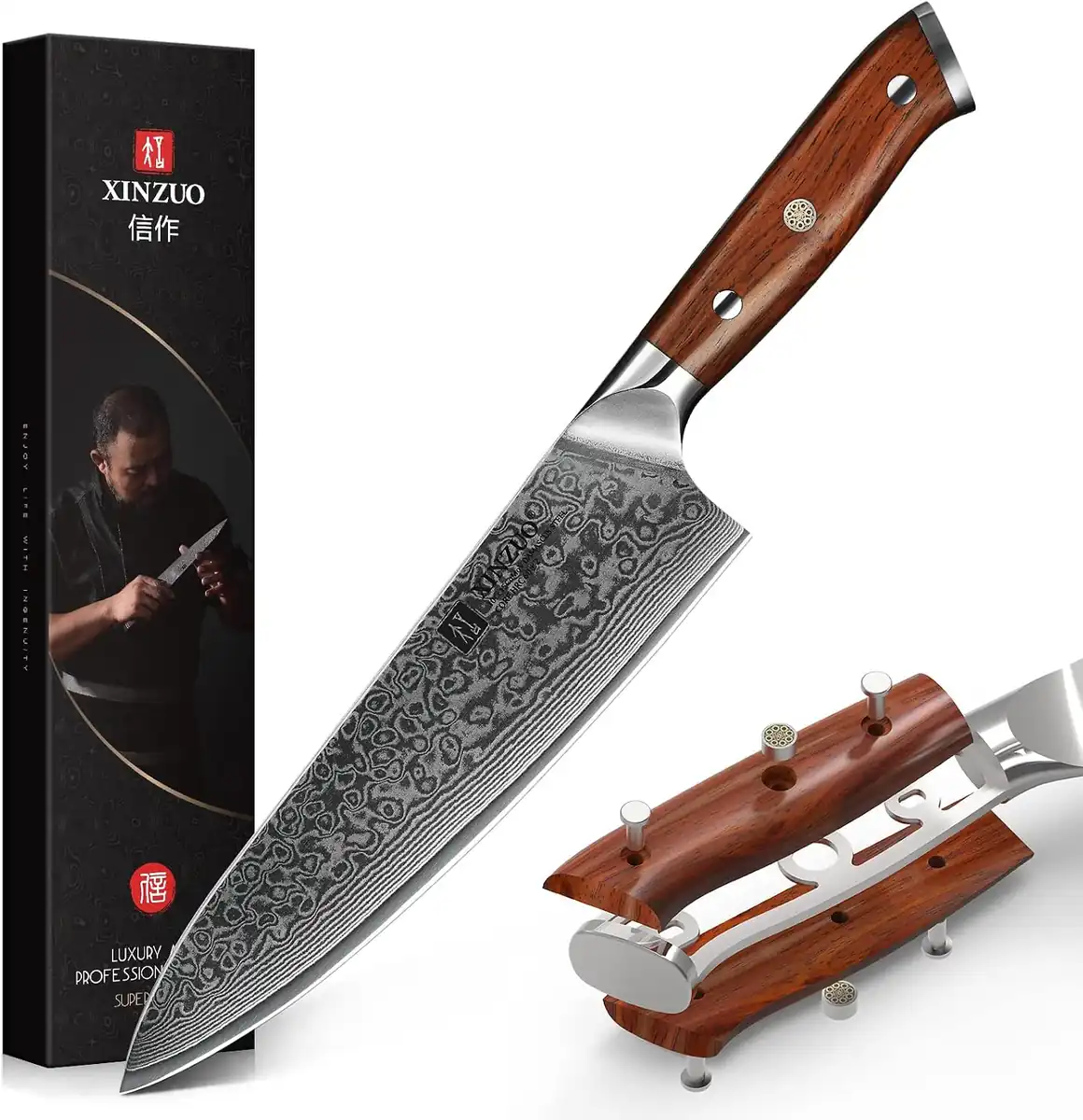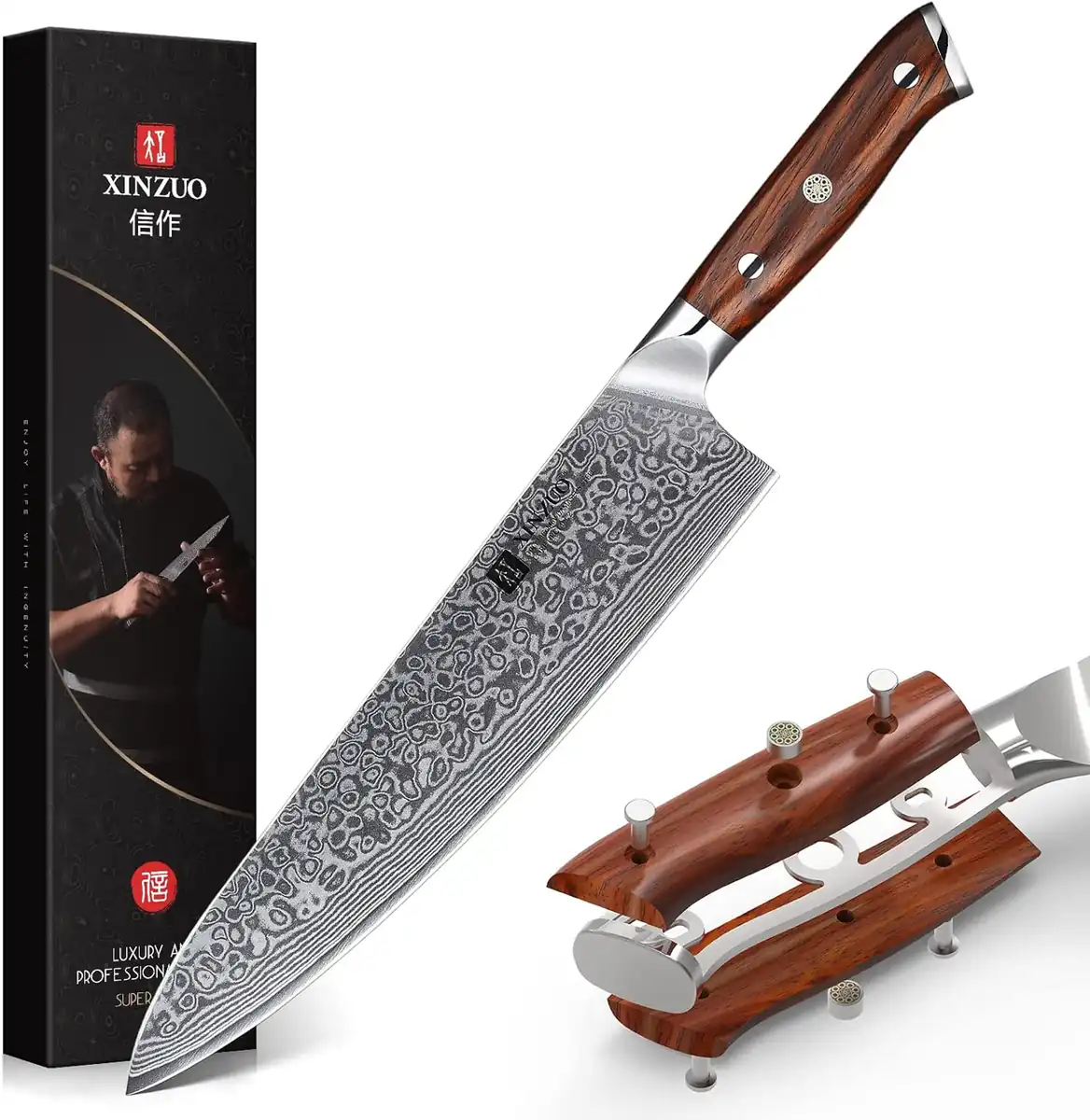
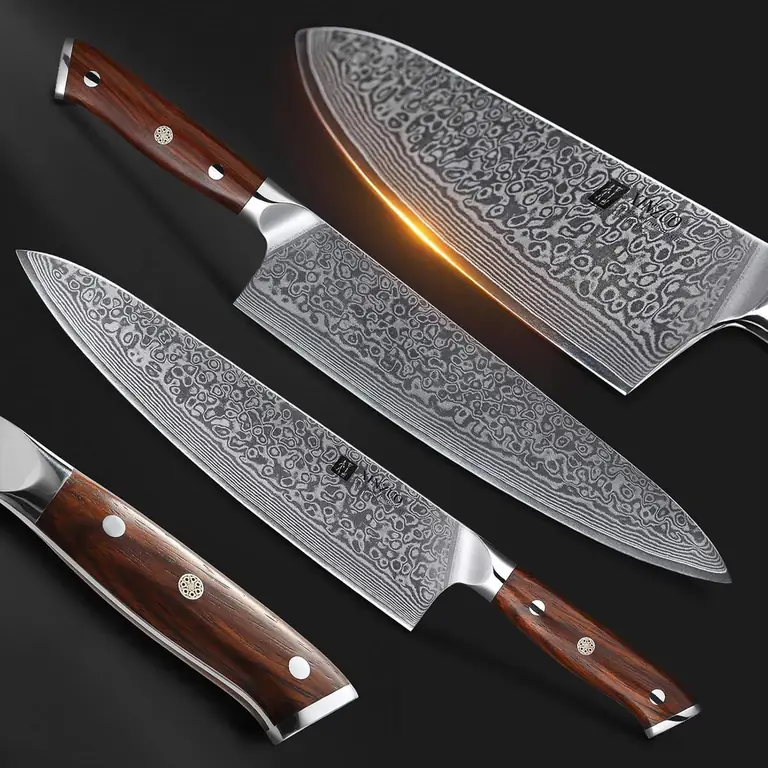
10 Inch Damascus Chef Knife Kitchen Knife Sharp Gyuto Knife Stainless Steel Fashion Professional Chef's Knife with Rosewood Handle
By 10 · Kitchen Knives · Kitchen & Cooking
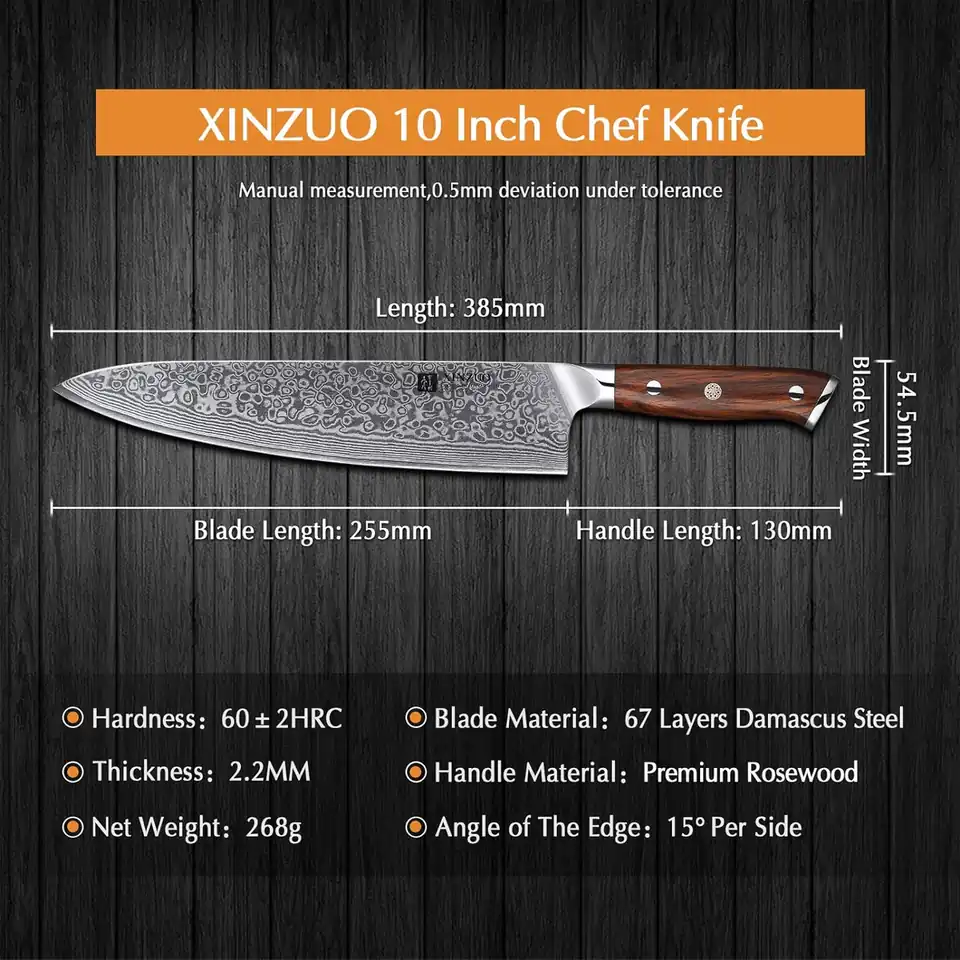
- 67-layer Damascus steel with 10Cr15CoMoV core
- 60±2 HRC core hardness
- 15°±1 per side edge angle
- Nature Rose wood handle
- 10 inch (254 mm) blade length
Price not listed
- 10View at 10
- eBay (used) eBay: used, open-box, refurbishedView at eBay (used)
- eBayView at eBay
- AmazonView at Amazon (paid link)
Stores are listed in a fixed order, never by price or commission. Prices are snapshots. Check the current price with the store.
Summary
A 10-inch Damascus gyuto sold under the white-label brand “10”, built around a 10Cr15CoMoV core steel that is real and documented. There is no maker page, independent test, owner discussion or warranty behind this exact listing, so check the price against the commodity class — and treat every spec as a seller claim — before you buy.
Strengths
- The core steel is genuine: 10Cr15CoMoV is a documented composition, not a marketing invention.
- Community consensus puts properly hardened examples around 440C level, with edge retention most users rate above 9Cr18MoV.
- It sharpens easily on common water stones and ceramics, and responds quickly on a standard whetstone.
- One BladeForums member in 2018 reported a cheap knife in this steel holding up “perfectly fine. About what I expect out of 440C”.
- The listed 60±2 HRC and 15°±1 per-side specs sit inside the documented ranges for this steel.
Weaknesses
- No maker page, warranty terms or service channel exists for brand “10”; this is a 2017-era white-label listing.
- No independent test, reviewer coverage or owner discussion of this exact knife could be found, so none of its specs are externally confirmed.
- Heat treatment is the dominant risk: skipping double tempering is a common cost-cutting shortcut in this steel class, and cheap examples can chip or roll the edge.
- An under-treated blade of the same steel may measure 4–6 HRC points lower and lose its edge in half the cutting cycles.
- The 6.0–8.0 N cutting force figure has no published test method and should be ignored.
- The 67-layer pattern has not been verified as genuine layered cladding rather than an etched surface, and layer count does not make a sharper knife.
Verified specifications
| Core steel | 10Cr15CoMoV, a documented Chinese stainless widely treated as the compositional analog of Japanese VG-10. |
|---|---|
| Composition | C 0.95–1.05%, Cr 14.50–15.50%, Co 1.30–1.80%, Mo 0.80–1.20%, V 0.25–0.35%, Mn 0.30–0.50%. |
| Hardness | 59–62 HRC documented when properly heat treated; the listing’s 60±2 HRC is consistent with that range but unverified for this unit. |
| Edge angle | 15–18° per side is the documented sharpening range for this steel; the listing claims 15°±1 per side. |
| Damascus construction | 67 layers as listed; layer count describes appearance, not sharpness. |
| Cutting force | 6.0–8.0 N as listed, with no published test method. |
| Blade length | 10 in (254 mm) as listed. |
| Handle | rosewood (“Nature Rose wood” on the listing). |
| Weight, blade stock thickness, tang construction and box contents: not published for this listing. | |
Full research notes and sources
The steel
10Cr15CoMoV is a real, documented Chinese stainless: about 1.05% carbon, 15% chromium, 1.5% cobalt, 1.2% molybdenum and 0.3% vanadium. Steel sources widely describe it as the compositional analog of Japanese VG-10, heat-treatable to 59–62 HRC, and one BladeForums member summed it up in 2017: “in my experience it behaves like VG-10”. Community sentiment on Chinese steel spans “underrated decent to high quality” (2022 BladeForums) to “ad department making up their new proprietary steel for marketing reasons” (2017 BladeForums). The honest read is that the chemistry is legitimate and the maker’s execution is the variable.
Heat treatment and quality control
This exact knife has no verifiable maker and no test history, so its steel specs cannot be confirmed for the unit in your hands. What the sources document is the failure mode: heat treatment, not chemistry, decides the outcome. An industry source states bluntly that two blades from identical 10Cr15CoMoV stock can perform completely differently depending on how they were heat treated, and that skipping double tempering is a common cost-cutting shortcut that leads to chipping or edge rolling. For a no-name white-label knife of this type, undertreated steel and inconsistent QC are the realistic failure modes. Nobody has published a failure rate, so treat early chipping or a rolling edge as the known risk rather than a measured defect.
Care, sharpening and running costs
Maintenance is that of any fixed-blade kitchen knife. Wash and dry the blade thoroughly after use and store it dry; the steel is stainless but not immune to rust without basic care. Avoid heavy chopping, prying or batoning, which risk chipping at 60 HRC-class hardness. Sharpen at the documented 15–18° per side on common water stones or ceramics. Running costs are a whetstone or ceramic rod plus a magnetic strip or sheath for storage; there are no consumables. One supplier publishes steel-class figures — roughly 800–1,000 CATRA sisal-rope cuts, 25–30 J/cm² impact toughness and 72 h salt spray with no surface rust — which say something about the steel, not about this knife. A 10-inch blade also needs more board space than the more common 8-inch class.
Is it worth it?
Cost context sets the bar. An industry source puts Yangjiang OEM FOB pricing for a 67-layer Damascus-clad 8-inch chef knife of this class at $14–30 per piece (MOQ 300–1,000), so most of whatever this knife sells for is margin and shipping, not materials. Community guidance from the 2017 BladeForums thread is blunt: members advised paying no more than $10–15 for unverifiable steel claims. The value thresholds for this commodity class: under about $20 is a plausible buy when you accept unverifiable specs and unknown heat treatment; $20–35 is the normal band, worth it only when no branded 8-inch 10Cr15CoMoV gyuto sits near the same price; above roughly $35–40, knives from Civivi, Kizer and Xinzuo in the same core steel are the safer purchase because they carry documented QC and warranty channels. At a deep commodity discount this white-label gyuto is a legitimate way to get documented VG-10-analog steel; treat it as a sharpen-and-learn tool, verify the edge geometry yourself, and don’t trust the cutting-force figure.
Which model this is
This page covers the 10-inch Damascus gyuto listed on Amazon under brand “10”: 67-layer Damascus cladding over a 10Cr15CoMoV core, rosewood handle, listed at 60±2 HRC and a 15°±1 per-side edge. The listing dates from the 2017 era of white-label Amazon gyuto knives, and the brand has no site, no manual and no warranty channel. The Amazon listing is ASIN B0736T2MWZ. Do not merge it with branded 10Cr15CoMoV gyutos (Civivi, Kizer, Xinzuo, Hezhen), which have their own QC and warranty channels.
Sources
Manufacturer:
- No manufacturer page, brand site, revision history or user manual was found for brand “10”.
Independent reviews:
- No independent review of this exact listing exists; the sources below document the steel class, not this knife.
Steel-level sources:
Owner reports: