Home & Workspace
Standing Desks
9 standing desks compared side by side — specs, features and trade-offs, with current commerce details checked at the retailer.

Choose by what matters
Jump straight to what fits your situation — use-case chips point to products that match those features. Price/rating leader chips stay off until approved API data is available.
Every product we track
FlexiSpot E7 Pro Electric Standing Desk
 VIVO Electric 60 x 24 in Standing Desk (1B Series)
 SHW 55 x 28 in Electric Standing Desk with Drawer
 FlexiSpot EN1 One-Piece Standing Desk
 FEZIBO L-Shaped Electric Standing Desk with Drawers
 ErGear 48x24 Electric Standing Desk
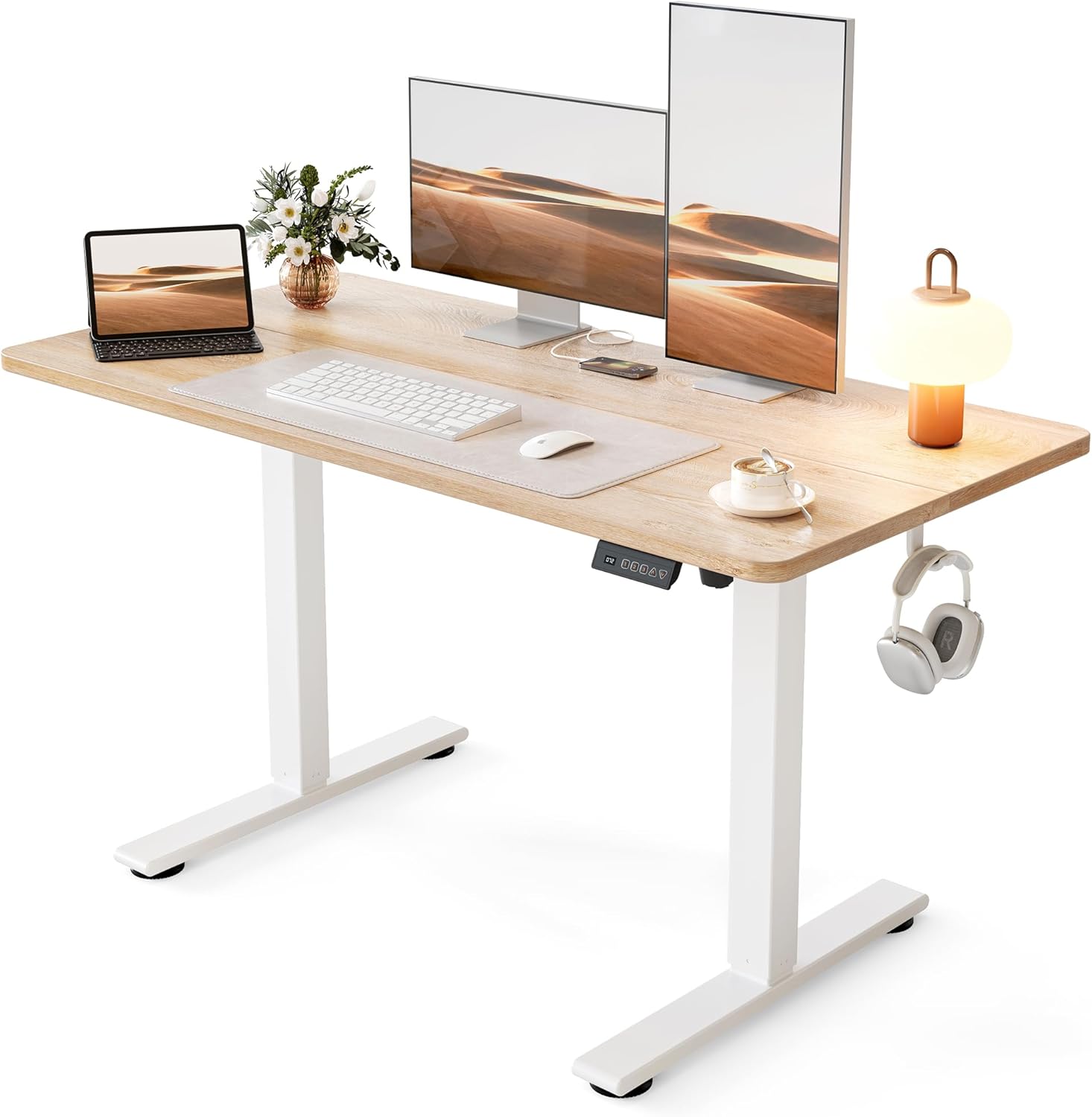 Cubiker 48x24 Electric Standing Desk
 Huuger 47x24 Electric Standing Desk with Outlets
 FEZIBO Standing Desk 48 x 24 Inch Electric Height Adjustable
Tap a product to jump to its breakdown — specs and honest pros/cons. Verify current price and retailer rating at the retailer.
Buying guides for this category
Frequently asked questions
How much weight can an electric standing desk actually support in real use?
The rated capacity, commonly 220-355 lbs across this category, applies to the desk fully raised and evenly loaded -- real-world safe practice is to load well under that max, especially at full height, since lifting mechanisms are more strained at the top of their travel. Concentrate heavier items like monitors and PC towers toward the center or back rather than the front edge.
Do you need an anti-collision sensor, or is it just a nice-to-have?
It's a genuine safety and practicality feature, not just marketing -- it stops the desk automatically if it hits an obstruction, like a chair, a drawer, or your knee, while raising or lowering, rather than continuing to push against it. Worth prioritizing if the desk will be adjusted often around furniture or in a shared space.
Single motor vs dual motor: does it really matter for a home office?
Dual-motor desks lift faster and stay more stable and level under uneven or heavy loads, like a corner-heavy dual-monitor setup, while single-motor desks are cheaper and perfectly adequate for lighter, evenly-distributed setups. If you have a heavy loadout or adjust height frequently through the day, dual-motor is the more noticeable upgrade; for a laptop and one monitor, single motor is fine.
How often should you actually alternate between sitting and standing?
Common ergonomic guidance suggests standing for roughly 15-30 minutes per hour, or shifting position every 30-60 minutes -- there's no single universal rule, and the bigger benefit shown in research is simply not staying in one position, sitting or standing, for hours at a stretch.
Can an electric standing desk go low enough for a fully ergonomic seated position too?
Most electric standing desks have a minimum height around 22-28 inches, which covers proper seated ergonomic height, roughly 28-30 inches including your chair, for the large majority of adult users. Check a specific model's stated height range against your own seated elbow height if you're notably short or tall.