Portable Power Stations
Portable Power Stations: A Side-by-Side Look
Compare 3 portable power stations side by side: Jackery Explorer 1000 v2, Anker SOLIX S2000 and EcoFlow DELTA 3 Plus — pros, cons, specs, and retailer links…
How we picked these products
We compare product identity, specifications, pros/cons and retailer links. Until approved retailer API access is available, current Amazon price, star-rating and review-count data are not republished here.
Choose by what matters
Jump straight to what fits your situation — use-case chips point to products that match those features. Price/rating leader chips stay off until approved API data is available.
We don't crown a single "best" pick — this table lays out what's factually true about each option, side by side.
| Product | Check current price |
|---|---|
| Jackery Explorer 1000 v2 | Check current price(paid link) |
| Anker SOLIX S2000 | Check current price(paid link) |
| EcoFlow DELTA 3 Plus | Check current price |
Portable power stations are sized in watt-hours, and the 3 units here bracket the two classes most buyers land in: about 1 kWh (Jackery Explorer 1000 v2, EcoFlow DELTA 3 Plus) and a 2 kWh step-up (Anker SOLIX S2000). Output ratings, recharge speed and whether the battery can grow later separate them more than raw capacity does. Solar panels are typically a separate purchase, so factor them into the real-world total.
Jackery Explorer 1000 v2

Specs & pros/cons
Key specs:
- 1,070Wh LiFePO4 battery, rated 4,000+ cycles to 70% capacity
- 1,500W continuous output / 3,000W surge
- 1-hour fast AC charge; 100W USB-C output
- Weighs 24 lbs
- ChargeShield 2.0 safety system, UL2743 certified
Pros:
- Fastest full recharge time of the three (about 1 hour via AC)
- Lightest weight among the three for its capacity class
- Widest retail availability (Amazon, Jackery direct, multiple resellers)
Cons:
- Lowest capacity of the three power stations here
- Lower continuous output than the Anker SOLIX in surge scenarios
- Solar panels sold separately, adding to real-world cost
Short version: The Explorer 1000 v2 is a compact 1.07 kWh LiFePO4 portable power station built around portability and simplicity rather than maximum inverter or solar-input performance. Jackery specifies 1,070 Wh, 1,500 W continuous / 3,000 W surge AC output, 400 W maximum solar input, three AC outlets, two USB-C outputs (100 W + 30 W), one 18 W USB-A and a 12 V/10 A car port.
Anker SOLIX S2000
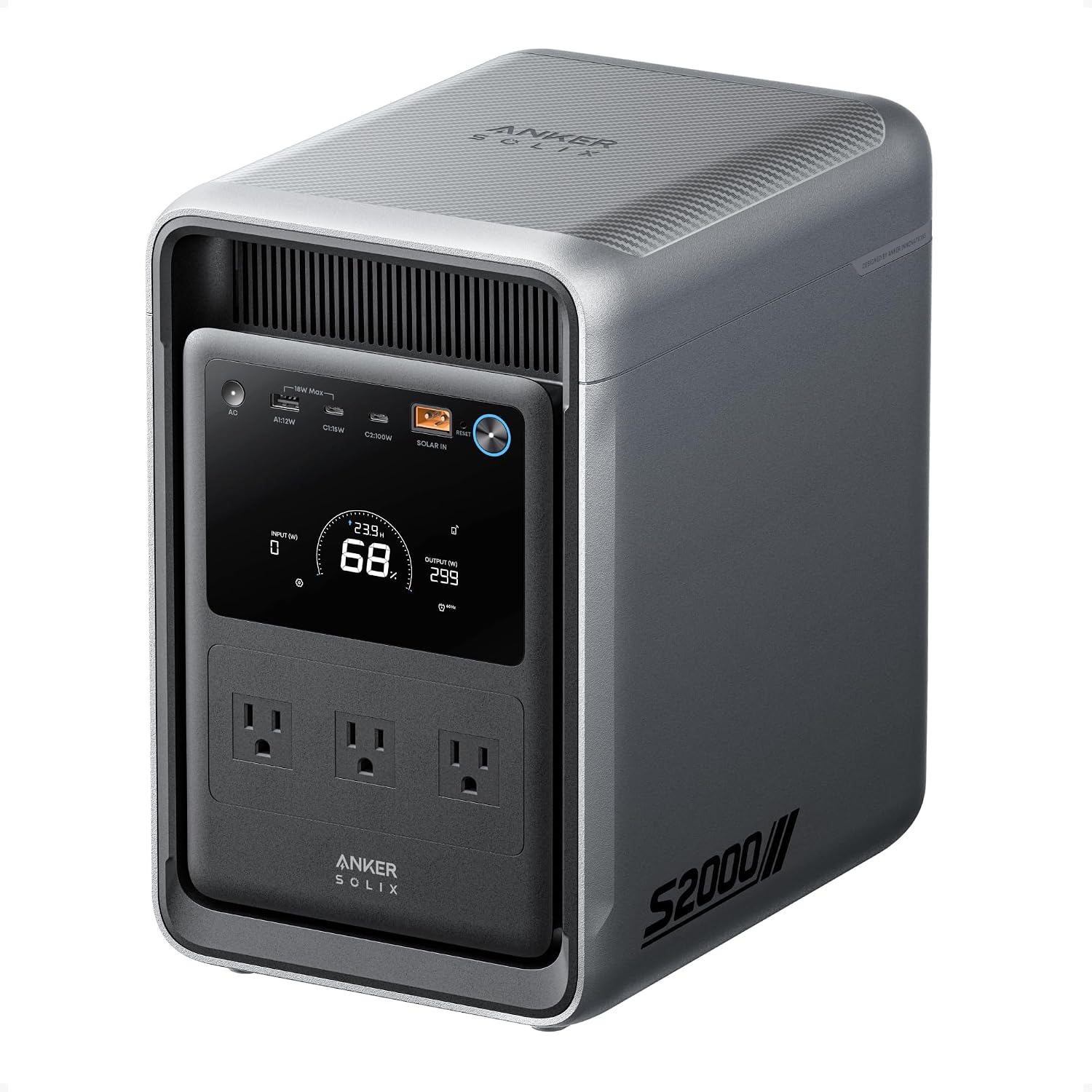
Specs & pros/cons
Key specs:
- 2,010Wh LFP battery, 10,000-cycle rated lifespan
- 1,500W continuous output, 3,000W peak
- Up to 35 hours of refrigerator backup on one charge
- Compact for its class: 8.2 x 11.1 x 12.7 in, 35.7 lbs
Pros:
- Largest battery capacity of the three for whole-home backup use cases
- Longest advertised cycle life / lifespan claim (10,000 cycles)
- Most compact-per-watt-hour footprint among the three
Cons:
- Heaviest single unit of the three despite compact dimensions
- Newest-to-market of the three, so has the least long-term field-reliability data
Short version: The S2000 is a unusually compact 2.01 kWh LFP power station aimed primarily at long-runtime backup of modest essential loads rather than high-power whole-kitchen/RV use. Its standout engineering choices are very low idle draw, 35.7 lb weight, ≤10 ms UPS transfer and extremely long stated cell cycle life.
EcoFlow DELTA 3 Plus

Specs & pros/cons
Key specs:
- 1,024Wh capacity, expandable to 2/3/5kWh with add-on batteries
- 1,800W continuous output (3,600W surge)
- Dual 500W MPPT solar inputs; 0-100% AC charge in 56 minutes
- X-Stream fast-charging technology
Pros:
- Only one of the three with modular battery expansion (up to 5kWh total)
- Dual solar inputs allow faster off-grid charging than single-input competitors
- Fastest AC recharge time relative to its capacity class
Cons:
- Base unit capacity is roughly half the Anker SOLIX S2000's 2,010Wh
- Expansion batteries are a separate purchase, raising total system cost
- Bought here direct from the manufacturer -- no marketplace buyer protections like Amazon's
Watt-hours set runtime; watts set what will even start
Capacity is runtime: Anker documents about 35 hours of refrigerator backup from the S2000's 2,010Wh, while the Jackery's 1,070Wh and the EcoFlow's 1,024Wh are the roughly half-that class. Output is compatibility: the EcoFlow pushes 1,800W continuous (3,600W surge) against 1,500W/3,000W for both rivals, which matters for heavier appliances near the surge limit. Cycle-life claims diverge sharply -- 4,000-plus cycles to 70% capacity for the Jackery versus a 10,000-cycle rated lifespan for the Anker -- and only the EcoFlow is modular, expanding to 2, 3 or 5kWh with add-on batteries.
Recharge speed and where you buy
All three recharge quickly from AC, but not identically: the Jackery hits full in about an hour and the EcoFlow claims 0-100% in 56 minutes, while the Anker's listing emphasizes capacity over charge time. Off-grid, the EcoFlow has the only documented dual 500W MPPT solar inputs, pulling from two panels at once. One practical difference at checkout: the Jackery and Anker sell through Amazon with standard marketplace protections, while this EcoFlow links to the manufacturer's own store.
Bottom line
Multi-day, keep-the-fridge-running backup points at the Anker SOLIX S2000's 2,010Wh, accepting 36 lbs and a shorter track record. The EcoFlow DELTA 3 Plus suits anyone who wants 1,800W output now and modular growth to 5kWh later, bought direct from the manufacturer.
Frequently asked questions
How do you size a portable power station for what you actually want to run?
Add up the wattage of the devices you'll run simultaneously, checked against each device's own rating plate, and compare that against the station's continuous output rating. Then check the battery's watt-hour (Wh) capacity against how long you need to run that load -- a 1,000Wh station running a 100W device continuously lasts roughly 8-9 hours after accounting for conversion losses.
Is LiFePO4 (LFP) battery chemistry actually safer or better than older lithium-ion for a power station?
Yes on both counts for this use case. LFP is significantly more thermally stable, with a much lower fire-risk profile, and is rated for far more charge cycles -- often 3,000 to 10,000-plus versus 500 to 1,000 for older NMC lithium-ion -- before capacity drops meaningfully, at the cost of being somewhat heavier per watt-hour. Nearly every current-generation power station in this price range now uses LFP for exactly this reason.
Can you run a refrigerator or CPAP machine off a portable power station overnight?
Yes for both, with the right sizing. A CPAP machine draws relatively little power, typically well under 100W, and can run many nights on a mid-size station. A full-size refrigerator's compressor draws more and cycles on and off, so check that the station's continuous wattage rating covers the fridge's startup surge, and that its Wh capacity covers as many hours of backup as you actually need.
Do portable power stations lose charge sitting in storage unused?
Yes -- all lithium batteries self-discharge slowly over time even unused, typically a few percent per month for LFP units. Manufacturers generally recommend storing at roughly 50-80% charge, not full or empty, and topping off every few months during long-term storage to protect long-term battery health.
Do you need to buy the matching brand's solar panels, or can any solar panel work?
Most stations accept generic solar panels as long as the voltage, current, and connector type match the station's solar input spec, commonly a barrel or DC connector with a defined voltage range. The brand's own panels are guaranteed plug-and-play and often support proprietary fast-charge input rates, but a compatible generic panel will still charge the unit, just not necessarily at the fastest advertised rate.