How to Choose a Power Bank in 2026
Published October 16, 2026
In this article
A power bank is easy to buy badly because the box leads with the number that is easiest to print: capacity. A 27,650mAh brick tells you nothing about whether it can run your laptop, how fast it refills itself, or whether it fits in the pocket you actually carry. The useful way to choose a power bank in 2026 is to start with the device you must keep alive, how often you can recharge the bank itself, and what “enough” looks like on a bad day — a delayed flight, a long commute, a dead outlet at a conference.
What actually matters
Capacity is a budget, not a promise
Milliamp-hours measure stored energy, not speed. A 10,000mAh bank is roughly two to three phone charges in practice, never the four or five the box implies, because energy is lost in conversion and phones are rarely drained to zero. A 20,000mAh bank doubles that budget. A 27,650mAh bank is close to the practical ceiling for air travel: airlines generally allow power banks up to 100Wh in carry-on baggage and require airline approval above that. Check the watt-hour rating, not just the mAh, before you fly.
Output wattage decides what it can run
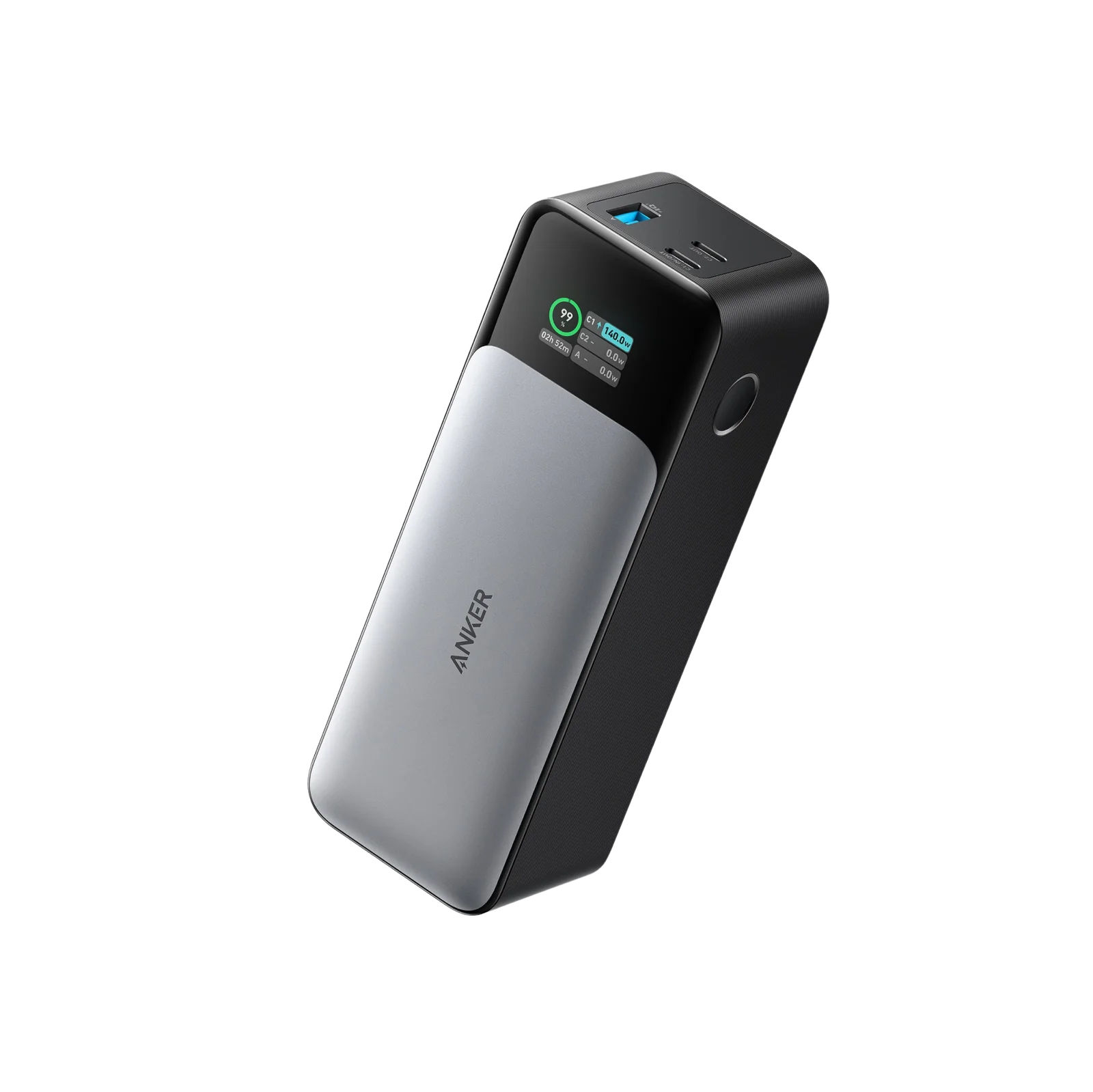
A modern phone is happy at 22.5W. A laptop is not. The Baseus Portable Charger tops out at 22.5W, which makes it a phone-and-earbuds bank. The Anker 737 Power Bank delivers 140W, which is laptop territory. Between those sits the Baseus Laptop Portable Charger 100W 20000mAh at 100W, enough for most laptops at a slower charge. Buy for the hungriest device you own, not for the biggest number on the shelf.
Rule of thumb: capacity tells you how many charges you get; watts tell you what the bank can actually run. Match the wattage to your hungriest device.
Ports: count them, then ask what each one does
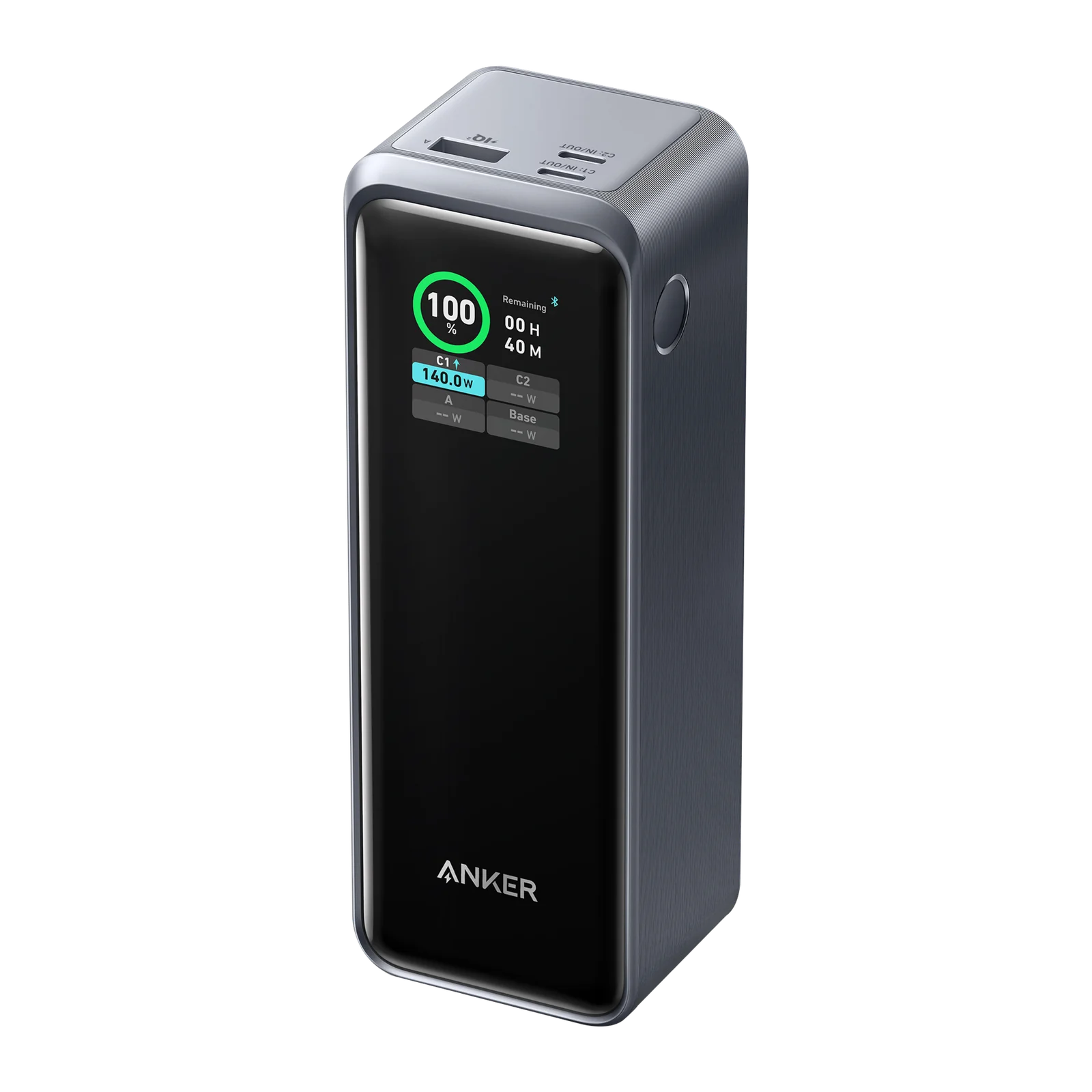
Port count matters less than port behavior. Two USB-C ports and one USB-A port, as on the Anker 737, covers a laptop, a phone, and an older cable. Four ports, as on the Baseus Power Bank 20000mAh 65W & 240W Smart 5, cover a household of mixed gadgets — including a Micro-USB port for older devices that USB-C has left behind. But total output is shared: the Anker Prime 27,650mAh 3-Port 250W Laptop Portable offers 250W across its three ports, not 250W from each. Check the per-port limits, not just the total.
Recharge speed is a feature too
Input wattage decides how fast the bank itself comes back. The Anker Prime lists 170W input and a full recharge in 43 minutes. The Baseus laptop charger lists 65W input; the Baseus Smart 5 lists 60W input. A bank that refills in under an hour lives in your bag; one that takes four hours lives on your desk, half forgotten. And input speed only matters if the charger you own can deliver it — a 170W input spec is wasted on an old 20W phone charger.
Rule of thumb: the best power bank is the one that is charged. If you only ever recharge overnight, fast input is a spec you paid for and never use.
Size, weight, and the cable question
The Anker 737 measures 6.13 x 2.15 x 1.95 inches — jacket-pocket territory for a laptop-class bank. Bigger capacity means more bulk, so match the bank to the bag it lives in. A built-in cable, like the braided USB-C cable on the Baseus Portable Charger, is one less thing to pack and one less thing to lose — but it also means the bank cannot serve a device that needs a different connector, so check what you actually carry.
Types compared
| Type | Typical capacity | Best when | Main drawback |
|---|---|---|---|
| Pocket / compact | Around 10,000mAh | You top up a phone or earbuds daily and want it to disappear in a pocket | Too slow for laptops; needs frequent refills |
| Laptop-class | 20,000–27,650mAh | You must keep a laptop or tablet alive away from outlets | Noticeably bigger and heavier; needs a capable charger to refill fast |
| High-output multi-device | 20,000mAh and up, 250W-class total | You charge a laptop plus phone plus accessories at once | Overkill for one phone; per-port output drops as you fill every port |
The pocket class is the right answer for most people most of the time. The Baseus Portable Charger is the example here: 10,000mAh, 22.5W, a built-in cable, and room for three devices across its USB-C and USB-A ports. It will not run a laptop, and it does not try to.
Laptop-class banks are the sweet spot for students, consultants, and frequent travelers. The Baseus Laptop Portable Charger 100W 20000mAh pairs 100W output with 65W input and four ports — two USB-C, two USB-A — so a laptop and a phone can charge together without a wall outlet. The Anker 737 Power Bank pushes to 140W for laptops that draw more, in a body still small enough for a jacket pocket.
High-output banks are for people who charge a small ecosystem at once.
Features that are marketing noise
The biggest number in the model name is not the port you will use. The Baseus Power Bank 20000mAh 65W & 240W Smart 5 carries “240W” in its name, but its listed output is 65W PD. Read the specification sheet, not the product name.
“Charges three devices” is a shared budget, not a promise. Three phones on a 22.5W bank trickle-charge. The claim is technically true and practically misleading.
Percentage readouts, “smart” in the name, app connectivity. A precise battery percentage is nice. An app that reports the same number is not a reason to pay more.
Capacity inflation. Real-world output is always below the rated mAh because of conversion losses and heat. Treat every capacity claim as roughly two-thirds of the usable truth.
Who should buy what
Commuters and students: a pocket bank around 10,000mAh. The Baseus Portable Charger is the fit — small enough to carry daily, built-in cable, enough for a phone and earbuds.
People who work on a laptop away from outlets: 20,000mAh or more at 100W-class output. The Baseus Laptop Portable Charger 100W 20000mAh or the Anker 737 Power Bank both qualify; pick the 140W Anker if your laptop draws more, the Baseus if you want four ports.
Frequent flyers and power users: the Anker Prime 27,650mAh 3-Port 250W Laptop Portable — largest capacity, fastest recharge, most output. Check the watt-hour rating against airline rules before you fly.
Households with mixed old and new gadgets: the Baseus Power Bank 20000mAh 65W & 240W Smart 5 — four ports including Micro-USB, so the older devices are not left behind.
Common mistakes
Buying by mAh alone. Capacity says nothing about whether the bank can run your laptop or how fast it refills.
Ignoring per-port output. 250W total is not 250W per port. A bank with every port full means everything charges slower.
Forgetting the airline limit. Above 100Wh you need airline approval; some banks are simply not worth the argument at the gate.
Letting it sit discharged. Lithium cells degrade faster when stored empty. If a bank lives in the car or a drawer, top it up every few months.
Paying for wattage you will never use. If your only device is a phone, 250W of output is a spec, not a feature.
Assuming the box includes a fast charger. Most banks ship with a cable, not a charger — check what your wall charger can deliver first.
A 60-Second Buying Checklist
- Name the device you must keep alive — and the hungriest one in the bag.
- Match output watts to that device, not to the biggest number on the box.
- Count the ports you will use at once, and check the per-port limits.
- Check input wattage against the charger you actually own.
- Check size and weight against the bag or pocket it will live in.
- Check the watt-hour rating against airline rules if you fly.
- Ignore any feature you cannot name a weekly use for.
The right power bank is the one that is charged, fits your bag, and can run the device you actually worry about. Everything else is a spec sheet.
- Baseus Portable Charger – suits buyers who want a pocket-size daily top-up for a phone and like a built-in USB-C cable so there is nothing extra to pack.
- Anker 737 Power Bank – fits travelers who need one bank that runs a laptop at 140W and still carries a USB-A port for older cables.
- Baseus Laptop Portable Charger 100W 20000mAh – matches people who charge a laptop and a phone at the same time and want four ports plus a 65W input for a quicker refill.
- Baseus Power Bank 20000mAh 65W & 240W Smart 5 – serves households with mixed old and new gadgets: four ports including Micro-USB, 65W PD output, 60W input.