How to Choose a Knife Sharpener in 2026
Published October 16, 2026
In this article
A knife sharpener is easy to buy badly because the category mixes two different jobs — honing and sharpening — and most boxes only advertise speed. A pull-through gadget promises a sharp knife in ten seconds; a guided system promises laboratory angles; a stone promises a razor polish. Each fits a different cook, steel, and tolerance for practice.
The useful way to choose starts with three questions: How hard is your steel? How often do you cook? Do you want a ten-second habit or a ten-minute ritual? In our kitchen the single most important tool is not a sharpener at all — it is a ceramic honing rod, and it does magic in the kitchen.
What actually matters
Honing comes before sharpening
Honing and sharpening are not the same job. Honing realigns the microscopic edge of a knife that is still sound; sharpening removes metal to make a new edge. Most home knives need honing far more often — that is why the rod comes first.
In our kitchen a ceramic honing rod is the tool we would keep above all others. It is worth every dollar, especially for harder steels: ceramic is harder than blade steel and works quickly without gouging the edge. A steel honing rod is the budget option — it suits many softer Western steels — but the editor’s pick is ceramic. An inexpensive rod used properly does more for your cooking than another expensive knife.
We hone slowly, at the correct angle, one side then the other, light pressure, heel to tip. Do not imitate television chefs who bang the knife against the rod — they do not sharpen their own knives. Ten calm strokes beat fifty theatrical ones.
For daily maintenance we reach for ceramic rods such as the Messermeister 10" Ceramic Rod / Sharpening Steel (1200 grit ceramic, solid aluminum oxide core) or the Green Elephant Ceramic Honing Rod (1500 grit, 9 Mohs hardness). If ceramic is not in the budget, a steel rod is a legitimate start: the ZWILLING 10-inch Sharpening Steel uses an oval chrome-plated rod for more surface contact, and the WÜSTHOF 10" Sharpening Steel pairs a stainless rod with a protective guard. Both suit the softer steels of Western kitchen knives.
Rule of thumb: buy the rod before the sharpener. A ceramic rod used every week keeps a good knife good; no sharpener can fix a knife that was never maintained.
Match the tool to your steel
Steel hardness decides which abrasive your edge can take. Hard, brittle steels — many Japanese knives sit in the 60+ HRC range — chip under aggressive carbide slots but respond well to ceramic and fine diamond. Softer Western steels, often in the mid-50s HRC, are tougher, dull a little sooner, and are easy to touch up on a steel rod.
This is also why we do not recommend pull-through sharpeners, manual or electric: they remove metal roughly and chew the edge. We do not list them.
Angle: the number that decides everything
Every knife has a bevel angle, and your tool must match it. Many Japanese knives are ground to roughly 15–16 degrees per side; many Western knives sit closer to 20. Freehand stone work asks you to hold that angle by feel — a learnable skill.
If you do not trust your wrist, a guided sharpening system clamps the knife at the angle you set and swaps grit plates. The Work Sharp Precision Adjust Elite Knife Sharpener adjusts from 15 to 30 degrees in 1-degree increments, runs a 7-abrasive system from 320/600 diamond to ceramic, and includes a leather strop. The Fixed Angle Knife Sharpener Kit with Digital adds a digital angle indicator with 0.25-degree precision, a weighted 7.5 lb base, and a 3-year warranty. The Sharp Pebble Knife Sharpening Stone Kit adds built-in angle guides at 15, 17, 20, and 22 degrees.
Rule of thumb: if you cannot name your knife’s bevel angle, buy a tool that holds the angle for you. Guided systems and angle guides are not cheating; they are how most people get consistent edges.
Grit logic: coarse repairs, fine polishes
For real sharpening — actually removing metal — we work through water stones of several grits, or diamond plates, or a guided system with swappable grit plates. The logic never changes: coarse grit repairs a dull or damaged edge, fine grit polishes it. Skipping grits leaves deep scratches.
Combination stones give you both sides in one block. The King Combination Waterstone, 1000/6000 Grit pairs a 1000 grit sharpening side with a 6000 grit polishing side on a 207 x 66 x 36 mm synthetic soaking stone made in Japan; the King KDS 1000/6000 Combination Grit Whetstone is the same format from Matsunaga Stone. Both are soaking stones, not splash-and-go.
Diamond plates cut faster, need no soaking, and stay flat for years. The SHARPAL 168H Large 8" x 3" Dual-Grit Diamond combines a coarse 325 grit (45 micron) side with an extra-fine 1000 grit (15 micron) side on an 8 x 3 inch surface, precision-ground to ±0.002 inch flatness. The DMT D6FC 6-Inch Dia-Sharp Double-Sided Diamond Stone packs fine (25 micron / 600 mesh) and coarse (45 micron / 325 mesh) sides into a 6-inch stone made in the USA. For refining alone, the DMT D6EF Dia-Sharp 2 is an extra-fine 9 micron / 1200 mesh polisher. For travel, the DMT FWFC DuoSharp Double-Sided Diamond Sharpening Stone folds from 9.5 inches open to 5 inches closed.
Types compared
| Type | Best when | Main drawback |
|---|---|---|
| Ceramic honing rod | Daily maintenance, hard steels, quick touch-ups | Only hones — will not sharpen a truly dull edge |
| Steel honing rod | Budget upkeep of softer Western steels | Less effective on very hard steels |
| Water stone | Learning the craft, polished edges | Needs soaking, flattening, and practice |
| Diamond plate | Fast metal removal, hard steels, zero soaking | Can feel aggressive; leaves a coarser scratch pattern |
| Guided sharpening system | Repeatable angles without the skill | Costs more, takes counter space |
| Pull-through sharpener | — | Not recommended: removes metal roughly and chews the edge |
Features worth paying for
- Angle guides or a clamp. Built-in guides or a digital indicator remove the most common beginner failure.
- A flattening stone. Water stones dish with use; a dished stone rounds your edge instead of sharpening it. The Sharp Pebble kit includes one.
- A non-slip base. A stone that slides is a stone that cuts your knuckles, not the knife.
- A leather strop. After the final grit it aligns the edge and removes the burr; the Work Sharp system includes one.
- Double-sided grits. Coarse on one side, fine on the other — the DMT D6FC and the King combos do this.
Marketing noise
“Diamond” is an abrasive, not a quality guarantee — grit size matters more than the word on the box. Huge advertised grit ranges (3000/8000 and beyond) are useful only if you own the coarse stones before them. Electric pull-through gadgets sell speed by sacrificing the edge.
Common mistakes
Buying a pull-through because it is fast. It is fast the way a chainsaw is fast. Sharpening on a rod. Rods hone; stones and plates sharpen. Skipping the flattening step. A dished stone ruins edges quietly. Using one grit for everything. Repair and polish are different jobs. Guessing the angle. Match the bevel or buy a guide. Waiting until the knife is hopeless. A slightly dull knife is a five-minute job; a neglected one is a project.
Who should buy what
Beginners: a ceramic honing rod plus the Sharp Pebble Kit — a combination stone with angle guides and a flattening stone. Learn the rod first; add the stone when honing stops working.
Daily home cooks: a ceramic rod for weekly maintenance and a diamond plate for the occasional real sharpening. The SHARPAL 168H handles repair and polish without soaking.
Owners of hard Japanese knives: ceramic rod for upkeep, extra-fine diamond for sharpening — the DMT D6EF polishes without risking chips.
People who want guided consistency: the Work Sharp Precision Adjust Elite for a complete guided system with strop; the Fixed Angle Kit with Digital for the angle readout and weighted base.
Travel and small spaces: the folding DMT FWFC DuoSharp tucks into a drawer.
Choosing knives first? Our guide to how to choose a kitchen knife covers it — the steel you pick decides the sharpener you need.
- Messermeister 10" Ceramic Rod / Sharpening Steel — suits cooks who want one daily honing tool for mixed knives; 1200 grit ceramic, solid aluminum oxide core.
- Green Elephant Ceramic Honing Rod — fits owners of harder steels; 1500 grit ceramic, 9 Mohs hardness.
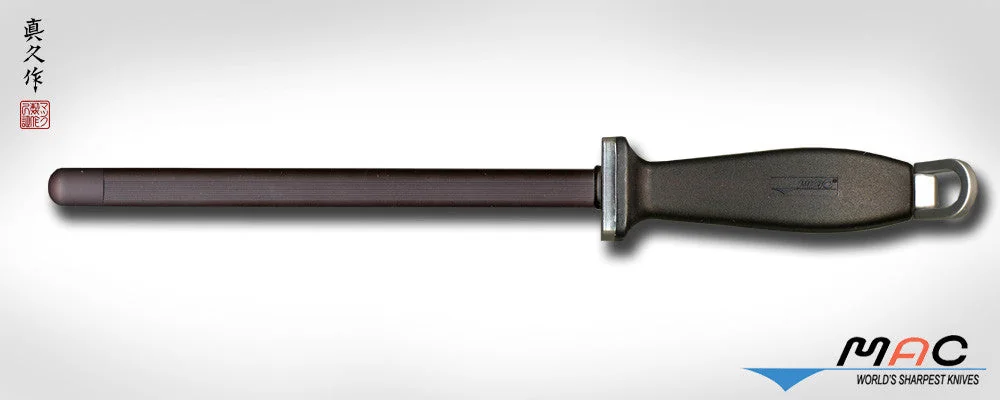
- MAC 8 1/2 in Black Ceramic Honing Rod with Grooves — matches anyone tired of slow touch-ups; grooved sides hone faster, smooth sides finish.
- ZWILLING 10-inch Sharpening Steel — the budget steel-rod option for softer Western steels; oval rod for more surface contact.
- Work Sharp Precision Adjust Elite Knife Sharpener — for buyers who want guided 15–30 degree angles, swappable abrasives, and a leather strop in one kit.