Filament Dryers
Filament Dryers: A Side-by-Side Look
Compare 5 filament dryers side by side: Creality SpacePi X4 4-Spool Filament Dryer, Sunlu FilaDryer S4 4-Spool Filament Dryer, Sovol SH04 4-Spool Filament…
How we picked these products
We compare product identity, specifications, pros/cons and retailer links. Until approved retailer API access is available, current Amazon price, star-rating and review-count data are not republished here.
Choose by what matters
Jump straight to what fits your situation — use-case chips point to products that match those features. Price/rating leader chips stay off until approved API data is available.
We don't crown a single "best" pick — this table lays out what's factually true about each option, side by side.
| Product | Check current price |
|---|---|
| Creality SpacePi X4 4-Spool Filament Dryer | Check current price(paid link) |
| Sunlu FilaDryer S4 4-Spool Filament Dryer | Check current price(paid link) |
| Sovol SH04 4-Spool Filament Dryer | Check current price(paid link) |
| Creality Space Pi Plus 2-Spool Filament Dryer | Check current price(paid link) |
| Creality Space Pi Single-Spool Filament Dryer | Check current price(paid link) |
Capacity and max temperature are the whole market in filament dryers: these 5 units run one to four spools and top out between 55 and 85 degrees C, and that ceiling decides which materials you can actually dry -- PLA needs little, PETG wants heat, and nylon is only practical on the two hottest machines.
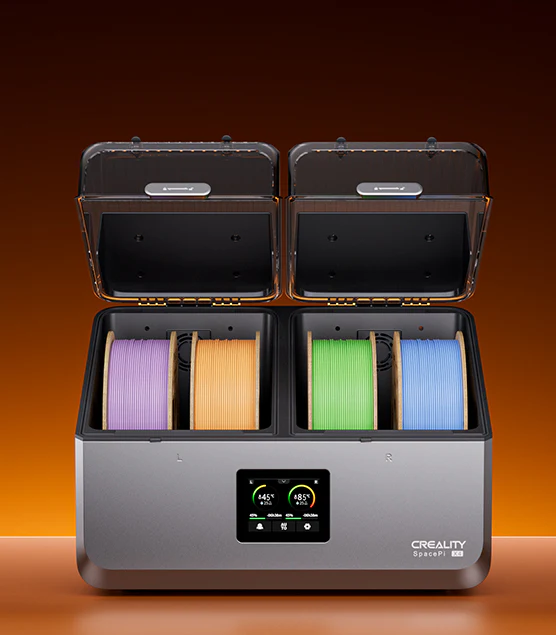
Creality SpacePi X4 4-Spool Filament Dryer
Specs & pros/cons
Key specs:
- 4 spools, dual independent chambers
- 85°C dual-zone heating -- nylon and PETG capable
- Auto-regenerating desiccant system
- 46-48 dB noise level
- Real-time humidity monitoring
Pros:
- Dual independent chambers -- dry two filament types simultaneously at different temps
- 85°C max heat handles nylon, PETG and engineering filaments
- Auto-regenerating desiccant system reduces manual desiccant maintenance
- 46-48 dB noise level -- quiet enough for a workspace
Cons:
- Overkill if you only dry 1-2 spools at a time
- Desiccant still saturates eventually -- long-term storage needs a sealed container
Sunlu FilaDryer S4 4-Spool Filament Dryer

Specs & pros/cons
Key specs:
- 4 spools, 1 kg each
- 350W heater, up to 70°C
- Community consensus pick for Bambu Lab AMS setups
Pros:
- Community consensus pick for 4-spool drying
- 350W heater dries efficiently at 70°C
- Good value for multi-spool setups
Cons:
- Humidity readings can be inaccurate (community reports)
- No independent chamber temperature control
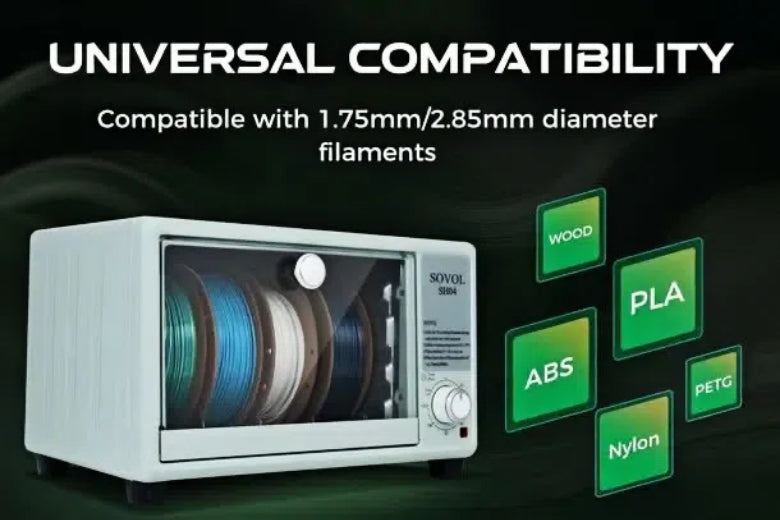
Sovol SH04 4-Spool Filament Dryer
Specs & pros/cons
Key specs:
- 4 spools up to 1 kg each
- 690W smart heating system
- PTFE pass-through tubes for dry-and-print
Pros:
- PTFE pass-through tubes -- dry and print simultaneously
- Smart 690W heating adjusts power to save energy
Cons:
- Temperature ceiling at ~55°C limits it to PLA/PETG -- not hot enough for nylon
- No independent chamber control
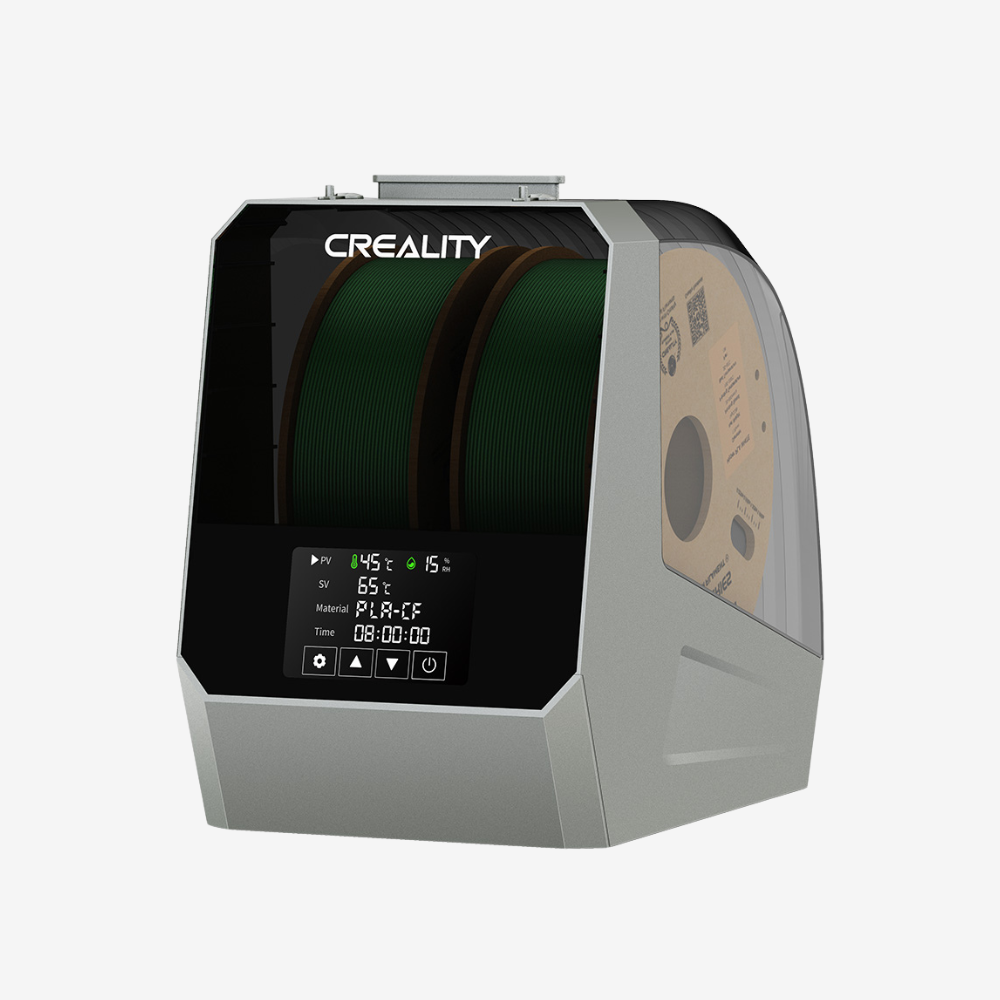
Creality Space Pi Plus 2-Spool Filament Dryer
Specs & pros/cons
Key specs:
- 2 spools, 1 kg each
- 45-70°C heating range
- 4-inch touchscreen
- 48-hour timer
- 360° PTC hot-air heating
Pros:
- Touchscreen interface with 48h timer
- Handles PLA, PETG and most consumer filaments
Cons:
- Only 2 spools -- need the X4 for 4 simultaneous
- 70°C may not be enough for nylon
Creality Space Pi Single-Spool Filament Dryer

Specs & pros/cons
Key specs:
- Single spool, 1 kg
- 70°C max temperature
- 3.7-inch touchscreen
- 48-hour timer
- 360° PTC hot-air heating
Pros:
- Compact single-spool format
- Touchscreen and 48h timer
Cons:
- Only 1 spool at a time
- Not suitable for multi-material printing setups
Short version: The Space Pi is a low-cost single-spool heated dryer whose core value is straightforward: 45–70°C control, a 48-hour timer, 3.7-inch touchscreen, real-time temperature/RH display, 12 material presets, and the ability to print directly from the box. Creality rates the whole unit at 145 W and describes a 110 W PTC heater with fan-driven 360° hot-air circulation.
What actually matters when choosing
Three numbers do most of the work here. Spool capacity sets whether you dry the roll that is loaded or your whole inventory at once -- the single-spool Creality holds 1 kg, the Sunlu S4, Sovol SH04 and SpacePi X4 hold four rolls each. Maximum temperature sets which materials are even possible: the Sovol SH04 tops out at a 45-55 degree range that handles PLA and PETG but not nylon, the Sunlu S4 and both smaller Creality units reach 70 degrees, and only the SpacePi X4 reaches 85 degrees across two independently controlled chambers. **Price per unit.
Trade-offs worth knowing
Four-spool machines are physically larger and cost 2-3x a single-spool dryer, which only pays off if you keep multiple open rolls. Dual chambers (SpacePi X4) let you dry PLA and nylon at the same time at their own temperatures; single-chamber four-spool units (Sunlu S4, Sovol SH04) dry everything at one shared setting. Listed review bases also differ a lot here: the SpacePi X4 and Space Pi carry 400-800 factor that into trust.
Bottom line
The Creality SpacePi X4 is the only unit here built for nylon-class materials: four spools, two independent chambers, 85-degree dual-zone for PLA/PETG users. Single-spool owners who dry occasionally should buy
Frequently asked questions
Is a filament dryer the same thing as a dry-storage box?
No. A filament dryer actively uses heat and airflow to remove moisture from filament. A dry-storage box is mainly meant to slow moisture from getting back in after drying. Some dryers also advertise sealed-storage features, but storage performance depends on the enclosure, seals and desiccant rather than the heater alone.
What drying temperature do PLA, PETG and nylon need?
Use the filament manufacturer's recommendation first. As a reference, Creality's current SpacePi X4 guidance lists about 50°C for PLA, 60°C for PETG and 80–85°C for PA/PAHT and several other engineering filaments. Different formulations can require different temperatures or longer drying times.
Can you print directly from a filament dryer?
Many dryers provide filament feed-throughs or PTFE-tube ports so the spool can stay inside while printing, but this is model-specific. Check the outlet layout and whether it works with the path to your printer before buying.
Do you still need desiccant if you own a filament dryer?
For storage, usually yes. Heating can remove moisture already absorbed by filament; desiccant in a sealed environment helps slow re-absorption afterward. Some models, including the Creality SpacePi X4, include built-in desiccant and regeneration features, but that is separate from the active heating cycle.
Is a 70°C filament dryer enough for nylon?
Not for every nylon or every drying schedule. Some materials can be dried at lower temperatures for longer, but Creality's current X4 guidance calls for 80–85°C for PA/PAHT-class filaments. Follow the specific filament maker's instructions rather than assuming one temperature works for every nylon.