Standing Desks
Electric Standing Desks: A Side-by-Side Look
Compare 9 standing desks side by side: FlexiSpot E7 Pro Electric Standing Desk, VIVO Electric 60 x 24 in Standing Desk (1B Series), SHW 55 x 28 in Electric…
How we picked these products
We compare product identity, specifications, pros/cons and retailer links. Until approved retailer API access is available, current Amazon price, star-rating and review-count data are not republished here.
Choose by what matters
Jump straight to what fits your situation — use-case chips point to products that match those features. Price/rating leader chips stay off until approved API data is available.
We don't crown a single "best" pick — this table lays out what's factually true about each option, side by side.
three-stage telescoping frame and a seamless solid-slab top. Top size is the other real variable -- 47-48 inches standard, one 60-inch entry, and one L-shaped 63-by-48 corner unit with drawers.
FlexiSpot E7 Pro Electric Standing Desk

Specs & pros/cons
Key specs:
- 48 x 30 inch seamless solid slab top
- Dual-motor, 3-stage telescoping legs
- Weight capacity up to 355 lbs
- Memory height presets, anti-collision sensor
Pros:
- Dual-motor lift, generally faster and more stable under load than the single-motor SHW here
- Highest weight capacity here (355 lbs)
- Seamless one-piece desktop, no visible seams like some laminate tops
Cons:
- No built-in storage drawer, unlike the SHW
- Larger 3-stage leg mechanism sits lower to the floor at max height than some 4-stage designs
VIVO Electric 60 x 24 in Standing Desk (1B Series)

Specs & pros/cons
Key specs:
- 60 x 24 inch one-piece dark walnut top
- Single-motor frame, memory height controller
- Weight capacity up to 220 lbs
- Black frame, cable management included
Pros:
- Widest single-piece rectangular desktop here (60 in) for a straight-wall setup
- Published weight capacity of 220 lbs (listing)
- No add-on drawer, so the full underside stays open for a CPU tower or legroom
Cons:
- No built-in storage, unlike the SHW or FEZIBO here
SHW 55 x 28 in Electric Standing Desk with Drawer

Specs & pros/cons
Key specs:
- 55 x 28 inch top with a built-in storage drawer
- Single-motor lift, memory height presets
- Height range roughly 28-45 inches
- Cable management channel included
Pros:
- Built-in storage drawer, plus a deep 28-inch simple-rectangle top for dual-monitor setups
Cons:
- Narrower desktop (55 in) than the VIVO's 60 in, and no L-shaped/corner option like the FEZIBO
- Drawer eats into usable under-desk clearance
- No published weight-capacity spec, unlike the VIVO/FEZIBO/EN1's stated numbers
FlexiSpot EN1 One-Piece Standing Desk

Specs & pros/cons
Key specs:
- 48 x 30 inch seamless one-piece desktop
- Electric lift with 4 memory height presets
- Weight capacity up to 176 lbs
- Anti-collision sensor, rated for dual-monitor setups
Pros:
- 4 memory height presets (listing)
- Seamless one-piece desktop, no visible seams like some laminate tops
Cons:
- Compact 48 x 30-inch desktop, and no built-in drawer
- No L-shaped/corner option like the FEZIBO for wraparound workspace
FEZIBO L-Shaped Electric Standing Desk with Drawers

Specs & pros/cons
Key specs:
- 63 x 48 inch L-shaped/corner desktop, reversible left or right
- Built-in storage drawers
- Weight capacity up to 176 lbs
- 2 memory height presets, anti-collision sensor
Pros:
- Only L-shaped/corner design here, largest total work surface (63 x 48 in) for dual-monitor or wraparound setups
- Reversible tabletop -- the corner return can be installed on either side at setup
- Built-in storage drawers, like the SHW
Cons:
- Only 2 memory height presets vs. the EN1's 4
ErGear 48x24 Electric Standing Desk

Specs & pros/cons
Key specs:
- 48 x 24 inch electric height-adjustable top, 28.35-46.46 inch range (manufacturer listing)
- Alloy-steel frame rated to 176 lbs (manufacturer listing)
Pros:
- Quiet smooth motor with memory presets (listing)
- Steel frame rated to 176 lbs (listing)
Cons:
- Entry-level price -- check the weight rating and motor warranty on the listing
- Reviewers note wobble at full height on carpet -- best on hard floors
Cubiker 48x24 Electric Standing Desk
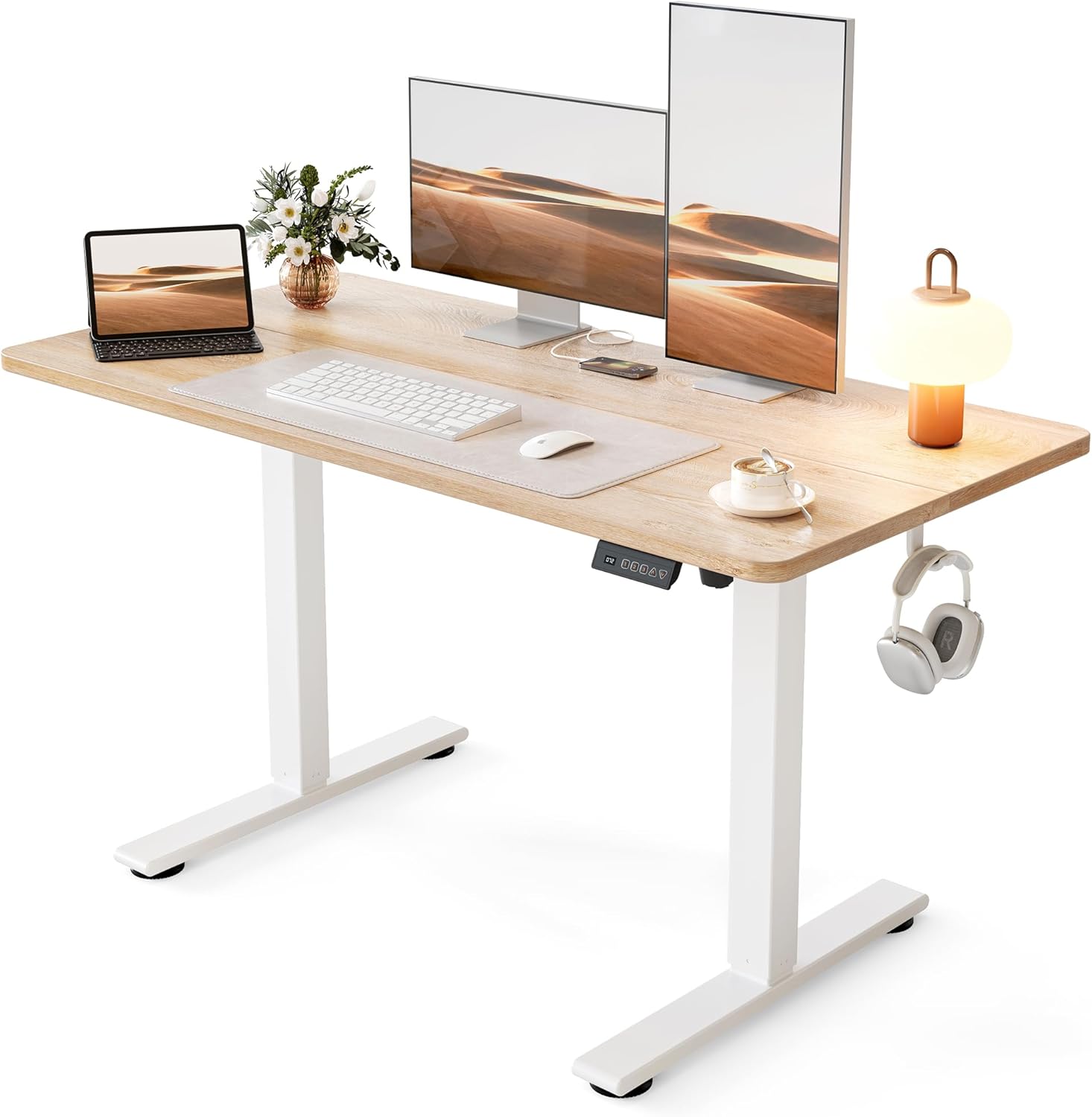
Specs & pros/cons
Key specs:
- 48 x 24 inch electric sit-stand top with room for dual monitors (manufacturer listing)
- Industrial-grade steel frame rated to 176 lbs (manufacturer listing)
- Quiet motor under 45 dB with 3 memory presets (manufacturer listing)
Pros:
- 3 memory presets and a quiet sub-45dB motor (listing)
- Low-VOC materials (listing)
Cons:
Huuger 47x24 Electric Standing Desk with Outlets

Specs & pros/cons
Key specs:
- 47 x 24 inch electric top with built-in power outlets and USB ports (manufacturer listing)
Pros:
- Built-in power outlets and USB ports (listing)
- Ultra-quiet motor under 35 dB (listing)
Cons:
Short version: This is a budget single-motor-style two-leg sit/stand desk sold around a 47.2 x 23.6 in engineered-wood top, 28.7–46.5 in lift range, integrated 4-AC + USB-A + USB-C charging block, digital height display and memory presets. Exact-ASIN Amazon evidence currently says **3 presets**, while several mirrors/older captures say **4**; that revision/listing drift must remain explicit.
FEZIBO Standing Desk 48 x 24 Inch Electric Height Adjustable

Specs & pros/cons
Key specs:
- Electric height adjustment 28.3" to 46.5"
- 3 customizable memory presets
- Reinforced steel frame, up to 176 lbs
- 50,000 lift cycles tested, under 45 dB
Pros:
- Budget standing desk with electric lift and memory presets
- FSC-certified wood desktop
Cons:
- 176 lbs capacity is lower than the FlexiSpot E7 Pro (355 lbs)
Bottom line
Tight budgets and light single-monitor setups are fine on the ErGear, Cubiker or Huuger (the latter adds built-in outlets and USB). The SHW Anyone mounting heavy gear or standing eight hours a day should pay for the E7 Pro's dual-motor stability, and corner-desk buyers have exactly one option here -- the reversible FEZIBO L-shape.
Frequently asked questions
How much weight can an electric standing desk actually support in real use?
The rated capacity, commonly 220-355 lbs across this category, applies to the desk fully raised and evenly loaded -- real-world safe practice is to load well under that max, especially at full height, since lifting mechanisms are more strained at the top of their travel. Concentrate heavier items like monitors and PC towers toward the center or back rather than the front edge.
Do you need an anti-collision sensor, or is it just a nice-to-have?
It's a genuine safety and practicality feature, not just marketing -- it stops the desk automatically if it hits an obstruction, like a chair, a drawer, or your knee, while raising or lowering, rather than continuing to push against it. Worth prioritizing if the desk will be adjusted often around furniture or in a shared space.
Single motor vs dual motor: does it really matter for a home office?
Dual-motor desks lift faster and stay more stable and level under uneven or heavy loads, like a corner-heavy dual-monitor setup, while single-motor desks are cheaper and perfectly adequate for lighter, evenly-distributed setups. If you have a heavy loadout or adjust height frequently through the day, dual-motor is the more noticeable upgrade; for a laptop and one monitor, single motor is fine.
How often should you actually alternate between sitting and standing?
Common ergonomic guidance suggests standing for roughly 15-30 minutes per hour, or shifting position every 30-60 minutes -- there's no single universal rule, and the bigger benefit shown in research is simply not staying in one position, sitting or standing, for hours at a stretch.
Can an electric standing desk go low enough for a fully ergonomic seated position too?
Most electric standing desks have a minimum height around 22-28 inches, which covers proper seated ergonomic height, roughly 28-30 inches including your chair, for the large majority of adult users. Check a specific model's stated height range against your own seated elbow height if you're notably short or tall.